
South Korea Silicon Photonics Market (2025-2030)

The South Korea Silicon Photonics Market was valued at $60.2 Million in 2025 and projected to reach to $192.7 Million by 2030, representing a compound annual growth rate of 26.2%. South Korea's silicon photonics market is positioned for accelerated growth through 2030, driven by the nation's strategic focus on next-generation semiconductor technologies and digital infrastructure expansion.


| Market Size in | USD 26.32 MN |
| Market Forecast in | |
| CAGR | |
| Forecast Period | |
| Units Considered | Value (USD MN) |
South Korea Silicon Photonics Market Trends and Insights
- This represents a compound annual growth rate of 26.2%, driven by South Korea's leadership in semiconductor manufacturing and increasing demand for high-speed data communication solutions.
- South Korea's advanced technology infrastructure and major investments in 5G and data center connectivity are accelerating adoption of silicon photonics across telecommunications and enterprise segments. The market growth in South Korea reflects the country's strategic positioning as a global semiconductor hub and its commitment to next-generation optical interconnect technologies.
- South Korea's major electronics manufacturers and foundries are integrating silicon photonics into their product portfolios to meet escalating bandwidth requirements.
- Between 2025 and 2030, South Korea is expected to capture significant market share within the Asia Pacific region, supported by government initiatives and private sector innovation in photonic integrated circuits..
Key Market Statistics
- CAGR (2025-2030) 26.2% CAGR
- Market Size, 2025 ~USD 60.2 Million
- Forecast, 2030 ~USD 192.7 Million
- Country South Korea
South Korea Silicon Photonics Market Overview
Market Valuation Growth :
South Korea's silicon photonics market is valued at $60.2 million in 2025, with projections to reach $192.7 million by 2030, representing a 26.2% CAGR and demonstrating strong market expansion.
Semiconductor Manufacturing Leadership :
South Korea's dominance in semiconductor manufacturing, led by companies like Samsung and SK Hynix, creates a robust ecosystem for silicon photonics adoption and innovation in integrated photonic solutions.
High-Speed Data Communication Demand :
Increasing demand for high-speed data communication infrastructure in South Korea's digital economy drives silicon photonics adoption across data centers, telecommunications, and 5G/6G networks.
Advanced Technology Infrastructure :
South Korea's world-class R&D capabilities, government support for semiconductor innovation, and strong venture capital ecosystem accelerate silicon photonics technology development and commercialization.
South Korea Silicon Photonics Market Dynamics
- The country's established semiconductor manufacturing base provides a competitive advantage for integrating photonic components into advanced chip architectures.
- Government initiatives supporting quantum computing, AI infrastructure, and 5G/6G deployment will further stimulate demand for high-speed optical interconnects and silicon photonics solutions. Key growth catalysts include increasing data center investments, expansion of cloud computing services, and South Korea's commitment to becoming a global leader in advanced semiconductor manufacturing.
- Collaborations between major conglomerates and emerging photonics startups will accelerate innovation cycles.
- The market's 26.2% CAGR reflects strong momentum, though competition from established global players and supply chain considerations will shape the competitive landscape through 2030..
Market Ecosystem
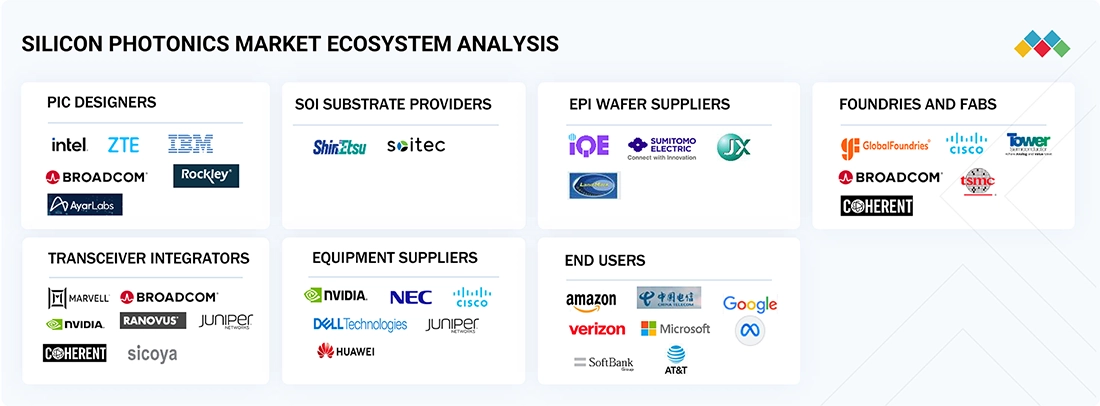
SILICON PHOTONICS MARKET SIZE, SHARE & GROWTH: COMMERCIAL USE CASES ACROSS INDUSTRIES
| COMPANY | USE CASE DESCRIPTION | BENEFITS |
|---|---|---|
 |
Data center optical transceivers and integrated optical interconnects for AI workloads | High-speed data transfer, reduced latency, improved energy efficiency, scalable optical I/O closer to CPU |
 |
High-speed optical interconnects integrated into networking equipment, enabled by Luxtera acquisition | Enhanced bandwidth for data centers and internet infrastructure, faster network speeds, improved network scalability |
 |
Silicon photonics-based optical components for telecom and hyperscale data communications | Enables high-capacity optical networking, lower power consumption, increased network reliability |
 |
Advanced silicon photonics in software-defined networking and high-speed switches | Improved network performance, efficient bandwidth management, agile data routing |
Logos and trademarks shown above are the property of their respective owners. Their use here is for informational and illustrative purposes only.
Related Ecosystem
Communication And Connectivity Technology
- Sensors
- Smart Card & Readers
- Cellular Network
- Femtocell
- Image Sensors
- Cisco Systems, Inc.
- HUAWEI TECHNOLOGIES CO LTD
- Lenovo
- CommScope Holding Company, Inc.
- Nokia corporation
Semiconductor Materials And Components
- Sensors
- Gallium Nitride (GaN)
- Digital Signal Processor (DSP)
- Natural Language Processing (NLP)
- Silicon Carbide
- Texas Instruments Incorporated
- Samsung
- APPLIED MATERIALS, INC.
- Stmicroelectronics
- Lenovo
Key Takeaways
- South Korea's silicon photonics market will grow from $60.2M (2025) to $192.7M (2030) at a 26.2% CAGR.
- South Korea's semiconductor manufacturing dominance positions it as a key hub for silicon photonics innovation and production.
- 5G infrastructure and data center expansion in South Korea are primary catalysts driving silicon photonics adoption.
- South Korea's integrated circuit ecosystem enables rapid commercialization of photonic technologies across multiple verticals.
Silicon Photonics Market Report Scope
| Report Metric | Details |
|---|---|
| Base Year | 2025 |
| Fastest Growing Segment | TRANSCEIVERS (Product) |
| Forecast Period | 2025–2030 |
| Growth Rate | CAGR of 29.5% from 2025 to 2030 |
| Largest Segment | TRANSCEIVERS (Product) |
| Market Size Base Year (Billions) | ~USD 2.65 (2025) |
| Revenue Forecast (Billions) | ~USD 9.65 (2030) |
| Segments Covered | Component, Product, Data Rate, End User |
South Korea Silicon Photonics Market Report Segmentation
4 segment dimensions are covered across the global market.
By Component
- Lasers
- Modulators
- Optical Interconnects
- Optical Waveguides
- Other Components
- Photodetectors
By Product
- Cables
- Sensor
- Sensors
- Switches
- Transceivers
- Variable Optical Attenuators
By Data Rate
- Less Than 10 Gbps
- More Than 100 Gbps
- Up To 100 Gbps
By End User
- Data Centers And Hpc
- Medical And Life Sciences
- Military, Defense, And Aerospace
- Other End Users
- Telecommunication
- Telecommunications
Target Audience
- Semiconductor Manufacturers : South Korean chipmakers need market intelligence to integrate silicon photonics into next-generation products and capitalize on the 26.2% CAGR growth opportunity in optical interconnect solutions.
- Photonics Technology Companies : Photonics firms require South Korea-specific market data to assess expansion opportunities, identify local partnerships, and develop region-tailored product strategies for the growing market.
- Data Center & Telecom Operators : South Korean data center and 5G/6G infrastructure providers need market insights to evaluate silicon photonics adoption for high-speed interconnects and optimize network performance investments.
- Investment & Private Equity Firms : Investors targeting South Korea's semiconductor and photonics sectors require detailed market forecasts and growth drivers to identify promising portfolio companies and funding opportunities.
- Government & Policy Makers : South Korean government agencies and policy bodies need market analysis to inform semiconductor strategy, R&D funding priorities, and technology roadmaps supporting national competitiveness.
Key Companies in the South Korea Silicon Photonics Market
| Company | HQ | Ownership | Strongest segments |
|---|---|---|---|
| EXTREME NETWORKS, INC. | United States | ||
| QORVO | United States | ||
| TOWER SEMICONDUCTOR LTD | Israel | ||
| CADENCE DESIGN SYSTEMS | United States | ||
| NOVANTA, INC | United States | ||
| LG CHEM LTD. | South Korea | ||
| BOREALIS AG | United States | ||
| ZUMTOBEL GROUP AG | Austria | ||
| LENOVO | China | ||
| MELLANOX TECHNOLOGIES LTD. | United States | Private Company | InfiniBand adapters, switches, and systems,Ethernet adapters,Ethernet switch products, |
| BROADCOM INC. | United States | Public Company | Networking connectivity (switching, routing, NICs, PHY, optics, AI networking),Wireless device connectivity and RF,Server and storage connectivity (PCIe, SAS/RAID, Fibre Channel, HDD/SSD), |
| HAMAMATSU PHOTONICS K.K. | Japan | Public Company | Electron Tube (photomultiplier tubes and related),Opto-Semiconductor (photodiodes, APDs, SPADs, sensors),Imaging and Measurement Instruments (cameras, spectrometers, systems, software), |
EXTREME NETWORKS, INC.
Extreme Networks, Inc. is a United States-based networking company that designs and manufactures cloud-driven networking infrastructure and software solutions.
QORVO
Qorvo is a United States semiconductor company that designs and manufactures RF semiconductors and solutions for mobile, infrastructure, and defense applications.
TOWER SEMICONDUCTOR LTD
Tower Semiconductor Ltd. is an Israeli foundry providing semiconductor manufacturing services and custom chip design for analog, mixed-signal, and specialty applications.
CADENCE DESIGN SYSTEMS
Cadence Design Systems is a United States software company providing electronic design automation tools and solutions for semiconductor and systems design.
NOVANTA, INC
Novanta, Inc. is a United States technology company providing precision photonics, motion control, and software solutions for medical and industrial markets.
LG CHEM LTD.
LG Chem Ltd. is a South Korean chemical and materials company producing advanced materials, batteries, and specialty chemicals for various industries.
BOREALIS AG
Borealis AG is a United States-based polyolefins and base chemicals company serving packaging, automotive, and construction markets.
ZUMTOBEL GROUP AG
Zumtobel Group AG is an Austrian lighting and lighting management company providing innovative lighting solutions for commercial and residential applications.
LENOVO
Lenovo is a Chinese multinational technology company manufacturing personal computers, servers, and other computing devices for global markets.
MELLANOX TECHNOLOGIES LTD.
Mellanox Technologies Ltd. is a United States semiconductor company founded in 1999 with 2,719 employees, specializing in high-performance computing and data center interconnect solutions.
BROADCOM INC.
Broadcom Inc. is a United States public company founded in 1961 with 33,000 employees, providing semiconductor and infrastructure software solutions for networking, broadband, and connectivity markets.
HAMAMATSU PHOTONICS K.K.
Hamamatsu Photonics K.K. is a Japanese public company founded in 1953 with 6,601 employees, manufacturing photonic sensors, light sources, and optical systems for scientific and industrial applications.
Reasons to Buy this Report
- Market-Specific Growth Projections : Access detailed forecasts showing South Korea's silicon photonics market expanding from $60.2M to $192.7M by 2030, enabling precise investment planning and resource allocation for the region.
- Competitive Landscape Intelligence : Understand South Korea's unique competitive dynamics, including Samsung, SK Hynix, and emerging photonics players, to identify partnership opportunities and market positioning strategies.
- Localized Technology Trends : Gain insights into South Korea-specific adoption drivers including 5G/6G infrastructure, data center expansion, and government semiconductor initiatives shaping market demand.
- Investment Decision Support : Make informed decisions about market entry, expansion, or M&A activities in South Korea with country-specific market sizing, growth rates, and opportunity assessment data.
- Supply Chain & Ecosystem Mapping : Identify key manufacturers, suppliers, and technology partners within South Korea's silicon photonics ecosystem to optimize sourcing, collaboration, and distribution strategies.
Frequently asked questions
What is the current market size of silicon photonics in South Korea?
South Korea's silicon photonics market was valued at $60.2 million in 2025 and is projected to grow to $192.7 million by 2030.
What is the growth rate of silicon photonics in South Korea?
South Korea's silicon photonics market is expected to grow at a compound annual growth rate (CAGR) of 26.2% from 2025 to 2030.
What are the main drivers of silicon photonics growth in South Korea?
South Korea's growth is driven by 5G deployment, data center expansion, semiconductor manufacturing leadership, and increasing demand for high-speed optical interconnects.
Which industries in South Korea are adopting silicon photonics?
South Korea's telecommunications, data center, consumer electronics, and enterprise networking sectors are primary adopters of silicon photonics technology.
How does South Korea's market compare to the global silicon photonics market?
South Korea's 26.2% CAGR is slightly below the global average of 29.5%, reflecting its mature semiconductor base and steady, sustainable growth trajectory.
RESEARCH METHODOLOGY
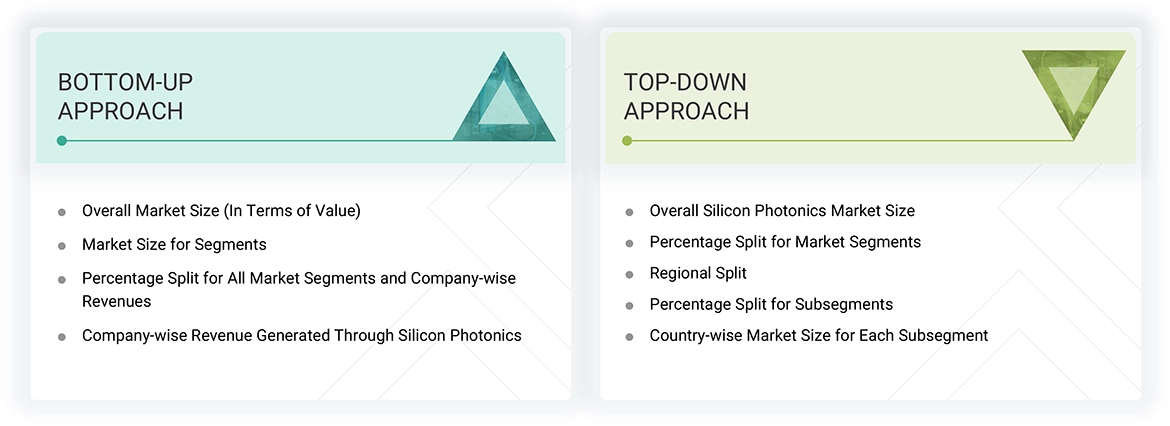
The study involved four major activities in estimating the current size of the global Silicon Photonics market—exhaustive secondary research collected information on the market and its peer and parent markets. The next step was to validate these findings, assumptions, and sizing with industry experts across the value chain through primary research. Both top-down and bottom-up approaches were employed to estimate the total market size. After that, market breakdown and data triangulation were used to estimate the market size of segments and subsegments.
Secondary Research
Various secondary sources have been referred to in the secondary research process to identify and collect important information for this study. These secondary sources include silicon photonics technology journals and magazines, annual reports, press releases, investor presentations of companies, white papers, certified publications and articles from recognized authors, and directories and databases such as Factiva, Hoovers, and OneSource.
Primary Research
Various primary sources from the supply and demand sides have been interviewed in the primary research process to obtain qualitative and quantitative information important for this report. The primary sources from the supply side included industry experts such as CEOs, VPs, marketing directors, technology and innovation directors, and related executives from key companies and organizations operating in the silicon photonics market. After complete market engineering (including calculations regarding market statistics, market breakdown, market size estimations, market forecasting, and data triangulation), extensive primary research was conducted to gather information as well as to verify and validate the critical numbers arrived at.
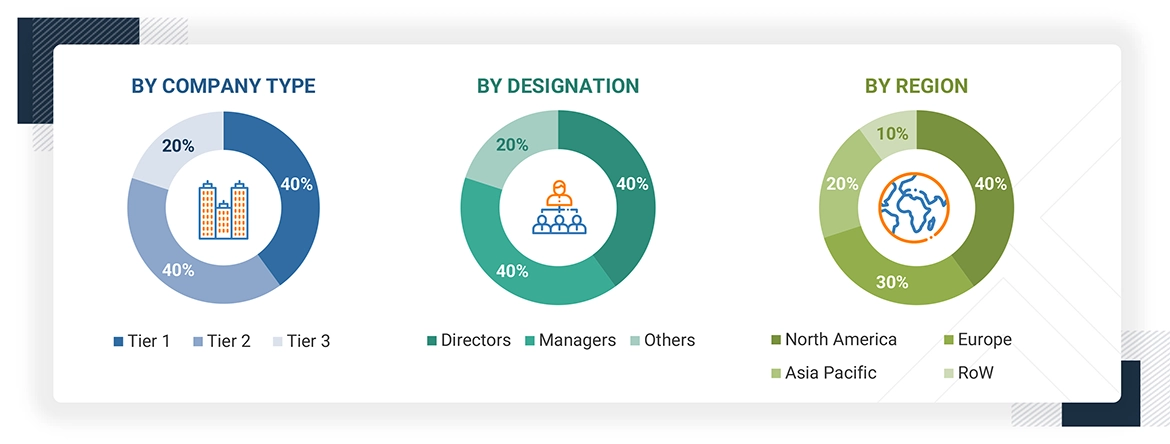
Note: Other designations include sales, marketing, and product managers. Tier 1 = USD 1 billion, Tier 2 = USD 0.5–1.0 billion, and Tier 3 = USD 0.5 billion.
To know about the assumptions considered for the study, download the pdf brochure
Market Size Estimation
In the complete market engineering process, top-down and bottom-up approaches and several data triangulation methods have been implemented to estimate and validate the size of the silicon photonics market and other dependent submarkets listed in this report.
- Extensive secondary research has identified key players in the industry and market.
- In terms of value, the industry’s supply chain and market size have been determined through primary and secondary research processes.
- All percentage shares, splits, and breakdowns have been determined using secondary sources and verified through primary sources.
Silicon Photonics Market : Top-Down and Bottom-Up Approach
Data Triangulation
After arriving at the overall market size from the estimation process explained above, the global market has been split into several segments and subsegments. Market breakdown and data triangulation procedures have been employed wherever applicable to complete the overall market engineering process and arrive at exact statistics for all segments and subsegments. The data has been triangulated by studying various factors and trends identified from both the demand and supply sides.
Market Definition
Silicon photonics is a technique that employs semiconductor-grade silicon to integrate photonic circuits and electronic components on a single microchip. This method minimizes system power consumption while increasing transmission bandwidth by employing silicon as an optical medium. Instead of electrical impulses, the technology transfers data using optical beams, which may send enormous amounts of data at a faster rate than electrical signals.
Key Stakeholders
- Component and material providers
- Semiconductor foundries
- Silicon photonics platform developers
- Silicon photonics product manufacturers and suppliers
- Assembly and testing vendors
- Original equipment manufacturers
- Research organizations and consulting companies
- Technology investors
- Associations, alliances, and organizations related to silicon photonics
- Analysts and strategic business planners
- End users
Report Objectives
- To describe and forecast the silicon photonics market size, in terms of value, by product, component, end user, and region
- To describe and forecast the market size across four key regions, namely, North America, Europe, Asia Pacific, and the Rest of the World (RoW), along with their respective country-level market size, in terms of value
- To provide details regarding the silicon photonic waveguide range
- To provide detailed information regarding the drivers, restraints, opportunities, and challenges of the silicon photonics market
- To strategically analyze the micromarkets1 concerning the individual growth trends, prospects, and their contribution to the silicon photonics market
- To map competitive intelligence based on company profiles, key player strategies, and key developments
- To provide a detailed overview of the silicon photonics value chain and ecosystem
- To provide information about the key technology trends and patents related to the silicon photonics market
- To provide information regarding trade data related to the silicon photonics market
- To analyze opportunities in the market for stakeholders by identifying high-growth segments of the silicon photonics ecosystem
- To benchmark the market players using the proprietary company evaluation matrix framework, which analyzes them on various parameters within the broad categories of market ranking/share and product portfolio
- To analyze competitive developments such as contracts, acquisitions, product launches and developments, collaborations, and partnerships, along with research & development (R&D), in the silicon photonics market
- To analyze the impact of the recession on the growth of the silicon photonics market
Available Customizations
With the given market data, MarketsandMarkets offers customizations according to a company’s specific needs. The following customization options are available for the report:
Company Information:
- Detailed analysis and profiling of additional market players (up to 5)
Get the Full Silicon Photonics Market Report
Full forecast, segment splits, and company analysis for all Silicon Photonics Market.
Need a Tailored Report?
Customize this report to your needs
Get 10% FREE Customization
Customize This Report
