
South Africa Smart City Platforms Market (2023-2028)

The South Africa Smart City Platforms Market was valued at $300 Million in 2023 and projected to reach to $440 Million by 2028, representing a compound annual growth rate of 7.8%. South Africa's smart city platforms market is positioned for steady growth as municipalities prioritize digital transformation to address urbanization challenges and improve operational efficiency.


| Market Size in | USD 26.32 MN |
| Market Forecast in | |
| CAGR | |
| Forecast Period | |
| Units Considered | Value (USD MN) |
South Africa Smart City Platforms Market Trends and Insights
- South Africa is leveraging digital infrastructure investments and urbanization trends to drive adoption of integrated smart city solutions across municipalities and metropolitan areas.
- South Africa's market growth is supported by increasing government initiatives, rising demand for efficient urban management systems, and growing private sector participation in smart infrastructure development..
Key Market Statistics
- CAGR (2023-2028) 7.8% CAGR
- Market Size, 2023 ~USD 300 Million
- Forecast, 2028 ~USD 440 Million
- Country South Africa
South Africa Smart City Platforms Market Overview
Market Valuation Growth :
South Africa's smart city platforms market reached USD 300 million in 2023 and is expected to expand to USD 440 million by 2028, driven by municipal digitalization initiatives and infrastructure modernization across major metropolitan areas.
Urbanization & Digital Infrastructure :
Rapid urbanization in South Africa is accelerating demand for integrated smart city solutions. Government investments in digital infrastructure and IoT connectivity are enabling municipalities to deploy comprehensive platforms for traffic management, utilities, and citizen services.
Municipal Adoption Trends :
South African cities including Johannesburg, Cape Town, and Durban are increasingly adopting smart city platforms to optimize urban operations, reduce costs, and improve service delivery. Public-private partnerships are facilitating technology deployment across municipalities.
Competitive Growth Trajectory :
At 7.8% CAGR, South Africa's market growth slightly trails the global average of 8.8%, reflecting steady but measured adoption rates as local governments balance digital transformation priorities with budget constraints and infrastructure readiness.
South Africa Smart City Platforms Market Dynamics
- Government support for smart infrastructure development, combined with increasing private sector participation, will drive platform adoption across major cities.
- The market will benefit from growing investments in IoT, data analytics, and cloud-based solutions tailored to South African urban environments. Key growth drivers include the need for improved traffic management, water and energy optimization, and enhanced citizen engagement platforms.
- However, market expansion will be tempered by budget constraints in local government and the need for standardized interoperability frameworks.
- Strategic partnerships between technology providers and municipalities will be critical to accelerating smart city platform deployment across South Africa's metropolitan regions through 2028..
Market Ecosystem
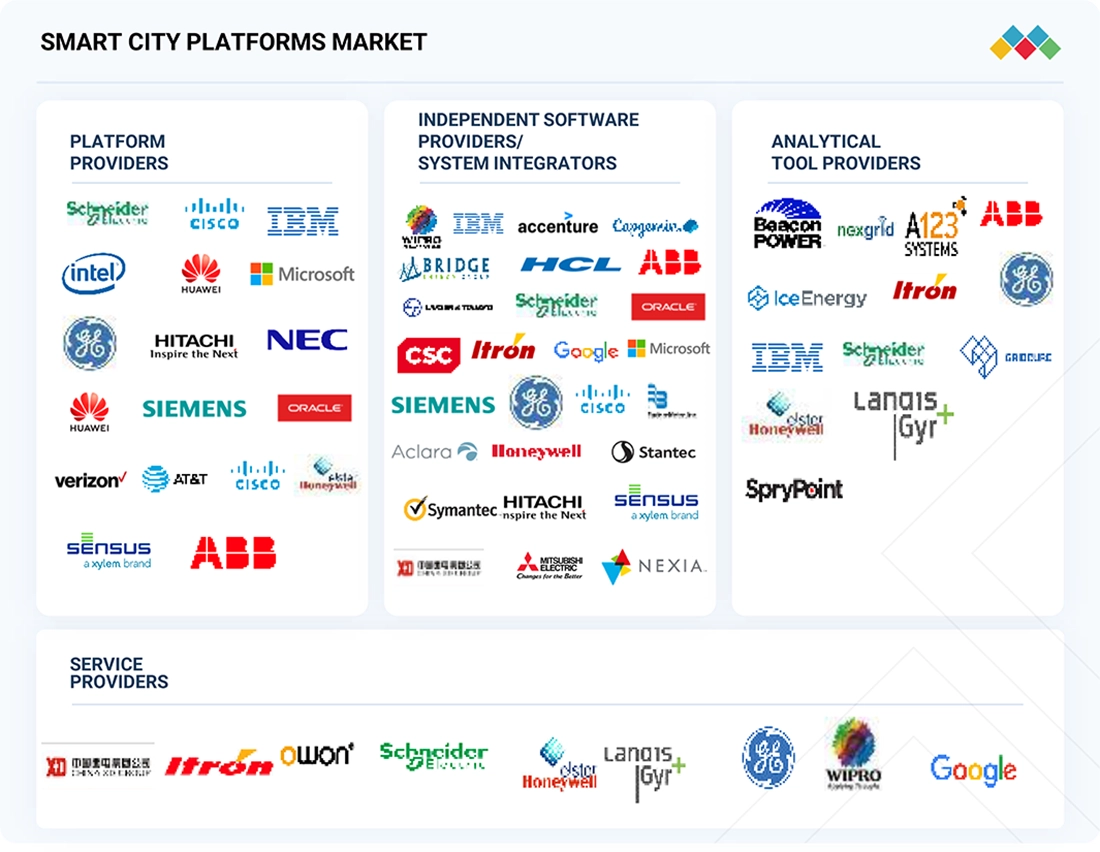
SMART CITY PLATFORMS MARKET SIZE: COMMERCIAL USE CASES ACROSS INDUSTRIES
| COMPANY | USE CASE DESCRIPTION | BENEFITS |
|---|---|---|
 |
Development of an integrated smart city platform for energy-aware street lighting, adaptive traffic signals, and grid-interactive buildings, using real-time sensor fusion and digital twin modeling | Reduced energy consumption, improved traffic flow, lower maintenance costs, enhanced urban resilience |
 |
Deployment of a cognitive city operations platform that correlates IoT telemetry, weather and event data to automate incident response, predictive maintenance, and citizen services orchestration | Faster incident resolution, proactive asset upkeep, improved citizen satisfaction, data-driven planning |
 |
Implementation of a distributed energy resources (DER) orchestration layer within the smart city platform to manage microgrids, EV charging, and demand-response programs | Optimized energy costs, higher renewable utilization, grid stability, new revenue streams |
 |
Rollout of a connectivity-first smart city platform combining 5G-enabled video analytics, public safety APIs, and edge AI for crowd management and emergency response | Faster situational awareness, reduced response times, scalable public-safety coverage, improved urban security |
 |
Integration of a citywide IoT fabric and secure API gateway to automate mobility services, parking management, and environmental monitoring with multi-vendor device support | Streamlined service delivery, interoperable device ecosystem, reduced congestion, better air-quality insights |
Logos and trademarks shown above are the property of their respective owners. Their use here is for informational and illustrative purposes only.
Related Ecosystem
Digitalization And Iot
- Sensors
- Remote Monitoring
- Supply Chain Management
- Passenger Information System (PIS)
- Platform as A Service (PaaS)
- International Business Machines Corporation
- Cisco Systems, Inc.
- MICROSOFT CORPORATION
- Oracle Corporation
- HUAWEI TECHNOLOGIES CO LTD
Automotive Systems
- Light Commercial Vehicles (LCVs)
- Battery Electric Vehicle (BEV)
- Hybrid Electric Vehicle (HEV)
- Agricultural Tractors
- Fuel Cell Electric Vehicle (FCEV)
- BOSCH LIMITED
- DENSO Corporation
- ZF FRIEDRICHSHAFEN AG
- Continental ag
- GORKOVSKY AVTOMOBILNY ZAVOD
Automotive Electronics And Electrical Equipment
- Battery Electric Vehicle (BEV)
- Light Commercial Vehicles (LCVs)
- Fuel Cell Electric Vehicle (FCEV)
- Sensors
- Hybrid Electric Vehicle (HEV)
- BOSCH LIMITED
- Continental ag
- DENSO Corporation
- Panasonic Holdings Corporation
- Texas Instruments Incorporated
Key Takeaways
- South Africa's smart city platforms market is estimated at USD 300 million in 2023 with a forecast of USD 440 million by 2028.
- South Africa is experiencing a 7.8% CAGR, driven by urbanization and digital transformation initiatives across major cities.
- South Africa's market growth is supported by government smart city programs and increased investment in IoT and data analytics infrastructure.
- South Africa's competitive landscape includes both international technology providers and local solution developers addressing municipal and enterprise needs.
Smart City Platforms Market Report Scope
| Report Metric | Details |
|---|---|
| Base Year | 2023 |
| Fastest Growing Segment | SYSTEMS AND SOFTWARE (Component) |
| Forecast Period | 2023–2028 |
| Growth Rate | CAGR of 8.8% from 2023 to 2028 |
| Largest Segment | PLATFORMS (Offering) |
| Market Size Base Year (Billions) | ~USD 191.6 (2023) |
| Revenue Forecast (Billions) | ~USD 292.1 (2028) |
| Segments Covered | Offering, Platform Type, Service, Professional Service, Delivery Model, Transportation Mode, Solution, Solution In Roadways, Service In Roadways, Solution In Railways, Service In Railways, Solution In Airways, Service In Airways, Solution In Maritime, Service In Maritime, Type, Application, Component, End User |
South Africa Smart City Platforms Market Report Segmentation
19 segment dimensions are covered across the global market.
By Offering
- Platforms
- Services
- Solutions
By Platform Type
- Connectivity Management Platforms
- Data Management Platforms
- Device Management Platforms
- Integration Platforms
- Security Platforms
By Service
- Managed Services
- Professional Services
By Professional Service
- Consulting & Architecture Designing
- Deployment & Training
- Infrastructure Monitoring & Management
By Delivery Model
- Hybrid
- Offshore
- On-Site
By Transportation Mode
- Airways
- Maritime
- Railways
- Roadways
By Solution
- Data Management
- Freight Information
- Network Management
- Others*
- Parking Management
- Passenger Information
- Real-Time Location System
- Remote Monitoring
- Reporting And Analytics
- Security
- Smart Ticketing
- Traffic Management
- Vehicle Telematics
By Solution In Roadways
- Freight Information
- Others*
- Parking Management
- Passenger Information
- Smart Ticketing
- Traffic Management
- Vehicle Telematics
By Service In Roadways
- Consulting
- Deployment And Integration
- Support And Maintenance
By Solution In Railways
- Freight Information
- Gis Tracking
- Others*
- Passenger Information
- Rail Traffic Management
- Smart Ticketing
By Service In Railways
- Consulting
- Deployment And Integration
- Support And Maintenance
By Solution In Airways
- Air Traffic Management
- Freight Information System
- Others*
- Passenger Information
- Ramp Management
- Smart Ticketing
By Service In Airways
- Consulting
- Deployment And Integration
- Support And Maintenance
By Solution In Maritime
- Maritime Software
- Others*
- Port Operations Management
- Vessel Tracking
By Service In Maritime
- Consulting
- Deployment And Integration
- Support And Maintenance
By Type
- Application Security
- Consulting
- Data Analytics
- Deployment And Integration
- Implanted Medical Devices
- Managed Services
- Network Bandwidth Management
- Network Security
- Professional Services
- Remote Device Management
- Stationary Medical Devices
- Support And Maintenance
- Wearable External Medical Devices
By Application
- Clinical Operations And Workflow Management
- Connected Imaging
- Inpatient Monitoring
- Medication Management
- Others*
- Smart Building
- Smart Citizen Services
- Smart Transportation
- Smart Utilities
- Telemedicine
By Component
- Connectivity Technology
- Medical Devices
- Services
- Systems And Software
By End User
- Cros
- Government And Defense Institutions
- Hospitals, Surgical Centers, And Clinics
- Research And Diagnostic Laboratories
Target Audience
- Municipal Government Officials : City planners, IT directors, and procurement managers in South African municipalities need market data to justify smart city investments, evaluate platform solutions, and align digital transformation initiatives with budget cycles and urban development goals.
- Smart City Technology Providers : Software vendors, IoT solution providers, and systems integrators require South Africa-specific market intelligence to identify growth opportunities, understand local regulatory requirements, and develop competitive strategies for municipal clients.
- Infrastructure & Utilities Companies : Water, energy, and transportation utilities operating in South Africa need insights into smart city platform adoption to optimize operations, reduce costs, and integrate with municipal digital ecosystems for improved service delivery.
- Investment & Consulting Firms : Private equity investors, management consultants, and strategic advisors need comprehensive market data on South Africa's smart city sector to evaluate investment opportunities, assess growth potential, and guide client expansion strategies.
- Government & Policy Makers : National and provincial government agencies require market research to develop smart city policies, allocate funding, establish regulatory frameworks, and coordinate digital infrastructure investments across South African urban centers.
Key Companies in the South Africa Smart City Platforms Market
| Company | HQ | Ownership | Strongest segments |
|---|---|---|---|
| FOXCONN INDUSTRIAL INTERNET CO LTD | United States | Public Company | Platforms – Connectivity Management,Platforms – Integration,Platforms – Device Management, |
| PLDT ENTERPRISE | Philippines | InvalidIdentifier | Connectivity Management Platforms,Integration Platforms and Services,Device Management Platforms, |
| PARSONS | United States | Public Company | Platforms – Connectivity Management,Platforms – Integration,Platforms – Device Management, |
| ATOS SE | United States | ||
| DATAMATICS GLOBAL SERVICES LIMITED | India | Public Company | Platforms – Connectivity & Integration,Platforms – Device Management,Platforms – Data, AI & Analytics (TruBI, TrueAI, TruDiscovery), |
| IBM | United States | ||
| SIEMENS | Germany | ||
| CISCO | United States | ||
| HITACHI | Japan | ||
| MICROSOFT | United States | ||
| United States | |||
| INTEL | United States | Public Company | Platforms (Connectivity Management),Platforms (Integration),Platforms (Device Management), |
| ORACLE | United States | Public Company | Platforms – Integration & Data Management,Platforms – Connectivity & Device Management,Services – Consulting & Implementation, |
| SAP | Germany | Public Company | Platforms – Integration & Connectivity Management,Platforms – Device Management,Services – Implementation & Integration, |
| NEC | Japan | Public Company | Platforms – Connectivity Management (CONNEXIVE, telecom-centric IoT),Platforms – Integration & Service Execution (WebOTX, MasterScope),Platforms – Device & Asset Management, |
| FUJITSU | Japan | Public Company | Platforms – Connectivity Management,Platforms – Integration,Platforms – Device Management, |
| SCHNEIDER ELECTRIC | France | Public Company | Platforms - Connectivity Management,Platforms - Integration,Platforms - Device Management, |
| ALIBABA | China | Public Company | Platforms - Connectivity Management,Platforms - Integration,Platforms - Device Management, |
FOXCONN INDUSTRIAL INTERNET CO LTD
Foxconn Industrial Internet Co Ltd is a United States-based public company founded in 2015 with 217,084 employees. The company operates in industrial internet and technology services.
PLDT ENTERPRISE
PLDT Enterprise is a Philippines-based telecommunications and enterprise services company.
PARSONS
Parsons is a United States-based public company founded in 1944 with 21,000 employees, providing engineering, construction, and technical services.
ATOS SE
Atos SE is a technology and digital services company based in the United States.
DATAMATICS GLOBAL SERVICES LIMITED
Datamatics Global Services Limited is an India-based public company founded in 1975 with 15,660 employees, providing IT and business process services.
IBM
IBM is a United States-based technology and consulting company.
SIEMENS
Siemens is a Germany-based industrial technology and engineering company.
CISCO
Cisco is a United States-based networking and technology company.
HITACHI
Hitachi is a Japan-based diversified technology and industrial conglomerate.
MICROSOFT
Microsoft is a United States-based software and cloud computing company.
Google is a United States-based technology and internet services company.
INTEL
Intel is a United States-based public company founded in 1968 with 85,100 employees, specializing in semiconductor design and manufacturing.
ORACLE
Oracle is a United States-based public company founded in 1977 with 141,000 employees, providing database software and cloud computing solutions.
SAP
SAP is a Germany-based public company founded in 1972 with 111,038 employees, specializing in enterprise resource planning software.
NEC
NEC is a Japan-based public company founded in 1899 with 101,800 employees, providing information technology and telecommunications solutions.
FUJITSU
Fujitsu is a Japan-based public company founded in 1935 with 99,203 employees, offering IT services, systems integration, and technology solutions.
SCHNEIDER ELECTRIC
Schneider Electric is a France-based public company founded in 1836 with 158,122 employees, specializing in energy management and automation solutions.
ALIBABA
Alibaba is a China-based public company founded in 1999 with 131,462 employees, operating e-commerce, cloud computing, and digital payment platforms.
Reasons to Buy this Report
- Municipal Decision-Making Intelligence : Gain detailed insights into South African municipal procurement patterns, technology preferences, and budget allocation strategies to inform sales and partnership approaches with city governments and metropolitan authorities.
- Competitive Landscape Analysis : Understand the competitive positioning of smart city platform providers in South Africa, identify market gaps, and benchmark your offerings against local and international competitors operating in major South African cities.
- Investment & Expansion Strategy : Access market sizing data and growth projections to support investment decisions, resource allocation, and go-to-market strategies for entering or expanding operations in South Africa's smart city sector.
- Technology Adoption Trends : Identify which smart city technologies (IoT, AI, cloud, data analytics) are gaining traction in South African municipalities and understand implementation barriers to tailor product development and service offerings accordingly.
- Partnership & Collaboration Opportunities : Discover public-private partnership models, government initiatives, and collaboration frameworks specific to South Africa that can accelerate market entry and create sustainable revenue streams in the smart city ecosystem.
Frequently asked questions
What is the current size of South Africa's smart city platforms market?
South Africa's smart city platforms market was valued at USD 300 million in 2023.
What is the projected market size for South Africa by 2028?
South Africa's smart city platforms market is forecast to reach USD 440 million by 2028.
What is the CAGR for South Africa's smart city platforms market?
South Africa's smart city platforms market is expected to grow at a compound annual growth rate of 7.8% from 2023 to 2028.
What are the main drivers of growth in South Africa's smart city market?
South Africa's market growth is driven by urbanization, government digital transformation initiatives, increased IoT adoption, and rising demand for efficient municipal management systems.
Which cities in South Africa are leading smart city platform adoption?
South Africa's major metropolitan areas including Johannesburg, Cape Town, and Durban are at the forefront of smart city platform implementation and digital infrastructure development.
RESEARCH METHODOLOGY
This research study on the smart city platforms market involved extensive secondary sources, directories, and several journals, databases, such as D&B Hoovers, Bloomberg Businessweek, and Factiva, to identify and collect information useful for this technical, market-oriented, and commercial study of the smart city platforms market. Primary sources were industry experts from core and related industries, preferred system developers, service providers, resellers, partners, and organizations related to the various segments of the industry’s value chain. In-depth interviews were conducted with different primary respondents, including key industry participants and subject-matter experts, to obtain and verify critical qualitative and quantitative information, as well as to assess the market’s prospects. These included key industry participants, subject-matter experts, C-level executives of key companies, and industry consultants. Primary sources were mainly industry experts from the core and related industries, preferred smart city platforms providers, third-party service providers, consulting service providers, end users, and other commercial enterprises. In-depth interviews were conducted with various primary respondents, including key industry participants and subject matter experts, to obtain and verify critical qualitative and quantitative information and assess growth prospects. The following figure highlights the market research methodology applied to make the smart city platforms market report.
Secondary Research
The market size of companies offering smart city platforms was determined based on secondary data available through paid and unpaid sources. It was also arrived at by analyzing the product portfolios of major companies and rating the companies based on their performance and quality.
In the secondary research process, various sources were referred to for identifying and collecting information for this study. Secondary sources included annual reports, press releases, and investor presentations of companies; white papers, journals, and certified publications; and articles from recognized authors, directories, and databases. The data was also collected from other secondary sources, such as journals and related magazines. Smart city platforms' spending in various countries was extracted from the respective sources. Secondary research was mainly used to obtain the key information related to the industry’s value chain and supply chain to identify key players, market classification, and segmentation according to offerings of major players; industry trends related to offering, deployment, application, and regions; and key developments from both market and technology-oriented perspectives.
Primary Research
In the primary research process, various primary sources from both the supply and demand sides were interviewed to obtain qualitative and quantitative information for the report. The primary sources from the supply side included industry experts, such as Chief Executive Officers (CEOs), Vice Presidents (VPs), marketing directors, technology and innovation directors, and related key executives from various key companies and organizations providing smart city platforms solutions and services. The primary sources from the demand side included end users, such as Chief Information Officers (CIOs), consultants, service professionals, technicians and technologists, and managers at public and investor-owned utilities.
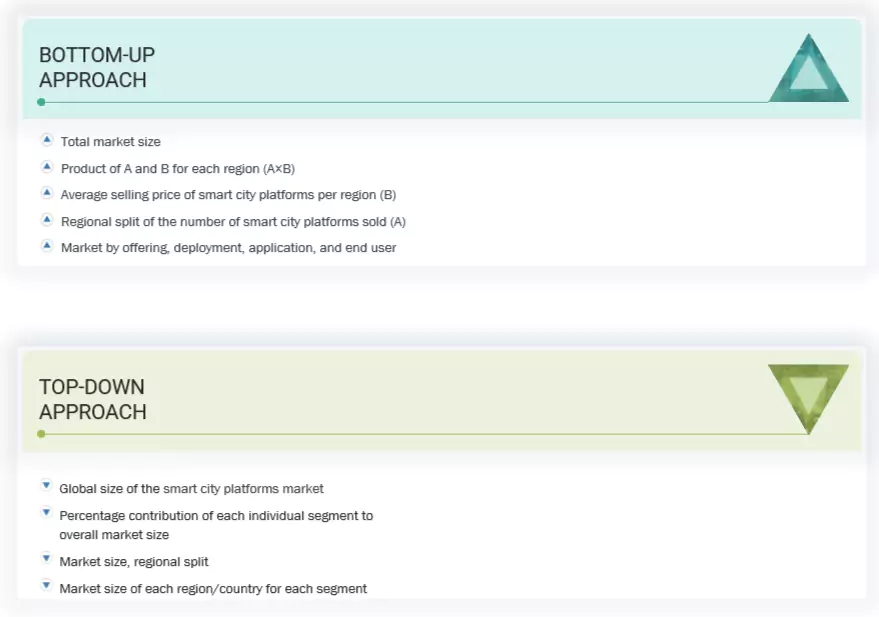
In the market engineering process, top-down and bottom-up approaches were extensively used, along with several data triangulation methods, to perform market estimation and market forecasting for the overall market segments and subsegments listed in the report. Extensive qualitative and quantitative analyses were performed on the complete market engineering process to list key information/insights throughout the report.
After the complete market engineering (including calculations for market statistics, market breakup, market size estimations, market forecasting, and data triangulation), extensive primary research was conducted to gather information. Primary research was conducted to identify the segmentation, industry trends, key players, competitive landscape, and key market dynamics, such as drivers, restraints, opportunities, challenges, industry trends, and key strategies.
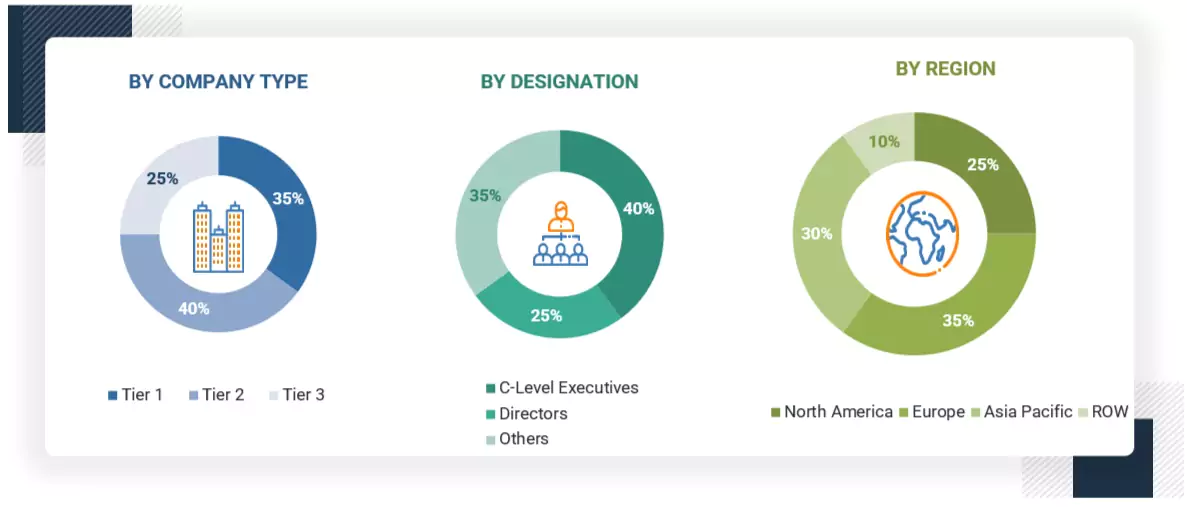
Note 1: Tier 1 companies have revenues greater than USD 10 billion; tier 2 companies' revenues range between
USD 1 and 10 billion; and tier 3 companies' revenues range between USD 500 million and 1 billion
Note 2: Others include sales, marketing, and product managers.
To know about the assumptions considered for the study, download the pdf brochure
Market Size Estimation
Multiple approaches were adopted to estimate and forecast the smart city platforms market. The first approach involved estimating the market size by summing up the companies’ revenue generated through the sale of services.
The research methodology used to estimate the market size included the following:
- We used primary and secondary research to determine the revenue contributions of the major market participants in each country after secondary research helped identify them.
- Throughout the process, we obtained critical insights by conducting in-depth interviews with industry professionals, including directors, CEOs, VPs, and marketing executives, and by reading the annual and financial reports of the top firms in the market.
- We used primary sources to verify all percentage splits and breakups, which we calculated using secondary sources.
Smart City Platforms Market : Top-Down and Bottom-Up Approach
Data Triangulation
Once the overall market size was determined, we divided the market into segments and subsegments using the previously described market size estimation procedures. When required, market breakdown and data triangulation procedures were employed to complete the market engineering process and specify the exact figures for every market segment and subsegment. The data was triangulated by examining several variables and patterns from the government entities' supply and demand sides.
Market Definition
Smart city platforms offer a middleware operational capacity that allows the integration of various software and hardware and several communication protocols. A smart city platform, in simple terms, binds multiple products, processes, systems, and people, bringing together a unified ‘system of systems' to deliver a holistic view of the city’s overall performance and functions. Powered by AI and IoT technologies, these platforms allow cities to transform, grow, and adapt to the evolving needs of a city.
Stakeholders
- National/State governments
- Municipal authorities
- Real estate developers
- Information technology (IT) solution providers
- Platform providers
- System integrators
- Telecom service providers
- Networking solution providers
- Utility companies
- Transportation service providers
- Independent software vendors (ISVs)
- Network equipment providers
- Communication service providers (CSPs)
Report Objectives
- To define, describe, and forecast the smart city platforms market in terms of value
- To provide detailed information regarding drivers, restraints, opportunities, and challenges influencing the growth of the market
- To forecast the market by offering, deployment, application, and region
- To forecast the market size of segments for the five main regions: North America, Europe, Asia Pacific, the Middle East & Africa, and Latin America
- To analyze opportunities in the market and provide details of the competitive landscape for stakeholders and market leaders
- To profile the key market players, including top vendors and startups; provide a comparative analysis based on business overviews, regional presence, product offerings, business strategies, and key financials; and provide a detailed competitive landscape of the market
- To analyze competitive developments, such as mergers & acquisitions (M&A), product launches/enhancements, agreements, partnerships, collaborations, expansions, and R&D activities, in the market
Available Customizations
MarketsandMarkets provides customizations based on the company's unique requirements using market data. The following customization options are available for the report:
Product Analysis
- The product matrix provides a detailed comparison of each company's portfolio.
Geographic Analysis as per Feasibility
- Further breakup of the smart city platforms market
Company Information
- Detailed analysis and profiling of five additional market players
Get the Full Smart City Platforms Market Report
Full forecast, segment splits, and company analysis for all Smart City Platforms Market.
- Canada Smart City Platforms Market
- US Smart City Platforms Market
- UK Smart City Platforms Market
- China Smart City Platforms Market
- Brazil Smart City Platforms Market
- France Smart City Platforms Market
- Germany Smart City Platforms Market
- Italy Smart City Platforms Market
- Nordics Smart City Platforms Market
- Rest Of Europe Smart City Platforms Market
- Spain Smart City Platforms Market
- Anz Smart City Platforms Market
- India Smart City Platforms Market
- Japan Smart City Platforms Market
- Rest Of Asia Pacific Smart City Platforms Market
- Se Asia Smart City Platforms Market
- South Korea Smart City Platforms Market
- Argentina Smart City Platforms Market
- Mexico Smart City Platforms Market
- Rest Of Latin America Smart City Platforms Market
- Ksa Smart City Platforms Market
- Rest Of Middle East Smart City Platforms Market
- UAE Smart City Platforms Market
- Egypt Smart City Platforms Market
- Nigeria Smart City Platforms Market
- Rest Of Africa Smart City Platforms Market
Need a Tailored Report?
Customize this report to your needs
Get 10% FREE Customization
Customize This Report
