
Mexico Smart Port Market (2025-2030)

The Mexico Smart Port Market was valued at $46.5 Million in 2025 and projected to reach to $134.3 Million by 2030, representing a compound annual growth rate of CAGR 23.6%. Mexico's smart port market is poised for substantial growth through 2030, driven by the country's critical role in North American trade and increasing pressure to modernize aging port infrastructure.


| Market Size in | USD 26.32 MN |
| Market Forecast in | |
| CAGR | |
| Forecast Period | |
| Units Considered | Value (USD MN) |
Mexico Smart Port Market Trends and Insights
- This expansion reflects Mexico's strategic position as a major maritime hub in North America and increasing investments in port digitalization and automation technologies.
- Mexico's ports are adopting IoT, AI, and real-time monitoring systems to enhance operational efficiency and cargo handling capabilities. The 23.6% compound annual growth rate underscores Mexico's commitment to modernizing its port infrastructure to compete globally.
- Mexico's geographic advantage, coupled with rising demand for supply chain visibility and sustainability initiatives, is driving smart port adoption across major facilities.
- By 2030, Mexico is expected to become a regional leader in intelligent port operations, supported by government initiatives and private sector investments in digital transformation..
Key Market Statistics
- CAGR (2025-2030) CAGR 23.6%
- Market Size, 2025 ~USD 46.5 Million
- Forecast, 2030 ~USD 134.3 Million
- Country Mexico
Mexico Smart Port Market Overview
Rapid Market Expansion :
Mexico's smart port market is projected to grow from $46.5 million in 2025 to $134.3 million by 2030, representing a robust 23.6% CAGR, outpacing many regional markets and reflecting strong digital transformation momentum.
Strategic Maritime Position :
As North America's premier maritime hub with access to both Pacific and Atlantic trade routes, Mexico's ports are increasingly investing in IoT, AI, and real-time monitoring systems to enhance operational efficiency and competitiveness.
Port Digitalization Initiatives :
Mexican ports are actively adopting automation technologies and smart infrastructure solutions to streamline cargo handling, reduce operational costs, and improve supply chain visibility across major facilities.
Investment in Infrastructure :
Significant capital allocation toward port modernization and digital infrastructure upgrades is driving demand for smart port solutions, positioning Mexico as a key growth market in Latin America's maritime sector.
Mexico Smart Port Market Dynamics
- Government initiatives and private sector investments are accelerating the adoption of digital technologies, including IoT sensors, AI-powered analytics, and automated cargo management systems.
- Major Mexican ports are prioritizing operational efficiency and real-time visibility to compete globally and meet rising e-commerce demands. The market will benefit from Mexico's geographic advantages, growing cross-border trade with the United States and Canada, and the need to enhance port security and environmental compliance.
- As supply chain resilience becomes paramount, Mexican ports will continue investing in smart technologies to reduce congestion, improve turnaround times, and enable seamless integration with regional logistics networks, ensuring sustained market expansion..
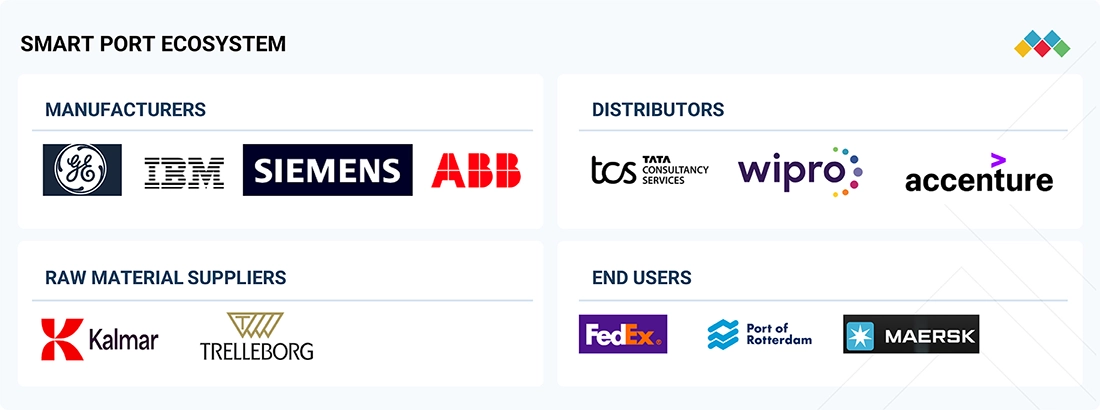
Market Ecosystem
Smart Port Market: COMMERCIAL USE CASES ACROSS INDUSTRIES
| COMPANY | USE CASE DESCRIPTION | BENEFITS |
|---|---|---|
 |
Uses smart port logistics platforms to optimize cargo tracking, automate customs clearance, and improve intermodal container movement | Leverages IoT sensors and AI for predictive supply chain visibility | Faster cargo turnaround, reduced delays, improved shipment transparency |
 |
Implements digital twin technology, IoT-enabled quay sensors, and AI-driven traffic management to enhance vessel scheduling, berth allocation, and real-time monitoring of port operations | Higher operational efficiency, reduced congestion, better energy/resource management |
 |
Deploys blockchain-enabled trade platforms (e.g., TradeLens), automated container handling systems, and shore-power electrification to make port operations greener and more efficient | Increased transparency in trade, reduced paperwork, lower emissions, faster container handling |
Logos and trademarks shown above are the property of their respective owners. Their use here is for informational and illustrative purposes only.
Related Ecosystem
Smart Energy And Digital Solutions
- Cellular Network
- Analytics Software
- Geographical Information System (GIS)
- Meter Data Management (MDM)
- Smart Meters
- Siemens ag
- SCHNEIDER ELECTRIC SE
- ABB India Limited
- General Electric Company
- Eaton Corporation plc
Key Takeaways
- Mexico's smart port market will nearly triple from $46.5M (2025) to $134.3M (2030), driven by 23.6% CAGR.
- Mexico's strategic location and major port hubs are accelerating adoption of IoT, AI, and automation technologies.
- Mexico is investing heavily in digital transformation to enhance cargo handling efficiency and supply chain visibility.
- By 2030, Mexico will establish itself as a regional smart port leader in North America through modernized infrastructure.
Smart Port Market Report Scope
| Report Metric | Details |
|---|---|
| Base Year | 2025 |
| Fastest Growing Segment | BLOCKCHAIN (Technology) |
| Forecast Period | 2025-2030 |
| Growth Rate | CAGR of 25.8% from 2025 to 2030 |
| Largest Segment | SEAPORTS (Port Type) |
| Market Size Base Year (Billions) | ~USD 2.52 (2025) |
| Revenue Forecast (Billions) | ~USD 7.95 (2030) |
| Segments Covered | Element, Smart Port Infrastructure Type, Port Traffic Management System Type, Port Type, Technology, Throughput Capacity |
Mexico Smart Port Market Report Segmentation
6 segment dimensions are covered across the global market.
By Element
- Port Community Systems
- Port Traffic Management Systems
- Smart Port Infrastructure
- Smart Port Safety & Security Systems
- Terminal Automation & Cargo Handling
By Smart Port Infrastructure Type
- Automated Mooring Systems
- Gate Automation
- Shore Power
- Smart Energy & Environment Solutions
By Port Traffic Management System Type
- Automated Information Systems
- Other Port Traffic Management Systems
- Real-Time Location Systems
By Port Type
- Inland Ports
- Seaports
By Technology
- AI
- Blockchain
- IoT
- Process Automation
By Throughput Capacity
- High Throughput Ports
- Low Throughput Ports
- Medium Throughput Ports
Target Audience
- Port Operators & Authorities : Mexican port operators need market intelligence to guide digitalization investments, benchmark performance against regional peers, and prioritize technology implementations that enhance operational efficiency and competitiveness.
- Technology Solution Providers : Smart port technology vendors require Mexico-specific market data to identify growth opportunities, understand local adoption rates, assess competitive positioning, and develop targeted sales strategies for this expanding market.
- Logistics & Supply Chain Companies : Logistics providers operating in Mexico need insights into port digitalization trends to optimize supply chain operations, improve visibility, reduce costs, and capitalize on enhanced port capabilities and real-time tracking systems.
- Investment & Private Equity Firms : Investors evaluating opportunities in Mexico's maritime and logistics sectors require detailed market analysis, growth projections, and competitive landscape data to make informed investment decisions in smart port infrastructure.
- Government & Policy Makers : Mexican government agencies and trade organizations need market research to inform port modernization policies, infrastructure investment priorities, and regulatory frameworks supporting smart port adoption and digital transformation.
Reasons to Buy this Report
- Market Size & Growth Data : Access precise valuation figures for Mexico's smart port market with verified 2025-2030 forecasts, enabling accurate investment planning and competitive benchmarking specific to this high-growth Latin American market.
- Strategic Investment Insights : Identify key investment opportunities in Mexico's port digitalization sector with detailed analysis of technology adoption trends, capital expenditure patterns, and emerging opportunities in automation and IoT integration.
- Competitive Landscape Analysis : Understand Mexico-specific competitive dynamics, major port operators, technology vendors, and market consolidation trends to inform go-to-market strategies and partnership development in this strategic maritime hub.
- Regional Trade Context : Leverage Mexico's unique position in North American trade networks to understand how smart port investments directly impact supply chain efficiency, cross-border logistics, and regional competitiveness.
- Technology Adoption Roadmap : Gain actionable intelligence on Mexico's smart port technology priorities, including IoT deployment, AI implementation, real-time monitoring systems, and automation solutions driving the 23.6% CAGR growth trajectory.
Frequently asked questions
What is the current size of Mexico's smart port market?
Mexico's smart port market was valued at $46.5 million in 2025 and is expected to grow significantly through 2030.
What is the projected market size for Mexico's smart ports by 2030?
Mexico's smart port market is forecasted to reach $134.3 million by 2030, representing substantial growth from 2025 levels.
What is driving growth in Mexico's smart port market?
Mexico's smart port growth is driven by digital transformation initiatives, IoT adoption, automation technologies, and government modernization efforts.
What is the CAGR for Mexico's smart port market?
Mexico's smart port market is growing at a compound annual growth rate of 23.6% between 2025 and 2030.
Which ports in Mexico are leading smart port adoption?
Mexico's major ports including those in Veracruz, Manzanillo, and Tampico are implementing smart technologies to enhance operational efficiency.
RESEARCH METHODOLOGY
The study involved major activities in estimating the current size of the smart port market. Exhaustive secondary research was done to collect information on the peer and parent markets. The next step was to validate these findings, assumptions, and sizing with industry experts across the value chain through primary research. Both top-down and bottom-up approaches were employed to estimate the complete market size. Thereafter, market breakdown and data triangulation techniques were used to estimate the market size of the segments and subsegments.
Secondary Research
This research study on the smart port market involved the use of extensive secondary sources, directories, and databases, such as Hoovers, Bloomberg, Businessweek, Factiva, International Energy Agency, and BP Statistical Review of World Energy, to identify and collect valuable information for a technical, market-oriented, and commercial study of the global smart port market. Other secondary sources included annual reports, press releases, and investor presentations of companies, white papers, certified publications, articles by recognized authors, manufacturer associations, trade directories, and databases.
Primary Research
The smart port market comprises stakeholders such as smart port technology providers, infrastructure developers, and support service providers in the supply chain. The demand side of this market is characterized by the rising demand for smart port solutions in nations due to the increasing need for port efficiency, real-time data analytics, and predictive operations in aging port infrastructure and expanding global trade volumes. The supply side is characterized by rising demand for smart infrastructure contracts from port authorities and operators, and mergers and acquisitions among major industry players. Various primary sources from both the supply and demand sides of the market were interviewed to obtain qualitative and quantitative information. The following is the breakdown of primary respondents:
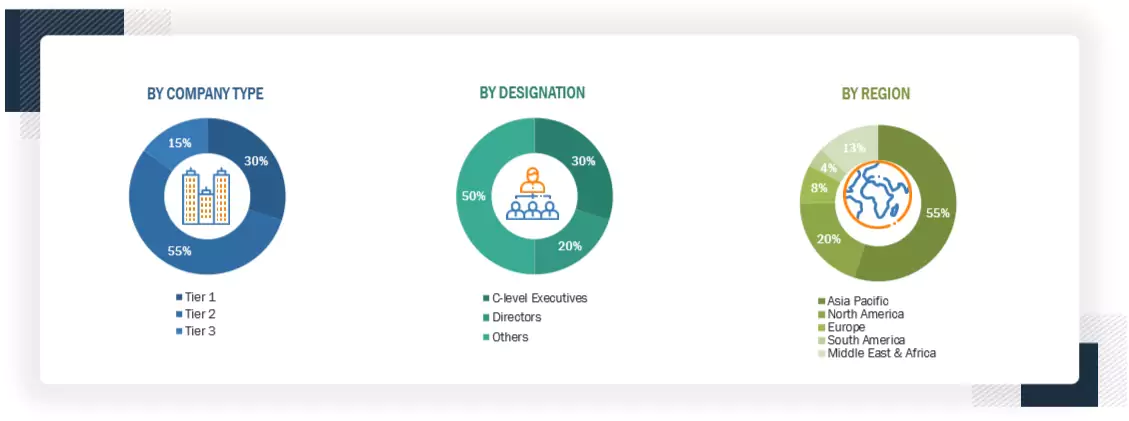
Note: Other designations include sales managers, engineers, and regional managers.
The tiers of the companies are defined based on their total revenue as of 2024: Tier 1: >USD 1 billion, Tier 2:
USD 500 million–1 billion, and Tier 3:
To know about the assumptions considered for the study, download the pdf brochure
Market Size Estimation
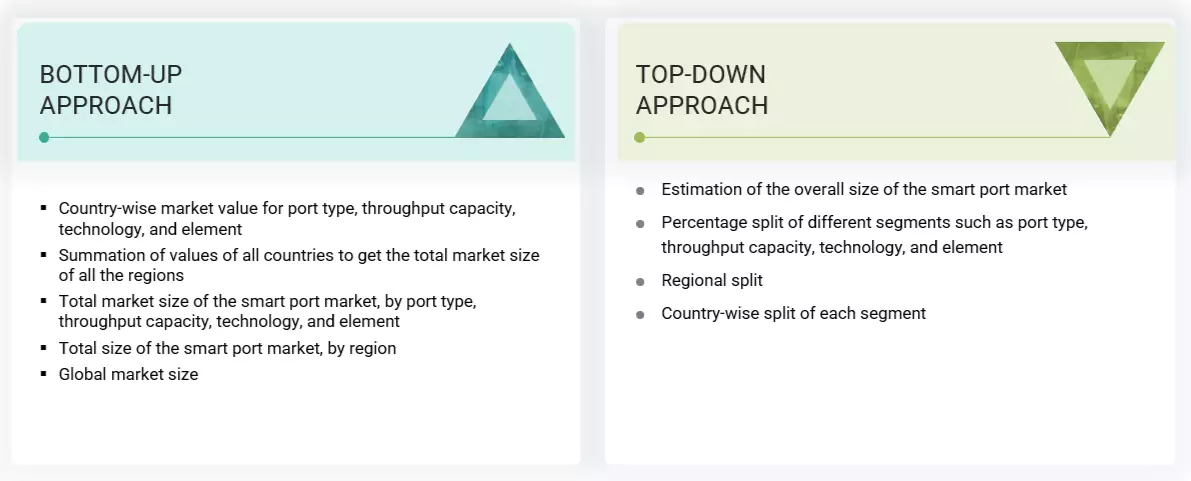
Both the top-down and bottom-up approaches were used to estimate and validate the size of the smart port market and its dependent submarkets. The key players in the market were identified through secondary research, and their market share in the respective regions was obtained through primary and secondary research. The research methodology includes studying the annual and financial reports of top market players and interviews with industry experts, such as chief executive officers, vice presidents, directors, sales managers, and marketing executives, for key quantitative and qualitative insights related to the smart port market.
Smart Port Market : Top-Down and Bottom-Up Approach
Data Triangulation
After arriving at the overall market size from the estimation process explained above, the total market was split into several segments and subsegments. The data triangulation and market breakdown processes were employed to complete the overall market engineering process and arrive at the exact statistics for all the segments and subsegments, wherever applicable. The data was triangulated by studying various factors and trends from both the demand and supply sides. The market was also validated using both the top-down and bottom-up approaches.
Market Definition
According to the Asian Development Bank, a smart port is equipped with sensors, cameras, and different types of devices, which help eliminate wastage of space, time, capital, and natural resources. Smart ports use smart technologies such as the Internet of Things (IoT), blockchain, artificial intelligence (AI), and process automation, which help enhance operational efficiency, cargo handling, passenger services, and port performance, ultimately reducing costs. These technologies allow the connection of the digital and physical worlds by providing real-time data and optimizing resources. A few major advantages associated with smart ports include eliminating human errors, faster turnaround time (increased productivity), and reduced port congestion. The smart port concept has been heavily influenced by the rise of Industry 4.0 (the Fourth Industrial Revolution) and its confluence with the Internet of Things (IoT). The manufacturing industry initially led industry 4.0. Since the port sector is an integral part of a manufacturer’s value chain, Industry 4.0 and IoT have been introduced into port operations as well, aiming at more efficient operations with less waste of space, time, and resources, resulting in the smart port concept. The flow of goods in the supply chain is a key focus of smart ports, but the other roles a port plays can equally benefit from smart initiatives—asset management, environmental protection, and staff support.
Stakeholders
- Maritime associations
- Port authorities and operators
- IoT and cloud-based solution providers
- Research and consulting companies in the marine sector
- Ship manufacturers
- Smart port equipment manufacturers
- AI solution providers
- Technology providers
- Banks and financial institutions
- Government organizations
- Investors/shareholders
- Logistic companies
- Barge operators
- Rail operators
- Terminal operators
- Cargo owners
Report Objectives
- To define, describe, segment, and forecast the smart port market based on element, technology, throughput capacity, port type, and region, in terms of value
- To describe and forecast the smart port market for various segments with respect to five main regions: North America, Europe, Asia Pacific, South America, and the Middle East & Africa, in terms of value
- To provide detailed information regarding drivers, restraints, opportunities, and challenges influencing the growth of the market
- To provide a detailed overview of the smart port value chain analysis, use case analysis, key stakeholders, buying criteria, patent analysis, trade analysis, tariff analysis, regulations and codes, pricing analysis, Porter’s five forces analysis, and impact of AI and 2025 US tariff on the market under study
- To strategically analyze micromarkets1 with respect to individual growth trends, prospects, and contributions to the total market
- To analyze opportunities in the market for various stakeholders by identifying high-growth segments
- To strategically profile key players and comprehensively analyze their market position regarding ranking and core competencies2, along with detailing the market’s competitive landscape.
- To analyze growth strategies adopted by market players, such as joint ventures, partnerships, mergers and acquisitions, contracts, agreements, and product launches in the smart port market
1. Micromarkets are defined as the segments and subsegments of the smart port market included in the report.
2. Core competencies of companies are defined in terms of the key developments and strategies adopted to sustain their position in the smart port market.
Available Customizations
MarketsandMarkets offers customizations according to the specific needs of the companies with the given market data.
The following customization options are available for the report:
Product Analysis
- Product matrix, which gives a detailed comparison of the product portfolio of each company
Geographic Analysis as per Feasibility
- Further breakdown of the smart port, by country
Company Information
- Detailed analysis and profiling of additional market players (up to five)
Get the Full Smart Port Market Report
Full forecast, segment splits, and company analysis for all Smart Port Market.
- South Korea Smart Port Market
- Japan Smart Port Market
- Hong Kong Smart Port Market
- Germany Smart Port Market
- Italy Smart Port Market
- UK Smart Port Market
- Netherlands Smart Port Market
- Canada Smart Port Market
- US Smart Port Market
- UAE Smart Port Market
- Saudi Arabia Smart Port Market
- Kuwait Smart Port Market
- South Africa Smart Port Market
- Brazil Smart Port Market
- Chile Smart Port Market
- Rest Of Europe Smart Port Market
- Rest Of Asia Pacific Smart Port Market
- Rest Of South America Smart Port Market
- China Smart Port Market
- Singapore Smart Port Market
Need a Tailored Report?
Customize this report to your needs
Get 10% FREE Customization
Customize This Report
