
South Korea VCSEL Market (2026-2031)

The South Korea VCSEL Market was valued at $80.5 Million in 2026 and projected to reach to $138.9 Million by 2031, representing a compound annual growth rate of 9.5%. South Korea's VCSEL market is poised for accelerated growth through 2031, driven by the country's robust semiconductor manufacturing infrastructure and increasing demand from consumer electronics and data center sectors.


| Market Size in | USD 26.32 MN |
| Market Forecast in | |
| CAGR | |
| Forecast Period | |
| Units Considered | Value (USD MN) |
South Korea VCSEL Market Trends and Insights
- Valued at USD 80.5 million in 2026, South Korea's VCSEL market is projected to expand to USD 138.9 million by 2031, representing a compound annual growth rate (CAGR) of 9.5%.
- This robust expansion reflects South Korea's strength in advanced semiconductor manufacturing and its leadership in consumer electronics and data center applications. The South Korea VCSEL market benefits from the country's established ecosystem of semiconductor fabricators, optical component manufacturers, and technology innovators.
- South Korea's strategic position in 3D sensing, LiDAR, and high-speed data communication drives sustained demand for VCSEL solutions.
- Between 2026 and 2031, South Korea is expected to capture increasing market share through investments in next-generation manufacturing capabilities and R&D initiatives focused on miniaturization and power efficiency. South Korea's competitive advantages in precision manufacturing and integration with global supply chains position the country as a key hub for VCSEL production and deployment.
- The forecast period underscores South Korea's pivotal role in meeting regional and global demand for advanced optical semiconductor technologies..
Key Market Statistics
- CAGR (2026-2031) 9.5% CAGR
- Market Size, 2026 ~USD 80.5 Million
- Forecast, 2031 ~USD 138.9 Million
- Country South Korea
South Korea VCSEL Market Overview
Market Valuation Growth :
South Korea's VCSEL market is valued at USD 80.5 million in 2026 and is projected to reach USD 138.9 million by 2031, demonstrating strong market expansion driven by semiconductor innovation and manufacturing excellence.
Outpacing Global Growth :
With a CAGR of 9.5%, South Korea's VCSEL market growth significantly exceeds the global average of 8.8%, positioning the country as a high-growth hub within the Asia Pacific semiconductor ecosystem.
Advanced Manufacturing Leadership :
South Korea's dominance in semiconductor fabrication and advanced technology nodes provides a competitive advantage for VCSEL production, supporting both domestic demand and regional supply chain integration.
Strategic Industry Applications :
Growing adoption of VCSELs in consumer electronics, data centers, and 3D sensing applications within South Korea's tech-driven economy is fueling sustained market demand and investment opportunities.
South Korea VCSEL Market Dynamics
- The nation's technological expertise and investment in advanced fabrication capabilities position it as a critical player in the global VCSEL supply chain.
- Domestic companies are expanding production capacity to meet both regional and international demand, supported by government initiatives promoting semiconductor self-sufficiency and innovation. The market outlook remains highly positive, with emerging applications in 5G infrastructure, automotive sensors, and AI-driven data centers creating new revenue streams.
- South Korea's established relationships with global technology leaders and its skilled workforce provide sustained competitive advantages.
- Strategic partnerships and R&D investments in next-generation VCSEL technologies are expected to maintain the country's growth trajectory above global averages through the forecast period..
Market Ecosystem
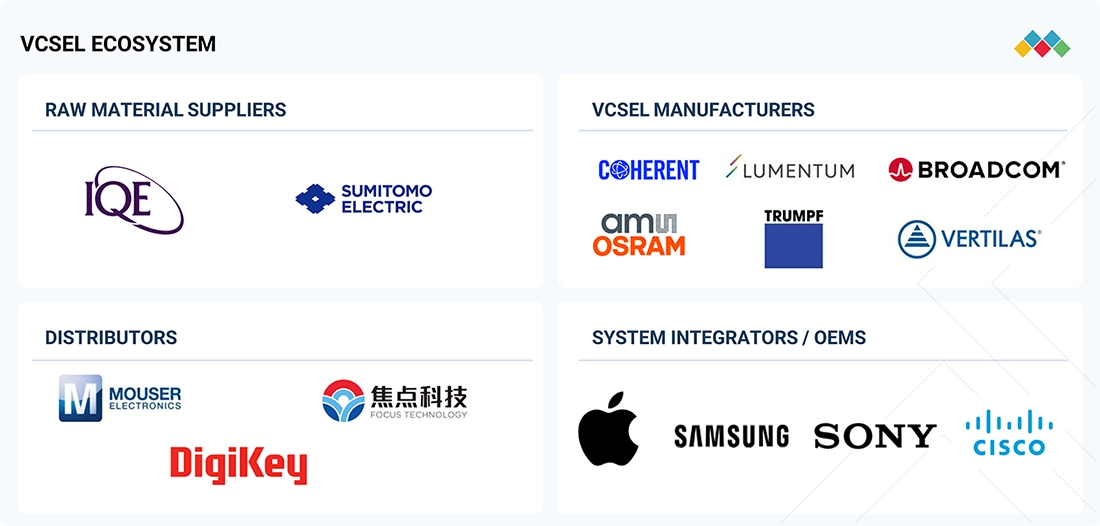
VCSEL MARKET SIZE, SHARE &TRENDS: COMMERCIAL USE CASES ACROSS INDUSTRIES
| COMPANY | USE CASE DESCRIPTION | BENEFITS |
|---|---|---|
 |
TRUMPF (Germany) collaborated with SICK AG (Germany) to develop SPEETEC sensors using VCSEL diodes for non-contact measurement of moving materials. The VCSEL-based system measures movement without physical contact, addressing limitations of traditional wheel encoders when handling sensitive, uneven, or difficult materials in industrial production environments. | The VCSEL-based solution enables high-precision, non-contact speed and length measurement, achieving approximately 0.1% measurement accuracy while reducing wear and improving measurement of sensitive materials. |
|
|
TRUMPF(Germany) and Bosch Sensortec GmbH (Germany) collaborated to develop a compact optical fine-dust sensing solution using VCSEL technology. VCSELs illuminate airborne particles, while the system analyzes the reflected light to measure particle concentration, enabling continuous monitoring of fine dust levels in indoor and outdoor environments. | The VCSEL-based solution enables compact, contactless, real-time fine-dust monitoring with low maintenance requirements, supporting easier integration into ventilation, air-quality monitoring, and other connected systems. |
 |
ams-OSRAM AG (Austria) provided a compact infrared VCSEL flood illuminator for Xiaomi Corporation’s (China) Mi 8 Explorer Edition. The solution delivered infrared illumination required for facial recognition while addressing Xiaomi’s need for a small, energy-efficient optical system that could be integrated within the smartphone’s limited available space. | The VCSEL solution enabled compact and energy-efficient facial recognition, helping Xiaomi reduce system size and power consumption while maintaining reliable infrared illumination performance. |
Logos and trademarks shown above are the property of their respective owners. Their use here is for informational and illustrative purposes only.
Related Ecosystem
Data Centre And Networking
- Software-Defined Networking (SDN)
- Mid-Sized Data Centers
- Small Data Centers
- Remote Monitoring
- Smart Healthcare
- Cisco Systems, Inc.
- HUAWEI TECHNOLOGIES CO LTD
- Hewlett Packard Enterprise Company
- MITSUBISHI ELECTRIC INFORMATION SYSTEMS CORPORATION
- MITSUBISHI ELECTRIC INFORMATION NETWORK CORPORATION
Semiconductor Materials And Components
- Sensors
- Gallium Nitride (GaN)
- Digital Signal Processor (DSP)
- Natural Language Processing (NLP)
- Silicon Carbide
- Texas Instruments Incorporated
- Samsung
- APPLIED MATERIALS, INC.
- Stmicroelectronics
- Lenovo
Key Takeaways
- South Korea's VCSEL market will grow from USD 80.5M (2026) to USD 138.9M (2031) at a 9.5% CAGR, outpacing global growth rates.
- South Korea's advanced semiconductor manufacturing ecosystem and expertise in 3D sensing and LiDAR applications drive sustained market expansion.
- South Korea's strategic investments in R&D and next-generation fabrication capabilities position the country as a regional VCSEL innovation leader.
- South Korea's integration within global supply chains and consumer electronics dominance create strong demand tailwinds for VCSEL deployment through 2031.
VCSEL Market Report Scope
| Report Metric | Details |
|---|---|
| Base Year | 2026 |
| Fastest Growing Segment | OTHER WAVELENGTHS (Wavelength) |
| Forecast Period | 2026-2031 |
| Growth Rate | CAGR of 8.8% from 2026 to 2031 |
| Largest Segment | GALLIUM ARSENIDE (GAAS) (Material) |
| Market Size Base Year (Billions) | ~USD 1.18 (2026) |
| Revenue Forecast (Billions) | ~USD 1.8 (2031) |
| Segments Covered | Type, Vertical, Wavelength, Material, Data Rate, Optical Power |
South Korea VCSEL Market Report Segmentation
6 segment dimensions are covered across the global market.
By Type
- Multimode
- Single-Mode
By Vertical
- Aerospace & Defense
- Automotive
- Commercial & Industrial
- Consumer Electronics
- Data Center
- Data Centers
- Healthcare
- Telecommunication
- Telecommunications
By Wavelength
- Near-Infrared (Nir)
- Other Wavelengths
- Red
- Short-Wave Infrared (Swir)
By Material
- Gallium Arsenide (Gaas)
- Gallium Nitride (Gan)
- Indium Phosphide (Inp)
By Data Rate
- 10.1 To 25 Gbps
- 25.1 To 50 Gbps
- Above 50 Gbps
- Up To 10 Gbps
By Optical Power
- High Power (101 To 1,000 Mw)
- Low Power (Less Than 10 Mw)
- Medium Power (10 To 100 Mw)
- Ultra-High Power (More Than 1,000 Mw)
Target Audience
- Semiconductor Manufacturers : South Korea-based and international VCSEL manufacturers need detailed market sizing and competitive analysis to optimize production capacity, pricing strategies, and market share positioning in this high-growth region.
- Technology Investors & PE Firms : Investment professionals targeting South Korea's semiconductor sector require precise market valuations, growth forecasts, and industry dynamics to evaluate acquisition targets and portfolio company performance.
- Supply Chain & Procurement Teams : Corporate procurement and supply chain managers sourcing VCSEL components need South Korea-specific market intelligence to identify qualified suppliers, negotiate contracts, and manage supply chain risks.
- Strategic Business Planners : Corporate strategy and business development teams planning regional expansion or product launches require South Korea market data to validate business cases and inform go-to-market strategies.
- Industry Consultants & Analysts : Management consultants and market research professionals advising clients on semiconductor opportunities need authoritative South Korea VCSEL market data to support strategic recommendations and client deliverables.
Reasons to Buy this Report
- Market-Specific Sizing & Forecasts : Access precise valuation data for South Korea's VCSEL market with detailed projections through 2031, enabling accurate financial planning and investment decisions tailored to this high-growth regional market.
- Competitive Landscape Intelligence : Understand South Korea's unique competitive positioning, manufacturing capabilities, and key players driving the 9.5% CAGR, providing strategic insights for market entry and expansion strategies.
- Application & Demand Analysis : Identify sector-specific growth drivers within South Korea including consumer electronics, data centers, and 3D sensing applications to prioritize product development and go-to-market initiatives.
- Supply Chain & Manufacturing Insights : Leverage detailed analysis of South Korea's semiconductor fabrication ecosystem, production capacity trends, and supply chain dynamics to optimize sourcing and partnership strategies.
- Regional Growth Benchmarking : Compare South Korea's 9.5% CAGR against the global 8.8% benchmark to validate market opportunity strength and inform resource allocation decisions for Asia Pacific expansion.
Frequently asked questions
What is the current size of South Korea's VCSEL market in 2026?
South Korea's VCSEL market is valued at USD 80.5 million in 2026, reflecting the country's significant role in semiconductor and optical component manufacturing.
What is the projected size of South Korea's VCSEL market by 2031?
South Korea's VCSEL market is forecast to reach USD 138.9 million by 2031, representing 73% growth over the five-year forecast period.
What is the CAGR for South Korea's VCSEL market from 2026 to 2031?
South Korea's VCSEL market is projected to grow at a compound annual growth rate (CAGR) of 9.5% between 2026 and 2031.
What are the primary drivers of growth in South Korea's VCSEL market?
South Korea's VCSEL market growth is driven by increasing demand for 3D sensing in consumer electronics, LiDAR applications in autonomous vehicles, and high-speed data center interconnects, supported by the country's advanced manufacturing capabilities.
Why is South Korea a key market for VCSEL technology?
South Korea is a key VCSEL market due to its world-class semiconductor fabrication infrastructure, leadership in consumer electronics and display technologies, and strategic position in global supply chains for optical and photonic components.
RESEARCH METHODOLOGY
The research process for this technical, market-oriented, and commercial study of the VCSEL market included systematic gathering, recording, and analysis of data about companies operating in the market. It involved the extensive use of secondary sources, directories, and databases (Factiva, Oanda) to identify and collect relevant information. In-depth interviews were conducted with various primary respondents, including experts from core and related industries and preferred manufacturers, to obtain and verify critical qualitative and quantitative information as well as to assess the growth prospects of the market. Key players in the VCSEL market were identified through secondary research, and their market rankings were determined through primary and secondary research. This included studying annual reports of top players and interviewing key industry experts, such as CEOs, directors, and marketing executives.
Secondary Research
In the secondary research process, various secondary sources have been referred to for identifying and collecting information relevant to this study. Secondary sources include annual reports, press releases, and investor presentations of companies; white papers, certified publications, and articles from recognized authors; directories; and databases. Secondary research has been mainly conducted to obtain key information about the supply of the industry; a total pool of key players; segmentation of the market according to industry trends, geographic markets, and key developments from market- and technology-oriented perspectives.
Primary Research
In the primary research process, primary sources from the supply and demand sides have been interviewed to obtain qualitative and quantitative information for this report. Primary sources from the supply side include experts, such as CEOs, vice presidents, marketing directors, technology and innovation directors, subject-matter experts, consultants, and related key executives from major companies and organizations operating in the VCSEL market.
After the complete market engineering process (market statistics calculations, market breakdown, market size estimations, market forecasting, and data triangulation), extensive primary research has been conducted to gather information and verify and validate the critical market numbers
Several primary interviews have been conducted with experts from the demand and supply sides across four major regions—North America, Europe, Asia Pacific, and RoW. Approximately 25% of the primary interviews were conducted with the demand side and 75% with the supply side. This primary data has been collected through questionnaires, emails, and telephonic interviews.
BREAKDOWN OF PRIMARY INTERVIEW PARTICIPANTS
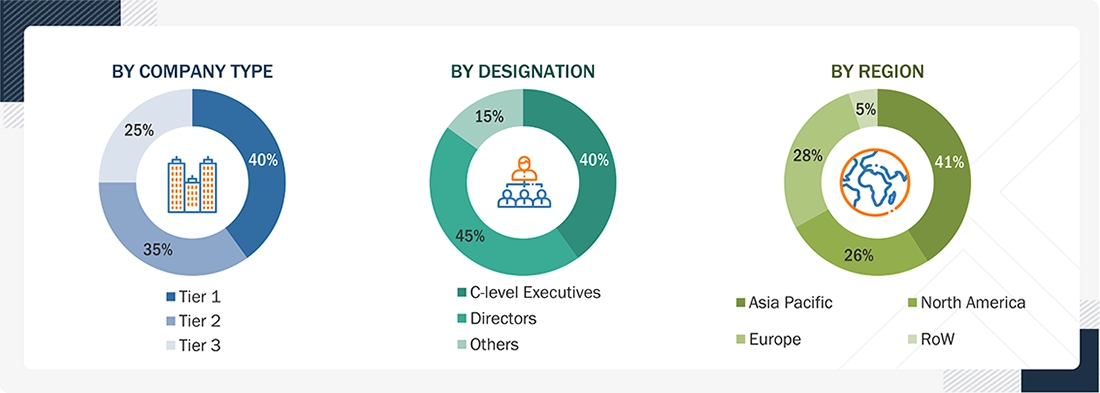
Notes: Tier 1 companies include market players with revenues above USD 500 million; tier 2 companies earn revenues between USD 100 million and USD 500 million; and tier 3 companies earn revenues up to USD 100 million.
To know about the assumptions considered for the study, download the pdf brochure
Market Size Estimation
In the complete market estimation process, the top-down and bottom-up approaches have been used, along with several data triangulation methods, to estimate and forecast the size of the market and its segments and subsegments listed in the report. Extensive qualitative and quantitative analyses have been carried out on the complete market engineering process to list the key information/insights pertaining to the VCSEL market.
Key players in the VCSEL market have been identified through secondary research, and their rankings in the respective regions have been determined through primary and secondary research. This process involved reviewing the annual and financial reports of top players and interviewing industry experts, such as chief executive officers, vice presidents, directors, and marketing executives, for quantitative and qualitative insights. All percentage shares, splits, and breakdowns have been determined using secondary sources and verified through primary sources. All parameters that affect the markets covered in this research study have been accounted for, viewed in extensive detail, verified through primary research, and analyzed to obtain the final quantitative and qualitative data. This data has been consolidated and enhanced with detailed inputs and analysis from MarketsandMarkets and presented in this report.
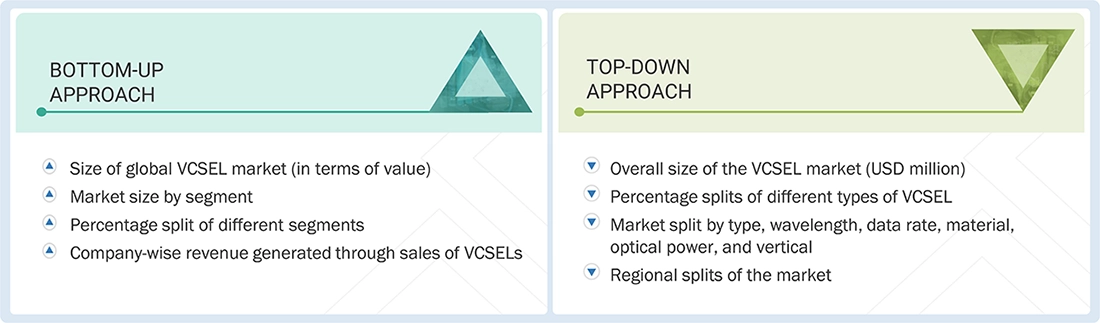
BOTTOM-UP APPROACH
- More than 25 companies in the VCSEL market were identified, and their offerings were mapped based on type, wavelength, data rate, material, optical power, vertical, and region.
- The global VCSEL market size was derived through the data sanity method. VCSEL providers' revenues were analyzed through annual reports and press releases and summed to derive the overall market size.
- For each company, a percentage was assigned to the overall revenue to derive the revenues from the VCSEL segment.
- Each company's percentage was assigned after analyzing various factors, including its product offerings, geographical presence, R&D expenditures and initiatives, and recent developments/strategies adopted for growth in the VCSEL market.
- For the CAGR, the market trend analysis of VCSEL was carried out by understanding the industry penetration rate and the demand and supply of VCSEL in different sectors.
- Estimates at every level were verified and cross-checked by discussing them with key opinion leaders, including sales heads, directors, operation managers, and market domain experts of MarketsandMarkets.
- Various paid and unpaid information sources, such as annual reports, press releases, white papers, and databases, were studied.
TOP-DOWN APPROACH
- Focusing initially on the top-line investments and expenditures being made in the ecosystem of VCSEL
- Splitting the market based on switching technology, type, wavelength, data rate, material, optical power, and vertical, and listing key developments in key market areas
- Identifying all major players in the VCSEL market by type, wavelength, data rate, material, and optical power, and their penetration in various vertical segments through secondary research and verifying the information with industry experts
- Analyzing revenues, product mix, geographic presence, and key applications for which VCSEL is offered by all identified players to estimate and arrive at percentage splits for all key segments
- Discussing these splits with the industry experts to validate the information and identify key growth pockets across all key segments
- Breaking down the global market based on verified splits and key growth pockets across all segments
VCSEL Market : Top-Down and Bottom-Up Approach
Data Triangulation
After arriving at the overall market size from the market size estimation process explained above, the total market has been split into several segments and subsegments. To complete the overall market engineering process and arrive at the exact statistics for all segments and subsegments, the market breakdown and data triangulation procedures have been employed, wherever applicable. The data has been triangulated by studying various factors and trends from both the demand and supply sides. Along with this, the market size has been validated using both the top-down and bottom-up approaches.
Market Definition
A vertical-cavity surface-emitting laser (VCSEL) is a monolithic semiconductor laser diode in which the laser beam is emitted perpendicularly/vertically from its top surface. VCSELs are typically made of gallium arsenide (GaAs), indium phosphide (InP), and gallium nitride (GaN) with single-mode and multimode functionalities. VCSELs are used in various verticals, such as telecommunications, consumer electronics, data center, automotive, industrial & manufacturing, healthcare, and aerospace & defense.
Key Stakeholders
- Raw material & wafer suppliers
- Foundry & fabless players
- Integrated device manufacturers (IDMS)
- VCSEL manufacturers
- Equipment providers
- Original equipment manufacturers (OEMS)
- Assembling, testing, and packaging vendors
- Technology, service, and solution providers
- Suppliers and distributors
- Government and other regulatory bodies
- Research institutes and organizations
- Market research and consulting firms
Report Objectives
- To describe and forecast the VCSEL market by type, wavelength, material, data rate, optical power, vertical, and region, in terms of value
- To describe and forecast the VCSEL market by vertical in terms of volume
- To forecast the market size for various segments across the main regions: North America, Europe, Asia Pacific, and the Rest of the World (RoW), along with their respective country-level market size, in terms of value
- To provide industry-specific information regarding the major drivers, restraints, opportunities, and challenges influencing the growth of the VCSEL market
- To study the complete supply chain and related industry segments for the VCSEL market
- To identify key VCSEL providers and analyze their product offerings in the market
- To analyze trends/disruptions impacting customer business; pricing analysis; patents analysis; trade analysis (export and import scenario); Porter's Five Forces analysis macroeconomics indicators; case studies; investment and funding scenario; decision-making process; buyer stakeholders and buying evaluation criteria; adoption barriers & internal challenges; unmet needs from various industries; technology analysis; ecosystem analysis; regional regulations and compliance; impact of artificial intelligence; impact of 2025 US tariff; and key conferences and events related to the VCSEL market
- To analyze opportunities in the market for various stakeholders by identifying the high-growth segments of the market
- To strategically profile the key players and comprehensively analyze their market position regarding ranking, along with detailing the competitive landscape for the market leaders
- To analyze competitive developments, such as product launches, collaborations, agreements, expansions, partnerships, and research & development (R&D) activities carried out by players in the VCSEL market
Available customizations:
With the given market data, MarketsandMarkets offers customizations according to the company’s specific needs. The following customization options are available for the report:
Company Information
- Detailed analysis and profiling of additional market players (up to 7)
Get the Full VCSEL Market Report
Full forecast, segment splits, and company analysis for all VCSEL Market.
Need a Tailored Report?
Customize this report to your needs
Get 10% FREE Customization
Customize This Report
