
China Vertical Farming Market (2024-2029)

The China Vertical Farming Market was valued at $662.3 Million in 2024 and projected to reach to $1729.1 Million by 2029, representing a compound annual growth rate of 21.2%. China's vertical farming market is positioned for exceptional growth through 2029, driven by urbanization, food security imperatives, and technological advancement in semiconductor-based automation systems.


| Market Size in | USD 26.32 MN |
| Market Forecast in | |
| CAGR | |
| Forecast Period | |
| Units Considered | Value (USD MN) |
China Vertical Farming Market Trends and Insights
- China is leveraging advanced semiconductor and electronics technologies to drive automation and climate control systems in vertical farming facilities, positioning itself as a key growth hub in Asia Pacific.
- The country's urbanization, food security concerns, and government support for agricultural innovation are accelerating adoption of vertical farming solutions across China. Driven by a 21.2% compound annual growth rate through 2029, China's vertical farming sector is attracting significant investment in controlled environment agriculture (CEA) infrastructure.
- China's integration of IoT sensors, LED lighting systems, and AI-powered monitoring solutions reflects the semiconductor industry's critical role in enabling vertical farm efficiency.
- By 2029, China is expected to account for a substantial portion of Asia Pacific's vertical farming market, supported by technological advancement and increasing consumer demand for locally-grown produce..
Key Market Statistics
- CAGR (2024-2029) 21.2% CAGR
- Market Size, 2024 ~USD 662.3 Million
- Forecast, 2029 ~USD 1729.1 Million
- Country China
China Vertical Farming Market Overview
Rapid Market Expansion :
China's vertical farming market is projected to grow from $662.3 million in 2024 to $1,729.1 million by 2029, representing a robust 21.2% CAGR, outpacing the global average of 19.7%.
Semiconductor-Driven Automation :
Chinese vertical farming facilities are increasingly integrating advanced semiconductor and electronics technologies for precision climate control, LED lighting systems, and IoT-enabled monitoring, enhancing operational efficiency.
Urbanization & Food Security :
China's accelerating urbanization and government focus on food security are driving investment in vertical farming as a sustainable solution to meet growing urban demand while reducing agricultural land pressure.
Asia Pacific Leadership :
China is establishing itself as the key growth hub in Asia Pacific's vertical farming sector, attracting significant capital investment and technological innovation from both domestic and international players.
China Vertical Farming Market Dynamics
- Government support for sustainable agriculture and rising consumer demand for locally-grown produce are accelerating facility development across major metropolitan areas.
- The integration of advanced electronics for climate control, nutrient delivery, and crop monitoring is enhancing yields and reducing operational costs, making vertical farming increasingly economically viable.
- China's manufacturing capabilities and tech ecosystem provide competitive advantages in developing cost-effective solutions, attracting both domestic entrepreneurs and international investors seeking to capitalize on Asia's fastest-growing agricultural technology market..
Market Ecosystem
Related Ecosystem
Precision Agriculture
- Sensors
- Global Positioning System (GPS)
- Camera Systems
- Data Services
- Platform as A Service (PaaS)
- MSK FARM MACHINERY CORPORATION
- MITSUBISHI AGRICULTURAL MACHINERY
- MITSUBISHI CHEMICAL AGRI DREAM
- Trimble Inc.
- Mitsui & Co., Ltd.
Electronics System And Components
- Sensors
- Temperature Sensors
- Pressure Sensors
- Actuators
- Image Sensors
- Lenovo
- Samsung
- Texas Instruments Incorporated
- HONEYWELL INTERNATIONAL INC.
- Teledyne Technologies Incorporated
Agricultural Biologicals
- Bionematicides
- Auxins
- Cytokinins
- Ethylene
- Humic Substances
- NICHINO INDIA PVT LTD.
- Corteva, Inc.
- Basf se
- AZELIS HOLDINGS SA
- BAYER AG
Key Takeaways
- China's vertical farming market will grow from $662.3M (2024) to $1,729.1M (2029), representing a 21.2% CAGR.
- China is integrating semiconductor and electronics technologies including IoT, LED systems, and AI to optimize vertical farm operations.
- Urbanization and food security initiatives in China are driving rapid adoption of controlled environment agriculture solutions.
- China is positioned as Asia Pacific's leading vertical farming market, supported by government policy and technological innovation.
Vertical Farming Market Report Scope
| Report Metric | Details |
|---|---|
| Base Year | 2024 |
| Fastest Growing Segment | BROCCOLI (Crop Type) |
| Forecast Period | 2024–2029 |
| Growth Rate | CAGR of 19.7% from 2024 to 2029 |
| Largest Segment | BUILDING-BASED VERTICAL FARMS (Structure) |
| Market Size Base Year (Billions) | ~USD 5.58 (2024) |
| Revenue Forecast (Billions) | ~USD 13.7 (2029) |
| Segments Covered | Offering, Hardware Type, Growth Mechanism, Structure, Crop Type |
China Vertical Farming Market Report Segmentation
5 segment dimensions are covered across the global market.
By Offering
- Building-Based Vertical Farms
- Hardware
- Services
- Shipping Container-Based Vertical Farms
- Software
By Hardware Type
- Climate Control
- Hydroponic Components
- Lighting
- Sensors
By Growth Mechanism
- Aeroponics
- Aquaponics
- Hydroponics
By Structure
- Building-Based Vertical Farms
- Shipping Container-Based Vertical Farms
By Crop Type
- Broccoli
- Cucumbers
- Herbs
- Kale
- Lettuce
- Other Crop Types
- Peppers
- Spinach
- Strawberries
- Tomatoes
Target Audience
- Agricultural Technology Investors : Investors seeking high-growth opportunities in Asia Pacific need China-specific market data to evaluate portfolio additions, assess competitive positioning, and identify emerging players in the 21.2% CAGR vertical farming sector.
- Vertical Farming Equipment Manufacturers : Equipment suppliers require detailed China market insights to understand demand for automation systems, semiconductor-based controls, and electronics integration to tailor product offerings and expand distribution networks.
- Food & Beverage Companies : F&B enterprises exploring vertical farming for supply chain resilience and sustainability need China market analysis to assess local production feasibility, cost structures, and competitive advantages in urban markets.
- Government & Policy Makers : Chinese agricultural and technology officials require market intelligence to inform food security policies, incentive programs, and infrastructure investments supporting vertical farming expansion and technology adoption.
- Semiconductor & Electronics Firms : Tech companies developing agricultural solutions need China-specific demand data to identify opportunities in climate control systems, LED lighting, IoT sensors, and automation technologies for vertical farming applications.
Key Companies in the China Vertical Farming Market
| Company | HQ | Ownership | Strongest segments |
|---|---|---|---|
| BOREALIS AG | United States | Private Company | Hardware-linked materials (polyolefins for structures, piping, trays, films),Packaging materials for vertical-farmed produce,Recyclates and circular solutions, |
| RIVULIS IRRIGATION | Israel | Private Company | Hardware – Drip lines, tapes, drippers, filters, valves, pipes,Software – Manna irrigation intelligence and automation platforms,Services – Design, installation, subscription advisory, and support, |
| MITSUI & CO., LTD. | Japan | Public Company | Hardware & Infrastructure (growth systems, energy, water, logistics),Agriscience Inputs & Natural Capital Solutions,Software & Digital Platforms, |
| AMS-OSRAM AG | United States | Public Company | LED packages and chips for horticulture,LED modules and boards,Drivers, power management ICs, and analog frontends, |
| HELIOSPECTRA | Sweden | Public Company | LED grow light hardware (MITRA X, MITRA X Flex, ELIXIA, DYNA),helioCORE light control software,Sensors and connectivity (DOXA, Adelphi), |
| EVERLIGHT ELECTRONICS CO., LTD | Taiwan | Public Company | Horticulture and general lighting LEDs for vertical farms,UV and specialty LEDs for disinfection and growth support,Sensors, IR, and optoelectronic components in farm control systems, |
BOREALIS AG
BOREALIS AG is a private company founded in 1994 in the United States with 5887 employees.
RIVULIS IRRIGATION
RIVULIS IRRIGATION is a private company founded in 1966 in Israel.
MITSUI & CO., LTD.
MITSUI & CO., LTD. is a public company founded in 1947 in Japan with 55463 employees.
AMS-OSRAM AG
AMS-OSRAM AG is a public company founded in 1981 in the United States with 18500 employees.
HELIOSPECTRA
HELIOSPECTRA is a public company founded in 2005 in Sweden with 15 employees.
EVERLIGHT ELECTRONICS CO., LTD
EVERLIGHT ELECTRONICS CO., LTD is a public company founded in 1983 in Taiwan with 4312 employees.
Reasons to Buy this Report
- Market Size & Growth Validation : Obtain precise market valuation ($662.3M in 2024) and verified 5-year forecast ($1,729.1M by 2029) specific to China, enabling accurate business planning and investment decisions in this high-growth market.
- Competitive Intelligence : Understand China's unique market dynamics, key players, technology adoption rates, and competitive landscape to identify partnership opportunities and market entry strategies in Asia Pacific's leading vertical farming hub.
- Technology & Innovation Insights : Access detailed analysis of semiconductor and electronics integration in Chinese vertical farming facilities, including automation trends, LED technology adoption, and IoT solutions driving operational excellence.
- Investment & Expansion Strategy : Leverage comprehensive market data to identify high-potential regions within China, assess urbanization-driven demand patterns, and evaluate ROI scenarios for facility development and technology deployment.
- Regulatory & Policy Context : Gain insights into China's food security policies, government incentives for vertical farming, sustainability regulations, and urbanization trends shaping market opportunities and operational requirements.
Frequently asked questions
What is the current market size of vertical farming in China?
China's vertical farming market was valued at $662.3 million in 2024 and is expected to grow to $1,729.1 million by 2029.
What is the growth rate of China's vertical farming market?
China's vertical farming market is projected to grow at a compound annual growth rate (CAGR) of 21.2% from 2024 to 2029.
What technologies are driving vertical farming adoption in China?
China is adopting advanced semiconductor and electronics technologies including IoT sensors, LED lighting systems, AI-powered monitoring, and automated climate control to enhance vertical farm productivity.
Why is vertical farming growing rapidly in China?
China's vertical farming growth is driven by urbanization, food security concerns, government agricultural innovation support, and increasing demand for locally-produced fresh vegetables.
How does China's vertical farming market compare to Asia Pacific?
China represents a significant portion of the Asia Pacific vertical farming market, with its 21.2% CAGR outpacing regional averages and establishing it as the region's primary growth driver.
RESEARCH METHODOLOGY
The study involved four major activities in estimating the size of the vertical farming market. Exhaustive secondary research has been carried out to collect information on the market, the peer markets, and the parent market. Both top-down and bottom-up approaches have been employed to estimate the total market size. Market breakdown and data triangulation methods have also been used to estimate the market for segments and subsegments.
Secondary Research
Revenues of companies offering vertical farming systems have been obtained from the secondary data available through paid and unpaid sources. The revenues have also been derived by analyzing the product portfolio of key companies, and these companies have been rated according to the performance and quality of their products.
In the secondary research process, various sources have been referred to for identifying and collecting information for this study on the vertical farming market. Secondary sources considered for this research study include government sources, corporate filings, and trade, business, and professional associations. Secondary data has been collected and analyzed to arrive at the overall market size, which has been further validated through primary research.
Secondary research has been mainly used to obtain key information about the supply chain of Vertical farming systems to identify key players based on their products and prevailing industry trends in the Vertical farming market by offering, type, panel size, location, vertical, and region. Secondary research also helped obtain market information- and technology-oriented key developments undertaken by market players to expand their presence and increase their market share.
Primary Research
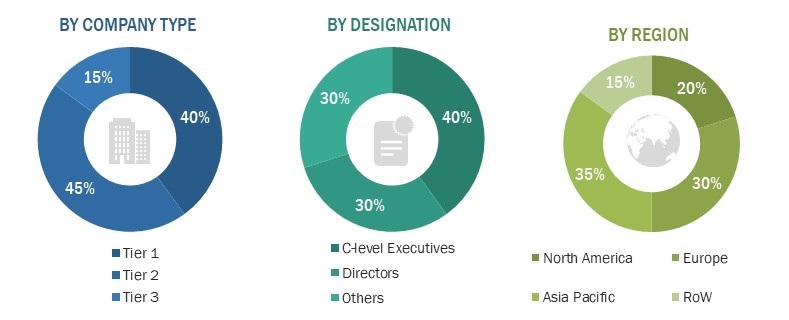
Extensive primary research has been conducted after understanding and analyzing the current scenario of the Vertical farming market through secondary research. Several primary interviews have been conducted with the key opinion leaders from the demand and supply sides across four main regions—North America, Europe, Asia Pacific, and the Rest of Europe. Approximately 25% of the primary interviews were conducted with the demand-side respondents, while approximately 75% were conducted with the supply-side respondents. The primary data has been collected through questionnaires, emails, and telephone interviews.
After interacting with industry experts, brief sessions were conducted with highly experienced independent consultants to reinforce the findings from our primary. This, along with the in-house subject matter experts’ opinions, has led us to the findings as described in the remainder of this report. The breakdown of primary respondents is as follows:
To know about the assumptions considered for the study, download the pdf brochure
Market Size Estimation
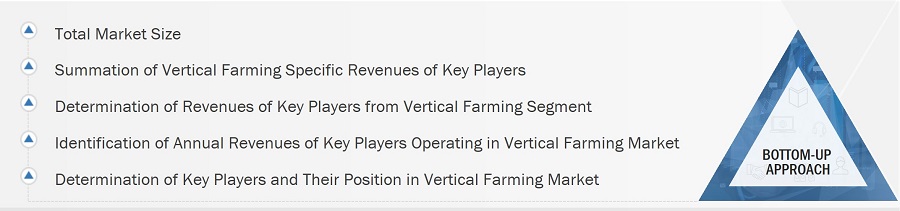
The bottom-up procedure has been employed to arrive at the overall size of the vertical farming market.
- Company-wise revenues generated through the sale of lighting, hydroponic components, climate control, sensors, software, and services have been estimated.
- Break down of the sales data of key companies offering products for vertical farming has been estimated, and percentage splits have been derived.
- The market size of each offering segment i.e. hardware, software, and services have been estimated.
- The global vertical farming market size has been arrived after adding market estimates from hardware, software, and services segment .
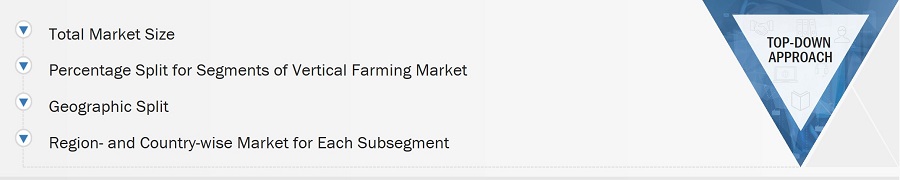
The top-down approach has been used to estimate and validate the total size of the Vertical farming market.
- MarketsandMarkets has considered top-line investments and R&D expenditure in the vertical farming ecosystem.
- Information related to the revenue generated in the vertical farming market through different segments—growth mechanisms, structures, and geography—has been collected.
- Multiple on-field discussions with key opinion leaders have been carried out across major companies involved in the vertical farming market to validate their market position.
- Geographic splits have been estimated using secondary sources based on numerous factors, such as the number of players in a specific country and region and the range of offerings each company serves.
Data Triangulation
After arriving at the overall market size-using the market size estimation processes as explained above-the market has been split into several segments and subsegments. To complete the entire market engineering process and arrive at the exact statistics of each market segment and subsegment, data triangulation and market breakdown procedures have been employed, wherever applicable. The data has been triangulated by studying various factors and trends from the demand and supply sides in the vertical farming market.
Market Definition
Vertical farming is a method of cultivating crops on a vertical stack in an urban setup. In vertical farming, an artificial environment is created inside a facility, using technology, which helps plants grow with high nutritious content in a short period compared with traditional farming. Growth, productivity, and quality of plants depend on technologies, such as climate control, air purification, lighting, and pump and irrigation systems. Vertical farming can be done using three different growth mechanisms: hydroponics, aeroponics, and aquaponics. The vertical farms can be of different types, such as building-based, shipping container-based, and deep farms. The output of the vertical farms is multifold compared with conventional farming in the same area of a farm, as crops are grown using vertical stacks in vertical farms in a controlled environment agriculture technology, increasing the quantity of produce, while in conventional farming, crops are planted at a single level, making vertical farming an efficient farming technique.
Key Stakeholders
- Raw material vendors
- Original technology designers and suppliers
- Raw material and component suppliers
- Vertical farming system manufacturers
- Assembly manufacturers
- System integrators
- Assembly and packaging vendors
- Technical universities
- Research institutes and organizations
- Market research and consulting firms
- Original equipment manufacturers (OEMs)
Report Objectives
- To define, describe, and forecast the vertical farming market by growth mechanism, structure, and offering, in terms of value
- To define, describe, and forecast the market by crop type in terms of volume
- To describe and forecast the market for various segments, with respect to four main regions, namely, the North America, Europe, Asia Pacific, and the RoW(South America, and MEA), in terms of value
- To provide detailed information regarding the drivers, restraints, opportunities, and challenges that influence the market’s growth
- To analyze the impact of generative artificial intelligence (Gen AI) on the vertical farming market.
- To provide a detailed overview of the vertical farming market’s value chain, along with the ecosystem, technology trends, use cases, regulatory environment, and Porter’s five forces analysis for the market
- To analyze industry trends, pricing data, patents and innovations, and trade data (export and import data) related to the vertical farming systems
- To strategically analyze the micro markets with respect to individual growth trends, prospects, and contributions to the total market
- To strategically profile the key players and comprehensively analyze their market share and core competencies
- To analyze opportunities for stakeholders and provide a detailed competitive landscape of the market
- To analyze competitive developments such as product launches/developments, contracts, collaborations, partnerships, agreements, acquisitions, expansions, and research and development (R&D) activities carried out by players in the vertical farming market
Available customizations:
With the given market data, MarketsandMarkets offers customizations according to the specific requirements of companies. The following customization options are available for the report:
- Detailed analysis and profiling of additional market players based on various blocks of the supply chain
Get the Full Vertical Farming Market Report
Full forecast, segment splits, and company analysis for all Vertical Farming Market.
Need a Tailored Report?
Customize this report to your needs
Get 10% FREE Customization
Customize This Report
