Humanoid Robot Market Size, Share, Trends & Growth Report, 2035

Humanoid Robot Market Size, Share & Trends by Type (Biped, Wheel-drive), Component (Linear & Rotary Actuators, Motors, Cameras & Vision Sensors, Harmonic & Planetary Reducers, Encoders, Accelerometers, Torque Sensors, Motion & Joint Controllers) - Global Forecast to 2035




HUMANOID ROBOT MARKET OVERVIEW
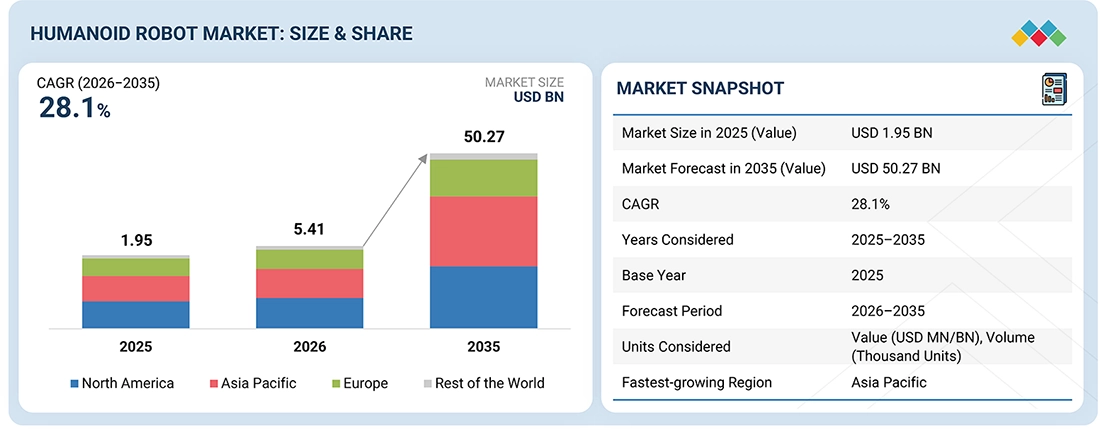
The humanoid robot market size is estimated to be USD 5.41 billion in 2026 and is projected to reach USD 50.27 billion by 2035, growing at a CAGR of 28.1% from 2026 to 2035. Market growth is driven by rising demand for flexible automation across manufacturing, warehousing & distribution centers, healthcare, education, hospitality & entertainment, retail, and public relations, as companies look to improve productivity, reduce labor dependency, and deploy robots in human-centric environments. Increasing adoption of biped, wheeled, and torso & stationary humanoid robots is supporting use cases such as assembly assistance, material handling, patient support, interactive learning, customer engagement, and facility operations. Advancements in AI-based perception, motion planning, manipulation software, sensors, actuators, power systems, and robot control platforms are improving humanoid robot mobility, task execution, and human–robot interaction. Growing investments in physical AI, simulation-based robot training, fleet management software, and robotics-as-a-service models are further accelerating commercialization and supporting large-scale deployment across major regions.
Technological advancements in artificial intelligence, machine learning, computer vision, sensors and robotics are accelerating the development of human-like machines, which is driving significant momentum in the humanoid robot market growth. The humanoid robots market size is expected to grow significantly as manufacturers shift from research prototypes to commercial deployments in manufacturing, logistics, retail, education and service industries. The humanoid robot market forecast looks good in the long term, with increasing investments in robotics startups, improving hardware capabilities, and growing demand for automation in labor intensive environments. Humanoid robots on the market are already being tested and implemented in industrial, commercial and research areas. This means that the field of humanoid robotics has moved from an experimental technology to business solutions. These trends are expected to drive the humanoid robot market size forecast through 2035, with increased adoption, decreasing technology costs and wider application opportunities supporting the market growth.
The humanoid robotics market is also seeing growing opportunities in specialized sectors such as healthcare where robots can potentially assist patients, rehabilitation, elderly care, hospital logistics and routine tasks. The healthcare humanoid robot market is anticipated to be aided by the aging population, shortage of healthcare workers, and demand for automated support services. Regionally, Europe humanoid robots market is growing owing to investments in the advanced manufacturing, industrial automation, artificial intelligence and robotics research and development, and next-generation autonomous systems development programs.
REPORT SCOPE
| REPORT METRIC | DETAILS |
|---|---|
| Market Size in 2025 (Value) | USD 1.95 Billion |
| Market Size in 2026 (Value) | USD 5.41 Billion |
| Market Forecast in 2035 (Value) | USD 50.27 Billion |
| CAGR | CAGR of 28.1% from 2026 to 2035 |
| Years Considered | 2025 – 2035 |
| Base Year | 2025 |
| Forecast Period | 2026 – 2035 |
| Units Considered | Value (USD Million/Billion), Volume (Thousand Units) |
| Report Coverage | Revenue Forecast, Company Ranking, Competitive Landscape, Growth Factors, and Trends |
| Top Companies |
|
| Growth Drivers |
|
| Segments Covered |
|
| Regions Covered | North America, Europe, Asia Pacific, Rest of the World |
KEY TAKEAWAYS
-
BY REGIONAsia Pacific is expected to account for more than 50% of the market share throughout the forecast period.
-
BY TYPEThe biped segment is expected to grow at the highest rate of ~28–30% during the forecast period.
-
BY OFFERINGThe hardware segment is estimated to hold the largest market share (~65–75%) in 2026.
-
BY APPLICATIONThe manufacturing segment is expected to register the highest growth rate of 27–30% during the forecast period.
-
COMPETITIVE LANDSCAPE (KEY PLAYERS)Unitree Robotics (China), AGIBOT Innovation (Shanghai) Technology Co., Ltd. (China), UBTECH Robotics (China), Leju Robotics (China), and EngineAI Robotics (China), among others, are identified as key players in the humanoid robot market.
-
COMPETITIVE LANDSCAPE (STARTUPS/SMES)Mentee Robotics and ROBOTERA, among others, have established strong positions in specialized humanoid robot development, highlighting their role as emerging players and SMEs in the humanoid robot market growth.
The humanoid robot Industry is witnessing strong growth as companies increasingly invest in human-centric automation to support complex, repetitive, and labor-intensive tasks across industrial and service environments. Demand is driven by rising deployment of humanoid robots across manufacturing, warehousing & distribution centers, healthcare, education, hospitality & entertainment, retail, and public relations applications. Increasing adoption of biped, wheeled, and torso & stationary humanoid robots is enabling use cases such as assembly support, material handling, inspection, patient assistance, interactive learning, customer engagement, and facility operations. Continuous advancements in sensors, actuators, controllers, power systems, AI-based perception, motion planning, manipulation software, and fleet management platforms are improving robot mobility, dexterity, task accuracy, and human–robot interaction. Growing interest in physical AI, simulation-based training, robotics-as-a-service models, and scalable deployment platforms is further strengthening the role of humanoid robots in next-generation automation ecosystems.
Source: Secondary Research, Interviews with Experts, MarketsandMarkets Analysis
TRENDS & DISRUPTIONS IMPACTING CUSTOMERS' CUSTOMERS
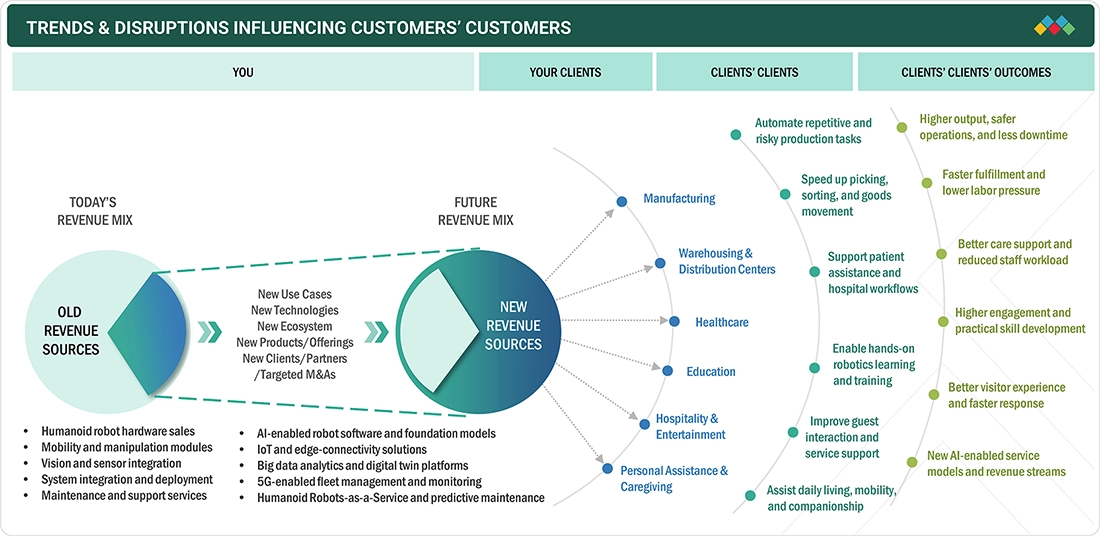
There is an increasing shift in the humanoid robot market size from traditional revenue sources toward AI-enabled software platforms, service-based deployment models, and intelligent automation solutions. Humanoid robot companies are expanding from hardware sales, mobility and manipulation modules, vision and sensor integration, system integration, deployment, and maintenance services toward new revenue sources such as AI-enabled robot software and foundation models, IoT and edge-connectivity solutions, big data analytics and digital twin platforms, 5G-enabled fleet management, and predictive maintenance. Growing demand across manufacturing, warehousing & distribution centers, healthcare, education, hospitality & entertainment, and personal assistance & caregiving is accelerating adoption as end users seek to automate repetitive tasks, improve fulfillment speed, support hospital workflows, enable interactive learning, enhance guest engagement, and assist daily living. This transition supports higher output, safer operations, reduced labor pressure, better care support, improved visitor experience, and new AI-enabled service models, positioning humanoid robots as key enablers of next-generation automation ecosystems.
Source: Secondary Research, Interviews with Experts, MarketsandMarkets Analysis
MARKET DYNAMICS

Level
-
Rapid progress in physical AI, robot foundation models, and simulation tools

-
Rising demand for humanoid robots from healthcare sector


Level
-
Requirement for significant capital investment and extensive R&D expenditure in humanoid robots

-
Performance limitations of humanoid robots in untested environments


Level
-
Increasing adoption of Robots-as-a-Service and fleet-management models

-
Rising demand for humanoid robots from logistics sector


Level
-
Safety concerns limiting adoption of humanoid robots

-
Limited awareness about advantages of humanoid robots

Source: Secondary Research, Interviews with Experts, MarketsandMarkets Analysis
Driver: Rapid progress in physical AI, robot foundation models, and simulation tools
Advancements in physical AI, robot foundation models, and simulation-based training are improving humanoid robots’ ability to perceive surroundings, plan movements, manipulate objects, and perform complex tasks in real-world environments. These developments are accelerating deployment across manufacturing, warehousing, healthcare, education, hospitality, retail, and public-facing applications.
Restraint: Requirement for significant capital investment and extensive R&D expenditure in humanoid robots
Humanoid robot development requires high capital investment in hardware components, AI software, sensors, actuators, batteries, testing infrastructure, and safety validation. Continuous R&D spending is also needed to improve mobility, dexterity, reliability, and human-robot interaction, which can limit adoption among cost-sensitive end users and smaller companies.
Opportunity: Increasing adoption of Robots-as-a-Service and fleet-management models
The growing shift toward Robots-as-a-Service and fleet-management platforms is creating opportunities for wider humanoid robot deployment by reducing upfront ownership costs and enabling scalable operations. These models support remote monitoring, software updates, performance optimization, and multi-robot coordination, making humanoid robots more accessible for commercial and industrial users.
Challenge: Safety concerns limiting adoption of humanoid robots
Safety concerns remain a key challenge as humanoid robots operate in human-centric environments and interact closely with workers, patients, customers, and visitors. Ensuring reliable movement, collision avoidance, task accuracy, emergency response, and compliance with safety standards is critical before large-scale deployment across industrial and service sectors.
HUMANOID ROBOT MARKET SIZE, SHARE, AND TRENDS: COMMERCIAL USE CASES ACROSS INDUSTRIES
| COMPANY | USE CASE DESCRIPTION | BENEFITS |
|---|---|---|
 |
Provides humanoid robots such as G1 for education, research, AI training, mobility testing, and manipulation-related development. | Supports humanoid robot experimentation, AI-driven learning, dexterous manipulation testing, and advanced mobility development. |
 |
Offers full-size humanoid robots such as A2 Ultra for reception, route guidance, explanation, obstacle avoidance, commercial performance, and brand ambassador applications. | Improves visitor engagement, supports autonomous service interaction, enhances brand visibility, and enables multi-scenario commercial deployment. |
 |
Provides Walker S industrial humanoid robot for factory assembly-line operations, object detection, grasping, navigation, and manufacturing system integration. | Improves industrial automation, supports safe synchronized operations, enhances object handling, and enables real-time production data exchange. |
 |
Develops general-purpose humanoid robots, small/medium biped humanoid robots, and educational programming robots for research, business services, industrial manufacturing, training, and education. | Supports wider humanoid adoption across research, industrial, service, and education use cases, while enabling training and application development. |
 |
Offers humanoid robots such as PM01, SE01, T800, and SA01 for embodied intelligence, general-purpose humanoid development, mobility testing, and service/retail applications. | Enhances humanoid mobility development, supports service interaction, enables embodied AI testing, and strengthens deployment potential across commercial environments. |
Logos and trademarks shown above are the property of their respective owners. Their use here is for informational and illustrative purposes only.
HUMANOID ROBOT MARKET ECOSYSTEM
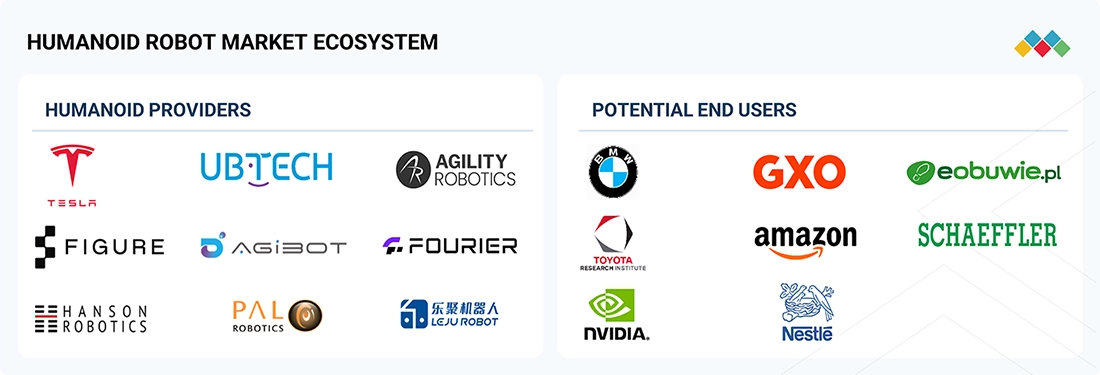
The humanoid robot market ecosystem is structured across humanoid providers and potential end users, collectively enabling the deployment of robots across industrial, logistics, service, research, and customer-facing environments. Humanoid providers develop biped, wheeled, and torso & stationary robots equipped with sensors, actuators, control systems, power systems, AI-enabled perception, mobility, and manipulation capabilities. End users across automotive, logistics, retail, food & beverage, electronics, manufacturing, and service industries are adopting humanoid robots to automate repetitive tasks, support material movement, improve inspection, enhance customer interaction, and reduce labor pressure. This ecosystem is supporting the transition of humanoid robots from prototype-stage development toward commercial deployment across next-generation automation environments The Humanoid Robotics Market is gaining momentum as commercially available humanoid robots move from research laboratories toward real-world applications in manufacturing, logistics, healthcare, retail, and service environments. Companies are developing humanoid robots with advanced vision systems, AI-powered perception, dexterous manipulation, and autonomous navigation to perform tasks alongside human workers. Increasing investments in generative AI, machine learning, sensors, and robotics are improving the capabilities of these systems and expanding potential use cases. As deployment moves beyond demonstrations toward pilot programs and commercial operations, the Humanoid Robotics Market size is expected to create new opportunities for automation, workforce assistance, and human-robot collaboration.
The Humanoid Robot Market Forecast indicates strong growth as advances in artificial intelligence, robotics, computer vision, sensors, actuators, and autonomous systems accelerate the development and adoption of humanoid robots. Increasing applications across manufacturing, logistics, healthcare, retail, and service industries are creating new opportunities for automation and human-robot collaboration. The Humanoid Robot Market Forecast is further supported by rising investments in physical AI, generative AI, intelligent automation, and next-generation robotic technologies, positioning humanoid robots as an important component of future automation ecosystems.
Logos and trademarks shown above are the property of their respective owners. Their use here is for informational and illustrative purposes only.
HUMANOID ROBOT MARKET SEGMENTS
Source: Secondary Research, Interviews with Experts, MarketsandMarkets Analysis
Humanoid Robot Market, By Type
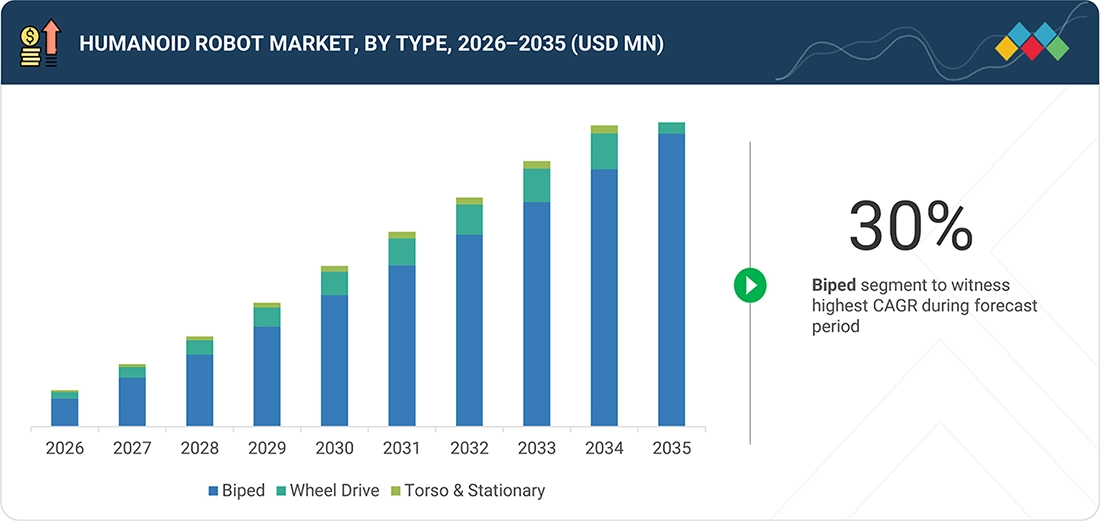
Biped humanoid robots are expected to account for the largest share and register the highest CAGR in the humanoid robot market during the forecast period. Demand is driven by their ability to operate in human-designed environments, perform complex mobility-based tasks, support manipulation activities, and serve industrial, logistics, healthcare, education, and service applications.
Humanoid Robot Market, By Offering
Hardware is expected to account for the largest share of the humanoid robot market due to the high value contribution of sensors, actuators, controllers, power systems, structural components, and mobility modules. Software is expected to register the highest CAGR during the forecast period, supported by advancements in perception, motion planning, manipulation, foundation models, simulation tools, fleet management, and robot intelligence platforms.
Humanoid Robot Market, By Application
Manufacturing is expected to register the highest CAGR in the humanoid robot market during the forecast period, driven by rising adoption for assembly support, inspection, material handling, machine tending, and repetitive production tasks. Warehousing & distribution centers are also expected to record impressive growth, supported by increasing deployment in logistics, e-commerce fulfillment, picking, sorting, and goods movement operations.
Humanoid Robot Market, By Region
Asia Pacific is expected to account for the largest share and register the highest CAGR in the humanoid robot market Analysis during the forecast period, supported by strong robotics manufacturing ecosystems, rising automation investments, and growing commercialization activities across China, Japan, and South Korea. North America is expected to register a significant CAGR, driven by AI innovation, industrial automation adoption, robotics startups, and increasing humanoid robot trials across manufacturing and logistics environments.
HUMANOID ROBOT MARKET BY REGION
Asia Pacific to be fastest-growing region in global humanoid robot market during forecast period
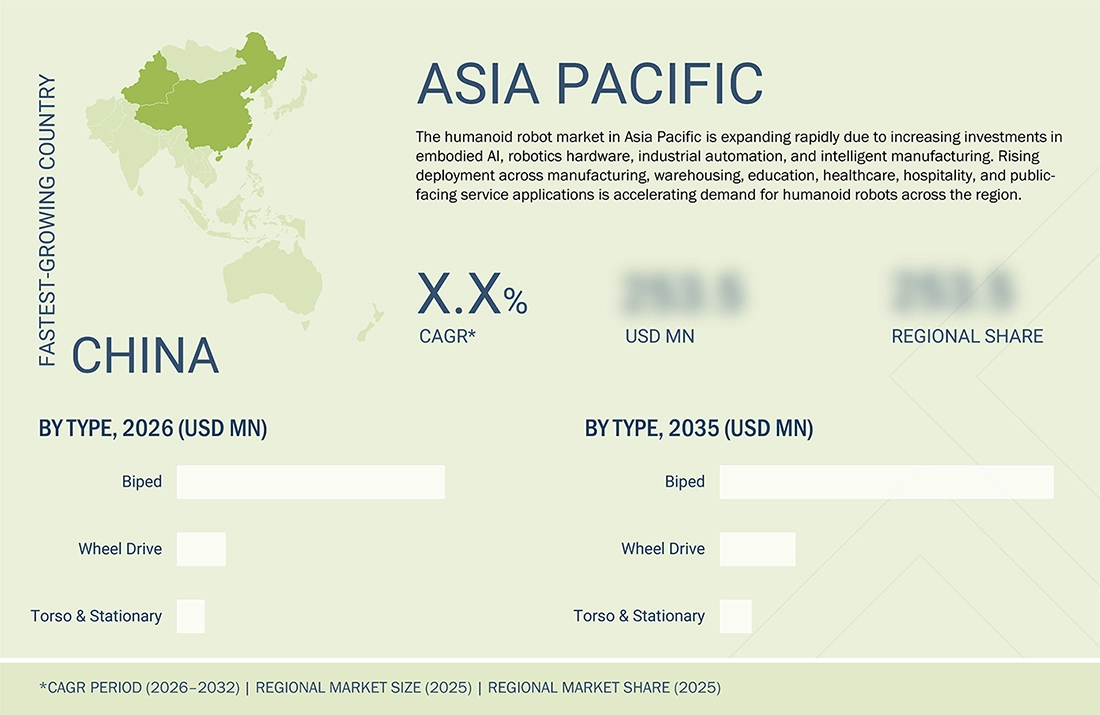
Asia Pacific is expected to be the fastest-growing regional market for humanoid robots, driven by strong robotics manufacturing ecosystems, rising automation investments, and rapid commercialization across China, Japan, South Korea, and Southeast Asia. Growth is supported by increasing adoption of humanoid robots across manufacturing, warehousing & distribution centers, healthcare, education, hospitality & entertainment, retail, and public-facing applications. The region is also benefiting from advancements in AI-enabled perception, motion planning, manipulation, sensors, actuators, and robot control platforms. China’s focus on humanoid robot standards and embodied intelligence, along with strong industrial robot adoption across Asia, is further supporting regional growth. Increasing investments by robot manufacturers, technology developers, and industrial end users are contributing to sustained expansion and wider deployment of biped, wheeled, and torso & stationary humanoid robots across Asia Pacific
The China humanoid robot market is projected to reach USD 2.80 billion by 2030 from USD 0.40 billion in 2025, at a CAGR of 47.6% from 2025 to 2030 . Humanoid robots are advanced robotic systems designed to replicate human form and behavior, integrating artificial intelligence and machine learning capabilities to interact with human environments
The South Korea humanoid robot market is projected to reach USD 583.5 million by 2030 from USD 112.6 million in 2025, at a CAGR of 39.0% from 2025 to 2030. Humanoid robots are advanced robotic systems designed to replicate human form and behavior, enabling them to interact naturally with human-centric environments
The Taiwan humanoid robot market is projected to reach USD 144.8 million by 2030 from USD 31.4 million in 2024, at a CAGR of 28.2% from 2025 to 2030. Humanoid robots are advanced robotic systems designed to replicate human form and behavior, integrating artificial intelligence and machine learning technologies to perform complex tasks .
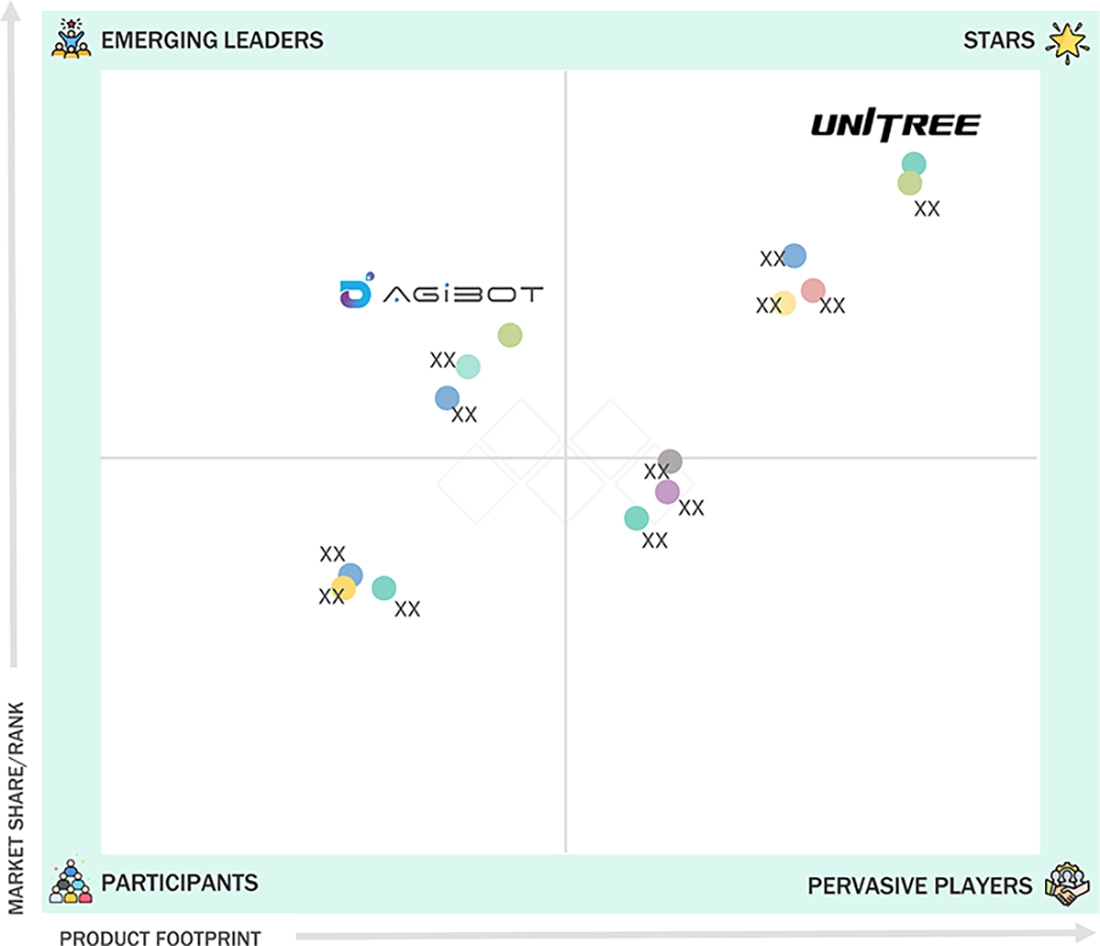
HUMANOID ROBOT MARKET SIZE, SHARE, AND TRENDS: COMPANY EVALUATION MATRIX
In the humanoid robot market growth matrix, Unitree Robotics is positioned as a Star player, supported by its strong humanoid robot portfolio, cost-competitive platforms, advanced mobility capabilities, and growing presence across research, education, entertainment, and early industrial applications. The company demonstrates strength in bipedal locomotion, motion control, robotics hardware, and developer-friendly humanoid platforms. AGIBOT has a broad embodied intelligence portfolio, full-size humanoid robots, industrial-grade platforms, and a focus on commercial service and manufacturing applications. Continued investments in embodied AI, robot learning, manipulation, and product expansion are strengthening the humanoid robot market presence of these humanoid robot companies and reinforcing their position within the evolving humanoid robot ecosystem.
Source: Secondary Research, Interviews with Experts, MarketsandMarkets Analysis
KEY MARKET PLAYERS
- Unitree Robotics (China)
- AGIBOT Innovation (Shanghai) Technology Co., Ltd. (China)
- UBTECH Robotics Corp Ltd (China)
- Leju (Shenzhen) Robotics Co., Ltd. (China)
- EngineAI (China)
- Fourier (China)
- Figure AI (US)
- Agility Robotics(US)
- Tesla (US)
- Boston Dynamics (US)
WHAT IS IN IT FOR YOU: HUMANOID ROBOT MARKET SIZE, SHARE, AND TRENDS REPORT CONTENT GUIDE
DELIVERED CUSTOMIZATIONS
We have successfully delivered the following deep-dive customizations:
| CLIENT REQUEST | CUSTOMIZATION DELIVERED | VALUE ADDS |
|---|---|---|
| Humanoid Robot Manufacturer/OEM | Mapping humanoid robot adoption across manufacturing, warehousing & distribution centers, healthcare, education, hospitality, retail, and public-facing service applications, with analysis by robot type, offering, application, and region | Benchmarking deployment readiness, product positioning, and commercialization opportunities across key end-use industries |
| Robotics Component/Technology Provider | Competitive benchmarking of humanoid robot technologies including actuators, sensors, controllers, power systems, AI perception, motion planning, manipulation software, and fleet management platforms across industrial and service applications | Technology benchmarking based on performance, safety, cost, scalability, integration complexity, and application fit |
RECENT DEVELOPMENTS
- August 2026 : Panda Express faced scrutiny after video footage from Milwaukee appeared to show a worker stepping around food while cleaning a frying station. The incident raised concerns about food-handling and sanitation practices during active meal preparation. The footage was reportedly captured by a customer and circulated online. The incident highlights the importance of strict hygiene protocols in restaurant operations. Panda Express has faced renewed attention over maintaining food-safety standards across its locations.
- August 2026 : XPENG raised over US$900 million for its robotics business at a post-money valuation exceeding US$6.3 billion, marking China’s largest single-round private funding in embodied AI. The funding will accelerate XPENG IRON humanoid robot development, Physical AI model training, and mass-production capabilities. XPENG IRON features 76 degrees of freedom, 21 degrees of freedom per hand, and three Turing AI chips delivering up to 2,250 TOPS. Mass production is expected by the end of 2026, with commercial deliveries in China and overseas markets planned for 2027. The investment strengthens XPENG’s position in Physical AI and supports the global commercialization of advanced humanoid robotics.
- August 2026 : Unitree Robotics, Xiaomi, JD.com, Tesla, and Galaxy Universal are advancing Physical AI and humanoid robotics from demonstrations toward real-world deployment. Xiaomi’s CyberOne improved its factory task success rate from 90% to 98% in four months, highlighting rapid learning in structured environments. JD.com plans to collect 10 million hours of high-quality scenario data over the next two years to improve robot generalization. Tesla is developing its next-generation AI5 chip with up to 2,500 TOPS of computing power for the next-generation Optimus robot brain. The industry is increasingly focused on data, world models, simulation, and real-world deployment as the critical building blocks for scalable Physical AI commercialization.
- August 2026 : China is strengthening its dominance in humanoid robotics, with the sector emerging as a major focus of international trade and technology competition. Chinese companies are rapidly advancing humanoid robot development, manufacturing capabilities, and commercialization. The country’s expanding robotics ecosystem is supported by strong domestic supply chains, government backing, and growing investment in Physical AI. This progress is increasing China’s influence over the global humanoid robotics supply chain and raising broader trade and competitive considerations. The development highlights humanoid robotics as an increasingly important strategic technology in global technology and trade relations.
- August 2026 : Georgia Southern University unveiled a state-of-the-art humanoid robot at its Allen E. Paulson College of Engineering and Computing. The platform will support hands-on research and education in human-robot interaction, machine learning, and autonomous navigation. Students across computer science, mechanical engineering, electrical engineering, and IT will program, maintain, and optimize the robot. The initiative will support undergraduate projects, graduate research, and faculty-led work in robotics and AI. The investment strengthens Georgia Southern University’s role in preparing talent for advanced manufacturing, logistics, and intelligent automation.
Table of Contents
 Exclusive indicates content/data unique to MarketsandMarkets and not available with any competitors.
Methodology
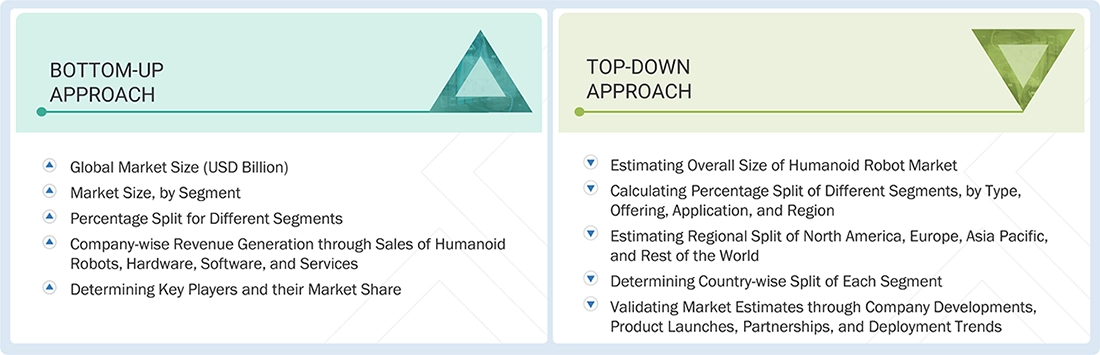
This study involved four major activities in estimating the current size of the humanoid robot market. Exhaustive secondary research was conducted to collect information on the market, peer market, and parent market. Validating these findings, assumptions, and sizing with industry experts across the value chain through primary research was the next step. Both top-down and bottom-up approaches were employed to estimate the complete market size. After that, market breakdown and data triangulation methods were used to estimate the market size of segments and subsegments. Two sources of information, secondary and primary, were used to identify and collect information for an extensive technical and commercial study of the humanoid robot market.
Secondary Research
Various secondary sources were referred to in the secondary research process to identify and collect information relevant to this study. The secondary sources included annual reports, press releases, investor presentations, company websites, product brochures, white papers, journals and other certified publications, articles by recognized authors, directories, and databases. Secondary research was conducted to obtain key information on the industry’s supply chain, the market’s value chain, the total pool of key players, market segmentation by type, offering, application, and region, regional markets, and key developments from market- and technology-oriented perspectives. The secondary data was collected and analyzed to determine the overall size of the humanoid robot market, and the results were further validated through primary research.
Primary Research
Extensive primary research was conducted after gaining an understanding of the current state of the humanoid robot market through secondary research. Several primary interviews were conducted with experts from the demand and supply sides across four major regions: North America, Europe, Asia Pacific, and the Rest of the World. This primary data was collected through questionnaires, emails, and telephonic interviews.
Breakdown of Primary Interviews
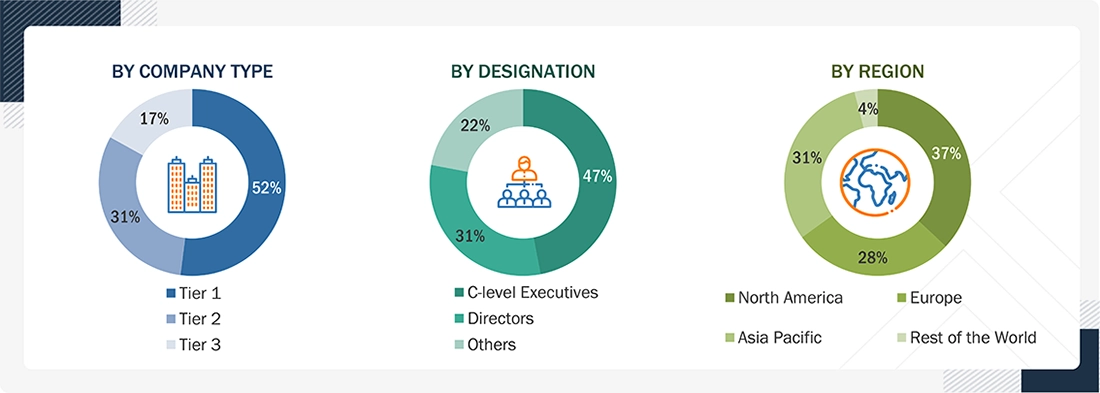
Note: Three tiers of companies were defined based on their total revenue as of 2025: tier 3: revenue less than USD 500 million; tier 2: revenue between USD 500 million and USD 5 billion; and tier 1: revenue more than USD 5 billion. Other designations include product, sales, and marketing managers. Rest of the World mainly includes South America, Africa, and the Middle East.
To know about the assumptions considered for the study, download the pdf brochure
Market Size Estimation
Both top-down and bottom-up approaches were used to estimate and validate the total size of the humanoid robot market. These methods were also used extensively to estimate the size of various market subsegments. The following research methodology was used to estimate the market size:
- Major players in the industry and markets were identified through extensive secondary research.
- The industry’s value chain and market size (in terms of value) were determined through primary and secondary research processes.
- All percentage shares, splits, and breakdowns were determined using secondary sources and verified through primary sources
Humanoid Robot Market: Top-Down and Bottom-Up Approach
Data Triangulation
After arriving at the overall size of the humanoid robot market from the market size estimation process explained above, the total market was split into several segments and subsegments. Data triangulation and market breakdown procedures were employed, where applicable, to complete the overall market engineering process and derive the exact statistics for all market segments and subsegments. The data was triangulated by studying various factors and trends from both the demand and supply sides. Additionally, the market size was validated using both top-down and bottom-up approaches.
Market Definition
The humanoid robot market comprises robots designed with human-like physical structures, mobility systems, sensing capabilities, control systems, and AI-enabled software to perform tasks in human-designed environments. It has a torso, a head, two arms, and two legs; however, some humanoid robots may replicate specific parts of the human body. It is a complex machine equipped with hardware, software, and cutting-edge technologies to perform various tasks in different industries. These robots are used to support automation, interaction, assistance, mobility, manipulation, and operational tasks across industrial, commercial, healthcare, education, hospitality, retail, and personal assistance environments. Humanoid robots play a vital role in improving productivity, supporting labor-intensive operations, enabling safer task execution, enhancing human–robot interaction, and expanding automation into environments where traditional robots may require major infrastructure changes. As physical AI, robot foundation models, sensors, actuators, control systems, and fleet-management platforms continue to advance, humanoid robots are becoming essential components of next-generation automation ecosystems.
Key Stakeholders
- Government bodies and policymakers
- Industry organizations, forums, alliances, and associations
- Market research and consulting firms
- Raw material suppliers and distributors
- Research institutes and organizations
- Traders and suppliers
- Raw material suppliers
- Original equipment manufacturers (OEMs)
- OEM technology solution providers
- Technology, service, and solution providers
- Intellectual property (IP) core and licensing providers
- Suppliers and distributors
- Forums, alliances, and associations
- Technology investors
- Research institutes and organizations
- Analysts and strategic business planners
- Market research and consulting firms
Report Objectives
- To define, describe, and forecast the humanoid robot market based on type, offering, and application, in terms of value
- To describe and forecast the size of the market in four regions: North America, Europe, Asia Pacific, and the Rest of the World (RoW), along with their respective countries, in terms of value
- To provide detailed information regarding drivers, restraints, opportunities, and challenges influencing market growth
- To strategically analyze micromarkets with respect to individual growth trends, prospects, and contributions to the overall market size
- To study the complete value chain of the market
- To analyze opportunities for stakeholders by identifying high-growth segments of the market
- To strategically profile the key players and comprehensively analyze their market positions in terms of their ranking and core competencies
- To analyze competitive developments, such as product launches, acquisitions, collaborations, and partnerships, in the market
- To provide ecosystem analysis, case study analysis, patent analysis, technology analysis, impact of AI/Gen AI, impact of 2025 US tariffs, key conferences and events, Porter’s five forces analysis, and regulations pertaining to the market under study
- To provide a macroeconomic outlook for all the regions
Available customizations:
With the market data given, MarketsandMarkets offers customizations according to the company’s specific needs. The following customization options are available for the report:
Company Information
-
Detailed analysis and profiling of additional market players (up to 5)
Key Questions Addressed by the Report
What is the current size of the Humanoid Robot Market?
The humanoid robot market size is estimated to be USD 5.41 billion in 2026 and is projected to reach USD 50.27 billion by 2035.
What is the expected growth rate of the Humanoid Robot Market?
The market is expected to grow at a CAGR of around 28.1 % during 2026–2030, driven by AI advancements and automation demand.
What are the major growth drivers of the Humanoid Robot Market?
Key drivers include advancements in AI and machine learning, increasing automation, labor shortages, human–robot collaboration, and growing demand for intelligent service robots.
What are the key trends shaping the Humanoid Robot Market?
Major trends include AI-powered humanoid robots, autonomous navigation, natural language interaction, improved sensors, and integration into industrial and service environments.
Which industries are adopting humanoid robots?
Major industries include healthcare, manufacturing, logistics, retail, education, hospitality, and personal assistance applications.
Which region dominates the Humanoid Robot Market?
Asia Pacific is a leading region due to strong robotics development, manufacturing capabilities, and adoption of automation technologies.
What are the main applications of humanoid robots?
Humanoid robots are used for industrial automation, customer service, healthcare assistance, education, research, and household support.
Who are the major companies in the Humanoid Robot Market?
Key companies include Tesla, Inc., UBTECH Robotics Corp Ltd., SoftBank Group Corp., Agility Robotics, and Boston Dynamics.
How is AI impacting humanoid robots?
AI and ML are improving robot perception, decision-making, speech interaction, and autonomous task execution, enabling advanced human–robot collaboration.
What does the Humanoid Robot Market report analyze?
The report covers market size, forecasts, technology trends, components, applications, industries, regional analysis, competitive landscape, and growth opportunities through the forecast period.


Personalize This Research
- Triangulate with your Own Data
- Get Data as per your Format and Definition
- Gain a Deeper Dive on a Specific Application, Geography, Customer or Competitor
- Any level of Personalization
Let Us Help You
- What are the Known and Unknown Adjacencies Impacting the Humanoid Robot Market
- What will your New Revenue Sources be?
- Who will be your Top Customer; what will make them switch?
- Defend your Market Share or Win Competitors
- Get a Scorecard for Target Partners

Custom Market Research Services
We Will Customise The Research For You, In Case The Report Listed Above Does Not Meet With Your Requirements
Get 10% Free CustomisationTESTIMONIALS

Tetsuya Ohhira
Business Development Manager-Technology Business
Nikon Corporation,
Leading Japanese MNC specializing in optics and imaging productswww.nikon.com
MarketsandMarkets™ response
is quick. Their attitude is flexible and positive. Analyst Insights are globally considered and
significant. Client Services quickly respond to our inquiry and demand. Their wide range of global
surveys help us make our strategic plan.
We hope Knowledge Store will be easier to search
for a report.
VP - Marketing & Business Development
Leading Provider of Process Control Solutions
We engaged with MarketsandMarkets on a study to perform an analysis and recommend a Go-To-Market strategy for metrology and process control in the semiconductor market. The study was tailored to our targets and needs with well-defined milestones. Our overall experience with the MarketsandMarkets team was very good throughout the project in all aspects including the analysis methodologies used, the quality and depth of primary and secondary data sets, the professionalism and flexibility of the team and the ability to meet the target schedule and milestones. We want to thank MarketsandMarkets team for a job well done.
- Rest Of Europe Humanoid Robot Market
- Rest Of Asia Pacific Humanoid Robot Market
- GCC Countries Humanoid Robot Market
- Rest Of Middle East Humanoid Robot Market
- US Humanoid Robot Market
- Canada Humanoid Robot Market
- Mexico Humanoid Robot Market
- UK Humanoid Robot Market
- Germany Humanoid Robot Market
- France Humanoid Robot Market
- Italy Humanoid Robot Market
- Spain Humanoid Robot Market
- China Humanoid Robot Market
- Japan Humanoid Robot Market
- India Humanoid Robot Market
- South Korea Humanoid Robot Market
- Australia Humanoid Robot Market
- Singapore Humanoid Robot Market
Growth opportunities and latent adjacency in Humanoid Robot Market




Hector
Apr, 2026
Will this report help assess the feasibility and ROI of deploying humanoid robots in logistics operations, including material handling and last-mile support?.
Ivan
Apr, 2026
Can this report help benchmark pricing trends, feature evolution, and competitive positioning of humanoid robots across regions and use cases?.
Stein
Sep, 2018
We are interested in researching more capable social or service robots. Could you tell us your coverage for the humanoid robot market? .
Daniela
Nov, 2019
In the context of a growing market and a very strong competitive environment, we are always looking for solutions and services to make a difference for our clients and potential clients. Humanoid Robot is a very interesting subject that we are willing to discover in order to find areas where we can develop and implement. .