



Parking Management Market Size, Share, Growth, Latest Trends
Report Code
TC 3072
Published in
Aug, 2025, By MarketsandMarkets™
Parking Management Market by Solutions (Parking Reservation Management, Parking Access & Revenue Control), Parking Site (Off-street, On-street), and End Use (Commercial, Government, Transport & Transit, Industrial, Residential) - Global Forecast to 2030

USD 12.41 BN
MARKET SIZE, 2030

CAGR 11.4%
(2025-2030)

330
REPORT PAGES

460
MARKET TABLES
OVERVIEW
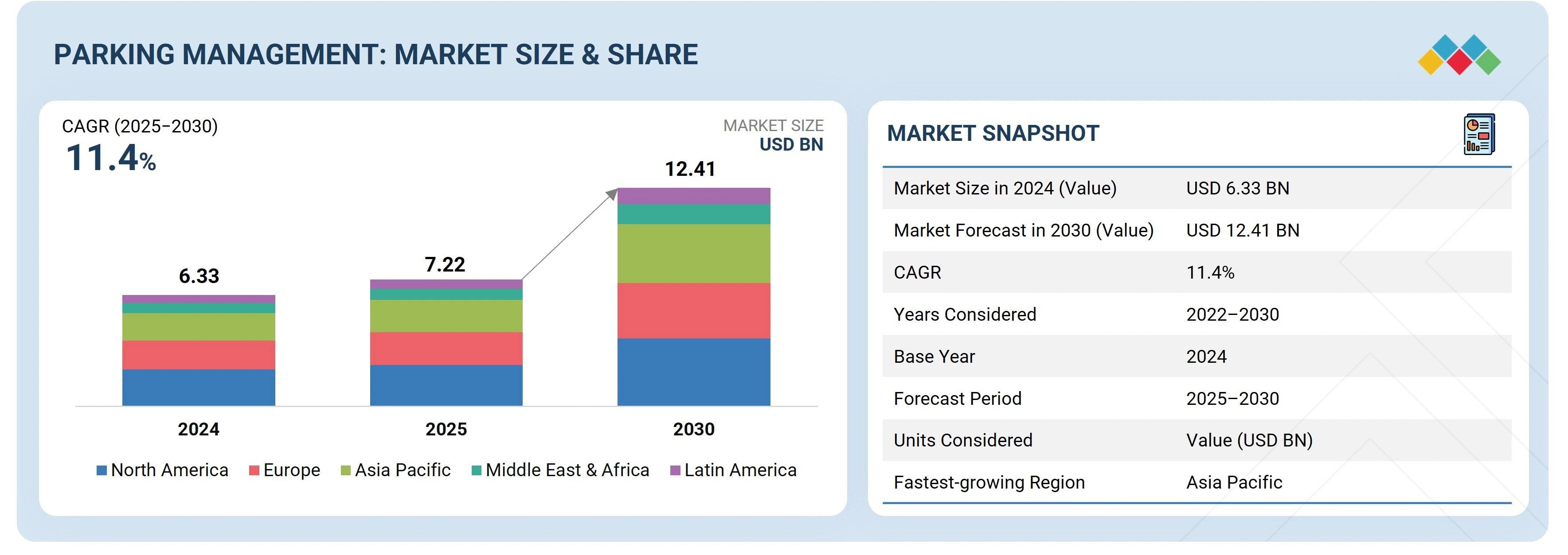
Source: Secondary Research, Interviews with Experts, MarketsandMarkets Analysis
The parking management market is projected to reach USD 12.41 billion by 2030 from USD 7.22 billion in 2025, at a CAGR of 11.4% from 2025 to 2030. Parking management offers a comprehensive suite of solutions, including parking guidance, reservation systems, permit management, enforcement, access control with integrated revenue collection, security surveillance, and data analytics. By integrating these solutions, the parking management market cultivates a more efficient, user-friendly, and secure parking ecosystem. This data-driven approach optimizes traffic flow, maximizes operator revenue, and enhances the overall parking experience. Parking management helps increase efficiency in parking operations, reduce congestion in the lot, and increase revenues for parking lot owners. It also enables a good customer experience by reducing the time spent looking for a parking spot and simplifying the payment process.
Market Size and Forecast:
- Market Size in 2024: USD 6.33 Billion
- 2025 Market Size: USD 7.22 Billion
- 2030 Forecasted Market Size: USD 12.41 Billion
- Growth Rate (2025-2030): CAGR of 11.4%
- Forecast period: 2025–2030
- The services segment is expected to register the highest CAGR of 12.6%.
Key Market Trends and Insights
- Future Outlook: Smart city initiatives and AI, IoT, and cloud-enabled solutions drive parking market expansion.
-
Growth Factors: Rising urbanization, vehicle ownership, and congestion drive the need to optimize limited parking space.
- Key Trends: License plate recognition, real-time tracking, and mobile payments dominate intelligent parking systems.
- Growth Opportunities: Smart cities, EV-ready parking infrastructure, and digital operations expand market growth.
KEY TAKEAWAYS
- The Asia Pacific Parking Management Market is expected to grow fastest, with a CAGR of 12.8% during the forecast.
- By Component, the services segment is expected to register the highest CAGR of 12.6%.
- By Parking Site, Off-Street parking accounted for a 64.0% revenue share in 2030.
- AMANO, SKIDATA, GROUP Indigo are players in the parking management market, as they have focused on innovation and have broad industry coverage and offer integrated hardware-software systems, strong global footprints, and advanced access-control, payment, and automation solutions that enable efficient, scalable, and secure parking operations for diverse commercial and urban environments.
- Spothero, TCS International, and Urbiotica have distinguished themselves among startups and SMEs by using digital reservations and platform integrations, deploying advanced parking-guidance systems and consulting, and delivering IoT sensor-based smart-parking analytics for operators and cities.
TRENDS & DISRUPTIONS IMPACTING CUSTOMERS' CUSTOMERS
The parking management market is undergoing a significant transformation, driven by emerging trends and disruptions that directly influence the business outcomes of customers’ customers. Key trends include the adoption of integrated mobility-as-a-service (MaaS) platforms, which combine parking services with public transit, ride-hailing, and EV charging, enabling seamless travel and enhancing passenger experience. Dynamic pricing and demand-based revenue management allow operators to optimize occupancy and revenue through real-time data analytics, while data monetization and targeted advertising open new revenue streams by leveraging user behavior and digital signage. Additionally, the shift toward subscription-based access and Parking-as-a-Service (PaaS) models facilitates recurring revenue while offering convenience and efficiency for end users. These technological and business-model innovations drive distinct imperatives across sectors. Commercial property owners focus on revenue optimization and enhanced customer experience. Municipal authorities prioritize traffic decongestion, revenue transparency, and sustainability compliance, while residential complexes emphasize resident satisfaction, security, and efficient space utilization. Transportation hubs benefit from operational efficiency, scalability, and integrated mobility, whereas hospitality and entertainment venues enhance guest experience, brand differentiation, and crowd management. Collectively, these trends enable faster, safer, and more convenient parking experiences, driving measurable value across all client segments.
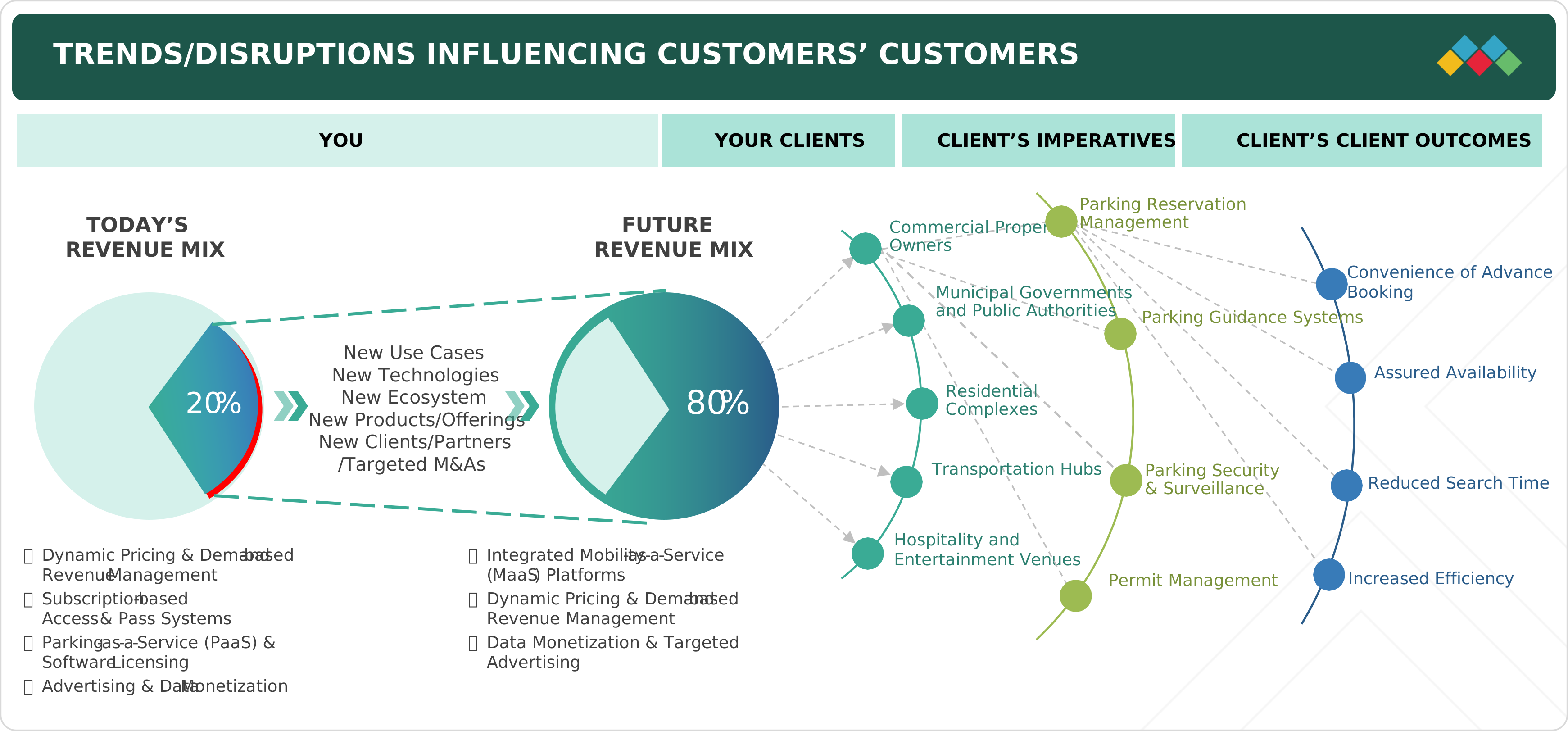
Source: Secondary Research, Interviews with Experts, MarketsandMarkets Analysis
MARKET DYNAMICS

Drivers
Impact
Level
Level
-
Rising urbanization and increasing global population density

-
Growing demand for seamless traffic flow and reduction in fuel consumption


RESTRAINTS
Impact
Level
Level
-
Shared mobility adoption limiting demand for conventional parking infrastructure

-
Infrastructure limitations hinder scalability of advanced parking solutions


OPPORTUNITIES
Impact
Level
Level
-
Rising smart city initiatives globally

-
Demand for innovative parking management solutions


CHALLENGES
Impact
Level
Level
-
Revenue management and dynamic pricing complexity

-
Scalability limitations and growth management

Source: Secondary Research, Interviews with Experts, MarketsandMarkets Analysis
Driver: Growing demand for seamless traffic flow and reduction in fuel consumption
Urban congestion continues to rise as vehicle density increases, leading to longer travel times and higher fuel consumption. A major contributor to wasted fuel is the time drivers spend searching for available parking, which studies estimate accounts for up to 30% of inner-city traffic. Parking management systems powered by IoT and AI help address this challenge by optimizing parking space utilization and guiding drivers directly to available spots. Real-time data collection, sensors, and cameras integrated with mobile applications or digital signage ensure that drivers are notified about vacant spaces, minimizing unnecessary circulation around parking zones. For instance, Barcelona’s smart parking initiative has reduced vehicle idle time and fuel usage by enabling dynamic guidance to open spaces. Similarly, San Francisco’s SFpark program reported a measurable reduction in vehicle miles traveled during parking searches, which directly lowered fuel consumption and greenhouse gas emissions. By reducing search-related traffic, these solutions improve urban traffic flow and support more eco-friendly, energy-efficient transportation systems.
Restraint: Shared mobility adoption limits demand for conventional parking infrastructure
The growing adoption of alternative mobility options, such as ride-hailing, car-sharing, bike-sharing, and micro-mobility services (e-scooters, e-bikes), is reducing the dependence on private vehicle ownership, thereby lowering demand for traditional parking spaces. According to the International Transport Forum, shared mobility could reduce the number of cars in cities by up to 90% if widely adopted, drastically transforming the urban parking landscape. For instance, New York, Paris, and Singapore are witnessing rising investments in shared mobility infrastructure, pushing commuters away from private vehicle use. As a result, parking operators face declining utilization rates, making it harder to justify large investments in smart parking systems. While these services improve urban sustainability, they create a significant restraint for the parking management market by shifting demand away from conventional parking solutions, challenging operators to adapt to new mobility dynamics.
Opportunity: Rising smart city initiative globally
The rising adoption of Smart City programs globally presents a major opportunity for the parking management Market. As urban areas increasingly incorporate IoT sensors, AI-driven analytics, and data platforms into their infrastructure, parking management systems can seamlessly integrate into these ecosystems to deliver real-time visibility of parking space availability. This not only helps reduce traffic congestion but also contributes to lower fuel consumption and emissions, aligning with sustainability goals. For example, cities such as Barcelona and Amsterdam have successfully embedded smart parking solutions within their broader smart city frameworks, enabling dynamic pricing, mobile-enabled payments, and digital enforcement. Such systems generate valuable datasets that support urban planning and optimize transport networks, while also enhancing revenue streams for municipalities. Moreover, collaboration between governments, technology providers, and private operators fosters innovation and expands the scope of applications, making smart parking a key enabler of sustainable, efficient, and future-ready cities.
Challenge: Inefficient Utilization of Urban Parking Spaces
A major challenge for the parking management market stems from the inefficient utilization of existing urban parking spaces. Despite the growing number of vehicles in cities, many parking areas remain underused due to poor layout, lack of real-time information, or fragmented management. This underutilization leads to increased traffic congestion, longer search times for drivers, and lost revenue for operators, highlighting the need for more intelligent parking systems. For parking management solution providers, this represents a significant operational challenge: deploying technology that not only increases occupancy rates but also seamlessly integrates with urban infrastructure, mobile applications, and payment systems. Cities require platforms capable of providing real-time guidance, dynamic pricing, and predictive analytics to optimize space usage. Without such solutions, the potential of digital and automated parking systems remains underexploited, slowing market adoption and limiting the effectiveness of investments in smart parking infrastructure. Addressing this challenge is critical for unlocking the full growth potential of the parking management market.
Parking Management Market: COMMERCIAL USE CASES ACROSS INDUSTRIES
| COMPANY | USE CASE DESCRIPTION | BENEFITS |
|---|---|---|
 |
Implemented comprehensive access control and parking management system at Perini Business Park in Brazil, managing 10,000+ daily visitors and 4,500+ vehicles with touchless entry and automated processing capabilities | Reduced entry processing time from 90 seconds to touchless operation, improved security with real-time monitoring, enhanced visitor experience, and provided scalable solution for large-scale operations across multiple segments |
 |
Automated parking expense management for pharmaceutical company with 500+ car-using staff, integrating with ERP cloud solution for seamless invoice processing and cost center identification with real-time expense tracking | Achieved 22% budget savings by eliminating 1200+ manual processing hours annually, reduced administrative burden by 48 days, improved staff morale, and enhanced procurement efficiency through streamlined operations |
 |
Deployed X60 ticketless solution with license plate recognition, integrated security cameras, and SPARK cloud platform and provided customizable configurations supporting diverse garage operations and various industry verticals globally | Eliminated paper ticket costs and administrative burden, enhanced security through integrated monitoring, improved user experience with scan-to-pay options, and supported eco-friendly operations by reducing paper waste significantly |
 |
Implemented comprehensive parking solution at Teesside Park retail space with dynamic parking guidance systems, RGB traffic information signs, and real-time occupancy monitoring for 12+ million annual visitors management | Reduced traffic congestion during peak times, improved driver experience through clear signposting to available spaces, maximized parking space utilization, and enhanced overall retail park operational efficiency |
 |
Implemented fully integrated smart parking ecosystem including single-space meters, multi-space pay stations, vehicle detection sensors, and centralized data management with real-time analytics for various municipal operations | Enhanced enforcement efficiency through real-time technology, improved customer convenience with mobile payment options, optimized resource allocation with data analytics, and streamlined parking operations management capabilities |
Logos and trademarks shown above are the property of their respective owners. Their use here is for informational and illustrative purposes only.
MARKET ECOSYSTEM
The current parking management ecosystem is a multi-layered network where diverse stakeholders collaborate to deliver end-to-end solutions. Cloud service providers, such as AWS and Azure, host scalable platforms, while connectivity providers like Huawei, Cisco, and Sigfox ensure reliable data transmission from IoT sensors. IoT application vendors, including Chetu, TIBA, and Propark Mobility, develop analytics and control software, and system integrators such as Siemens, SKIDATA, and Indigo Group customize and deploy these solutions on-site. Independent software providers, such as Park Assist and Get My Parking, offer niche modules for reservation, enforcement, or payment, while network operators such as AT&T and Verizon maintain seamless connectivity. Service providers and government bodies collaborate on standards, funding, and regulatory frameworks, and research institutions and startups drive innovation in AI-driven guidance and EV integration.
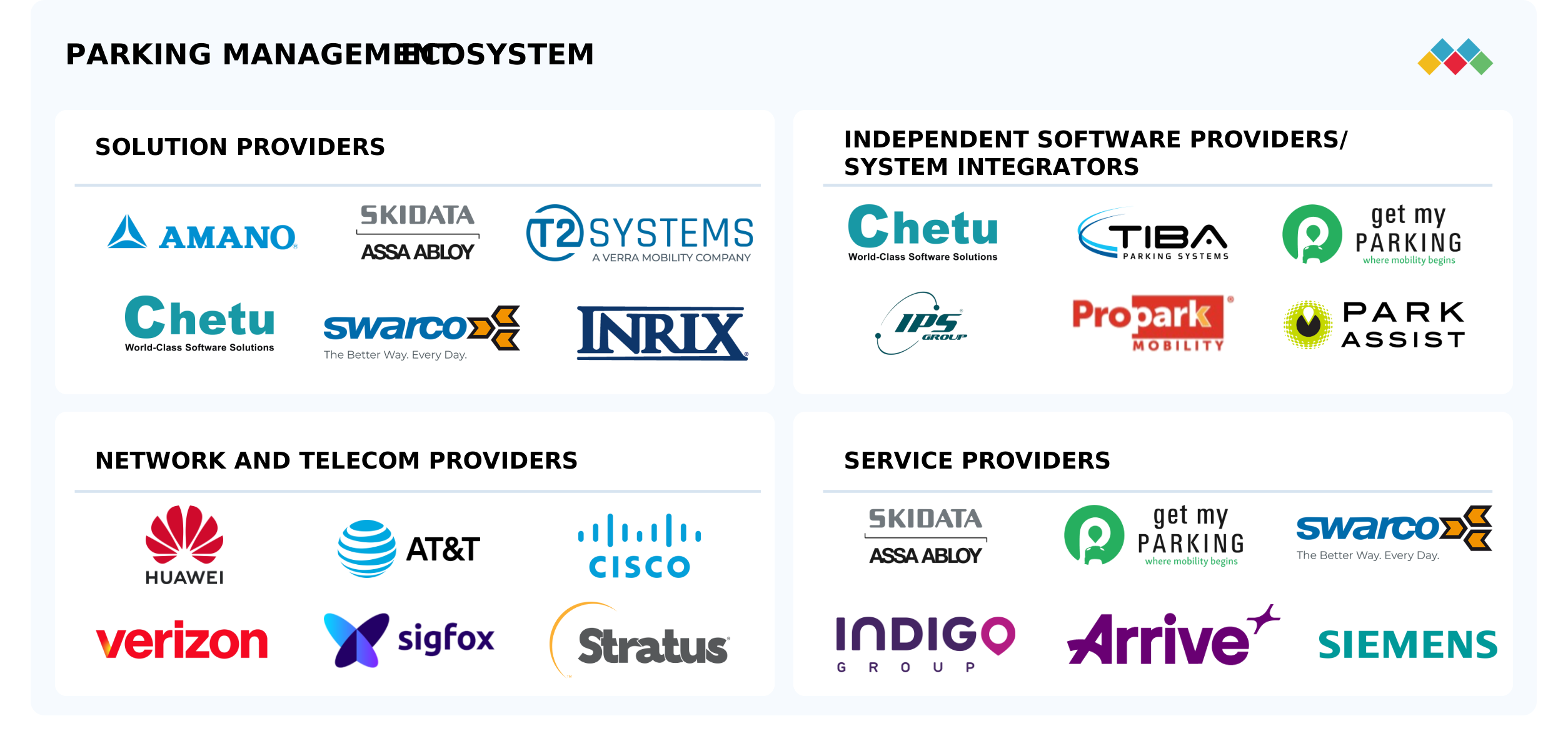
Logos and trademarks shown above are the property of their respective owners. Their use here is for informational and illustrative purposes only.
MARKET SEGMENTS
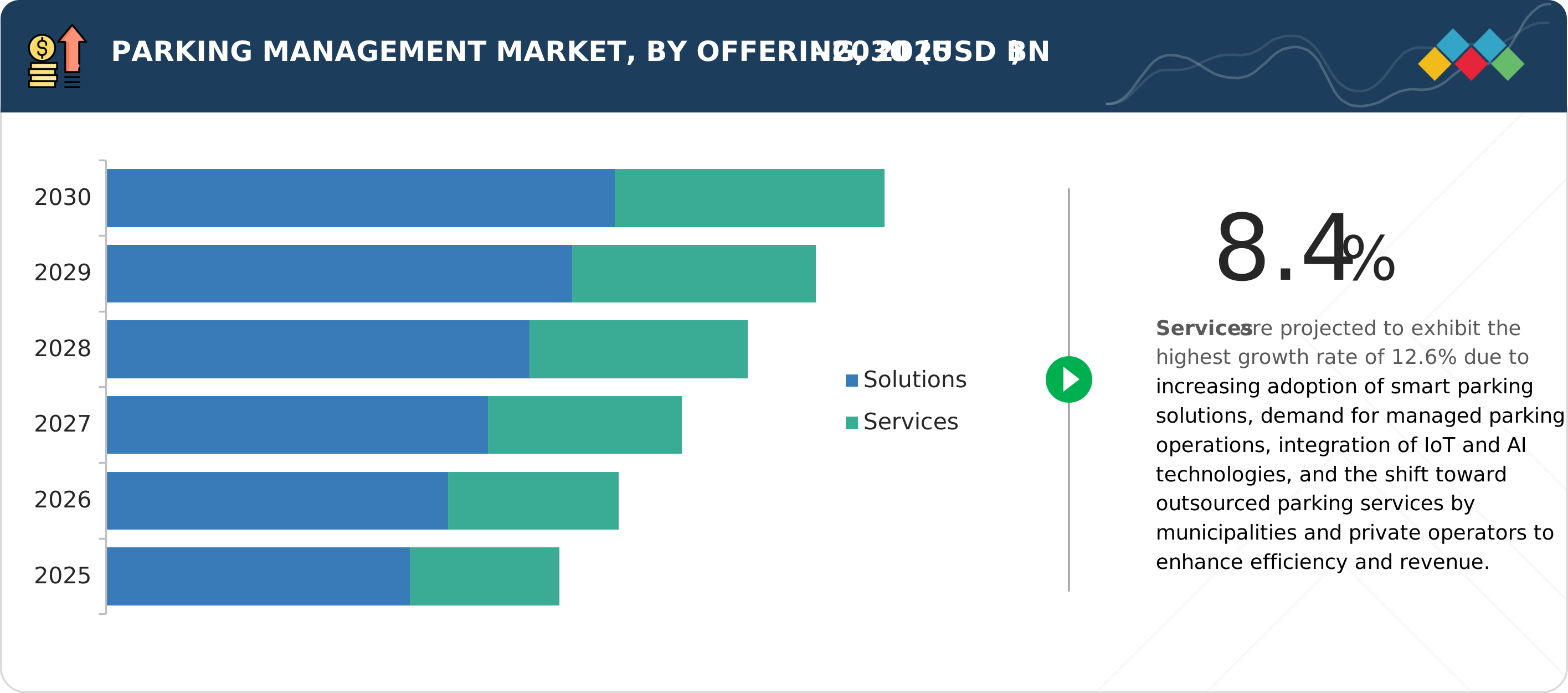
Source: Secondary Research, Interviews with Experts, MarketsandMarkets Analysis
Parking Management Market, By Offering
Solutions are expected to hold the largest market share in the offerings segment of the parking management market as they form the backbone of modern parking operations, enabling automation, efficiency, and scalability. With rapid urbanization and limited parking spaces, cities and private operators are increasingly investing in integrated parking management platforms, access control systems, license plate recognition, and smart payment solutions. These technologies streamline operations, reduce manual intervention, enhance security, and improve the overall customer experience. Additionally, the growing adoption of cloud-based platforms and IoT-enabled systems supports real-time monitoring, data-driven decision-making, and predictive analytics for demand management. As governments and municipalities prioritize smart city initiatives, the demand for robust, end-to-end parking management solutions continues to rise. Their ability to optimize space utilization, increase compliance, and generate higher revenues makes solutions the dominant segment in the market.
Parking Management Market, By Parking Site
On-street parking is expected to record the highest CAGR in the parking site segment of the parking management market due to increasing urbanization, rising vehicle ownership, and growing demand for efficient curbside management in congested city centers. Municipalities are actively deploying smart meters, mobile payment systems, and sensor-based occupancy detection to optimize space utilization and reduce traffic congestion caused by vehicles searching for parking. Digital enforcement tools, such as license plate recognition and integrated payment platforms, are further streamlining operations and improving compliance. Additionally, governments are leveraging dynamic pricing models to maximize revenue while encouraging efficient use of limited curbside space. The integration of on-street parking within broader smart city and Mobility-as-a-Service (MaaS) frameworks is also creating new value streams, enhancing user convenience, and driving adoption. These factors collectively position on-street parking as the fastest-growing segment in the market.
Parking Management Market, By End Use
The commercial end-use segment is expected to achieve the largest market share in the parking management market, as retail complexes, office buildings, and mixed-use developments increasingly adopt smart solutions to improve customer convenience and optimize operations. In Dubai, The Dubai Mall has deployed an advanced parking guidance system with real-time availability displays and mobile app integration, helping manage thousands of vehicles daily and significantly reducing congestion during peak shopping hours. In the United States, several commercial real estate operators, such as Brookfield Properties, are implementing ticketless, app-based parking across office towers, enabling employees and visitors to access seamless digital payments and reservations. Similarly, in Europe, Westfield London has embraced a fully automated system using license plate recognition, providing frictionless entry and exit for shoppers while improving turnover rates for retailers. These deployments show how commercial operators view smart parking as a value-added service that enhances customer experience, maximizes space utilization, and supports revenue growth. With rising competition in retail and commercial real estate, parking management solutions are evolving from operational necessities into strategic differentiators, driving robust adoption in this segment.
REGION
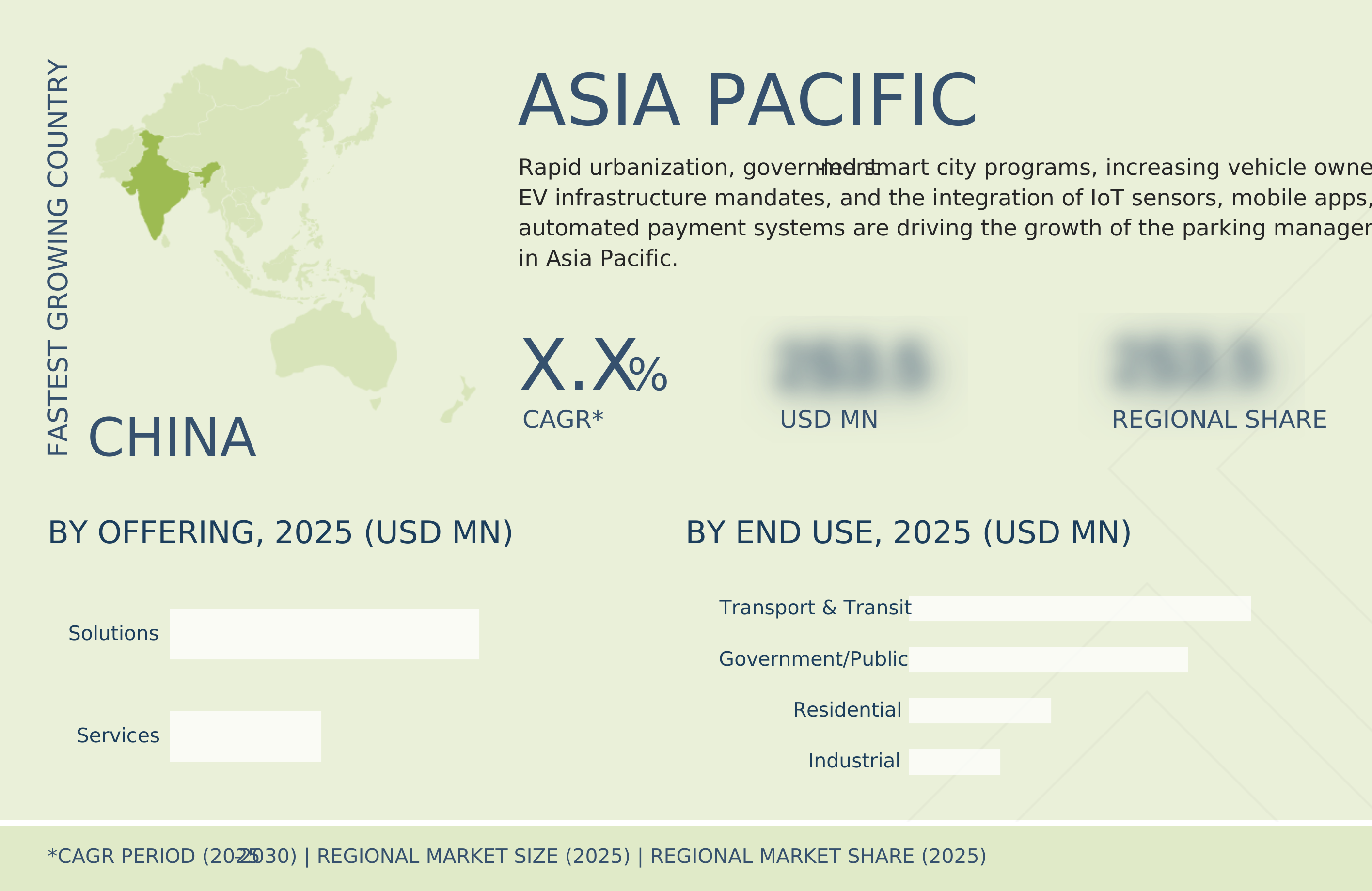
Asia Pacific to be fastest-growing region in global parking management market during forecast period
Asia Pacific is projected to achieve the highest CAGR in the parking management market, driven by significant government initiatives and regulatory support for the digital transformation of urban mobility. In Singapore, the Land Transport Authority replaced paper coupons with the nationwide Parking.sg system, enabling app-based payments and remote extensions across all public on-street spaces, setting a benchmark for digital enforcement and analytics. Hong Kong has deployed over 11,000 smart meters with occupancy sensors and the HKeMeter app, providing real-time data for improved curbside management and dynamic pricing. In Australia, the New South Wales government’s Park’nPay program is expanding across councils, including the City of Ryde, offering live availability, ticketless payments, and accessibility-focused features, reflecting a commitment to standardized parking solutions. Seoul is scaling IoT-enabled shared parking integrated within its smart mobility framework, supported by open APIs and real-time information platforms. These initiatives underscore a strong governmental push to modernize parking infrastructure, enhance operational efficiency, and improve user convenience, positioning Asia Pacific as the fastest-growing region for parking management solutions.
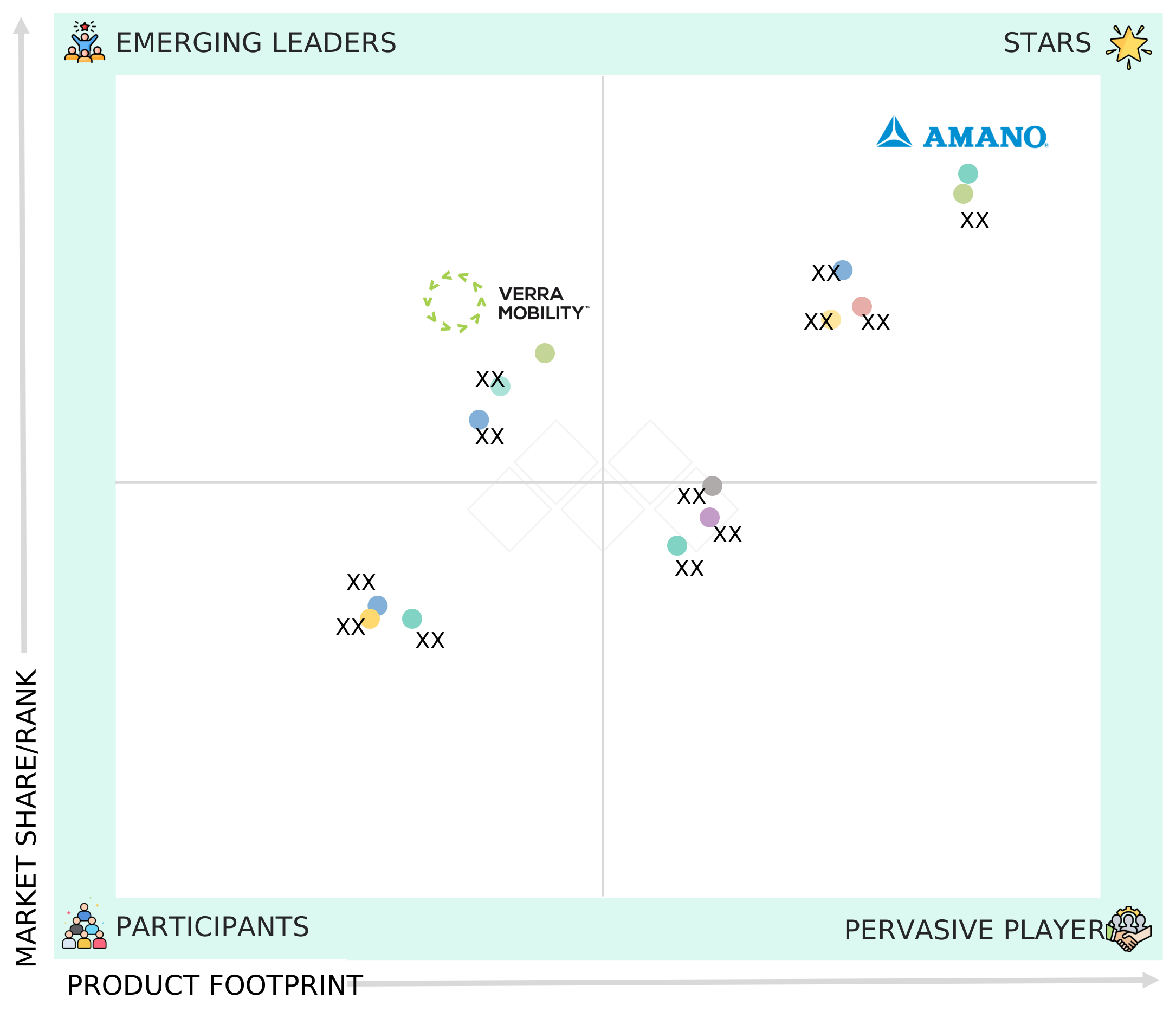
Parking Management Market: COMPANY EVALUATION MATRIX
In the parking management market matrix, AMANO (Star) leads with a strong market presence and wide product portfolio, offering solutions and services across residential, commercial, and industrial end uses. Verra Mobility (Emerging Leader) is gaining traction in the parking management market through strategic acquisitions and technological advancements. The company acquired T2 Systems, a leading provider of parking management solutions, enhancing its capabilities in smart parking technologies.
Source: Secondary Research, Interviews with Experts, MarketsandMarkets Analysis
KEY MARKET PLAYERS
MARKET SCOPE
| REPORT METRIC | DETAILS |
|---|---|
| Market Size in 2024 (Value) | USD 6.33 Billion |
| Market Forecast in 2030 (value) | USD 12.41 Billion |
| Growth Rate | CAGR of 11.4% from 2025–2030 |
| Years Considered | 2022–2030 |
| Base Year | 2024 |
| Forecast Period | 2025–2030 |
| Units Considered | Value (USD) Million/Billion |
| Report Coverage | Revenue forecast, company ranking, competitive landscape, growth factors, and trends |
| Segments Covered |
|
| Regions Covered | North America, Asia Pacific, Europe, South America, Middle East & Africa, and Latin America |
WHAT IS IN IT FOR YOU: Parking Management Market REPORT CONTENT GUIDE
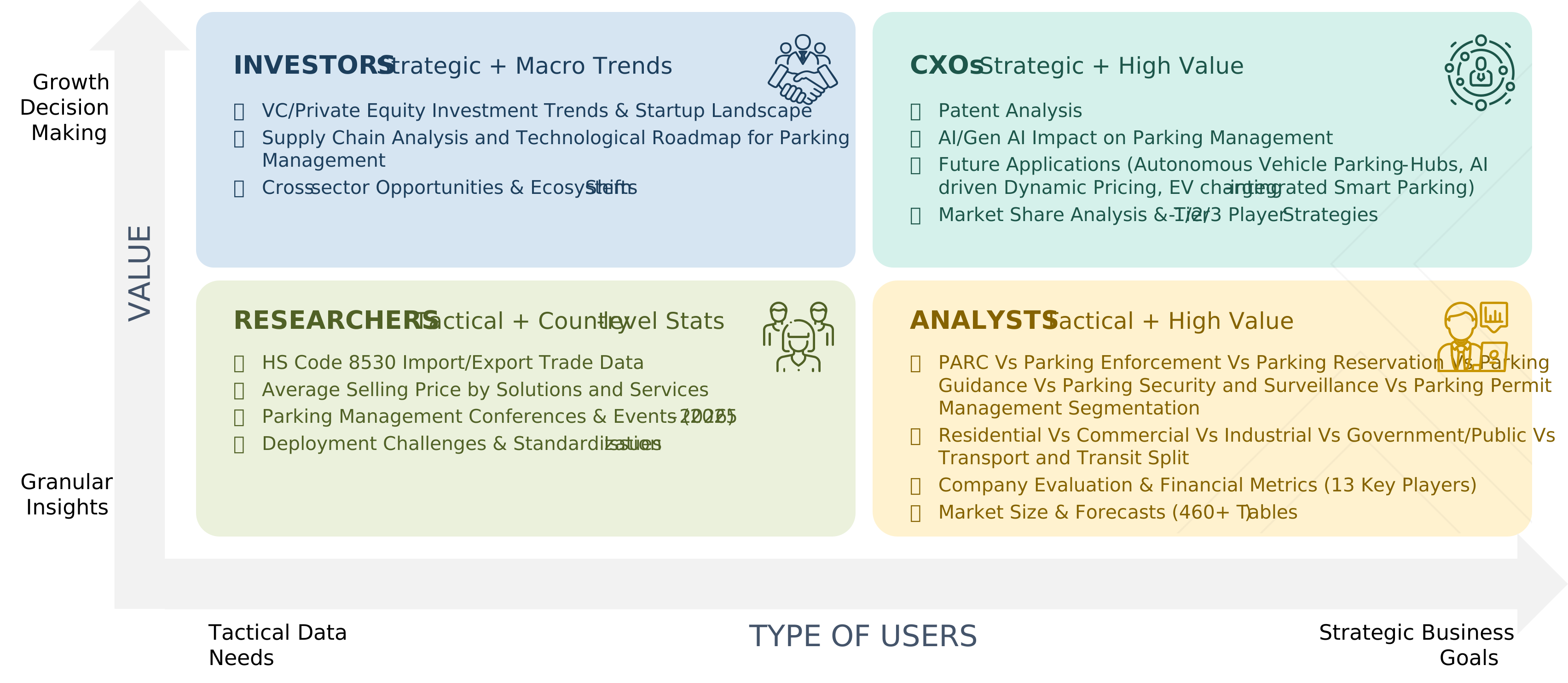
DELIVERED CUSTOMIZATIONS
We have successfully delivered the following deep-dive customizations:
| CLIENT REQUEST | CUSTOMIZATION DELIVERED | VALUE ADDS |
|---|---|---|
| KSA-based infrastructure development arm of a Municipality |
|
|
RECENT DEVELOPMENTS
- July 2026: AMANO (Japan) launched ASAS (AMANO Smart Access Service), a cloud-based vehicle and personnel access-management service for factories and logistics facilities. The system uses license-plate recognition and integrates visitor reservations, reception management, shuttle-bus access and dock-reservation systems, extending AMANO’s parking and access-management capabilities.
- March 2026: Arrive (Sweden) announced its intended acquisition of Passport, bringing paid-parking, parking-enforcement and payment infrastructure together with Arrive’s broader urban-mobility platform. The transaction is intended to create an integrated mobility-management solution for cities and private operators.
- September 2025: SKIDATA (Austria) acquired Sweden-based ePARK to expand its app-based smart-parking portfolio. The integration combines ePARK’s digital short-term parking and permit platform with SKIDATA’s access and revenue-management systems, supporting integrated on- and off-street parking management.
- May 2025: TIBA Parking Systems (Israel) was acquired by FAAC in a $135 million transaction, strengthening FAAC’s position in parking-management systems and adding TIBA’s turnkey parking-site management and revenue-collection solutions to its portfolio.
- April 2025: Group Indigo (France) launched INDIGO Pro, a fully digital parking-management offering for businesses and their employees. Built around the INDIGO Neo platform, it provides centralized management of vehicle parking, parking access and expenses through a single interface, with access to more than 400 French car parks.
Table of Contents
 Exclusive indicates content/data unique to MarketsandMarkets and not available with any competitors.
TITLE
PAGE NO
1
INTRODUCTION
35
2
RESEARCH METHODOLOGY
40
3
EXECUTIVE SUMMARY
49
4
PREMIUM INSIGHTS
52
5
MARKET OVERVIEW AND INDUSTRY TRENDS
Urbanization and smart cities drive innovative parking solutions amid infrastructure and regulatory challenges.
55
5.1
INTRODUCTION
5.2
MARKET DYNAMICS
5.2.1
DRIVERS
5.2.1.1
Rising urbanization and increasing global population density
5.2.1.2
Strengthening environmental regulations and sustainability mandates
5.2.1.3
Growing demand for seamless traffic flow and reduction in fuel consumption
5.2.2
RESTRAINTS
5.2.2.1
Shared mobility adoption limits demand for conventional parking infrastructure
5.2.2.2
Infrastructure limitations hinder scalability of advanced parking solutions
5.2.2.3
Regulatory and policy fragmentation restrain adoption of parking management solutions
5.2.3
OPPORTUNITIES
5.2.3.1
Rising smart city initiatives globally
5.2.3.2
Emergence of autonomous cars
5.2.3.3
Demand for innovative parking management solutions
5.2.4
CHALLENGES
5.2.4.1
Inefficient utilization of urban parking spaces
5.2.4.2
Revenue management and dynamic pricing complexity
5.2.4.3
Scalability limitations and growth management
5.3
EVOLUTION OF PARKING MANAGEMENT
5.4
ECOSYSTEM ANALYSIS
5.5
CASE STUDY ANALYSIS
5.5.1
CASE STUDY 1: PRECISE PARKLINK ENHANCED PARKING MANAGEMENT AT VICTORIA INTERNATIONAL AIRPORT
5.5.2
CASE STUDY 2: FLASH’S SCAN-TO-PAY TRANSFORMED PARKWELL PORTFOLIO
5.5.3
CASE STUDY 3: PASSPORT LABS COVERED MORE GROUND WITH LPR IN CLAYTON, MISSOURI
5.6
SUPPLY CHAIN ANALYSIS
5.7
PRICING ANALYSIS
5.7.1
AVERAGE SELLING PRICE OF KEY PLAYERS, BY SOLUTION AND SERVICE
5.7.2
INDICATIVE PRICING ANALYSIS FOR PARKING MANAGEMENT SOLUTIONS (PER MONTH)
5.8
TECHNOLOGY ANALYSIS
5.8.1
KEY TECHNOLOGIES
5.8.1.1
Mobile payment & ticketing systems
5.8.1.2
License plate recognition (LPR) systems
5.8.1.3
Sensor-based parking guidance (ultrasonic, infrared, magnetic field & micro radar, camera)
5.8.1.4
Parking access control hardware
5.8.2
COMPLEMENTARY TECHNOLOGIES
5.8.2.1
Edge computing
5.8.2.2
Digital twin
5.8.3
ADJACENT TECHNOLOGIES
5.8.3.1
Autonomous vehicles and self-parking technology
5.8.3.2
Urban mobility and smart city solutions
5.8.3.3
Electric vehicle charging infrastructure management
5.8.3.4
AES (Advanced Encryption Standard)
5.8.3.5
Data masking
5.8.3.6
Encrypted databases
5.9
PATENT ANALYSIS
5.9.1
METHODOLOGY
5.10
TRENDS/DISRUPTIONS IMPACTING CUSTOMER BUSINESS
5.11
PORTER’S FIVE FORCES ANALYSIS
5.11.1
THREAT OF NEW ENTRANTS
5.11.2
THREAT OF SUBSTITUTES
5.11.3
BARGAINING POWER OF BUYERS
5.11.4
BARGAINING POWER OF SUPPLIERS
5.11.5
INTENSITY OF COMPETITIVE RIVALRY
5.12
TARIFF AND REGULATORY LANDSCAPE
5.12.1
TARIFF RELATED TO PARKING MANAGEMENT (853090)
5.12.2
REGULATORY BODIES, GOVERNMENT AGENCIES, AND OTHER ORGANIZATIONS
5.13
KEY STAKEHOLDERS AND BUYING CRITERIA
5.13.1
KEY STAKEHOLDERS IN BUYING PROCESS
5.13.2
BUYING CRITERIA
5.14
KEY CONFERENCES AND EVENTS, 2025–2026
5.15
TECHNOLOGY ROADMAP FOR PARKING MANAGEMENT MARKET
5.15.1
PARKING MANAGEMENT TECHNOLOGY ROADMAP TILL 2030
5.15.1.1
Short-term roadmap (2025–2026)
5.15.1.2
Mid-term roadmap (2027–2028)
5.15.1.3
Long-term roadmap (2029–2030)
5.16
IMPACT OF ARTIFICIAL INTELLIGENCE AND GENERATIVE AI ON PARKING MANAGEMENT
5.16.1
USE CASES OF GENERATIVE AI IN PARKING MANAGEMENT
5.16.2
FUTURE OF GENERATIVE AI IN PARKING MANAGEMENT
5.16.3
BEST PRACTICES TO LEVERAGE AI FOR PARKING MANAGEMENT
5.17
INVESTMENT AND FUNDING SCENARIO, 2024
5.17.1
PARKING MANAGEMENT MARKET: INVESTMENT AND FUNDING SCENARIO OF MAJOR COMPANIES
5.18
CURRENT AND EMERGING BUSINESS MODELS
5.18.1
SHARED PARKING
5.18.2
SMART PARKING
5.18.3
PARKING-AS-A-SERVICE (PAAS)
5.18.4
ELECTRIC VEHICLE (EV) CHARGING AND PARKING INTEGRATION
5.18.5
MARKETPLACE/AGGREGATION PLATFORMS
5.18.6
SUBSCRIPTION-BASED BUSINESS MODELS
5.19
PARKING MANAGEMENT SOLUTION BEST PRACTICES
5.20
TRADE ANALYSIS
5.20.1
EXPORT SCENARIO FOR HS CODE: 8530
5.20.2
IMPORT SCENARIO FOR HS CODE: 8530
5.21
TOOLS, FRAMEWORKS, AND TECHNIQUES USED IN PARKING MANAGEMENT SOLUTIONS
5.22
IMPACT OF 2025 US TARIFF – PARKING MANAGEMENT MARKET
5.22.1
INTRODUCTION
5.22.2
KEY TARIFF RATES
5.22.3
PRICE IMPACT ANALYSIS
5.22.4
IMPACT ON COUNTRY/REGION
5.22.4.1
US
5.22.4.2
Europe
5.22.4.3
Asia Pacific
5.22.5
IMPACT ON END USERS
5.22.5.1
Municipal Governments and Public Authorities
5.22.5.2
Commercial Property Owners and Managers
5.22.5.3
Transportation Hubs
5.22.5.4
Residential Complexes
6
PARKING MANAGEMENT MARKET, BY OFFERING
Market Size & Growth Rate Forecast Analysis to 2030 in USD Million | 36 Data Tables
101
6.1
INTRODUCTION
6.1.1
OFFERING: PARKING MANAGEMENT MARKET DRIVERS
6.2
SOLUTIONS
6.2.1
PARKING ACCESS AND REVENUE CONTROL
6.2.1.1
Need for proper organization of vehicles in parking facilities to drive market
6.2.2
PARKING ENFORCEMENT MANAGEMENT
6.2.2.1
Need for strict adherence to parking rules to drive demand for parking management solutions
6.2.3
PARKING RESERVATION MANAGEMENT
6.2.3.1
Growing demand for convenience parking spaces to drive market
6.2.4
PARKING GUIDANCE
6.2.4.1
Rising need for reduced traffic congestion and short travel time to drive market
6.2.5
PARKING SECURITY AND SURVEILLANCE
6.2.5.1
Growing need to prevent theft and ensure personal safety to drive market
6.2.6
PARKING PERMIT MANAGEMENT
6.2.6.1
Growing need to manage parking permits to drive market
6.2.7
OTHER SOLUTIONS
6.3
SERVICES
6.3.1
PROFESSIONAL SERVICES
6.3.1.1
System integration & deployment
6.3.1.2
Support & maintenance
6.3.1.3
Consulting & training
6.3.2
MANAGED SERVICES
6.3.2.1
Requirement for technical skills to maintain and update parking management software to drive demand for managed services
7
PARKING MANAGEMENT MARKET, BY PARKING SITE
Market Size & Growth Rate Forecast Analysis to 2030 in USD Million | 20 Data Tables
120
7.1
INTRODUCTION
7.1.1
PARKING SITE: PARKING MANAGEMENT MARKET DRIVERS
7.2
OFF-STREET PARKING
7.2.1
FOCUS ON VEHICLE SECURITY, PRE-BOOKING OF PARKING SPOTS, AND PARKING FEE MANAGEMENT TO BOOST MARKET
7.2.2
GARAGE PARKING
7.2.2.1
Single-level Garage Parking
7.2.2.2
Multi-level/Structured Garage Parking
7.2.2.3
Automated Garage Parking
7.2.3
LOT PARKING
7.3
ON-STREET PARKING
7.3.1
AVAILABILITY OF ON-STREET PARKING NEAR COMMERCIAL AREAS TO ENCOURAGE MARKET GROWTH
8
PARKING MANAGEMENT MARKET, BY END USE
Market Size & Growth Rate Forecast Analysis to 2030 in USD Million | 12 Data Tables
130
8.1
INTRODUCTION
8.1.1
END USE: PARKING MANAGEMENT MARKET DRIVERS
8.2
RESIDENTIAL
8.2.1
GROWING NUMBER OF APARTMENT COMPLEXES AND GATED COMMUNITIES TO DRIVE MARKET
8.2.2
RESIDENTIAL PARKING MANAGEMENT: USE CASES
8.3
COMMERCIAL
8.3.1
RISING FOCUS OF COMMERCIAL BUSINESSES ON AUTOMATING PARKING OPERATIONS, TRACKING PARKING REVENUE, AND MANAGING PARKING SPACES TO DRIVE MARKET
8.3.2
COMMERCIAL PARKING MANAGEMENT: USE CASES
8.4
INDUSTRIAL
8.4.1
NEED TO STREAMLINE VEHICLE FLOW AND REDUCE CONGESTION IN INDUSTRIAL ZONES TO DRIVE MARKET
8.4.2
INDUSTRIAL PARKING MANAGEMENT: USE CASES
8.5
GOVERNMENT/PUBLIC
8.5.1
GROWING DEMAND FOR PARKING SPACES IN METROPOLITAN AREAS TO DRIVE MARKET
8.5.2
GOVERNMENT/PUBLIC PARKING MANAGEMENT: USE CASES
8.6
TRANSPORT & TRANSIT
8.6.1
RISING URBAN TRANSIT INTEGRATION BOOSTS DEMAND FOR SMART, EFFICIENT PARKING MANAGEMENT SOLUTIONS
8.6.2
TRANSPORT & TRANSIT PARKING MANAGEMENT: USE CASES
9
PARKING MANAGEMENT MARKET, BY REGION
Market Size & Growth Rate Forecast Analysis to 2030 in USD Million | 316 Data Tables
140
9.1
INTRODUCTION
9.2
NORTH AMERICA
9.2.1
NORTH AMERICA: MACROECONOMIC OUTLOOK
9.2.2
US
9.2.2.1
Need to decrease traffic and reduce accidents to drive market
9.2.3
CANADA
9.2.3.1
Rising number of vehicles to drive adoption of parking management solutions
9.3
EUROPE
9.3.1
EUROPE: MACROECONOMIC OUTLOOK
9.3.2
UK
9.3.2.1
Adoption of new technologies to transform parking facilities to boost market
9.3.3
GERMANY
9.3.3.1
Focus of companies on technological advancements to drive market
9.3.4
FRANCE
9.3.4.1
Rising need to upgrade parking facilities with latest technologies to drive market
9.3.5
ITALY
9.3.5.1
Use of sensors and mobile apps to monitor real-time parking availability to drive market
9.3.6
REST OF EUROPE
9.4
ASIA PACIFIC
9.4.1
ASIA PACIFIC: MACROECONOMIC OUTLOOK
9.4.2
CHINA
9.4.2.1
Substantial investments in digital technologies to drive market
9.4.3
JAPAN
9.4.3.1
Increasing number of vehicles and scarcity of land to boost demand for parking management solutions
9.4.4
INDIA
9.4.4.1
Increasing adoption of technology-based transportation systems to drive market
9.4.5
REST OF ASIA PACIFIC
9.5
MIDDLE EAST & AFRICA
9.5.1
MIDDLE EAST & AFRICA: MACROECONOMIC OUTLOOK
9.5.2
UAE
9.5.2.1
Significant investment in parking management to boost market
9.5.3
KSA
9.5.3.1
Government focus on sustainable urban development to drive market
9.5.4
SOUTH AFRICA
9.5.4.1
Popularity of mobile application-based parking management solutions to drive market
9.5.5
REST OF MIDDLE EAST & AFRICA
9.6
LATIN AMERICA
9.6.1
LATIN AMERICA: MACROECONOMIC OUTLOOK
9.6.2
BRAZIL
9.6.2.1
Thriving startup ecosystem to drive popularity of parking management solutions
9.6.3
MEXICO
9.6.3.1
Growing traffic congestion to fuel demand for smart parking solutions
9.6.4
REST OF LATIN AMERICA
10
COMPETITIVE LANDSCAPE
Uncover key player strategies and market share insights shaping the competitive landscape in 2024.
245
10.1
OVERVIEW
10.2
KEY PLAYER STRATEGIES/RIGHT TO WIN
10.3
REVENUE ANALYSIS
10.4
MARKET SHARE ANALYSIS, 2024
10.5
COMPANY VALUATION AND FINANCIAL METRICS
10.6
BRAND/PRODUCT COMPARISON
10.7
COMPANY EVALUATION MATRIX: KEY PLAYERS, 2023
10.7.1
STARS
10.7.2
EMERGING LEADERS
10.7.3
PERVASIVE PLAYERS
10.7.4
PARTICIPANTS
10.7.5
COMPANY FOOTPRINT: KEY PLAYERS, 2024
10.8
COMPANY EVALUATION MATRIX: STARTUPS/SMES, 2024
10.8.1
PROGRESSIVE COMPANIES
10.8.2
RESPONSIVE COMPANIES
10.8.3
DYNAMIC COMPANIES
10.8.4
STARTING BLOCKS
10.8.5
COMPETITIVE BENCHMARKING, 2023
10.8.5.1
Detailed list of key startups/SMEs
10.9
COMPETITIVE SCENARIO
10.9.1
PRODUCT LAUNCHES
10.9.2
DEALS
11
COMPANY PROFILES
In-depth Company Profiles of Leading Market Players with detailed Business Overview, Product and Service Portfolio, Recent Developments, and Unique Analyst Perspective (MnM View)
269
11.1
KEY PLAYERS
11.1.1
AMANO
11.1.1.1
Business overview
11.1.1.2
Products/Solutions/Services offered
11.1.1.3
Recent developments
11.1.1.4
MnM view
11.1.2
SKIDATA
11.1.3
GROUP INDIGO
11.1.4
ARRIVE
11.1.5
TIBA PARKING SYSTEMS
11.1.6
SWARCO
11.1.7
CHETU
11.1.8
INRIX
11.1.9
IPS GROUP
11.1.10
PRECISE PARKLINK
11.1.11
VERRA MOBILITY
11.1.12
INFOCOMM GROUP
11.1.13
EGIS GROUP
11.2
OTHER PLAYERS
11.2.1
PASSPORT LABS
11.2.2
GET MY PARKING
11.2.3
STREETLINE
11.2.4
CLEVERCITI
11.2.5
SPOTHERO
11.2.6
WAYLEADR
11.2.7
URBIOTICA
11.2.8
CIVICSMART
11.2.9
PARKLIO
11.2.10
TCS INTERNATIONAL
11.2.11
PARKABLE
11.2.12
PARKALOT
11.2.13
PARKING TELECOM
11.2.14
OMNITEC
12
ADJACENT/RELATED MARKETS
316
12.1
INTRODUCTION
12.2
TRAFFIC MANAGEMENT MARKET – GLOBAL FORECAST TO 2029
12.2.1
MARKET DEFINITION
12.2.2
MARKET OVERVIEW
12.2.2.1
Traffic management market, by offering
12.2.2.2
Traffic management market, by area of application
12.2.2.3
Traffic management market, by end user
12.2.2.4
Traffic management market, by region
12.3
FLEET MANAGEMENT MARKET – GLOBAL FORECAST TO 2028
12.3.1
MARKET DEFINITION
12.3.2
MARKET OVERVIEW
12.3.2.1
Fleet management market, by component
12.3.2.2
Fleet management market, by fleet type
12.3.2.3
Fleet management market, by vertical
13
APPENDIX
324
13.1
DISCUSSION GUIDE
13.2
KNOWLEDGESTORE: MARKETSANDMARKETS’ SUBSCRIPTION PORTAL
13.3
CUSTOMIZATION OPTIONS
13.4
RELATED REPORTS
13.5
AUTHOR DETAILS
LIST OF TABLES
TABLE 1
USD EXCHANGE RATES, 2020–2024
TABLE 2
RISK ASSESSMENT
TABLE 3
RESEARCH ASSUMPTIONS
TABLE 4
SMART CITY INITIATIVES AND INVESTMENTS
TABLE 5
PARKING MANAGEMENT MARKET: ECOSYSTEM
TABLE 6
AVERAGE SELLING PRICE OF PARKING MANAGEMENT SOLUTIONS AND SERVICES, BY KEY PLAYER, 2024
TABLE 7
INDICATIVE PRICING ANALYSIS FOR PARKING MANAGEMENT SOLUTIONS
TABLE 8
LIST OF PATENTS IN PARKING MANAGEMENT MARKET, 2016–2025
TABLE 9
IMPACT OF EACH FORCE ON PARKING MANAGEMENT MARKET
TABLE 10
TARIFF RELATED TO ELECTRICAL SIGNALING, SAFETY, OR TRAFFIC CONTROL EQUIPMENT, BY COUNTRY
TABLE 11
NORTH AMERICA: REGULATORY BODIES, GOVERNMENT AGENCIES, AND OTHER ORGANIZATIONS
TABLE 12
EUROPE: REGULATORY BODIES, GOVERNMENT AGENCIES, AND OTHER ORGANIZATIONS
TABLE 13
ASIA PACIFIC: LIST OF REGULATORY BODIES, GOVERNMENT AGENCIES, AND OTHER ORGANIZATIONS
TABLE 14
REST OF THE WORLD: REGULATORY BODIES, GOVERNMENT AGENCIES, AND OTHER ORGANIZATIONS
TABLE 15
INFLUENCE OF STAKEHOLDERS ON BUYING PROCESS FOR TOP THREE END USES
TABLE 16
KEY BUYING CRITERIA FOR TOP THREE END USES
TABLE 17
PARKING MANAGEMENT MARKET: DETAILED LIST OF CONFERENCES AND EVENTS, 2025–2026
TABLE 18
US ADJUSTED RECIPROCAL TARIFF RATES
TABLE 19
PARKING MANAGEMENT MARKET, BY OFFERING, 2020–2024 (USD MILLION)
TABLE 20
PARKING MANAGEMENT MARKET, BY OFFERING, 2025–2030 (USD MILLION)
TABLE 21
SOLUTIONS: PARKING MANAGEMENT MARKET, BY REGION, 2020–2024 (USD MILLION)
TABLE 22
SOLUTIONS: PARKING MANAGEMENT MARKET, BY REGION, 2025–2030 (USD MILLION)
TABLE 23
PARKING MANAGEMENT MARKET, BY SOLUTION, 2020–2024 (USD MILLION)
TABLE 24
PARKING MANAGEMENT MARKET, BY SOLUTION, 2025–2030 (USD MILLION)
TABLE 25
PARKING ACCESS AND REVENUE CONTROL: PARKING MANAGEMENT MARKET, BY REGION, 2020–2024 (USD MILLION)
TABLE 26
PARKING ACCESS AND REVENUE CONTROL: PARKING MANAGEMENT MARKET, BY REGION, 2025–2030 (USD MILLION)
TABLE 27
PARKING ENFORCEMENT MANAGEMENT: PARKING MANAGEMENT MARKET, BY REGION, 2020–2024 (USD MILLION)
TABLE 28
PARKING ENFORCEMENT MANAGEMENT: PARKING MANAGEMENT MARKET, BY REGION, 2025–2030 (USD MILLION)
TABLE 29
PARKING RESERVATION MANAGEMENT: PARKING MANAGEMENT MARKET, BY REGION, 2020–2024 (USD MILLION)
TABLE 30
PARKING RESERVATION MANAGEMENT: PARKING MANAGEMENT MARKET, BY REGION, 2025–2030 (USD MILLION)
TABLE 31
PARKING GUIDANCE: PARKING MANAGEMENT MARKET, BY REGION, 2020–2024 (USD MILLION)
TABLE 32
PARKING GUIDANCE: PARKING MANAGEMENT MARKET, BY REGION, 2025–2030 (USD MILLION)
TABLE 33
PARKING SECURITY AND SURVEILLANCE: PARKING MANAGEMENT MARKET, BY REGION, 2020–2024 (USD MILLION)
TABLE 34
PARKING SECURITY AND SURVEILLANCE: PARKING MANAGEMENT MARKET, BY REGION, 2025–2030 (USD MILLION)
TABLE 35
PARKING PERMIT MANAGEMENT: PARKING MANAGEMENT MARKET, BY REGION, 2020–2024 (USD MILLION)
TABLE 36
PARKING PERMIT MANAGEMENT: PARKING MANAGEMENT MARKET, BY REGION, 2025–2030 (USD MILLION)
TABLE 37
OTHER SOLUTIONS: PARKING MANAGEMENT MARKET, BY REGION, 2020–2024 (USD MILLION)
TABLE 38
OTHER SOLUTIONS: PARKING MANAGEMENT MARKET, BY REGION, 2025–2030 (USD MILLION)
TABLE 39
SERVICES: PARKING MANAGEMENT MARKET, BY REGION, 2020–2024 (USD MILLION)
TABLE 40
SERVICES: PARKING MANAGEMENT MARKET, BY REGION, 2025–2030 (USD MILLION)
TABLE 41
PARKING MANAGEMENT MARKET, BY SERVICE, 2020–2024 (USD MILLION)
TABLE 42
PARKING MANAGEMENT MARKET, BY SERVICE, 2025–2030 (USD MILLION)
TABLE 43
PARKING MANAGEMENT MARKET, BY PROFESSIONAL SERVICE, 2020–2024 (USD MILLION)
TABLE 44
PARKING MANAGEMENT MARKET, BY PROFESSIONAL SERVICE, 2025–2030 (USD MILLION)
TABLE 45
PROFESSIONAL SERVICES: PARKING MANAGEMENT MARKET, BY REGION, 2020–2024 (USD MILLION)
TABLE 46
PROFESSIONAL SERVICES: PARKING MANAGEMENT MARKET, BY REGION, 2025–2030 (USD MILLION)
TABLE 47
SYSTEM INTEGRATION & DEPLOYMENT: PARKING MANAGEMENT MARKET, BY REGION, 2020–2024 (USD MILLION)
TABLE 48
SYSTEM INTEGRATION & DEPLOYMENT: PARKING MANAGEMENT MARKET, BY REGION, 2025–2030 (USD MILLION)
TABLE 49
SUPPORT & MAINTENANCE: PARKING MANAGEMENT MARKET, BY REGION, 2020–2024 (USD MILLION)
TABLE 50
SUPPORT & MAINTENANCE: PARKING MANAGEMENT MARKET, BY REGION, 2025–2030 (USD MILLION)
TABLE 51
CONSULTING & TRAINING: PARKING MANAGEMENT MARKET, BY REGION, 2020–2024 (USD MILLION)
TABLE 52
CONSULTING & TRAINING: PARKING MANAGEMENT MARKET, BY REGION, 2025–2030 (USD MILLION)
TABLE 53
MANAGED SERVICES: PARKING MANAGEMENT MARKET, BY REGION, 2020–2024 (USD MILLION)
TABLE 54
MANAGED SERVICES: PARKING MANAGEMENT MARKET, BY REGION, 2025–2030 (USD MILLION)
TABLE 55
PARKING MANAGEMENT MARKET, BY PARKING SITE, 2020–2024 (USD MILLION)
TABLE 56
PARKING MANAGEMENT MARKET, BY PARKING SITE, 2025–2030 (USD MILLION)
TABLE 57
OFF-STREET PARKING MANAGEMENT MARKET, BY REGION, 2020–2024 (USD MILLION)
TABLE 58
OFF-STREET PARKING MANAGEMENT MARKET, BY REGION, 2025–2030 (USD MILLION)
TABLE 59
OFF-STREET PARKING MANAGEMENT MARKET, BY TYPE, 2020–2024 (USD MILLION)
TABLE 60
OFF-STREET PARKING MANAGEMENT MARKET, BY TYPE, 2025–2030 (USD MILLION)
TABLE 61
GARAGE PARKING: PARKING MANAGEMENT MARKET, BY REGION, 2020–2024 (USD MILLION)
TABLE 62
GARAGE PARKING: PARKING MANAGEMENT MARKET, BY REGION, 2025–2030 (USD MILLION)
TABLE 63
GARAGE PARKING: PARKING MANAGEMENT MARKET, BY TYPE, 2020–2024 (USD MILLION)
TABLE 64
GARAGE PARKING: PARKING MANAGEMENT MARKET, BY TYPE, 2025–2030 (USD MILLION)
TABLE 65
SINGLE-LEVEL GARAGE PARKING: PARKING MANAGEMENT MARKET, BY REGION, 2020–2024 (USD MILLION)
TABLE 66
SINGLE-LEVEL GARAGE PARKING: PARKING MANAGEMENT MARKET, BY REGION, 2025–2030 (USD MILLION)
TABLE 67
MULTI-LEVEL/STRUCTURED GARAGE PARKING: PARKING MANAGEMENT MARKET, BY REGION, 2020–2024 (USD MILLION)
TABLE 68
MULTI-LEVEL/STRUCTURED GARAGE PARKING: PARKING MANAGEMENT MARKET, BY REGION, 2025–2030 (USD MILLION)
TABLE 69
AUTOMATED GARAGE PARKING: PARKING MANAGEMENT MARKET, BY REGION, 2020–2024 (USD MILLION)
TABLE 70
AUTOMATED GARAGE PARKING: PARKING MANAGEMENT MARKET, BY REGION, 2025–2030 (USD MILLION)
TABLE 71
LOT PARKING: PARKING MANAGEMENT MARKET, BY REGION, 2020–2024 (USD MILLION)
TABLE 72
LOT PARKING: PARKING MANAGEMENT MARKET, BY REGION, 2025–2030 (USD MILLION)
TABLE 73
ON-STREET PARKING MANAGEMENT MARKET, BY REGION, 2020–2024 (USD MILLION)
TABLE 74
ON-STREET PARKING MANAGEMENT MARKET, BY REGION, 2025–2030 (USD MILLION)
TABLE 75
PARKING MANAGEMENT MARKET, BY END USE, 2020–2024 (USD MILLION)
TABLE 76
PARKING MANAGEMENT MARKET, BY END USE, 2025–2030 (USD MILLION)
TABLE 77
RESIDENTIAL: PARKING MANAGEMENT MARKET, BY REGION, 2020–2024 (USD MILLION)
TABLE 78
RESIDENTIAL: PARKING MANAGEMENT MARKET, BY REGION, 2025–2030 (USD MILLION)
TABLE 79
COMMERCIAL: PARKING MANAGEMENT MARKET, BY REGION, 2020–2024 (USD MILLION)
TABLE 80
COMMERCIAL: PARKING MANAGEMENT MARKET, BY REGION, 2025–2030 (USD MILLION)
TABLE 81
INDUSTRIAL: PARKING MANAGEMENT MARKET, BY REGION, 2020–2024 (USD MILLION)
TABLE 82
INDUSTRIAL: PARKING MANAGEMENT MARKET, BY REGION, 2025–2030 (USD MILLION)
TABLE 83
GOVERNMENT/PUBLIC: PARKING MANAGEMENT MARKET, BY REGION, 2020–2024 (USD MILLION)
TABLE 84
GOVERNMENT/PUBLIC: PARKING MANAGEMENT MARKET, BY REGION, 2025–2030 (USD MILLION)
TABLE 85
TRANSPORT & TRANSIT: PARKING MANAGEMENT MARKET, BY REGION, 2020–2024 (USD MILLION)
TABLE 86
TRANSPORT & TRANSIT: PARKING MANAGEMENT MARKET, BY REGION, 2025–2030 (USD MILLION)
TABLE 87
PARKING MANAGEMENT MARKET, BY REGION, 2020–2024 (USD MILLION)
TABLE 88
PARKING MANAGEMENT MARKET, BY REGION, 2025–2030 (USD MILLION)
TABLE 89
NORTH AMERICA: PARKING MANAGEMENT MARKET, BY OFFERING, 2020–2024 (USD MILLION)
TABLE 90
NORTH AMERICA: PARKING MANAGEMENT MARKET, BY OFFERING, 2025–2030 (USD MILLION)
TABLE 91
NORTH AMERICA: PARKING MANAGEMENT MARKET, BY SOLUTION, 2020–2024 (USD MILLION)
TABLE 92
NORTH AMERICA: PARKING MANAGEMENT MARKET, BY SOLUTION, 2025–2030 (USD MILLION)
TABLE 93
NORTH AMERICA: PARKING MANAGEMENT MARKET, BY SERVICE, 2020–2024 (USD MILLION)
TABLE 94
NORTH AMERICA: PARKING MANAGEMENT MARKET, BY SERVICE, 2025–2030 (USD MILLION)
TABLE 95
NORTH AMERICA: PARKING MANAGEMENT MARKET, BY PROFESSIONAL SERVICE, 2020–2024 (USD MILLION)
TABLE 96
NORTH AMERICA: PARKING MANAGEMENT MARKET, BY PROFESSIONAL SERVICE, 2025–2030 (USD MILLION)
TABLE 97
NORTH AMERICA: PARKING MANAGEMENT MARKET, BY PARKING SITE, 2020–2024 (USD MILLION)
TABLE 98
NORTH AMERICA: PARKING MANAGEMENT MARKET, BY PARKING SITE, 2025–2030 (USD MILLION)
TABLE 99
NORTH AMERICA: PARKING MANAGEMENT MARKET, BY OFF-STREET PARKING, 2020–2024 (USD MILLION)
TABLE 100
NORTH AMERICA: PARKING MANAGEMENT MARKET, BY OFF-STREET PARKING, 2025–2030 (USD MILLION)
TABLE 101
NORTH AMERICA: PARKING MANAGEMENT MARKET, BY GARAGE PARKING TYPE, 2020–2024 (USD MILLION)
TABLE 102
NORTH AMERICA: PARKING MANAGEMENT MARKET, BY GARAGE PARKING TYPE, 2025–2030 (USD MILLION)
TABLE 103
NORTH AMERICA: PARKING MANAGEMENT MARKET, BY END USE, 2020–2024 (USD MILLION)
TABLE 104
NORTH AMERICA: PARKING MANAGEMENT MARKET, BY END USE, 2025–2030 (USD MILLION)
TABLE 105
NORTH AMERICA: PARKING MANAGEMENT MARKET, BY COUNTRY, 2020–2024 (USD MILLION)
TABLE 106
NORTH AMERICA: PARKING MANAGEMENT MARKET, BY COUNTRY, 2025–2030 (USD MILLION)
TABLE 107
US: PARKING MANAGEMENT MARKET, BY OFFERING, 2020–2024 (USD MILLION)
TABLE 108
US: PARKING MANAGEMENT MARKET, BY OFFERING, 2025–2030 (USD MILLION)
TABLE 109
US: PARKING MANAGEMENT MARKET, BY SOLUTION, 2020–2024 (USD MILLION)
TABLE 110
US: PARKING MANAGEMENT MARKET, BY SOLUTION, 2025–2030 (USD MILLION)
TABLE 111
US: PARKING MANAGEMENT MARKET, BY SERVICE, 2020–2024 (USD MILLION)
TABLE 112
US: PARKING MANAGEMENT MARKET, BY SERVICE, 2025–2030 (USD MILLION)
TABLE 113
US: PARKING MANAGEMENT MARKET, BY PROFESSIONAL SERVICE, 2020–2024 (USD MILLION)
TABLE 114
US: PARKING MANAGEMENT MARKET, BY PROFESSIONAL SERVICE, 2025–2030 (USD MILLION)
TABLE 115
US: PARKING MANAGEMENT MARKET, BY PARKING SITE, 2020–2024 (USD MILLION)
TABLE 116
US: PARKING MANAGEMENT MARKET, BY PARKING SITE, 2025–2030 (USD MILLION)
TABLE 117
US: PARKING MANAGEMENT MARKET, BY OFF-STREET PARKING, 2020–2024 (USD MILLION)
TABLE 118
US: PARKING MANAGEMENT MARKET, BY OFF-STREET PARKING, 2025–2030 (USD MILLION)
TABLE 119
US: PARKING MANAGEMENT MARKET, BY GARAGE PARKING TYPE, 2020–2024 (USD MILLION)
TABLE 120
US: PARKING MANAGEMENT MARKET, BY GARAGE PARKING TYPE, 2025–2030 (USD MILLION)
TABLE 121
US: PARKING MANAGEMENT MARKET, BY END USE, 2020–2024 (USD MILLION)
TABLE 122
US: PARKING MANAGEMENT MARKET, BY END USE, 2025–2030 (USD MILLION)
TABLE 123
CANADA: PARKING MANAGEMENT MARKET, BY OFFERING, 2020–2024 (USD MILLION)
TABLE 124
CANADA: PARKING MANAGEMENT MARKET, BY OFFERING, 2025–2030 (USD MILLION)
TABLE 125
CANADA: PARKING MANAGEMENT MARKET, BY SOLUTION, 2020–2024 (USD MILLION)
TABLE 126
CANADA: PARKING MANAGEMENT MARKET, BY SOLUTION, 2025–2030 (USD MILLION)
TABLE 127
CANADA: PARKING MANAGEMENT MARKET, BY SERVICE, 2020–2024 (USD MILLION)
TABLE 128
CANADA: PARKING MANAGEMENT MARKET, BY SERVICE, 2025–2030 (USD MILLION)
TABLE 129
CANADA: PARKING MANAGEMENT MARKET, BY PROFESSIONAL SERVICE, 2020–2024 (USD MILLION)
TABLE 130
CANADA: PARKING MANAGEMENT MARKET, BY PROFESSIONAL SERVICE, 2025–2030 (USD MILLION)
TABLE 131
CANADA: PARKING MANAGEMENT MARKET, BY PARKING SITE, 2020–2024 (USD MILLION)
TABLE 132
CANADA: PARKING MANAGEMENT MARKET, BY PARKING SITE, 2025–2030 (USD MILLION)
TABLE 133
CANADA: PARKING MANAGEMENT MARKET, BY OFF-STREET PARKING, 2020–2024 (USD MILLION)
TABLE 134
CANADA: PARKING MANAGEMENT MARKET, BY OFF-STREET PARKING, 2025–2030 (USD MILLION)
TABLE 135
CANADA: PARKING MANAGEMENT MARKET, BY GARAGE PARKING TYPE, 2020–2024 (USD MILLION)
TABLE 136
CANADA: PARKING MANAGEMENT MARKET, BY GARAGE PARKING TYPE, 2025–2030 (USD MILLION)
TABLE 137
CANADA: PARKING MANAGEMENT MARKET, BY END USE, 2020–2024 (USD MILLION)
TABLE 138
CANADA: PARKING MANAGEMENT MARKET, BY END USE, 2025–2030 (USD MILLION)
TABLE 139
EUROPE: PARKING MANAGEMENT MARKET, BY OFFERING, 2020–2024 (USD MILLION)
TABLE 140
EUROPE: PARKING MANAGEMENT MARKET, BY OFFERING, 2025–2030 (USD MILLION)
TABLE 141
EUROPE: PARKING MANAGEMENT MARKET, BY SOLUTION, 2020–2024 (USD MILLION)
TABLE 142
EUROPE: PARKING MANAGEMENT MARKET, BY SOLUTION, 2025–2030 (USD MILLION)
TABLE 143
EUROPE: PARKING MANAGEMENT MARKET, BY SERVICE, 2020–2024 (USD MILLION)
TABLE 144
EUROPE: PARKING MANAGEMENT MARKET, BY SERVICE, 2025–2030 (USD MILLION)
TABLE 145
EUROPE: PARKING MANAGEMENT MARKET, BY PROFESSIONAL SERVICE, 2020–2024 (USD MILLION)
TABLE 146
EUROPE: PARKING MANAGEMENT MARKET, BY PROFESSIONAL SERVICE, 2025–2030 (USD MILLION)
TABLE 147
EUROPE: PARKING MANAGEMENT MARKET, BY PARKING SITE, 2020–2024 (USD MILLION)
TABLE 148
EUROPE: PARKING MANAGEMENT MARKET, BY PARKING SITE, 2025–2030 (USD MILLION)
TABLE 149
EUROPE: PARKING MANAGEMENT MARKET, BY OFF-STREET PARKING, 2020–2024 (USD MILLION)
TABLE 150
EUROPE: PARKING MANAGEMENT MARKET, BY OFF-STREET PARKING, 2025–2030 (USD MILLION)
TABLE 151
EUROPE: PARKING MANAGEMENT MARKET, BY GARAGE PARKING TYPE, 2020–2024 (USD MILLION)
TABLE 152
EUROPE: PARKING MANAGEMENT MARKET, BY GARAGE PARKING TYPE, 2025–2030 (USD MILLION)
TABLE 153
EUROPE: PARKING MANAGEMENT MARKET, BY END USE, 2020–2024 (USD MILLION)
TABLE 154
EUROPE: PARKING MANAGEMENT MARKET, BY END USE, 2025–2030 (USD MILLION)
TABLE 155
EUROPE: PARKING MANAGEMENT MARKET, BY COUNTRY, 2020–2024 (USD MILLION)
TABLE 156
EUROPE: PARKING MANAGEMENT MARKET, BY COUNTRY, 2025–2030 (USD MILLION)
TABLE 157
UK: PARKING MANAGEMENT MARKET, BY OFFERING, 2020–2024 (USD MILLION)
TABLE 158
UK: PARKING MANAGEMENT MARKET, BY OFFERING, 2025–2030 (USD MILLION)
TABLE 159
UK: PARKING MANAGEMENT MARKET, BY SOLUTION, 2020–2024 (USD MILLION)
TABLE 160
UK: PARKING MANAGEMENT MARKET, BY SOLUTION, 2025–2030 (USD MILLION)
TABLE 161
UK: PARKING MANAGEMENT MARKET, BY SERVICE, 2020–2024 (USD MILLION)
TABLE 162
UK: PARKING MANAGEMENT MARKET, BY SERVICE, 2025–2030 (USD MILLION)
TABLE 163
UK: PARKING MANAGEMENT MARKET, BY PROFESSIONAL SERVICE, 2020–2024 (USD MILLION)
TABLE 164
UK: PARKING MANAGEMENT MARKET, BY PROFESSIONAL SERVICE, 2025–2030 (USD MILLION)
TABLE 165
UK: PARKING MANAGEMENT MARKET, BY PARKING SITE, 2020–2024 (USD MILLION)
TABLE 166
UK: PARKING MANAGEMENT MARKET, BY PARKING SITE, 2025–2030 (USD MILLION)
TABLE 167
UK: PARKING MANAGEMENT MARKET, BY OFF-STREET PARKING, 2020–2024 (USD MILLION)
TABLE 168
UK: PARKING MANAGEMENT MARKET, BY OFF-STREET PARKING, 2025–2030 (USD MILLION)
TABLE 169
UK: PARKING MANAGEMENT MARKET, BY GARAGE PARKING TYPE, 2020–2024 (USD MILLION)
TABLE 170
UK: PARKING MANAGEMENT MARKET, BY GARAGE PARKING TYPE, 2025–2030 (USD MILLION)
TABLE 171
UK: PARKING MANAGEMENT MARKET, BY END USE, 2020–2024 (USD MILLION)
TABLE 172
UK: PARKING MANAGEMENT MARKET, BY END USE, 2025–2030 (USD MILLION)
TABLE 173
GERMANY: PARKING MANAGEMENT MARKET, BY OFFERING, 2020–2024 (USD MILLION)
TABLE 174
GERMANY: PARKING MANAGEMENT MARKET, BY OFFERING, 2025–2030 (USD MILLION)
TABLE 175
GERMANY: PARKING MANAGEMENT MARKET, BY SOLUTION, 2020–2024 (USD MILLION)
TABLE 176
GERMANY: PARKING MANAGEMENT MARKET, BY SOLUTION, 2025–2030 (USD MILLION)
TABLE 177
GERMANY: PARKING MANAGEMENT MARKET, BY SERVICE, 2020–2024 (USD MILLION)
TABLE 178
GERMANY: PARKING MANAGEMENT MARKET, BY SERVICE, 2025–2030 (USD MILLION)
TABLE 179
GERMANY: PARKING MANAGEMENT MARKET, BY PROFESSIONAL SERVICE, 2020–2024 (USD MILLION)
TABLE 180
GERMANY: PARKING MANAGEMENT MARKET, BY PROFESSIONAL SERVICE, 2025–2030 (USD MILLION)
TABLE 181
GERMANY: PARKING MANAGEMENT MARKET, BY PARKING SITE, 2020–2024 (USD MILLION)
TABLE 182
GERMANY: PARKING MANAGEMENT MARKET, BY PARKING SITE, 2025–2030 (USD MILLION)
TABLE 183
GERMANY: PARKING MANAGEMENT MARKET, BY OFF-STREET PARKING, 2020–2024 (USD MILLION)
TABLE 184
GERMANY: PARKING MANAGEMENT MARKET, BY OFF-STREET PARKING, 2025–2030 (USD MILLION)
TABLE 185
GERMANY: PARKING MANAGEMENT MARKET, BY GARAGE PARKING TYPE, 2020–2024 (USD MILLION)
TABLE 186
GERMANY: PARKING MANAGEMENT MARKET, BY GARAGE PARKING TYPE, 2025–2030 (USD MILLION)
TABLE 187
GERMANY: PARKING MANAGEMENT MARKET, BY END USE, 2020–2024 (USD MILLION)
TABLE 188
GERMANY: PARKING MANAGEMENT MARKET, BY END USE, 2025–2030 (USD MILLION)
TABLE 189
FRANCE: PARKING MANAGEMENT MARKET, BY OFFERING, 2020–2024 (USD MILLION)
TABLE 190
FRANCE: PARKING MANAGEMENT MARKET, BY OFFERING, 2025–2030 (USD MILLION)
TABLE 191
FRANCE: PARKING MANAGEMENT MARKET, BY SOLUTION, 2020–2024 (USD MILLION)
TABLE 192
FRANCE: PARKING MANAGEMENT MARKET, BY SOLUTION, 2025–2030 (USD MILLION)
TABLE 193
FRANCE: PARKING MANAGEMENT MARKET, BY SERVICE, 2020–2024 (USD MILLION)
TABLE 194
FRANCE: PARKING MANAGEMENT MARKET, BY SERVICE, 2025–2030 (USD MILLION)
TABLE 195
FRANCE: PARKING MANAGEMENT MARKET, BY PROFESSIONAL SERVICE, 2020–2024 (USD MILLION)
TABLE 196
FRANCE: PARKING MANAGEMENT MARKET, BY PROFESSIONAL SERVICE, 2025–2030 (USD MILLION)
TABLE 197
FRANCE: PARKING MANAGEMENT MARKET, BY PARKING SITE, 2020–2024 (USD MILLION)
TABLE 198
FRANCE: PARKING MANAGEMENT MARKET, BY PARKING SITE, 2025–2030 (USD MILLION)
TABLE 199
FRANCE: PARKING MANAGEMENT MARKET, BY OFF-STREET PARKING, 2020–2024 (USD MILLION)
TABLE 200
FRANCE: PARKING MANAGEMENT MARKET, BY OFF-STREET PARKING, 2025–2030 (USD MILLION)
TABLE 201
FRANCE: PARKING MANAGEMENT MARKET, BY GARAGE PARKING TYPE, 2020–2024 (USD MILLION)
TABLE 202
FRANCE: PARKING MANAGEMENT MARKET, BY GARAGE PARKING TYPE, 2025–2030 (USD MILLION)
TABLE 203
FRANCE: PARKING MANAGEMENT MARKET, BY END USE, 2020–2024 (USD MILLION)
TABLE 204
FRANCE: PARKING MANAGEMENT MARKET, BY END USE, 2025–2030 (USD MILLION)
TABLE 205
ITALY: PARKING MANAGEMENT MARKET, BY OFFERING, 2020–2024 (USD MILLION)
TABLE 206
ITALY: PARKING MANAGEMENT MARKET, BY OFFERING, 2025–2030 (USD MILLION)
TABLE 207
ITALY: PARKING MANAGEMENT MARKET, BY SOLUTION, 2020–2024 (USD MILLION)
TABLE 208
ITALY: PARKING MANAGEMENT MARKET, BY SOLUTION, 2025–2030 (USD MILLION)
TABLE 209
ITALY: PARKING MANAGEMENT MARKET, BY SERVICE, 2020–2024 (USD MILLION)
TABLE 210
ITALY: PARKING MANAGEMENT MARKET, BY SERVICE, 2025–2030 (USD MILLION)
TABLE 211
ITALY: PARKING MANAGEMENT MARKET, BY PROFESSIONAL SERVICE, 2020–2024 (USD MILLION)
TABLE 212
ITALY: PARKING MANAGEMENT MARKET, BY PROFESSIONAL SERVICE, 2025–2030 (USD MILLION)
TABLE 213
ITALY: PARKING MANAGEMENT MARKET, BY PARKING SITE, 2020–2024 (USD MILLION)
TABLE 214
ITALY: PARKING MANAGEMENT MARKET, BY PARKING SITE, 2025–2030 (USD MILLION)
TABLE 215
ITALY: PARKING MANAGEMENT MARKET, BY OFF-STREET PARKING, 2020–2024 (USD MILLION)
TABLE 216
ITALY: PARKING MANAGEMENT MARKET, BY OFF-STREET PARKING, 2025–2030 (USD MILLION)
TABLE 217
ITALY: PARKING MANAGEMENT MARKET, BY GARAGE PARKING TYPE, 2020–2024 (USD MILLION)
TABLE 218
ITALY: PARKING MANAGEMENT MARKET, BY GARAGE PARKING TYPE, 2025–2030 (USD MILLION)
TABLE 219
ITALY: PARKING MANAGEMENT MARKET, BY END USE, 2020–2024 (USD MILLION)
TABLE 220
ITALY: PARKING MANAGEMENT MARKET, BY END USE, 2025–2030 (USD MILLION)
TABLE 221
ASIA PACIFIC: PARKING MANAGEMENT MARKET, BY OFFERING, 2020–2024 (USD MILLION)
TABLE 222
ASIA PACIFIC: PARKING MANAGEMENT MARKET, BY OFFERING, 2025–2030 (USD MILLION)
TABLE 223
ASIA PACIFIC: PARKING MANAGEMENT MARKET, BY SOLUTION, 2020–2024 (USD MILLION)
TABLE 224
ASIA PACIFIC: PARKING MANAGEMENT MARKET, BY SOLUTION, 2025–2030 (USD MILLION)
TABLE 225
ASIA PACIFIC: PARKING MANAGEMENT MARKET, BY SERVICE, 2020–2024 (USD MILLION)
TABLE 226
ASIA PACIFIC: PARKING MANAGEMENT MARKET, BY SERVICE, 2025–2030 (USD MILLION)
TABLE 227
ASIA PACIFIC: PARKING MANAGEMENT MARKET, BY PROFESSIONAL SERVICE, 2020–2024 (USD MILLION)
TABLE 228
ASIA PACIFIC: PARKING MANAGEMENT MARKET, BY PROFESSIONAL SERVICE, 2025–2030 (USD MILLION)
TABLE 229
ASIA PACIFIC: PARKING MANAGEMENT MARKET, BY PARKING SITE, 2020–2024 (USD MILLION)
TABLE 230
ASIA PACIFIC: PARKING MANAGEMENT MARKET, BY PARKING SITE, 2025–2030 (USD MILLION)
TABLE 231
ASIA PACIFIC: PARKING MANAGEMENT MARKET, BY OFF-STREET PARKING, 2020–2024 (USD MILLION)
TABLE 232
ASIA PACIFIC: PARKING MANAGEMENT MARKET, BY OFF-STREET PARKING, 2025–2030 (USD MILLION)
TABLE 233
ASIA PACIFIC: PARKING MANAGEMENT MARKET, BY GARAGE PARKING TYPE, 2020–2024 (USD MILLION)
TABLE 234
ASIA PACIFIC: PARKING MANAGEMENT MARKET, BY GARAGE PARKING TYPE, 2025–2030 (USD MILLION)
TABLE 235
ASIA PACIFIC: PARKING MANAGEMENT MARKET, BY END USE, 2020–2024 (USD MILLION)
TABLE 236
ASIA PACIFIC: PARKING MANAGEMENT MARKET, BY END USE, 2025–2030 (USD MILLION)
TABLE 237
ASIA PACIFIC: PARKING MANAGEMENT MARKET, BY COUNTRY, 2020–2024 (USD MILLION)
TABLE 238
ASIA PACIFIC: PARKING MANAGEMENT MARKET, BY COUNTRY, 2025–2030 (USD MILLION)
TABLE 239
CHINA: PARKING MANAGEMENT MARKET, BY OFFERING, 2020–2024 (USD MILLION)
TABLE 240
CHINA: PARKING MANAGEMENT MARKET, BY OFFERING, 2025–2030 (USD MILLION)
TABLE 241
CHINA: PARKING MANAGEMENT MARKET, BY SOLUTION, 2020–2024 (USD MILLION)
TABLE 242
CHINA: PARKING MANAGEMENT MARKET, BY SOLUTION, 2025–2030 (USD MILLION)
TABLE 243
CHINA: PARKING MANAGEMENT MARKET, BY SERVICE, 2020–2024 (USD MILLION)
TABLE 244
CHINA: PARKING MANAGEMENT MARKET, BY SERVICE, 2025–2030 (USD MILLION)
TABLE 245
CHINA: PARKING MANAGEMENT MARKET, BY PROFESSIONAL SERVICE, 2020–2024 (USD MILLION)
TABLE 246
CHINA: PARKING MANAGEMENT MARKET, BY PROFESSIONAL SERVICE, 2025–2030 (USD MILLION)
TABLE 247
CHINA: PARKING MANAGEMENT MARKET, BY PARKING SITE, 2020–2024 (USD MILLION)
TABLE 248
CHINA: PARKING MANAGEMENT MARKET, BY PARKING SITE, 2025–2030 (USD MILLION)
TABLE 249
CHINA: PARKING MANAGEMENT MARKET, BY OFF-STREET PARKING, 2020–2024 (USD MILLION)
TABLE 250
CHINA: PARKING MANAGEMENT MARKET, BY OFF-STREET PARKING, 2025–2030 (USD MILLION)
TABLE 251
CHINA: PARKING MANAGEMENT MARKET, BY GARAGE PARKING TYPE, 2020–2024 (USD MILLION)
TABLE 252
CHINA: PARKING MANAGEMENT MARKET, BY GARAGE PARKING TYPE, 2025–2030 (USD MILLION)
TABLE 253
CHINA: PARKING MANAGEMENT MARKET, BY END USE, 2020–2024 (USD MILLION)
TABLE 254
CHINA: PARKING MANAGEMENT MARKET, BY END USE, 2025–2030 (USD MILLION)
TABLE 255
JAPAN: PARKING MANAGEMENT MARKET, BY OFFERING, 2020–2024 (USD MILLION)
TABLE 256
JAPAN: PARKING MANAGEMENT MARKET, BY OFFERING, 2025–2030 (USD MILLION)
TABLE 257
JAPAN: PARKING MANAGEMENT MARKET, BY SOLUTION, 2020–2024 (USD MILLION)
TABLE 258
JAPAN: PARKING MANAGEMENT MARKET, BY SOLUTION, 2025–2030 (USD MILLION)
TABLE 259
JAPAN: PARKING MANAGEMENT MARKET, BY SERVICE, 2020–2024 (USD MILLION)
TABLE 260
JAPAN: PARKING MANAGEMENT MARKET, BY SERVICE, 2025–2030 (USD MILLION)
TABLE 261
JAPAN: PARKING MANAGEMENT MARKET, BY PROFESSIONAL SERVICE, 2020–2024 (USD MILLION)
TABLE 262
JAPAN: PARKING MANAGEMENT MARKET, BY PROFESSIONAL SERVICE, 2025–2030 (USD MILLION)
TABLE 263
JAPAN: PARKING MANAGEMENT MARKET, BY PARKING SITE, 2020–2024 (USD MILLION)
TABLE 264
JAPAN: PARKING MANAGEMENT MARKET, BY PARKING SITE, 2025–2030 (USD MILLION)
TABLE 265
JAPAN: PARKING MANAGEMENT MARKET, BY OFF-STREET PARKING, 2020–2024 (USD MILLION)
TABLE 266
JAPAN: PARKING MANAGEMENT MARKET, BY OFF-STREET PARKING, 2025–2030 (USD MILLION)
TABLE 267
JAPAN: PARKING MANAGEMENT MARKET, BY GARAGE PARKING TYPE, 2020–2024 (USD MILLION)
TABLE 268
JAPAN: PARKING MANAGEMENT MARKET, BY GARAGE PARKING TYPE, 2025–2030 (USD MILLION)
TABLE 269
JAPAN: PARKING MANAGEMENT MARKET, BY END USE, 2020–2024 (USD MILLION)
TABLE 270
JAPAN: PARKING MANAGEMENT MARKET, BY END USE, 2025–2030 (USD MILLION)
TABLE 271
INDIA: PARKING MANAGEMENT MARKET, BY OFFERING, 2020–2024 (USD MILLION)
TABLE 272
INDIA: PARKING MANAGEMENT MARKET, BY OFFERING, 2025–2030 (USD MILLION)
TABLE 273
INDIA: PARKING MANAGEMENT MARKET, BY SOLUTION, 2020–2024 (USD MILLION)
TABLE 274
INDIA: PARKING MANAGEMENT MARKET, BY SOLUTION, 2025–2030 (USD MILLION)
TABLE 275
INDIA: PARKING MANAGEMENT MARKET, BY SERVICE, 2020–2024 (USD MILLION)
TABLE 276
INDIA: PARKING MANAGEMENT MARKET, BY SERVICE, 2025–2030 (USD MILLION)
TABLE 277
INDIA: PARKING MANAGEMENT MARKET, BY PROFESSIONAL SERVICE, 2020–2024 (USD MILLION)
TABLE 278
INDIA: PARKING MANAGEMENT MARKET, BY PROFESSIONAL SERVICE, 2025–2030 (USD MILLION)
TABLE 279
INDIA: PARKING MANAGEMENT MARKET, BY PARKING SITE, 2020–2024 (USD MILLION)
TABLE 280
INDIA: PARKING MANAGEMENT MARKET, BY PARKING SITE, 2025–2030 (USD MILLION)
TABLE 281
INDIA: PARKING MANAGEMENT MARKET, BY OFF-STREET PARKING, 2020–2024 (USD MILLION)
TABLE 282
INDIA: PARKING MANAGEMENT MARKET, BY OFF-STREET PARKING, 2025–2030 (USD MILLION)
TABLE 283
INDIA: PARKING MANAGEMENT MARKET, BY GARAGE PARKING TYPE, 2020–2024 (USD MILLION)
TABLE 284
INDIA: PARKING MANAGEMENT MARKET, BY GARAGE PARKING TYPE, 2025–2030 (USD MILLION)
TABLE 285
INDIA: PARKING MANAGEMENT MARKET, BY END USE, 2020–2024 (USD MILLION)
TABLE 286
INDIA: PARKING MANAGEMENT MARKET, BY END USE, 2025–2030 (USD MILLION)
TABLE 287
MIDDLE EAST & AFRICA: PARKING MANAGEMENT MARKET, BY OFFERING, 2020–2024 (USD MILLION)
TABLE 288
MIDDLE EAST & AFRICA: PARKING MANAGEMENT MARKET, BY OFFERING, 2025–2030 (USD MILLION)
TABLE 289
MIDDLE EAST & AFRICA: PARKING MANAGEMENT MARKET, BY SOLUTION, 2020–2024 (USD MILLION)
TABLE 290
MIDDLE EAST & AFRICA: PARKING MANAGEMENT MARKET, BY SOLUTION, 2025–2030 (USD MILLION)
TABLE 291
MIDDLE EAST & AFRICA: PARKING MANAGEMENT MARKET, BY SERVICE, 2020–2024 (USD MILLION)
TABLE 292
MIDDLE EAST & AFRICA: PARKING MANAGEMENT MARKET, BY SERVICE, 2025–2030 (USD MILLION)
TABLE 293
MIDDLE EAST & AFRICA: PARKING MANAGEMENT MARKET, BY PROFESSIONAL SERVICE, 2020–2024 (USD MILLION)
TABLE 294
MIDDLE EAST & AFRICA: PARKING MANAGEMENT MARKET, BY PROFESSIONAL SERVICE, 2025–2030 (USD MILLION)
TABLE 295
MIDDLE EAST & AFRICA: PARKING MANAGEMENT MARKET, BY PARKING SITE, 2020–2024 (USD MILLION)
TABLE 296
MIDDLE EAST & AFRICA: PARKING MANAGEMENT MARKET, BY PARKING SITE, 2025–2030 (USD MILLION)
TABLE 297
MIDDLE EAST & AFRICA: PARKING MANAGEMENT MARKET, BY OFF-STREET PARKING, 2020–2024 (USD MILLION)
TABLE 298
MIDDLE EAST & AFRICA: PARKING MANAGEMENT MARKET, BY OFF-STREET PARKING, 2025–2030 (USD MILLION)
TABLE 299
MIDDLE EAST & AFRICA: PARKING MANAGEMENT MARKET, BY GARAGE PARKING TYPE, 2020–2024 (USD MILLION)
TABLE 300
MIDDLE EAST & AFRICA: PARKING MANAGEMENT MARKET, BY GARAGE PARKING TYPE, 2025–2030 (USD MILLION)
TABLE 301
MIDDLE EAST & AFRICA: PARKING MANAGEMENT MARKET, BY END USE, 2020–2024 (USD MILLION)
TABLE 302
MIDDLE EAST & AFRICA: PARKING MANAGEMENT MARKET, BY END USE, 2025–2030 (USD MILLION)
TABLE 303
MIDDLE EAST & AFRICA: PARKING MANAGEMENT MARKET, BY COUNTRY, 2020–2024 (USD MILLION)
TABLE 304
MIDDLE EAST & AFRICA: PARKING MANAGEMENT MARKET, BY COUNTRY, 2025–2030 (USD MILLION)
TABLE 305
UAE: PARKING MANAGEMENT MARKET, BY OFFERING, 2020–2024 (USD MILLION)
TABLE 306
UAE: PARKING MANAGEMENT MARKET, BY OFFERING, 2025–2030 (USD MILLION)
TABLE 307
UAE: PARKING MANAGEMENT MARKET, BY SOLUTION, 2020–2024 (USD MILLION)
TABLE 308
UAE: PARKING MANAGEMENT MARKET, BY SOLUTION, 2025–2030 (USD MILLION)
TABLE 309
UAE: PARKING MANAGEMENT MARKET, BY SERVICE, 2020–2024 (USD MILLION)
TABLE 310
UAE: PARKING MANAGEMENT MARKET, BY SERVICE, 2025–2030 (USD MILLION)
TABLE 311
UAE: PARKING MANAGEMENT MARKET, BY PROFESSIONAL SERVICE, 2020–2024 (USD MILLION)
TABLE 312
UAE: PARKING MANAGEMENT MARKET, BY PROFESSIONAL SERVICE, 2025–2030 (USD MILLION)
TABLE 313
UAE: PARKING MANAGEMENT MARKET, BY PARKING SITE, 2020–2024 (USD MILLION)
TABLE 314
UAE: PARKING MANAGEMENT MARKET, BY PARKING SITE, 2025–2030 (USD MILLION)
TABLE 315
UAE: PARKING MANAGEMENT MARKET, BY OFF-STREET PARKING, 2020–2024 (USD MILLION)
TABLE 316
UAE: PARKING MANAGEMENT MARKET, BY OFF-STREET PARKING, 2025–2030 (USD MILLION)
TABLE 317
UAE: PARKING MANAGEMENT MARKET, BY GARAGE PARKING TYPE, 2020–2024 (USD MILLION)
TABLE 318
UAE: PARKING MANAGEMENT MARKET, BY GARAGE PARKING TYPE, 2025–2030 (USD MILLION)
TABLE 319
UAE: PARKING MANAGEMENT MARKET, BY END USE, 2020–2024 (USD MILLION)
TABLE 320
UAE: PARKING MANAGEMENT MARKET, BY END USE, 2025–2030 (USD MILLION)
TABLE 321
KSA: PARKING MANAGEMENT MARKET, BY OFFERING, 2020–2024 (USD MILLION)
TABLE 322
KSA: PARKING MANAGEMENT MARKET, BY OFFERING, 2025–2030 (USD MILLION)
TABLE 323
KSA: PARKING MANAGEMENT MARKET, BY SOLUTION, 2020–2024 (USD MILLION)
TABLE 324
KSA: PARKING MANAGEMENT MARKET, BY SOLUTION, 2025–2030 (USD MILLION)
TABLE 325
KSA: PARKING MANAGEMENT MARKET, BY SERVICE, 2020–2024 (USD MILLION)
TABLE 326
KSA: PARKING MANAGEMENT MARKET, BY SERVICE, 2025–2030 (USD MILLION)
TABLE 327
KSA: PARKING MANAGEMENT MARKET, BY PROFESSIONAL SERVICE, 2020–2024 (USD MILLION)
TABLE 328
KSA: PARKING MANAGEMENT MARKET, BY PROFESSIONAL SERVICE, 2025–2030 (USD MILLION)
TABLE 329
KSA: PARKING MANAGEMENT MARKET, BY PARKING SITE, 2020–2024 (USD MILLION)
TABLE 330
KSA: PARKING MANAGEMENT MARKET, BY PARKING SITE, 2025–2030 (USD MILLION)
TABLE 331
KSA: PARKING MANAGEMENT MARKET, BY OFF-STREET PARKING, 2020–2024 (USD MILLION)
TABLE 332
KSA: PARKING MANAGEMENT MARKET, BY OFF-STREET PARKING, 2025–2030 (USD MILLION)
TABLE 333
KSA: PARKING MANAGEMENT MARKET, BY GARAGE PARKING TYPE, 2020–2024 (USD MILLION)
TABLE 334
KSA: PARKING MANAGEMENT MARKET, BY GARAGE PARKING TYPE, 2025–2030 (USD MILLION)
TABLE 335
KSA: PARKING MANAGEMENT MARKET, BY END USE, 2020–2024 (USD MILLION)
TABLE 336
KSA: PARKING MANAGEMENT MARKET, BY END USE, 2025–2030 (USD MILLION)
TABLE 337
SOUTH AFRICA: PARKING MANAGEMENT MARKET, BY OFFERING, 2020–2024 (USD MILLION)
TABLE 338
SOUTH AFRICA: PARKING MANAGEMENT MARKET, BY OFFERING, 2025–2030 (USD MILLION)
TABLE 339
SOUTH AFRICA: PARKING MANAGEMENT MARKET, BY SOLUTION, 2020–2024 (USD MILLION)
TABLE 340
SOUTH AFRICA: PARKING MANAGEMENT MARKET, BY SOLUTION, 2025–2030 (USD MILLION)
TABLE 341
SOUTH AFRICA: PARKING MANAGEMENT MARKET, BY SERVICE, 2020–2024 (USD MILLION)
TABLE 342
SOUTH AFRICA: PARKING MANAGEMENT MARKET, BY SERVICE, 2025–2030 (USD MILLION)
TABLE 343
SOUTH AFRICA: PARKING MANAGEMENT MARKET, BY PROFESSIONAL SERVICE, 2020–2024 (USD MILLION)
TABLE 344
SOUTH AFRICA: PARKING MANAGEMENT MARKET, BY PROFESSIONAL SERVICE, 2025–2030 (USD MILLION)
TABLE 345
SOUTH AFRICA: PARKING MANAGEMENT MARKET, BY PARKING SITE, 2020–2024 (USD MILLION)
TABLE 346
SOUTH AFRICA: PARKING MANAGEMENT MARKET, BY PARKING SITE, 2025–2030 (USD MILLION)
TABLE 347
SOUTH AFRICA: PARKING MANAGEMENT MARKET, BY OFF-STREET PARKING, 2020–2024 (USD MILLION)
TABLE 348
SOUTH AFRICA: PARKING MANAGEMENT MARKET, BY OFF-STREET PARKING, 2025–2030 (USD MILLION)
TABLE 349
SOUTH AFRICA: PARKING MANAGEMENT MARKET, BY GARAGE PARKING TYPE, 2020–2024 (USD MILLION)
TABLE 350
SOUTH AFRICA: PARKING MANAGEMENT MARKET, BY GARAGE PARKING TYPE, 2025–2030 (USD MILLION)
TABLE 351
SOUTH AFRICA: PARKING MANAGEMENT MARKET, BY END USE, 2020–2024 (USD MILLION)
TABLE 352
SOUTH AFRICA: PARKING MANAGEMENT MARKET, BY END USE, 2025–2030 (USD MILLION)
TABLE 353
LATIN AMERICA: PARKING MANAGEMENT MARKET, BY OFFERING, 2020–2024 (USD MILLION)
TABLE 354
LATIN AMERICA: PARKING MANAGEMENT MARKET, BY OFFERING, 2025–2030 (USD MILLION)
TABLE 355
LATIN AMERICA: PARKING MANAGEMENT MARKET, BY SOLUTION, 2020–2024 (USD MILLION)
TABLE 356
LATIN AMERICA: PARKING MANAGEMENT MARKET, BY SOLUTION, 2025–2030 (USD MILLION)
TABLE 357
LATIN AMERICA: PARKING MANAGEMENT MARKET, BY SERVICE, 2020–2024 (USD MILLION)
TABLE 358
LATIN AMERICA: PARKING MANAGEMENT MARKET, BY SERVICE, 2025–2030 (USD MILLION)
TABLE 359
LATIN AMERICA: PARKING MANAGEMENT MARKET, BY PROFESSIONAL SERVICE, 2020–2024 (USD MILLION)
TABLE 360
LATIN AMERICA: PARKING MANAGEMENT MARKET, BY PROFESSIONAL SERVICE, 2025–2030 (USD MILLION)
TABLE 361
LATIN AMERICA: PARKING MANAGEMENT MARKET, BY PARKING SITE, 2020–2024 (USD MILLION)
TABLE 362
LATIN AMERICA: PARKING MANAGEMENT MARKET, BY PARKING SITE,2025–2030 (USD MILLION)
TABLE 363
LATIN AMERICA: PARKING MANAGEMENT MARKET, BY OFF-STREET PARKING, 2020–2024 (USD MILLION)
TABLE 364
LATIN AMERICA: PARKING MANAGEMENT MARKET, BY OFF-STREET PARKING, 2025–2030 (USD MILLION)
TABLE 365
LATIN AMERICA: PARKING MANAGEMENT MARKET, BY GARAGE PARKING TYPE, 2020–2024 (USD MILLION)
TABLE 366
LATIN AMERICA: PARKING MANAGEMENT MARKET, BY GARAGE PARKING TYPE, 2025–2030 (USD MILLION)
TABLE 367
LATIN AMERICA: PARKING MANAGEMENT MARKET, BY END USE, 2020–2024 (USD MILLION)
TABLE 368
LATIN AMERICA: PARKING MANAGEMENT MARKET, BY END USE, 2025–2030 (USD MILLION)
TABLE 369
LATIN AMERICA: PARKING MANAGEMENT MARKET, BY COUNTRY, 2020–2024 (USD MILLION)
TABLE 370
LATIN AMERICA: PARKING MANAGEMENT MARKET, BY COUNTRY, 2025–2030 (USD MILLION)
TABLE 371
BRAZIL: PARKING MANAGEMENT MARKET, BY OFFERING, 2020–2024 (USD MILLION)
TABLE 372
BRAZIL: PARKING MANAGEMENT MARKET, BY OFFERING, 2025–2030 (USD MILLION)
TABLE 373
BRAZIL: PARKING MANAGEMENT MARKET, BY SOLUTION, 2020–2024 (USD MILLION)
TABLE 374
BRAZIL: PARKING MANAGEMENT MARKET, BY SOLUTION, 2025–2030 (USD MILLION)
TABLE 375
BRAZIL: PARKING MANAGEMENT MARKET, BY SERVICE, 2020–2024 (USD MILLION)
TABLE 376
BRAZIL: PARKING MANAGEMENT MARKET, BY SERVICE, 2025–2030 (USD MILLION)
TABLE 377
BRAZIL: PARKING MANAGEMENT MARKET, BY PROFESSIONAL SERVICE, 2020–2024 (USD MILLION)
TABLE 378
BRAZIL: PARKING MANAGEMENT MARKET, BY PROFESSIONAL SERVICE, 2025–2030 (USD MILLION)
TABLE 379
BRAZIL: PARKING MANAGEMENT MARKET, BY PARKING SITE, 2020–2024 (USD MILLION)
TABLE 380
BRAZIL: PARKING MANAGEMENT MARKET, BY PARKING SITE, 2025–2030 (USD MILLION)
TABLE 381
BRAZIL: PARKING MANAGEMENT MARKET, BY OFF-STREET PARKING, 2020–2024 (USD MILLION)
TABLE 382
BRAZIL: PARKING MANAGEMENT MARKET, BY OFF-STREET PARKING,2025–2030 (USD MILLION)
TABLE 383
BRAZIL: PARKING MANAGEMENT MARKET, BY GARAGE PARKING TYPE, 2020–2024 (USD MILLION)
TABLE 384
BRAZIL: PARKING MANAGEMENT MARKET, BY GARAGE PARKING TYPE, 2025–2030 (USD MILLION)
TABLE 385
BRAZIL: PARKING MANAGEMENT MARKET, BY END USE, 2020–2024 (USD MILLION)
TABLE 386
BRAZIL: PARKING MANAGEMENT MARKET, BY END USE, 2025–2030 (USD MILLION)
TABLE 387
MEXICO: PARKING MANAGEMENT MARKET, BY OFFERING, 2020–2024 (USD MILLION)
TABLE 388
MEXICO: PARKING MANAGEMENT MARKET, BY OFFERING, 2025–2030 (USD MILLION)
TABLE 389
MEXICO: PARKING MANAGEMENT MARKET, BY SOLUTION, 2020–2024 (USD MILLION)
TABLE 390
MEXICO: PARKING MANAGEMENT MARKET, BY SOLUTION, 2025–2030 (USD MILLION)
TABLE 391
MEXICO: PARKING MANAGEMENT MARKET, BY SERVICE, 2020–2024 (USD MILLION)
TABLE 392
MEXICO: PARKING MANAGEMENT MARKET, BY SERVICE, 2025–2030 (USD MILLION)
TABLE 393
MEXICO: PARKING MANAGEMENT MARKET, BY PROFESSIONAL SERVICE, 2020–2024 (USD MILLION)
TABLE 394
MEXICO: PARKING MANAGEMENT MARKET, BY PROFESSIONAL SERVICE, 2025–2030 (USD MILLION)
TABLE 395
MEXICO: PARKING MANAGEMENT MARKET, BY PARKING SITE, 2020–2024 (USD MILLION)
TABLE 396
MEXICO: PARKING MANAGEMENT MARKET, BY PARKING SITE, 2025–2030 (USD MILLION)
TABLE 397
MEXICO: PARKING MANAGEMENT MARKET, BY OFF-STREET PARKING, 2020–2024 (USD MILLION)
TABLE 398
MEXICO: PARKING MANAGEMENT MARKET, BY OFF-STREET PARKING, 2025–2030 (USD MILLION)
TABLE 399
MEXICO: PARKING MANAGEMENT MARKET, BY GARAGE PARKING TYPE, 2020–2024 (USD MILLION)
TABLE 400
MEXICO: PARKING MANAGEMENT MARKET, BY GARAGE PARKING TYPE, 2025–2030 (USD MILLION)
TABLE 401
MEXICO: PARKING MANAGEMENT MARKET, BY END USE, 2020–2024 (USD MILLION)
TABLE 402
MEXICO: PARKING MANAGEMENT MARKET, BY END USE, 2025–2030 (USD MILLION)
TABLE 403
OVERVIEW OF STRATEGIES ADOPTED BY KEY PLAYERS IN PARKING MANAGEMENT MARKET
TABLE 404
PARKING MANAGEMENT MARKET: DEGREE OF COMPETITION
TABLE 405
PARKING MANAGEMENT MARKET: REGION FOOTPRINT
TABLE 406
PARKING MANAGEMENT MARKET: OFFERING FOOTPRINT
TABLE 407
PARKING MANAGEMENT MARKET: PARKING SITE FOOTPRINT
TABLE 408
PARKING MANAGEMENT MARKET: END USE FOOTPRINT
TABLE 409
PARKING MANAGEMENT MARKET: DETAILED LIST OF KEY STARTUPS/SMES
TABLE 410
PARKING MANAGEMENT MARKET: COMPETITIVE BENCHMARKING OF STARTUP/SMES
TABLE 411
PARKING MANAGEMENT MARKET: PRODUCT LAUNCHES, JANUARY 2022–MAY 2025
TABLE 412
PARKING MANAGEMENT MARKET: DEALS, JANUARY 2022–JULY 2025
TABLE 413
AMANO: COMPANY OVERVIEW
TABLE 414
AMANO: PRODUCTS/SOLUTIONS/SERVICES OFFERED
TABLE 415
AMANO: PRODUCT LAUNCHES AND ENHANCEMENTS
TABLE 416
AMANO: DEALS
TABLE 417
SKIDATA: COMPANY OVERVIEW
TABLE 418
SKIDATA: PRODUCTS/SOLUTIONS/SERVICES OFFERED
TABLE 419
SKIDATA: PRODUCT LAUNCHES
TABLE 420
SKIDATA: DEALS
TABLE 421
GROUP INDIGO: COMPANY OVERVIEW
TABLE 422
GROUP INDIGO: PRODUCTS/SOLUTIONS/SERVICES OFFERED
TABLE 423
GROUP INDIGO: DEALS
TABLE 424
ARRIVE: COMPANY OVERVIEW
TABLE 425
ARRIVE: PRODUCTS/SOLUTIONS/SERVICES OFFERED
TABLE 426
ARRIVE: PRODUCT LAUNCHES AND ENHANCEMENT
TABLE 427
ARRIVE: DEALS
TABLE 428
TIBA PARKING SYSTEMS: COMPANY OVERVIEW
TABLE 429
TIBA PARKING SYSTEMS: PRODUCTS/SOLUTIONS/SERVICES OFFERED
TABLE 430
TIBA PARKING SYSTEMS: PRODUCT LAUNCHES AND ENHANCEMENT
TABLE 431
TIBA PARKING SYSTEMS: DEALS
TABLE 432
SWARCO: COMPANY OVERVIEW
TABLE 433
SWARCO: PRODUCTS/SOLUTIONS/SERVICES OFFERED
TABLE 434
SWARCO: PRODUCT LAUNCHES AND ENHANCEMENT
TABLE 435
SWARCO: DEALS
TABLE 436
CHETU: COMPANY OVERVIEW
TABLE 437
CHETU: PRODUCTS/SOLUTIONS/SERVICES OFFERED
TABLE 438
INRIX: COMPANY OVERVIEW
TABLE 439
INRIX: PRODUCTS/SOLUTIONS/SERVICES OFFERED
TABLE 440
INRIX: PRODUCT LAUNCHES AND ENHANCEMENT
TABLE 441
INRIX: DEALS
TABLE 442
IPS GROUP: COMPANY OVERVIEW
TABLE 443
IPS GROUP: PRODUCTS/SOLUTIONS/SERVICES OFFERED
TABLE 444
IPS GROUP: DEALS
TABLE 445
PRECISE PARKLINK: COMPANY OVERVIEW
TABLE 446
PRECISE PARKLINK: PRODUCTS/SOLUTIONS/SERVICES OFFERED
TABLE 447
PRECISE PARKLINK: DEALS
TABLE 448
TRAFFIC MANAGEMENT MARKET, BY OFFERING, 2019–2023 (USD MILLION)
TABLE 449
TRAFFIC MANAGEMENT MARKET, BY OFFERING, 2024–2029 (USD MILLION)
TABLE 450
TRAFFIC MANAGEMENT MARKET, BY AREA OF APPLICATION, 2019–2023 (USD MILLION)
TABLE 451
TRAFFIC MANAGEMENT MARKET, BY AREA OF APPLICATION, 2024–2029 (USD MILLION)
TABLE 452
TRAFFIC MANAGEMENT MARKET, BY END USER, 2019–2023 (USD MILLION)
TABLE 453
TRAFFIC MANAGEMENT MARKET, BY END USER, 2024–2029 (USD MILLION)
TABLE 454
TRAFFIC MANAGEMENT MARKET, BY REGION, 2019–2023 (USD MILLION)
TABLE 455
TRAFFIC MANAGEMENT MARKET, BY REGION, 2024–2029 (USD MILLION)
TABLE 456
FLEET MANAGEMENT MARKET, BY COMPONENT, 2018–2022 (USD MILLION)
TABLE 457
FLEET MANAGEMENT MARKET, BY COMPONENT, 2023–2028 (USD MILLION)
TABLE 458
FLEET MANAGEMENT MARKET, BY FLEET TYPE, 2018–2022 (USD MILLION)
TABLE 459
FLEET MANAGEMENT MARKET, BY FLEET TYPE, 2023–2028 (USD MILLION)
TABLE 460
FLEET MANAGEMENT MARKET, BY VERTICAL, 2018–2022 (USD MILLION)
TABLE 461
FLEET MANAGEMENT MARKET, BY VERTICAL, 2023–2028 (USD MILLION)
LIST OF FIGURES
FIGURE 1
PARKING MANAGEMENT MARKET SEGMENTATION
FIGURE 2
PARKING MANAGEMENT MARKET: RESEARCH DESIGN
FIGURE 3
BREAKUP OF PROFILES OF PRIMARY PARTICIPANTS, BY COMPANY TYPE, DESIGNATION, AND REGION
FIGURE 4
BOTTOM-UP APPROACH
FIGURE 5
MARKET SIZE ESTIMATION METHODOLOGY, BOTTOM-UP (SUPPLY-SIDE): COLLECTIVE REVENUE FROM SOLUTIONS/SERVICES OF PARKING MANAGEMENT MARKET
FIGURE 6
TOP-DOWN APPROACH
FIGURE 7
DATA TRIANGULATION
FIGURE 8
PARKING MANAGEMENT MARKET, 2023–2030
FIGURE 9
PARKING MANAGEMENT MARKET: REGIONAL SNAPSHOT
FIGURE 10
GROWING DEMAND FOR EFFICIENT URBAN TRAFFIC FLOW AND REDUCED CONGESTION TO DRIVE MARKET
FIGURE 11
COMMERCIAL SEGMENT AND US TO ACCOUNT FOR LARGEST SHARES OF NORTH AMERICAN PARKING MANAGEMENT MARKET IN 2025
FIGURE 12
COMMERCIAL SEGMENT AND CHINA TO ACCOUNT FOR LARGEST SHARES OF ASIA PACIFIC PARKING MANAGEMENT MARKET IN 2025
FIGURE 13
LEADING SEGMENTS IN PARKING MANAGEMENT MARKET, 2025
FIGURE 14
PARKING MANAGEMENT MARKET: DRIVERS, RESTRAINTS, OPPORTUNITIES, AND CHALLENGES
FIGURE 15
EVOLUTION OF PARKING MANAGEMENT
FIGURE 16
PARKING MANAGEMENT MARKET ECOSYSTEM
FIGURE 17
PARKING MANAGEMENT MARKET: SUPPLY CHAIN ANALYSIS
FIGURE 18
AVERAGE SELLING PRICE OF KEY PLAYERS, BY SOLUTION AND SERVICE (PER MONTH), 2024
FIGURE 19
LIST OF MAJOR PATENTS FOR PARKING MANAGEMENT
FIGURE 20
TRENDS/DISRUPTIONS IMPACTING CUSTOMER BUSINESS
FIGURE 21
PARKING MANAGEMENT MARKET: PORTER’S FIVE FORCES MODEL
FIGURE 22
INFLUENCE OF STAKEHOLDERS ON BUYING PROCESS FOR TOP THREE END USES
FIGURE 23
KEY BUYING CRITERIA FOR TOP THREE END USES
FIGURE 24
TOTAL FUNDING VALUE AND NUMBER OF ROUNDS, BY KEY PLAYER
FIGURE 25
EXPORT VALUE OF ELECTRICAL SIGNALING, SAFETY, OR TRAFFIC CONTROL EQUIPMENT, BY COUNTRY, 2015–2024 (USD MILLION)
FIGURE 26
IMPORT VALUE OF ELECTRICAL SIGNALING, SAFETY, OR TRAFFIC CONTROL EQUIPMENT, BY COUNTRY, 2015–2024 (USD MILLION)
FIGURE 27
SERVICES SEGMENT TO REGISTER HIGHER CAGR DURING FORECAST PERIOD
FIGURE 28
PARKING RESERVATION MANAGEMENT TO REGISTER HIGHEST CAGR DURING FORECAST PERIOD
FIGURE 29
MANAGED SERVICES SEGMENT TO REGISTER HIGHER CAGR DURING FORECAST PERIOD
FIGURE 30
ON-STREET PARKING SEGMENT TO REGISTER HIGHER CAGR DURING FORECAST PERIOD
FIGURE 31
RESIDENTIAL SEGMENT TO REGISTER HIGHEST CAGR DURING FORECAST PERIOD
FIGURE 32
NORTH AMERICA: PARKING MANAGEMENT MARKET SNAPSHOT
FIGURE 33
ASIA PACIFIC: PARKING MANAGEMENT MARKET SNAPSHOT
FIGURE 34
PARKING MANAGEMENT MARKET: REVENUE ANALYSIS OF KEY PLAYERS, 2020–2024
FIGURE 35
PARKING MANAGEMENT MARKET: MARKET SHARE ANALYSIS
FIGURE 36
FINANCIAL METRICS OF PARKING MANAGEMENT VENDORS
FIGURE 37
COMPANY VALUATION OF PARKING MANAGEMENT VENDORS
FIGURE 38
BRAND/PRODUCT COMPARISON
FIGURE 39
PARKING MANAGEMENT MARKET: COMPANY EVALUATION MATRIX (KEY PLAYERS), 2024
FIGURE 40
PARKING MANAGEMENT MARKET: COMPANY FOOTPRINT
FIGURE 41
PARKING MANAGEMENT MARKET: COMPANY EVALUATION MATRIX (STARTUPS/SMES), 2024
FIGURE 42
AMANO: COMPANY SNAPSHOT
FIGURE 43
GROUP INDIGO: COMPANY SNAPSHOT
Methodology
The research study involved four major activities in estimating the parking management market size. Exhaustive secondary research was done to collect important information about the market and peer markets. The next step was to validate these findings and assumptions and size them with the help of primary research with industry experts across the value chain. The top-down and bottom-up approaches were used to estimate the market size, following which the market breakdown and data triangulation were adopted to estimate the market sizes of segments and sub-segments.
Secondary Research
The market size for companies providing parking management solutions to different end users was established using secondary data from both paid and unpaid sources. This analysis involved examining the product portfolios of major companies in the industry and evaluating their performance and quality. In the secondary research process, various sources were referred to identify and collect information for the study. The secondary sources included annual reports, press releases, investor presentations of companies, white papers, journals, certified publications, and articles from recognized authors, directories, and databases.
Secondary research was used to obtain critical information about industry insights, the market’s monetary chain, the overall pool of key players, market classification, and segmentation according to industry trends to the bottom-most level, regional markets, and key developments from the market- and technology-oriented perspectives.
Primary Research
In the primary research process, various sources from the supply and demand sides were interviewed to obtain qualitative and quantitative information for the report. The primary sources from the supply side included Chief Executive Officers (CEOs), Chief Technology Officers (CTOs), Chief Operating Officers (COOs), Vice Presidents (VPs), Managing Directors (MDs), technology and innovation directors, and related key executives from various key companies and organizations operating in the parking management market.
Primary interviews were conducted to gather insights, such as market statistics, data on revenue collected from software and services, market breakups, market size estimations, market forecasts, and data triangulation. Stakeholders from the demand side, such as Chief Information Officers (CIOs), Chief Finance Officers (CFOs), Chief Strategy Officers (CSOs), and the installation team of end users who use parking management, were interviewed to understand buyers’ perspectives on suppliers, products, service providers, and their current usage of parking management solutions which is expected to affect the overall parking management market growth.
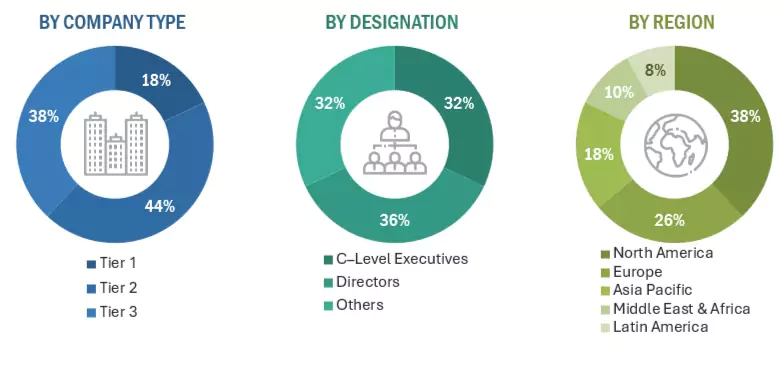
Note 1: Tier 1 companies have revenues of more than USD 10 billion; tier 2 companies’ revenue ranges
from USD 1 billion to USD 10 billion; and tier 3 companies’ revenue ranges from USD 500 million
to USD 1 billion
Source: Secondary Literature, Interviews with Experts, and MarketsandMarkets Analysis
To know about the assumptions considered for the study, download the pdf brochure
Market Size Estimation
In the market engineering process, the top-down and bottom-up approaches were used along with multiple data triangulation methods to estimate and validate the size of the parking management market and other dependent submarkets. The research methodology used to estimate the market sizes includes the following:
- Focusing on top-line investments and spending in the ecosystems and considering developments in the critical market area
- Tracking the recent and upcoming developments in the parking management market that include investments, R&D activities, product launches, collaborations, mergers and acquisitions, and partnerships, as well as forecasting the market size based on these developments and other critical parameters
- Conducting multiple discussions with key opinion leaders to learn about the diverse types of authentications and brand protection offerings used, and the applications for which they are used, in order to analyze the breakdown of the scope of work carried out by major companies
- Segmenting the market by technology types and their applications, while also determining the size of the global application market
- Segmenting the overall market into various market segments
- Validating the estimates at every level through discussions with key opinion leaders, such as chief executives (CXOs), directors, and operations managers, and finally with the domain experts at MarketsandMarkets
Parking Management Market : Top-Down and Bottom-Up Approach
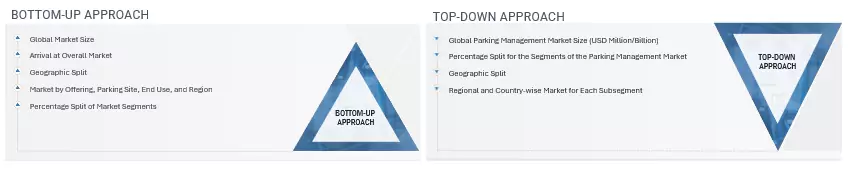
Data Triangulation
After determining the overall market size from the above estimation process, the parking management market was split into several segments and sub-segments. Data triangulation and market breakdown procedures were used, wherever applicable, to complete the overall market engineering process and arrive at the exact statistics for all segments and sub-segments. The data was triangulated by studying various factors and trends from the demand and supply sides. The parking management market size was validated using top-down and bottom-up approaches.
Market Definition
Parking management offers a comprehensive suite of solutions, including parking guidance, reservation systems, permit management, enforcement, and access control with integrated revenue collection, security surveillance, and data analytics. By integrating these solutions, the parking management market cultivates a more efficient, user-friendly, and secure parking ecosystem. This data-driven approach optimizes traffic flow, maximizes operator revenue, and enhances the overall parking experience.
Parking management helps increase efficiency in parking operations, reduce congestion in the lot, and increase revenues for parking lot owners. It also enables a good customer experience by reducing the time spent looking for a parking spot and simplifying the payment process.
Stakeholders
- Parking management solution providers
- Parking management service providers/third-party vendors
- Government organizations
- Consultants/advisory firms
- System integrators (SIs)
- Training and education service providers
- Managed service providers
- Support and maintenance service providers
- System integrators
- Value-added resellers (VARs) and distributors
Report Objectives
- To determine and forecast the global parking management market by offering (solutions and services), parking site, end use, and region from 2025 to 2030, and analyze the various macroeconomic and microeconomic factors affecting the market growth
- To forecast the size of the market segments concerning five central regions: North America, Europe, Asia Pacific (APAC), Middle East & Africa (MEA), and Latin America
- To provide detailed information about the major factors (drivers, restraints, opportunities, and challenges) influencing market growth
- To analyze each submarket concerning individual growth trends, prospects, and contributions to the overall parking management market
- To assess the market opportunities for stakeholders by identifying the high-growth segments of the parking management market
- To profile the key market players, provide a comparative analysis based on business overviews, regional presence, product offerings, business strategies, and key financials, and illustrate the market’s competitive landscape
- To track and analyze competitive developments in the market, such as mergers and acquisitions, product developments, partnerships and collaborations, and research and development (R&D) activities
Available Customizations
With the given market data, MarketsandMarkets offers customizations per the company’s specific needs. The following customization options are available for the report:
Geographic Analysis as per Feasibility
- Further break-up of the Asia Pacific market into countries contributing 75% to the regional market size
- Further break-up of the North American market into countries contributing 75% to the regional market size
- Further break-up of the Latin American market into countries contributing 75% to the regional market size
- Further break-up of the Middle East African market into countries contributing 75% to the regional market size
- Further break-up of the European market into countries contributing 75% to the regional market size
Company Information
- Detailed analysis and profiling of additional market players (up to 5)
Key Questions Addressed by the Report
What is the definition of parking management market?
Parking management offers parking guidance, reservation systems, permit management, enforcement, access control with integrated revenue collection, security surveillance, and data analytics. By integrating these solutions, the parking management market cultivates a more efficient, user-friendly, and secure parking ecosystem. This data-driven approach optimizes traffic flow, maximizes operator revenue, and enhances the overall parking experience.
Parking management helps increase efficiency in parking operations, reduce congestion in the lot, and increase revenues for parking lot owners. It also enables a good customer experience by reducing the time spent looking for a parking spot and simplifying the payment process.
What is the market size of the parking management market?
The parking management market size is projected to grow from USD 7.22 billion in 2025 to USD 12.41 billion by 2030, at a CAGR of 11.4% during the forecast period.
What are the major factors that drive the market?
Urbanization and population growth in congested cities are creating a greater need for effective parking solutions, leading to increased use of smart parking systems. Technological advancements such as IoT-enabled sensors and mobile apps, which improve operational efficiency and user convenience, are enhancing market growth.
Requirements for sustainable city planning and the necessity to alleviate traffic congestion are also motivating factors for investment in smart parking solutions. Furthermore, the combination of AI and data analytics to provide real-time information on parking availability speeds up market growth and enhances resource usage and customer satisfaction.
Who are the key players operating in the parking management market?
The major players in the market are Amano (Japan), SKIDATA (Austria), Group Indigo (France), Arrive (Sweden), TIBA Parking Systems (Israel), SWARCO (Austria), Chetu (US), INRIX (US), IPS Group (US), Precise ParkLink (Canada), Infocomm Group (Oman), Verra Mobility (US), Egis Group (France), Passport Labs (US), SpotHero (US), Get My Parking (India), Streetline (US), Cleverciti (Germany), Wayleadr (US), Urbiotica (Spain), CivicSmart (US), Parklio (Croatia), TCS International (US), Parkable (New Zealand), Parkalot (Poland), Parking Telecom (France), and Omnitec (Dubai). These players have adopted various growth strategies, such as partnerships, agreements, and collaborations, new product launches, enhancements, and acquisitions, to expand their footprint in the Parking Management market.
What are the opportunities for new market entrants?
New entrants in the parking management market have significant opportunities to capitalize on evolving urban mobility trends and technological advancements. The increasing demand for smart parking solutions, powered by AI, IoT, and data analytics, enables optimized space utilization, reduced congestion, and improved user experience through real-time availability and dynamic pricing. As electric vehicles become more popular and sustainability mandates increase, incorporating EV charging infrastructure into parking management systems presents a significant competitive advantage.
Moreover, innovations in digital payments and contactless access systems cater to customer expectations for convenience and seamless experiences. Rapid urbanization and government-backed smart city initiatives in Asia Pacific and Europe provide fertile ground for new players to pilot and expand innovative solutions in collaboration with local authorities.
In addition, emerging trends such as micro-mobility, autonomous vehicles, and mobility-as-a-service (MaaS) ecosystems create room for integrated, multimodal parking platforms. Finally, bicycle parking and last-mile logistics hubs offer untapped potential for specialized, technology-driven business models, enabling newcomers to establish a distinct competitive edge in the market.
Fact checked
Personalize This Research
- Triangulate with your Own Data
- Get Data as per your Format and Definition
- Gain a Deeper Dive on a Specific Application, Geography, Customer or Competitor
- Any level of Personalization
Let Us Help You
- What are the Known and Unknown Adjacencies Impacting the Parking Management Market
- What will your New Revenue Sources be?
- Who will be your Top Customer; what will make them switch?
- Defend your Market Share or Win Competitors
- Get a Scorecard for Target Partners

Custom Market Research Services
We Will Customise The Research For You, In Case The Report Listed Above Does Not Meet With Your Requirements
Get 10% Free CustomisationTESTIMONIALS
- Canada Parking Management Market
- US Parking Management Market
- UK Parking Management Market
- Germany Parking Management Market
- France Parking Management Market
- Italy Parking Management Market
- China Parking Management Market
- Japan Parking Management Market
- India Parking Management Market
- UAE Parking Management Market
- South Africa Parking Management Market
- Brazil Parking Management Market
- Mexico Parking Management Market
Growth opportunities and latent adjacency in Parking Management Market






Alan
Jul, 2026
Which geographic regions are expected to drive the strongest growth in the parking management market?.
Juan
Jul, 2026
How important are mobile parking solutions becoming within the parking management market?.
Liam
Jul, 2026
Are parking robots becoming a strategic investment area within smart city and smart parking initiatives?.
Madalynn
Jul, 2026
The report mentions strong momentum in on-street parking management. Are cities increasingly adopting digital curbside management and dynamic pricing systems to reduce congestion?.