Indoor Location Market Size, Share, Growth, Opportunities & Latest Trends

Indoor Location Market by Solution (Asset & People Tracking, Indoor Location Analytics, Indoor Navigation, Database Management Systems), By Technology (BLE, UWB, Wi-Fi, RFID, Magnetic Positioning, Wirepas Mesh) - Global Forecast to 2031




OVERVIEW
Source: Secondary Research, Interviews with Experts, MarketsandMarkets Analysis
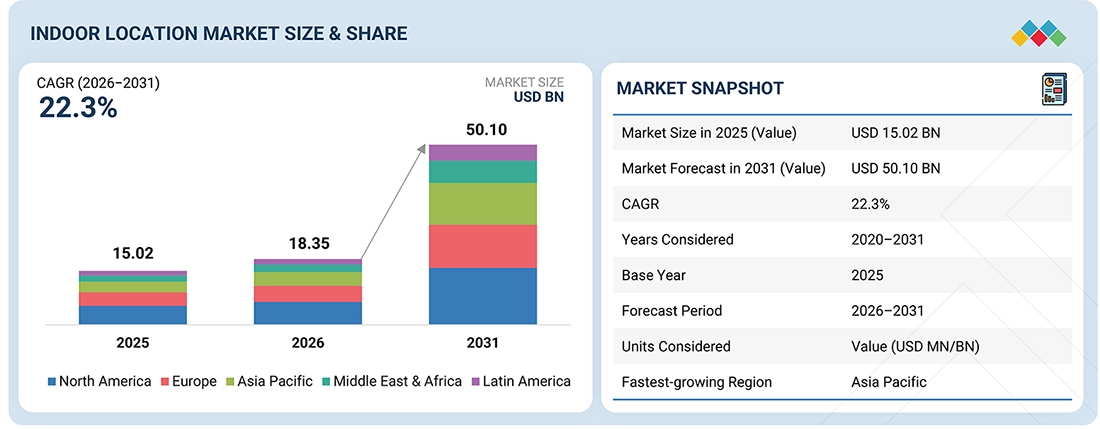
The global indoor location market is projected to reach USD 50.10 billion by 2031, growing at a CAGR of 22.3% during the forecast period. The global market is experiencing strong growth as organizations increasingly seek real-time visibility of people, assets, and workflows within complex indoor environments. Traditional GPS technology performs poorly indoors, creating demand for advanced positioning technologies, such as Bluetooth Low Energy (BLE), Ultra-Wideband (UWB), and sensor fusion. These solutions enable accurate indoor navigation, asset tracking, workforce management, and location-based services across healthcare, retail, manufacturing, transportation, and logistics sectors. The growing adoption of Industry 4.0, smart buildings, and connected infrastructure is further boosting market expansion. Recent developments include the increasing deployment of UWB-enabled devices, AI-powered location analytics, and the integration of indoor mapping capabilities into enterprise and mobile platforms, enhancing operational efficiency, safety, and customer experiences worldwide.
Market Size and Forecast:
- 2025 Market Size: USD 15.02 Billion
- 2026 Projected Market Size: USD 18.35 Billion
- 2031 Forecasted Market Size: USD 50.10 Billion
- Growth Rate (2026-2031): CAGR of 22.3%
- Data available from 2024 to 2031
Key Market Trends and Insights
- Leading Companies: Zebra Technologies, HPE, Cisco, Here Technologies
-
Growth Drivers: increasing demand for smart building analytics, Industry 4.0, and UWB/BLE asset tracking.
- Latest Trends: seamless system integration, enhanced safety and compliance, and actionable location intelligence.
- Emerging Opportunities: real-time tracking and navigation services for assets and people within buildings.
-
US Indoor Location Market
- Market size USD 4.13 billion in 2025
- Market forecast USD 9.97 billion in 2030
- Market Growing at a CAGR of 19.3%
-
BLE Indoor Location Market
- Market size USD 4.30 billion in 2025
- Market forecast USD 11.88 billion in 2030
- Market Growing at a CAGR of 22.5%
-
APAC Indoor Location Market
- Market size USD 2.79 billion in 2025
- Market forecast USD 8.52 billion in 2030
- Market Growing at a CAGR of 25.0%
-
Saudi Arabia Indoor Location Market
- Market size USD 0.36 billion in 2025
- Market forecast USD 1.10 billion in 2030
- Market Growing at a CAGR of 25.0%
-
Europe Indoor Location Market
- Market size USD 3.72 billion in 2025
- Market forecast USD 10.50 billion in 2030
- Market Growing at a CAGR of 23.0%
-
Ultra-Wideband (UWB) Indoor Location Market
- Market size USD 1.65 billion in 2025
- Market forecast USD 4.94 billion in 2030
- Market Growing at a CAGR of 24.5%
KEY TAKEAWAYS
-
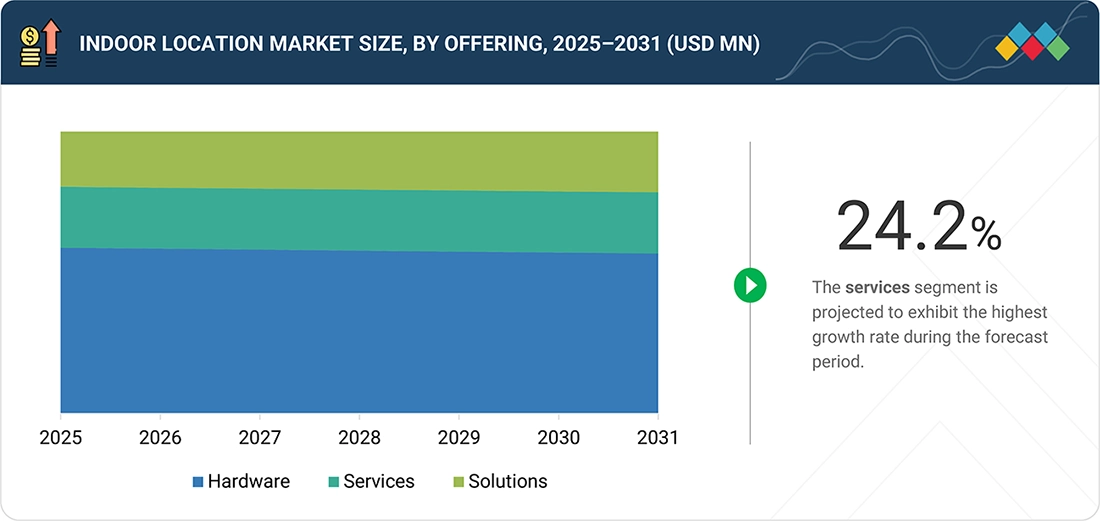
By OfferingBy offering, the services segment is expected to register the highest CAGR of 24.2% between 2026 and 2031.
-
By TechnologyBy technology, the UWB segment is projected to grow at the fastest rate of 24.3% during the forecast period.
-
By ApplicationBy application, the supply chain management segment is expected to dominate the market during the forecast period.
-
By RegionBy region, Asia Pacific is likely to be the fastest-growing region in the global indoor location market from 2026 to 2031.
-
Competitive Landscape (Key Players)Zebra Technologies, HPE, Cisco, and Here Technologies were identified as some star players in the indoor location market, given their strong market share and product footprint.
-
Competitive Landscape (Startups/SMEs)Kontakt.io, Pointr, Syook, and Mapxus have distinguished themselves among startups and SMEs in the indoor location market.
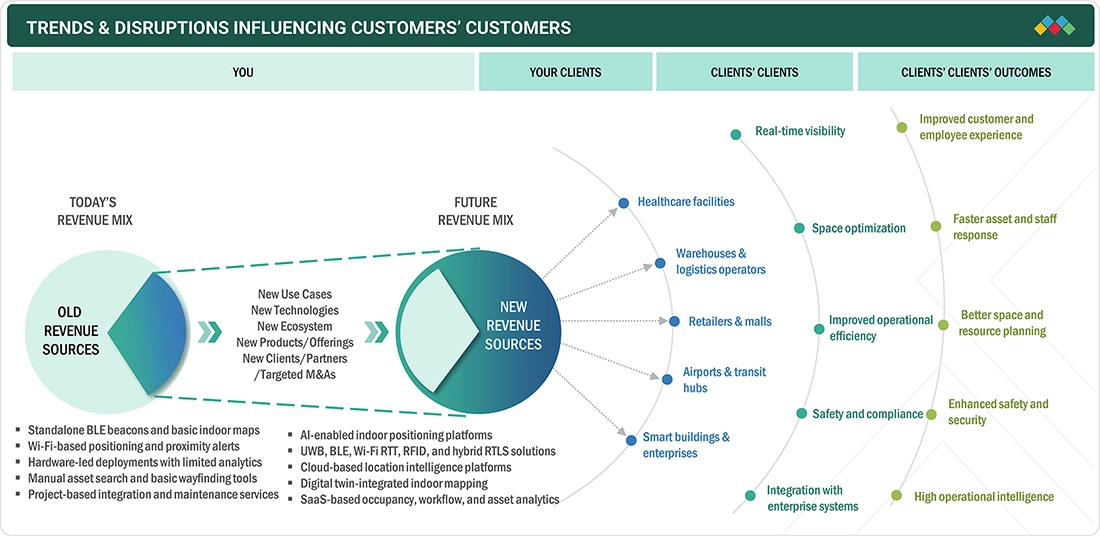
Indoor location technology is transforming how organizations manage people, assets, and operations within indoor environments. Previously, businesses relied on manual processes, barcode scanning, and limited visibility systems that provided little real-time insight into asset movement and workforce activities. However, the growing need for operational efficiency, workplace safety, and seamless customer experiences has accelerated the adoption of advanced indoor positioning technologies, such as BLE, UWB, Wi-Fi, RFID, and AI-powered analytics. Across healthcare facilities, warehouses, airports, retail stores, and manufacturing plants, indoor location solutions have become critical for real-time asset tracking, navigation, workflow optimization, and location intelligence. The significant impact of these technologies is evident through the increasing use of smart sensors, connected devices, digital twins, autonomous mobile robots, and IoT-enabled infrastructure.
TRENDS & DISRUPTIONS IMPACTING CUSTOMERS' CUSTOMERS
The indoor location market is evolving from basic beacon- and Wi-Fi-based positioning solutions toward intelligent, software-driven location platforms. Future growth will be fueled by AI-powered analytics, UWB/RTLS technologies, digital twin integration, and SaaS-based location services. Adoption is increasing across healthcare, logistics, retail, airports, and smart buildings as organizations seek real-time visibility, operational efficiency, asset tracking, and space optimization. For these customers, key priorities include seamless system integration, enhanced safety and compliance, and actionable location intelligence. Ultimately, these advancements will enable faster decision-making, improved customer and employee experiences, better resource utilization, and more secure, connected indoor environments.
Source: Secondary Research, Interviews with Experts, MarketsandMarkets Analysis
MARKET DYNAMICS

Level
-
Mounting demand for indoor navigation, occupancy analytics, and space optimization in smart buildings and campuses

-
Rising integration of beacons into cameras, LED lighting, PoS devices, and digital signage


Level
-
Concerns related to data security and privacy

-
Location inaccuracy due to signal interference and complex indoor layouts


Level
-
Increasing digital twin integration to support space planning, maintenance, energy optimization, and facility automation

-
Focus on Industry 4.0 smart cities and smart manufacturing


Level
-
Lack of skills and awareness about indoor location technologies

-
Issues in maintaining maps, tags, beacons, and sensors

Source: Secondary Research, Interviews with Experts, MarketsandMarkets Analysis
Driver: Mounting demand for indoor navigation, occupancy analytics, and space optimization in smart buildings and campuses
The rapid adoption of smart buildings and connected campuses is accelerating the demand for indoor location technologies. Organizations are using real-time positioning to improve navigation, occupancy monitoring, asset tracking, and space utilization. Integration with IoT devices and building management systems enhances operational efficiency, supports sustainability goals, and delivers improved user experiences.
Restraint: Location inaccuracy due to signal interference and complex indoor layouts
Indoor location systems often face challenges from signal interference caused by walls, metal structures, machinery, and dense building materials. Complex floor plans and multi-level facilities can further reduce positioning accuracy. These limitations may affect reliability, increase deployment complexity, and require additional calibration, infrastructure upgrades, or advanced positioning technologies.
Opportunity: Increasing digital twin integration to support space planning, maintenance, energy optimization, and facility automation
The growing adoption of digital twins creates significant opportunities for indoor location solutions. Real-time location data can enhance virtual building models, enabling better space planning, predictive maintenance, energy management, and facility automation. This integration helps organizations optimize operations, improve decision-making, reduce costs, and enhance overall building performance and efficiency.
Challenge: Issues in maintaining maps, tags, beacons, and sensors
Maintaining indoor location infrastructure remains a key challenge for organizations. Regular updates to maps, tags, beacons, and sensors are necessary to ensure system accuracy and performance. As facilities expand or change layouts, operational complexity increases, requiring continuous monitoring, maintenance, and resource investment to keep location services reliable and effective.
INDOOR LOCATION MARKET: COMMERCIAL USE CASES ACROSS INDUSTRIES
| COMPANY | USE CASE DESCRIPTION | BENEFITS |
|---|---|---|
 |
Zebra Technologies provides real-time indoor location and asset visibility solutions through RFID, BLE beacons, ultra-wideband (UWB), and the Zebra MotionWorks platform. These solutions are widely deployed across warehouses, manufacturing facilities, healthcare institutions, and retail environments to track assets, equipment, inventory, and personnel. Organizations utilize Zebra’s indoor location capabilities to automate workflows, optimize asset utilization, and improve operational efficiency through continuous monitoring and analytics. | Real-time asset and workforce visibility | Improved inventory accuracy and asset utilization | Reduced search time and operational costs | Enhanced workplace productivity and safety |
 |
HPE Aruba delivers indoor location services through Aruba Meridian, Wi-Fi, BLE beacons, and location analytics platforms. Enterprises, hospitals, airports, and large commercial facilities leverage these solutions for indoor navigation, wayfinding, occupancy monitoring, contact tracing, and visitor engagement. The platform combines network infrastructure with advanced analytics to provide actionable insights into movement patterns and space utilization. | Accurate indoor navigation and wayfinding | Improved visitor and employee experiences | Enhanced space utilization and occupancy management | Data-driven operational decision-making |
 |
CenTrak specializes in healthcare-focused real-time location systems (RTLS) utilizing RFID, infrared (IR), BLE, and UWB technologies. Hospitals and healthcare providers deploy CenTrak solutions to track medical equipment, patients, staff, and critical assets across complex indoor environments. The platform enables automated workflow management, patient safety monitoring, environmental sensing, and compliance reporting while improving overall healthcare operations. | Improved patient safety and care coordination | Enhanced utilization of medical assets and equipment | Reduced operational inefficiencies and staff workload | Greater regulatory compliance and workflow automation |
Logos and trademarks shown above are the property of their respective owners. Their use here is for informational and illustrative purposes only.
MARKET ECOSYSTEM
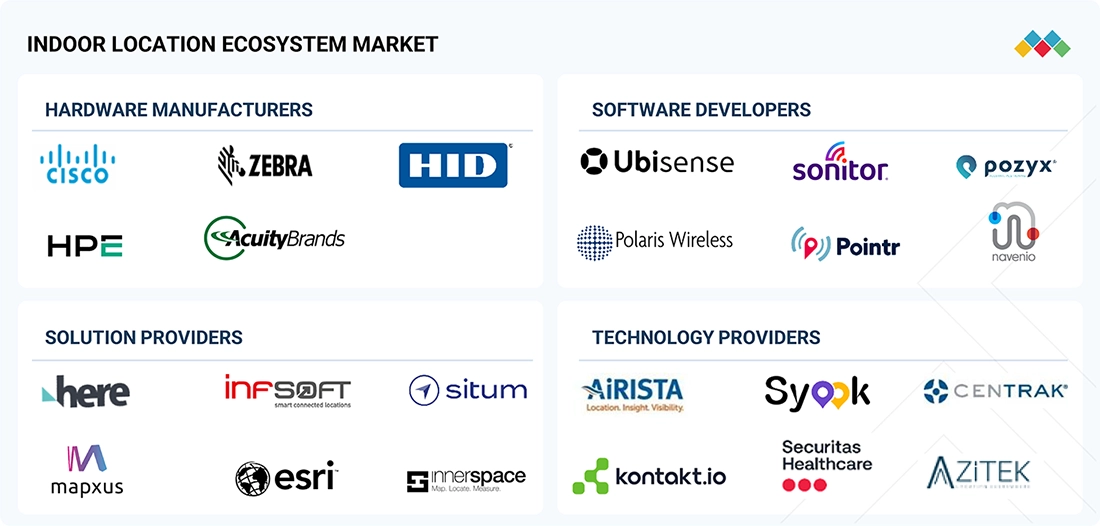
The indoor location ecosystem comprises a diverse network of hardware manufacturers, software developers, solution providers, and technology providers that collectively enable accurate indoor positioning, navigation, asset tracking, and location intelligence. Hardware manufacturers such as Cisco Systems, Zebra Technologies, HID Global, Hewlett Packard Enterprise, and Acuity Brands provide the infrastructure layer. Software developers, including Quuppa, Ubisense, Blueiot, Sonitor, Oriient, Pozyx, Navenio, Polaris Wireless, and Point Inside, develop positioning algorithms and mapping platforms. Solution providers such as HERE Technologies, Esri, Navigine, Infsoft, Situm, Mapxus, and InnerSpace support end-use applications. Supporting technology providers, including CenTrak, Azitek, Securitas Healthcare, Inpixon, Kontakt.io, Sypok, and AiRISTA Flow, enhance ecosystem capabilities, driving innovation across smart buildings, healthcare, retail, manufacturing, transportation, and enterprise environments.
Logos and trademarks shown above are the property of their respective owners. Their use here is for informational and illustrative purposes only.
MARKET SEGMENTS
Source: Secondary Research, Interviews with Experts, MarketsandMarkets Analysis
Indoor Location Market, By Offering
By offering, the indoor location market comprises hardware, software, and services. Hardware includes beacons, sensors, tags, gateways, and access points that enable indoor positioning and tracking. Software platforms provide location analytics, mapping, asset visibility, navigation, and workflow optimization capabilities. Services include consulting, deployment, integration, maintenance, and support. Market growth is driven by increasing adoption of real-time location systems (RTLS), smart buildings, Industry 4.0 initiatives, and the need for operational efficiency across healthcare, manufacturing, retail, transportation, and logistics sectors. Continuous investments in digital transformation and location intelligence are accelerating the demand for comprehensive indoor location solutions.
Indoor Location Market, By Technology
The indoor location market, by technology, includes BLE, UWB, Wi-Fi, RFID, Zigbee, and other positioning technologies. BLE remains widely adopted due to its cost-effectiveness and compatibility with smartphones, while UWB is gaining traction for its high-precision tracking capabilities. Wi-Fi-based positioning leverages existing network infrastructure, reducing deployment costs. RFID continues to be used extensively for asset tracking and inventory management. The segment is driven by increasing demand for real-time visibility, indoor navigation, workforce safety, smart facility management, and automation. The expansion of IoT ecosystems and advancements in wireless communication technologies are further strengthening market adoption.
REGION
Asia Pacific to grow at fastest rate in indoor location market during forecast period
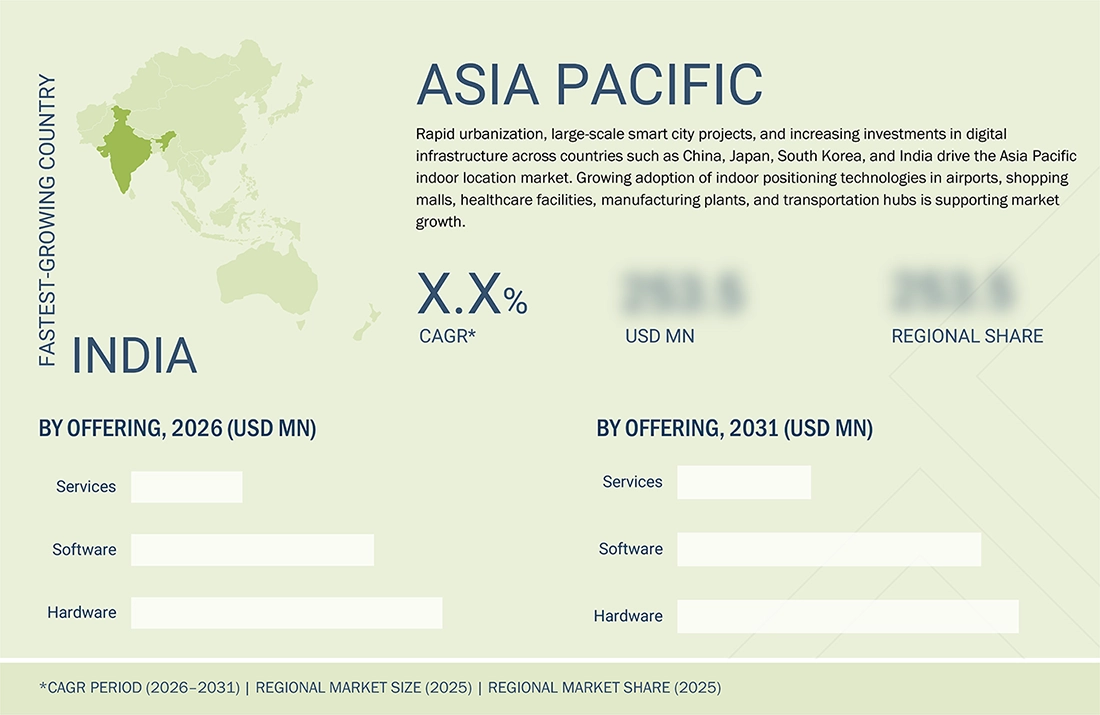
Asia Pacific is projected to be the fastest-growing market for indoor location solutions during the forecast period, driven by rapid urbanization, large-scale smart infrastructure projects, and accelerating digital transformation across industries. China, India, Japan, South Korea, and Singapore are increasingly deploying indoor positioning technologies in airports, hospitals, manufacturing facilities, retail centers, and transportation hubs to improve operational efficiency, asset visibility, and customer experience. The growing adoption of Industry 4.0, smart factories, and advanced wireless technologies, such as UWB, BLE, and Wi-Fi 6, is further accelerating market expansion. Government-led smart city initiatives and investments in digital infrastructure are creating significant opportunities for indoor navigation, workforce tracking, and real-time asset management applications. As enterprises continue to prioritize automation and location intelligence, the region is expected to witness the highest growth rate and emerge as a key innovation hub for indoor location technologies.
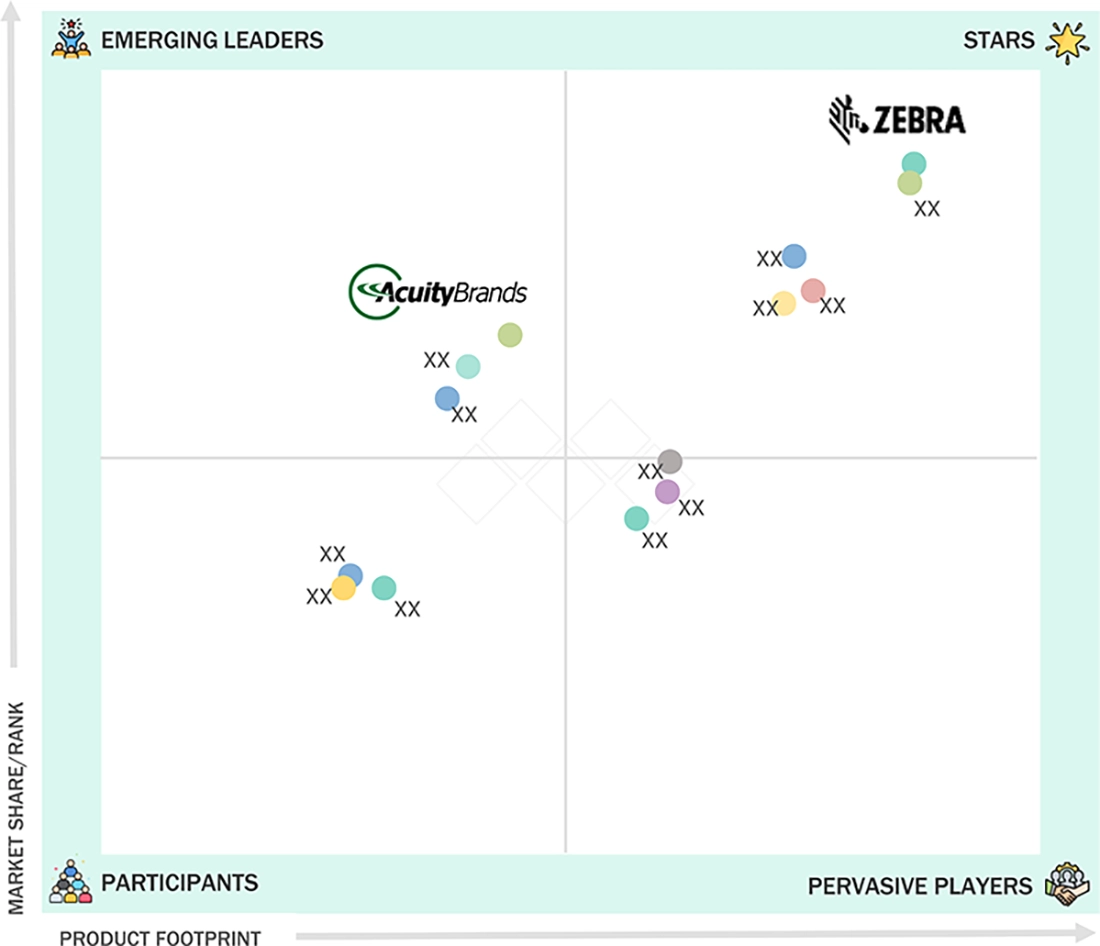
INDOOR LOCATION MARKET : COMPANY EVALUATION MATRIX
The two firms that occupy the top position in the indoor location market matrix are Zebra Technologies and Cisco Systems due to their comprehensive portfolios spanning Wi-Fi-based positioning, real-time location systems (RTLS), asset tracking, workforce visibility, and location analytics solutions. Their strong global presence, extensive partner ecosystems, and continuous investments in enterprise mobility and location intelligence strengthen their leadership positions. Acuity Brands is regarded as an emerging firm in the market owing to its innovations in indoor mapping, venue digitization, and location-based services. The company has introduced advanced indoor navigation, wayfinding, and spatial intelligence solutions that enhance user experience, operational efficiency, and real-time decision-making across airports, retail centers, healthcare facilities, and smart buildings.
Source: Secondary Research, Interviews with Experts, MarketsandMarkets Analysis
KEY MARKET PLAYERS
- Zebra Technologies (US)
- Cisco (US)
- HPE – Hewlett Packard Enterprise (US)
- Esri (US)
- HERE Technologies (Netherlands)
- Inpixon (US)
- HID Global (US)
- Acuity Brands (US)
- Quuppa (Finland)
- CenTrak (US)
MARKET SCOPE
| REPORT METRIC | DETAILS |
|---|---|
| Market Size in 2025 (Value) | USD 15.02 Billion |
| Market Size in 2026 (Value) | USD 18.35 Billion |
| Market Forecast in 2031 (Value) | USD 50.10 Billion |
| Growth Rate | CAGR of 22.3% from 2026-2031 |
| Years Considered | 2020-2031 |
| Base Year | 2025 |
| Forecast Period | 2026-2031 |
| Units Considered | Value (USD Million/Billion) |
| Report Coverage | Revenue forecast, company ranking, competitive landscape, growth factors, and trends |
| Segments Covered |
|
| Regions Covered | North America, Europe, Asia Pacific, the Middle East & Africa, and Latin America |
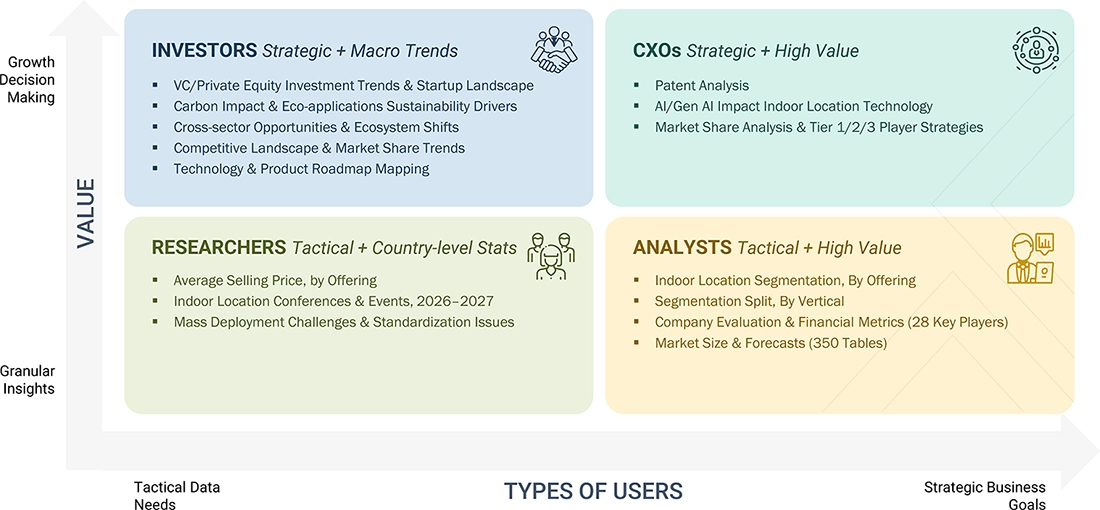
WHAT IS IN IT FOR YOU: INDOOR LOCATION MARKET REPORT CONTENT GUIDE
DELIVERED CUSTOMIZATIONS
We have successfully delivered the following deep-dive customizations:
| CLIENT REQUEST | CUSTOMIZATION DELIVERED | VALUE ADDS |
|---|---|---|
| Leading Service Provider (US) | Regional Analysis: • Further breakdown of the North American indoor location market • Further breakdown of the European indoor location market • Further breakdown of the Asia Pacific indoor location market • Further breakdown of the Middle Eastern & African indoor location market • Further breakdown of the Latin American indoor location market | • Identifies high-growth regional opportunities, enabling tailored market entry strategies. • Optimizes resource allocation and investment based on region-specific demand and trends. |
| Company Information | Detailed analysis and profiling of additional market players (up to 5) | • Broadens competitive insights, helping clients make informed strategic and investment decisions. • Reveals market gaps and opportunities, supporting differentiation and targeted growth initiatives. |
RECENT DEVELOPMENTS
- May 2026 : Qorvo announced a breakthrough in enterprise indoor positioning by integrating UWB Real-Time Location Systems (RTLS) directly into existing Wi-Fi access points. The solution leverages FiRa and Omlox standards, enabling organizations to deploy highly accurate indoor location services without installing dedicated RTLS infrastructure. This development is expected to accelerate adoption across manufacturing, healthcare, logistics, and smart buildings by reducing deployment costs and complexity.
- May 2026 : The National Institute of Standards and Technology (NIST) introduced its new Z-Axis Test Facility to advance indoor localization technologies for public safety applications. The facility provides highly accurate reference datasets for validating indoor positioning systems, particularly for first responders operating in multi-story buildings. The initiative aims to improve vertical positioning accuracy and support the development of future indoor navigation and emergency response solutions.
- April 2026 : Pole Star showcased its latest indoor positioning platform for the cruise industry at Seatrade Cruise Global 2026. The solution enables indoor location services using existing Bluetooth Low Energy (BLE) infrastructure deployed onboard vessels, eliminating the need for additional hardware. Cruise operators are increasingly adopting indoor positioning technologies to improve passenger navigation, operational efficiency, and onboard safety management.
Table of Contents
 Exclusive indicates content/data unique to MarketsandMarkets and not available with any competitors.
Methodology
The research study involved four major activities in estimating the indoor location market size. Exhaustive secondary research has been done to collect important information about the market and peer markets. The next step has been to validate these findings and assumptions and size them with the help of primary research with industry experts across the value chain. Both top-down and bottom-up approaches have been used to estimate the market size. Post which, the market breakdown and data triangulation have been adopted to estimate the market sizes of segments and sub-segments.
Secondary Research
The market size of companies offering indoor location hardware, solutions, and services for various subscribers is arrived at based on the secondary data available through paid and unpaid sources and by analyzing the different components (hardware, solutions, and services) of major companies in the ecosystem and rating them based on their performance and quality. In the secondary research process, various sources were referred to for identifying and collecting information for this study. The secondary sources included annual reports, press releases, and investor presentations of companies, white papers, journals, and certified publications and articles from recognized authors, directories, and databases.
Secondary research was mainly used to obtain key information about the industry’s supply chain, the total pool of key players, market classification, and segmentation according to the industry trends to the bottommost level, regional markets, and key developments from both market- and technology-oriented perspectives, all of which were further validated by primary sources.
Primary Research
In the primary research process, various primary sources from the supply and demand sides were interviewed to obtain qualitative and quantitative information for the report. The primary sources from the supply side include industry experts, such as chief executive officers (CEOs), vice presidents (VPs), marketing directors, technology and innovation directors, and related key executives from various key companies and organizations providing indoor location solutions. The primary sources from the demand side include end users, such as chief information officers (CIOs), consultants, service professionals, technicians, technologists, and managers at public and investor-owned utilities
In the market engineering process, the top-down and bottom-up approaches have been extensively used, along with several data triangulation methods, to perform market estimation and market forecasting for the overall market segments and sub-segments listed in the report. Extensive qualitative and quantitative analyses have been performed on the complete market engineering process to list key information/insights throughout the report.
After the complete market engineering (calculations for market statistics, market breakup, market size estimations, market forecasting, and data triangulation), extensive primary research has been conducted to gather information. Primary research has been conducted to identify the segmentation, industry trends, key players, competitive landscape, and key market dynamics, such as drivers, restraints, opportunities, challenges, trends, and strategies.
BREAKDOWN OF PRIMARIES
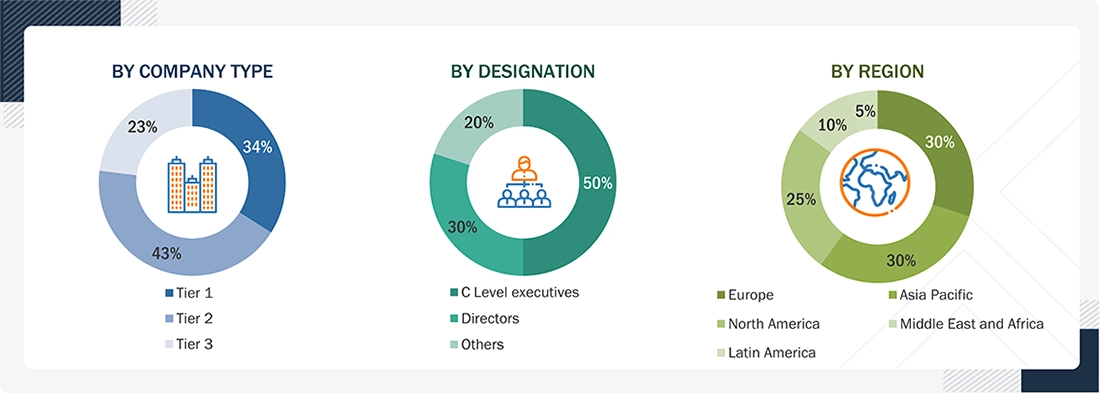
Note 1: Tier 1 companies have revenues of more than USD 10 billion; tier 2 companies’ revenue ranges from USD 1 billion to USD 10 billion; and tier 3 companies’ revenue ranges from USD 500 million to USD 1 billion
Source: Secondary Literature, Expert Interviews, and MarketsandMarkets Analysis
To know about the assumptions considered for the study, download the pdf brochure
Market Size Estimation
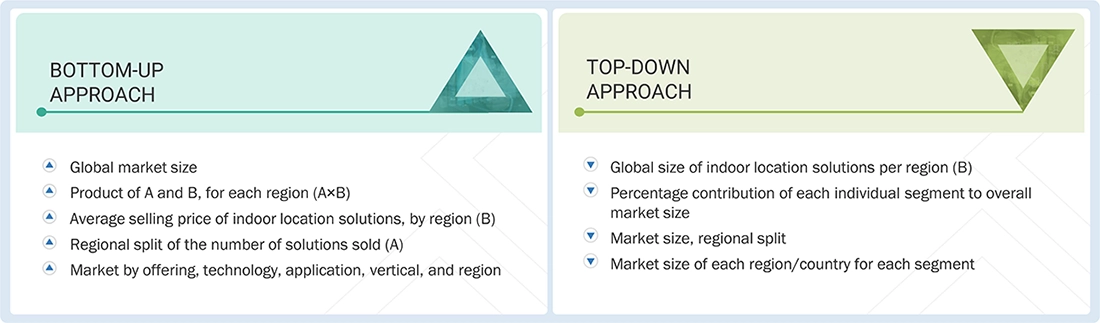
In the market engineering process, the top-down and bottom-up approaches were used along with multiple data triangulation methods to estimate and validate the size of the indoor location market, as well as other dependent submarkets. The research methodology used to estimate the market sizes includes the following:
- Initially, MarketsandMarkets focuses on top-line investments and spending in the ecosystems. Furthermore, significant developments in the critical market area have been considered.
- Tracking the recent and upcoming developments in the indoor location market that include investments, R&D activities, product launches, collaborations, mergers & acquisitions, and partnerships, as well as forecasting the market size based on these developments and other critical parameters.
- Conduct multiple discussions with key opinion leaders to learn about the diverse types of authentications and brand protection offerings used and the applications for which they are used to analyze the breakdown of the scope of work carried out by major companies.
- Segmenting the market based on technology types concerning applications, wherein the types are to be used, and deriving the size of the global indoor location market.
- Segmenting the overall market into various market segments
- Validating the estimates at every level through discussions with key opinion leaders, such as chief executives (CXOs), directors, and operations managers, and finally with the domain experts at MarketsandMarkets
Indoor Location Market : Top-Down and Bottom-Up Approach
Data Triangulation
After arriving at the overall market size from the above estimation process, the indoor location market has been split into several segments and sub-segments. To complete the overall market engineering process and arrive at the exact statistics for all segments and sub-segments, data triangulation and market breakdown procedures have been used, wherever applicable. The data has been triangulated by studying various factors and trends from the demand and supply sides.
The indoor location market size has been validated using top-down and bottom-up approaches.
Market Definition
An indoor location/positioning system helps in locating the position of objects or people within a building. Global Positioning System (GPS) is unreliable in interior spaces, as there is no visual contact with GPS satellites; hence, an indoor positioning system (IPS) must use other positioning methods. Indoor location or indoor positioning technology facilitates the navigation and tracking of objects and people in a building using sensory information captured by mobile devices. It includes hardware, software, and service components to provide indoor location services to various organizations across verticals. Indoor location solutions may collect location data using radio frequency (RF), visible light communication (VLC), sound navigation and ranging (Sonar), light detection and ranging (Lidar), or any technology or a combination of technologies.
Key Stakeholders
- Indoor Location Solution Providers
- Independent Software Vendors
- Investors and Venture Capitalists
- Managed Service Providers
- Support and Maintenance Service Providers
- System Integrators/Migration Service Providers
- Value-added Resellers and Distributors
Report Objectives
- To determine, segment, and forecast the indoor location market, by offering, technology, application, and vertical, in terms of value
- To forecast the size of the market segments with respect to five main regions: North America, Europe, Asia Pacific, the Middle East & Africa, and Latin America, in terms of value
- To provide detailed information about the major factors (drivers, restraints, opportunities, and challenges) influencing the growth of the market
- To study the complete value chain and related industry segments, and perform a value chain analysis of the market landscape
- To strategically analyze the macro and micromarkets with respect to individual growth trends, prospects, and contributions to the total market
- To analyze the industry trends, pricing data, patents, and innovations related to the market
- To analyze the opportunities for stakeholders by identifying the high-growth segments of the market
- To profile the key players in the market and comprehensively analyze their market share/ranking and core competencies
- To track and analyze competitive developments, such as mergers & acquisitions, product launches & developments, partnerships, agreements, collaborations, business expansions, and R&D activities
Available customizations:
With the given market data, MarketsandMarkets offers customizations per the company’s specific needs. The following customization options are available for the report:
Geographic Analysis
- Further break-up of the Asia Pacific market into countries contributing 75% to the regional market size
- Further break-up of the North American market into countries contributing 75% to the regional market size
- Further break-up of the Latin American market into countries contributing 75% to the regional market size
- Further break-up of the Middle East & African market into countries contributing 75% to the regional market size
- Further break-up of the European market into countries contributing 75% to the regional market size
Company Information
- Detailed analysis and profiling of additional market players (up to five)
Key Questions Addressed by the Report
What is the current size of the Indoor Location Market?
The indoor location market is valued at USD 18.35 billion in 2026 and is projected to reach USD 50.10 billion by 2031, growing at a CAGR of 22.3%.
What is driving buyer demand in the Indoor Location Market?
uyer demand is rising due to the need for real-time asset visibility, workforce tracking, indoor navigation, and smart building optimization across enterprises.
What are the major trends shaping the Indoor Location Market?
Key trends include AI-powered location analytics, BLE beacons, UWB-enabled smartphones, IoT integration, and smart infrastructure deployments.
Which region is growing fastest in the Indoor Location Market?
Asia Pacific is projected to witness the highest growth due to smart city investments, industrial automation, and expanding digital infrastructure.
Who are the leading players in the Indoor Location Market?
Major players include Zebra Technologies, Cisco, HPE, Esri, and HERE Technologies
Which application segment dominates the Indoor Location Market?
Supply chain management is expected to hold the largest market share in 2026 due to rising demand for warehouse visibility and logistics optimization.


Personalize This Research
- Triangulate with your Own Data
- Get Data as per your Format and Definition
- Gain a Deeper Dive on a Specific Application, Geography, Customer or Competitor
- Any level of Personalization
Let Us Help You
- What are the Known and Unknown Adjacencies Impacting the Indoor Location Market
- What will your New Revenue Sources be?
- Who will be your Top Customer; what will make them switch?
- Defend your Market Share or Win Competitors
- Get a Scorecard for Target Partners

Custom Market Research Services
We Will Customise The Research For You, In Case The Report Listed Above Does Not Meet With Your Requirements
Get 10% Free CustomisationTESTIMONIALS
- Canada Indoor Location Market
- US Indoor Location Market
- UK Indoor Location Market
- Germany Indoor Location Market
- France Indoor Location Market
- Spain Indoor Location Market
- Italy Indoor Location Market
- China Indoor Location Market
- India Indoor Location Market
- Japan Indoor Location Market
- UAE Indoor Location Market
- South Africa Indoor Location Market
- Brazil Indoor Location Market
- Mexico Indoor Location Market
- Rest Of Europe Indoor Location Market
- Nordics Indoor Location Market
- Rest Of Asia Pacific Indoor Location Market
- Anz Indoor Location Market
- Southeast Asia Indoor Location Market






Growth opportunities and latent adjacency in Indoor Location Market