
Rest Of Europe Automotive Digital Cockpit Market (2025-2030)

The Rest Of Europe Automotive Digital Cockpit Market was valued at $4486 Million in 2025 and projected to reach to $5904 Million by 2030, representing a compound annual growth rate of 4.0%. Rest Of Europe's automotive digital cockpit market is positioned for moderate but sustainable growth through 2030, driven by regulatory mandates, evolving consumer preferences, and gradual technology adoption across diverse national markets.


| Market Size in | USD 26.32 MN |
| Market Forecast in | |
| CAGR | |
| Forecast Period | |
| Units Considered | Value (USD MN) |
Rest Of Europe Automotive Digital Cockpit Market Trends and Insights
- This moderate but steady expansion reflects Rest Of Europe's gradual adoption of advanced in-vehicle infotainment and driver assistance technologies, driven by regulatory compliance and consumer demand for connected vehicle experiences.
- Rest Of Europe's market growth is supported by increasing vehicle electrification and the integration of digital cockpit solutions across mid-range and premium vehicle segments. Rest Of Europe faces unique market dynamics shaped by diverse regulatory frameworks across multiple countries and varying levels of automotive manufacturing infrastructure.
- The region's digital cockpit adoption is influenced by OEM investment strategies, aftermarket integration capabilities, and consumer preferences for user-friendly interfaces.
- Rest Of Europe's market trajectory through 2030 will be determined by the pace of technology standardization, supply chain resilience, and the region's competitive positioning relative to Western Europe's more mature digital cockpit ecosystem..
Key Market Statistics
- CAGR (2025-2030) 4.0% CAGR
- Market Size, 2025 ~USD 4486 Million
- Forecast, 2030 ~USD 5904 Million
- Country Rest Of Europe
Rest Of Europe Automotive Digital Cockpit Market Overview
Steady Growth Trajectory :
Rest Of Europe's automotive digital cockpit market is estimated at USD 4,486 million in 2025 and projected to reach USD 5,904 million by 2030, with a CAGR of 4.0%, reflecting consistent market expansion driven by technological advancement and consumer demand.
Regulatory Compliance Driver :
Stringent EU regulations on vehicle safety, emissions, and connectivity standards are compelling automotive manufacturers in Rest Of Europe to integrate advanced digital cockpit solutions, accelerating market adoption across the region.
Consumer Technology Adoption :
Rest Of Europe's consumers increasingly demand sophisticated in-vehicle infotainment systems, driver assistance technologies, and seamless smartphone integration, pushing OEMs to invest in next-generation digital cockpit platforms.
Regional Market Maturity :
Unlike leading European markets, Rest Of Europe demonstrates moderate but sustainable growth potential, with emerging opportunities in mid-tier vehicle segments and aftermarket digital cockpit upgrades across diverse country markets.
Rest Of Europe Automotive Digital Cockpit Market Dynamics
- The region's automotive manufacturers are increasingly prioritizing digital cockpit integration to meet EU compliance requirements and enhance vehicle competitiveness in a technology-driven market landscape. Key growth catalysts include rising demand for advanced driver assistance systems (ADAS), connected vehicle technologies, and premium infotainment experiences.
- While Rest Of Europe lags behind leading European markets in adoption rates, the region presents significant opportunities for suppliers targeting cost-conscious OEMs and emerging automotive segments seeking affordable digital cockpit solutions..
Market Ecosystem
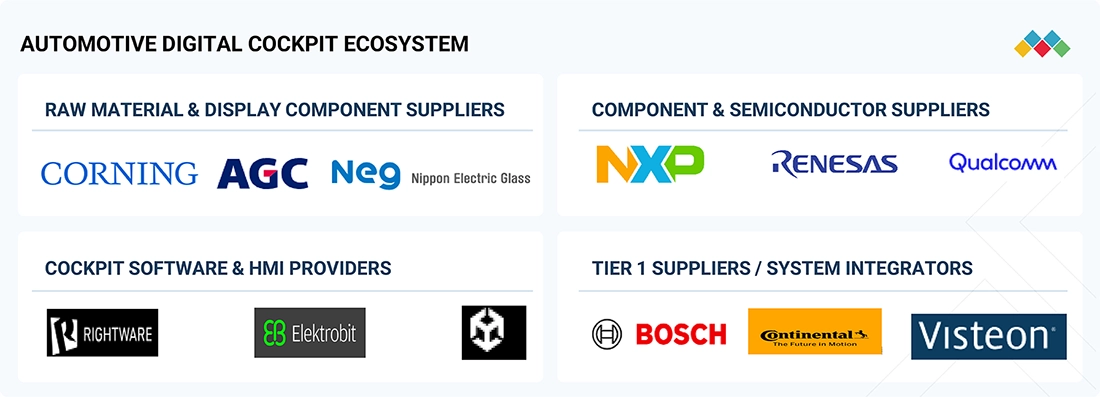
AUTOMOTIVE DIGITAL COCKPIT MARKET: COMMERCIAL USE CASES ACROSS INDUSTRIES
| COMPANY | USE CASE DESCRIPTION | BENEFITS |
|---|---|---|
 |
Develops cockpit domain controllers, integrated display platforms, and scalable HMI solutions that support connected infotainment, digital clusters, and driver monitoring across passenger and commercial vehicles | Improves system consolidation, reduces electronic complexity, and supports faster deployment of advanced cockpit features for global automakers |
 |
Provides high-performance infotainment systems, cloud-linked cockpit software, driver monitoring technologies, and centralized compute units tailored for software-driven vehicles | Enhances safety, improves user experience, and supports continuous feature upgrades through secure connectivity and software management |
 |
Offers cockpit electronics, instrument clusters, HUD systems, and integrated HMI platforms designed for electric and hybrid vehicles requiring energy insights and efficient control interfaces | Supports efficient EV operations, improves visibility of vehicle status, and strengthens real-time decision making for drivers |
 |
Specializes in digital clusters, large display modules, cockpit domain controllers, and AI-enabled interfaces optimized for unified multiscreen layouts in modern vehicles | Boosts cabin digitalization, improves processing speed for graphics output, and enhances brand differentiation for automakers |
 |
Provides connected infotainment platforms, premium audio-integrated cockpits, voice assistant technologies, and cloud-based services that power immersive in-cabin experiences | Strengthens consumer engagement, supports personalized content delivery, and improves integration of connected services across vehicle models |
Logos and trademarks shown above are the property of their respective owners. Their use here is for informational and illustrative purposes only.
Related Ecosystem
Automotive Electronics And Electrical Equipment
- Battery Electric Vehicle (BEV)
- Light Commercial Vehicles (LCVs)
- Fuel Cell Electric Vehicle (FCEV)
- Sensors
- Hybrid Electric Vehicle (HEV)
- BOSCH LIMITED
- Continental ag
- DENSO Corporation
- Texas Instruments Incorporated
- Panasonic Holdings Corporation
Key Takeaways
- Rest Of Europe's digital cockpit market will expand from USD 4,486 million in 2025 to USD 5,904 million by 2030 at a 4.0% CAGR.
- Rest Of Europe's growth is driven by increasing vehicle electrification and regulatory mandates for connected vehicle safety features.
- Rest Of Europe's market adoption is slower than Western Europe due to diverse regulatory environments and varying OEM investment levels.
- Rest Of Europe's digital cockpit solutions are increasingly integrated across mid-range vehicle segments, expanding addressable market opportunities.
Automotive Digital Cockpit Market Report Scope
| Report Metric | Details |
|---|---|
| Base Year | 2025 |
| Fastest Growing Segment | BEV (Electric Vehicle Type) |
| Forecast Period | 2025–2030 |
| Growth Rate | CAGR of 7.9% from 2025 to 2030 |
| Largest Segment | PASSENGER CAR (Vehicle Type) |
| Market Size Base Year (Billions) | ~USD 27.17 (2025) |
| Revenue Forecast (Billions) | ~USD 39.73 (2030) |
| Segments Covered | Equipment, Vehicle Type, Electric Vehicle Type, Application, Display Size, Display Type |
Rest Of Europe Automotive Digital Cockpit Market Report Segmentation
6 segment dimensions are covered across the global market.
By Equipment
- Digital Center Console
- Digital Instrument Cluster
- Driver Monitoring System
- Hud
- Infotainment Unit
- Passenger Infotainment Unit
- Rear Infotainment Unit
By Vehicle Type
- Heavy Commercial Vehicle
- Light Commercial Vehicle
- Passenger Car
By Electric Vehicle Type
- Bev
- Phev
By Application
- Driver Assistance & Monitoring
- Infotainment
- Vehicle & Comfort Control System
By Display Size
- 5-10"
- <5"
- >10"
By Display Type
- Lcd
- Oled
- Tft-Lcd
Target Audience
- Automotive OEMs : Rest Of Europe-based and international automotive manufacturers need regional market intelligence to optimize digital cockpit product portfolios, align with local regulatory requirements, and identify cost-effective technology integration strategies.
- Tier-1 Suppliers : Component and system suppliers serving Rest Of Europe's automotive sector require detailed market data to forecast demand, plan capacity investments, and develop region-specific solutions for infotainment and ADAS platforms.
- Technology Providers : Software, semiconductor, and connectivity solution providers targeting Rest Of Europe's automotive market need insights into regional adoption trends, competitive landscape, and customer requirements for digital cockpit technologies.
- Investment & Strategy Teams : Private equity firms, venture capital investors, and corporate strategy departments evaluating opportunities in Rest Of Europe's automotive technology sector require comprehensive market analysis and growth projections.
- Market Consultants : Business consultants and research firms advising automotive clients on Rest Of Europe expansion strategies need reliable market data, regional trends, and competitive intelligence to support client recommendations.
Key Companies in the Rest Of Europe Automotive Digital Cockpit Market
| Company | HQ | Ownership | Strongest segments |
|---|---|---|---|
| VALENS | Israel | Public Company | Front infotainment and digital center console connectivity,Digital instrument cluster and HUD connectivity,Passenger and rear-seat infotainment, |
| CONTINENTAL AG | Germany | Public Company | Front infotainment and digital center console,Digital instrument cluster,HUD (Head-Up Display), |
| ROBERT BOSCH GMBH | Germany | Private Company | Front infotainment (center stack HMI and connectivity),Passenger and rear-seat infotainment,Head-up displays (HUD), |
| HARMAN INTERNATIONAL | United States | Private Company | Front infotainment systems and connected head units,Passenger and rear-seat infotainment,Digital instrument clusters and HUD-related electronics, |
| VISTEON CORPORATION | United States | Public Company | Digital Instrument Cluster,Front / Center Infotainment & Displays,Integrated Digital Cockpit / SmartCore Domain Controllers, |
| DENSO CORPORATION | Japan | Public Company | Front infotainment and digital center console,Digital instrument cluster,HUD (Head-Up Display), |
| VALEO | France | Public Company | Front infotainment and digital center console,Digital instrument cluster,Head-up display (HUD), |
| MITSUBISHI ELECTRIC CORPORATION | Japan | Public Company | Front infotainment and digital center console,Digital instrument cluster,HUD (Head-Up Display), |
| APTIV | Switzerland | Public Company | Front infotainment and digital center console,Digital instrument cluster,Driver monitoring system, |
| LG ELECTRONICS | South Korea | Public Company | Front infotainment (center display and head unit),Digital instrument cluster,Passenger and rear-seat infotainment, |
| FORVIA | France | Public Company | Front infotainment systems,Passenger and rear infotainment,Head-up displays (HUD), |
| MAGNA INTERNATIONAL INC. | Canada | Public Company | Front infotainment and digital center console,Digital instrument cluster,Passenger and rear infotainment, |
| HYUNDAI MOBIS | South Korea | Public Company | Front infotainment (head unit, center stack display),Digital instrument cluster,HUD (Head-Up Display), |
| ALPS ALPINE CO., LTD. | Japan | Public Company | Front, Passenger and Rear Infotainment,Digital Instrument Cluster,Digital Center Console, |
VALENS
VALENS is an Israeli public company founded in 2006 with 233 employees.
CONTINENTAL AG
Continental AG is a German public company founded in 1871 with 22,076 employees.
ROBERT BOSCH GMBH
Robert Bosch GmbH is a German private company founded in 1886 with 412,774 employees.
HARMAN INTERNATIONAL
Harman International is a United States private company founded in 1980 with 26,000 employees.
VISTEON CORPORATION
Visteon Corporation is a United States public company founded in 2000 with 10,500 employees.
DENSO CORPORATION
Denso Corporation is a Japanese public company founded in 1949 with 154,716 employees.
VALEO
Valeo is a French public company founded in 1923 with 87,115 employees.
MITSUBISHI ELECTRIC CORPORATION
Mitsubishi Electric Corporation is a Japanese public company founded in 1921 with 150,386 employees.
APTIV
Aptiv is a Swiss public company founded in 2011 with 140,000 employees.
LG ELECTRONICS
LG Electronics is a South Korean public company founded in 1958 with 34,884 employees.
FORVIA
Forvia is a French public company founded in 1914 with 106,513 employees.
MAGNA INTERNATIONAL INC.
Magna International Inc. is a Canadian public company founded in 1957 with 156,000 employees.
HYUNDAI MOBIS
Hyundai Mobis is a South Korean public company founded in 1977.
ALPS ALPINE CO., LTD.
Alps Alpine Co., Ltd. is a Japanese public company founded in 1948 with 25,924 employees.
Reasons to Buy this Report
- Regional Market Segmentation : Gain detailed insights specific to Rest Of Europe's automotive digital cockpit landscape, including country-level analysis, competitive dynamics, and market penetration rates distinct from Western European markets.
- Regulatory Intelligence : Understand how EU compliance requirements and regional safety standards are shaping digital cockpit adoption strategies, enabling informed product development and market entry decisions for Rest Of Europe.
- Growth Opportunity Identification : Identify emerging segments and underserved markets within Rest Of Europe where digital cockpit solutions can capture growth, including mid-tier vehicle manufacturers and aftermarket upgrade opportunities.
- Competitive Positioning : Benchmark your offerings against regional competitors and understand market gaps in Rest Of Europe's digital cockpit ecosystem to develop targeted go-to-market strategies and differentiation approaches.
- Investment Decision Support : Make data-driven investment and expansion decisions for Rest Of Europe with accurate market sizing, CAGR projections, and trend analysis supporting strategic planning through 2030.
Frequently asked questions
What is the market size of the automotive digital cockpit market in Rest Of Europe?
Rest Of Europe's automotive digital cockpit market is valued at USD 4,486 million in 2025 and is forecast to reach USD 5,904 million by 2030.
What is the expected growth rate for Rest Of Europe's digital cockpit market?
Rest Of Europe's digital cockpit market is expected to grow at a CAGR of 4.0% from 2025 to 2030.
What factors are driving digital cockpit adoption in Rest Of Europe?
Rest Of Europe's digital cockpit adoption is driven by vehicle electrification, regulatory compliance requirements, consumer demand for connected features, and OEM technology investments.
How does Rest Of Europe's market compare to other European regions?
Rest Of Europe's 4.0% CAGR is more moderate than Western Europe's mature market, reflecting diverse regulatory frameworks and varying levels of automotive manufacturing infrastructure across the region.
Which vehicle segments are driving Rest Of Europe's digital cockpit market growth?
Rest Of Europe's market growth is primarily driven by mid-range and premium vehicle segments, where OEMs are increasingly integrating advanced infotainment and driver assistance technologies.
RESEARCH METHODOLOGY
The research study involves four major steps in estimating the automotive digital cockpit market size. Exhaustive secondary research has been done to collect important information about the market and peer markets. The next step has been to validate these findings, assumptions, and size them with the help of primary research with industry experts across the value chain. Both top-down and bottom-up approaches have been used to estimate the market size. After this, the market breakdown and data triangulation approaches have been adopted to estimate the market sizes of segments and subsegments.
Secondary Research
The secondary sources referred to the automotive digital cockpit market as directly dependent on vehicle production. Vehicle production volume is derived through secondary sources such as automotive sector organizations (Organisation Internationale des Constructeurs d'Automobiles (OICA), publications from government sources [such as country-level automotive associations and organizations, Organisation for Economic Co-operation and Development (OECD), World Bank, CDC, and Eurostat]; corporate filings (such as annual reports, investor presentations, and financial statements); and trade, paid repository. Historical production data has been collected and analyzed, and the industry trend has been considered to arrive at the forecast, which has been further validated by primary research.
Primary Research
In the primary research process, various primary sources from both supply and demand sides have been interviewed to obtain qualitative and quantitative information on the market. The primary sources from the supply side include various industry experts, such as CXOs, Vice Presidents, directors from business development, marketing, product development/innovation teams, and related key executives from various key companies. Various system integrators, industry associations, independent consultants/industry veterans, and key opinion leaders have also been interviewed.
Primary interviews have been conducted to gather insights such as vehicle production forecast, automotive digital cockpit market forecast, future technology trends, and upcoming technologies in the market. Data triangulation of all these points has been done with the information gathered from secondary research as well as model mapping. Stakeholders from the demand and supply sides have been interviewed to understand their views on the aforementioned points.
Primary interviews have been conducted with market experts from both the demand (OEMs) and supply (automotive digital cockpit solution and service providers) sides across four major regions: North America, Europe, the Asia Pacific, and the Rest of the World. Approximately 20% and 80% of primary interviews have been conducted from the demand and supply sides, respectively. Primary data has been collected through questionnaires, emails, and telephonic interviews. In the canvassing of primaries, we have strived to cover various departments within organizations, such as sales and operations, to provide a holistic viewpoint in our report.
After successful interaction with industry experts, brief sessions have been conducted with highly experienced independent consultants to reinforce the findings of our primary research. This, along with the in-house subject-matter experts’ opinions, has led to the findings described in the report. The breakdown of primary respondents is as follows:
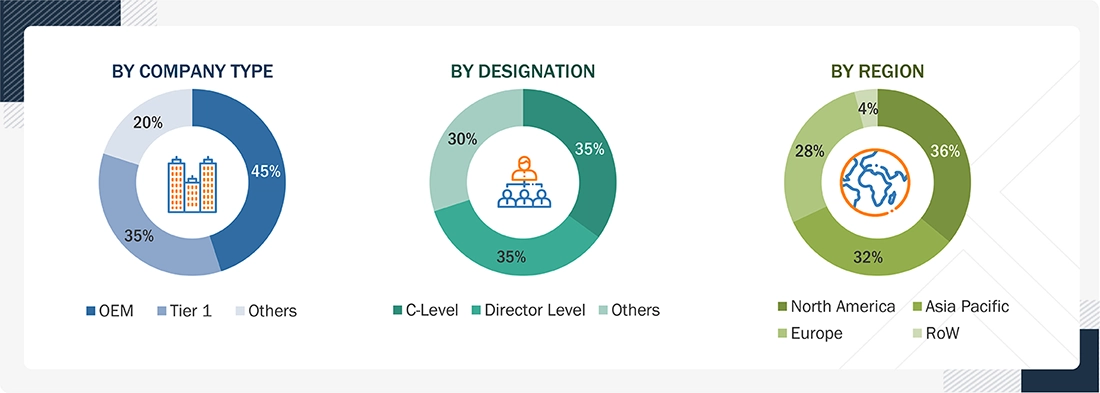
Note: Others in the designation include sales, marketing, and product managers. Others in the company type include infotainment, component, and technology providers. Company tiers are based on the value chain; the revenue of the company is not considered.
OEMs are automotive digital cockpit providers, while Tier I are suppliers of automotive digital cockpit systems and components.
To know about the assumptions considered for the study, download the pdf brochure
Market Size Estimation
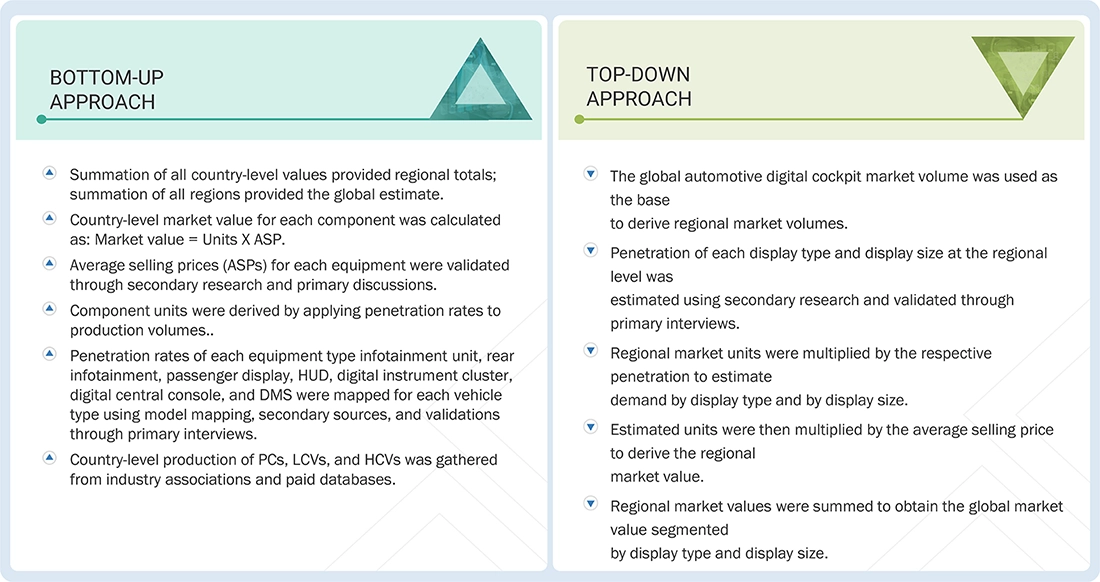
A detailed market estimation approach has been followed to estimate and validate the value of the automotive digital cockpit market and other dependent submarkets, as mentioned below.
- Key players in the market have been identified through secondary research, and their global market ranking has been determined through primary and secondary research.
- The research methodology includes a study of annual and quarterly financial reports and regulatory filings of major market players (public), as well as interviews with industry experts for detailed market insights.
- All vehicle-level penetration rates, percentage shares, splits, and breakdowns for the market have been determined using secondary sources and verified through primary sources.
- All key macro indicators affecting the revenue growth of the market segments and subsegments have been accounted for, viewed in extensive detail, verified through primary research, and analyzed to obtain validated and verified quantitative and qualitative data.
- The gathered market data has been consolidated, enhanced with detailed inputs, analyzed, and presented in this report.
Automotive Digital Cockpit Market : Top-Down and Bottom-Up Approach
Data Triangulation
After deriving the overall size of the automotive digital cockpit market through the established market estimation process, the total market has been segmented into multiple equipment types, vehicle types, electric vehicle types, display types, and display sizes. Market breakdown and data triangulation methods have been applied to validate the distribution of value and volume across all subsegments. The triangulation process incorporates secondary research, primary interviews with OEMs and Tier 1 suppliers, and validation through top-down and bottom-up approaches. These steps ensured accuracy in segment-level statistics and strengthened confidence in the final market estimates.
Market Definition
Automotive digital cockpits comprise integrated electronic interfaces that enhance driver information, connectivity, safety, and in-cabin experience. They include digital instrument clusters, infotainment units, passenger displays, head-up displays, camera-based driver monitoring systems, and other cockpit electronics. These systems consolidate vehicle data, navigation, entertainment, and driver assistance functions to improve situational awareness and personalization.
Key Stakeholders
- Automotive digital cockpit manufacturers
- Parts and component suppliers
- Automotive OEMS
- R&D department
- Automotive association and regulatory bodies
- Infotainment service providers
- Fleet owners
- Telecom companies
Report Objectives
- To define, describe, and forecast the automotive digital cockpit market by equipment, electric vehicle (EV) type, vehicle type, display type, display size, and application in terms of value and volume
- To describe and forecast the size of the automotive digital cockpit market, by four regions: North America, Europe, the Asia Pacific, and the Rest of the World (RoW), along with their respective countries, in terms of value and volume
- To provide detailed information regarding drivers, restraints, opportunities, and challenges influencing market growth
- To strategically analyze micromarkets with respect to individual growth trends, prospects, and contributions to the overall market size
- To study the complete value chain of the market
- To analyze opportunities for stakeholders by identifying high-growth segments of the market
- To strategically profile the key players and comprehensively analyze their market positions in terms of their ranking and core competencies
- To analyze competitive developments, such as product launches, acquisitions, agreements, and partnerships, in the market
- To provide ecosystem analysis, case study analysis, patent analysis, technology analysis, impact of 2025 US tariffs, key conferences and events, and regulations pertaining to the market under study
Available customizations:
With the given market data, MarketsandMarkets offers customizations according to the specific requirements of companies. The following customization options are available for the report:
- Detailed analysis and profiling of additional market players based on various blocks of the supply chain
Get the Full Automotive Digital Cockpit Market Report
Full forecast, segment splits, and company analysis for all Automotive Digital Cockpit Market.
- China Automotive Digital Cockpit Market
- India Automotive Digital Cockpit Market
- Japan Automotive Digital Cockpit Market
- South Korea Automotive Digital Cockpit Market
- Thailand Automotive Digital Cockpit Market
- Canada Automotive Digital Cockpit Market
- Mexico Automotive Digital Cockpit Market
- US Automotive Digital Cockpit Market
- Germany Automotive Digital Cockpit Market
- France Automotive Digital Cockpit Market
- Rest Of Asia Pacific Automotive Digital Cockpit Market
- Italy Automotive Digital Cockpit Market
- Spain Automotive Digital Cockpit Market
- UK Automotive Digital Cockpit Market
- Russia Automotive Digital Cockpit Market
- Brazil Automotive Digital Cockpit Market
- Iran Automotive Digital Cockpit Market
Need a Tailored Report?
Customize this report to your needs
Get 10% FREE Customization
Customize This Report
