
Japan Event Management Software Market (2026-2031)

The Japan Event Management Software Market was valued at $691.5 Million in 2026 and projected to reach to $1293.7 Million by 2031, representing a compound annual growth rate of CAGR 13.3%. Japan's event management software market is poised for sustained expansion as organizations across corporate, hospitality, and entertainment sectors increasingly digitize their event operations.


| Market Size in | USD 26.32 MN |
| Market Forecast in | |
| CAGR | |
| Forecast Period | |
| Units Considered | Value (USD MN) |
Japan Event Management Software Market Trends and Insights
- This expansion reflects Japan's increasing adoption of digital solutions for corporate events, conferences, and experiential marketing initiatives.
- Japan's market growth is driven by the nation's emphasis on technological innovation and the rising demand for seamless event orchestration across hybrid and in-person formats. The 13.3% compound annual growth rate (CAGR) demonstrates Japan's commitment to modernizing event operations and enhancing attendee engagement through software-driven platforms.
- Japan's event management software sector benefits from strong enterprise spending, particularly among large corporations and event organizers seeking to optimize logistics, registration, and post-event analytics.
- By 2031, Japan is expected to solidify its position as a key market within the Asia Pacific region, with continued investment in cloud-based and AI-enabled event solutions..
Key Market Statistics
- CAGR (2026-2031) CAGR 13.3%
- Market Size, 2026 ~USD 691.5 Million
- Forecast, 2031 ~USD 1293.7 Million
- Country Japan
Japan Event Management Software Market Overview
Market Valuation Growth :
Japan's event management software market is valued at USD 691.5 million in 2026 and is projected to reach USD 1,293.7 million by 2031, representing a robust 13.3% CAGR over the forecast period.
Digital Transformation Adoption :
Japanese enterprises are increasingly embracing digital solutions for corporate events, conferences, and experiential marketing, driven by the nation's strong emphasis on technological innovation and modernization.
Competitive Growth Rate :
Japan's market CAGR of 13.3% demonstrates solid growth momentum, though slightly below the global average of 14.6%, indicating steady regional demand and market maturation.
Enterprise Event Focus :
The market is primarily driven by large Japanese corporations and event organizers seeking advanced software solutions to streamline event planning, registration, and attendee engagement across hybrid and in-person formats.
Japan Event Management Software Market Dynamics
- The market's growth trajectory reflects Japan's commitment to technological advancement and the rising complexity of managing multi-channel events in a post-pandemic landscape.
- Japanese enterprises are investing in sophisticated event management platforms to enhance attendee experiences, improve operational efficiency, and gather actionable insights from event data. Looking ahead to 2031, Japan's market will benefit from continued digital transformation initiatives, growing adoption of AI-powered event analytics, and the integration of virtual and hybrid event capabilities.
- The nation's strong IT infrastructure and high digital literacy rates position it as a key growth market in the Asia-Pacific region, with increasing demand from mid-market companies seeking scalable event management solutions..
Market Ecosystem
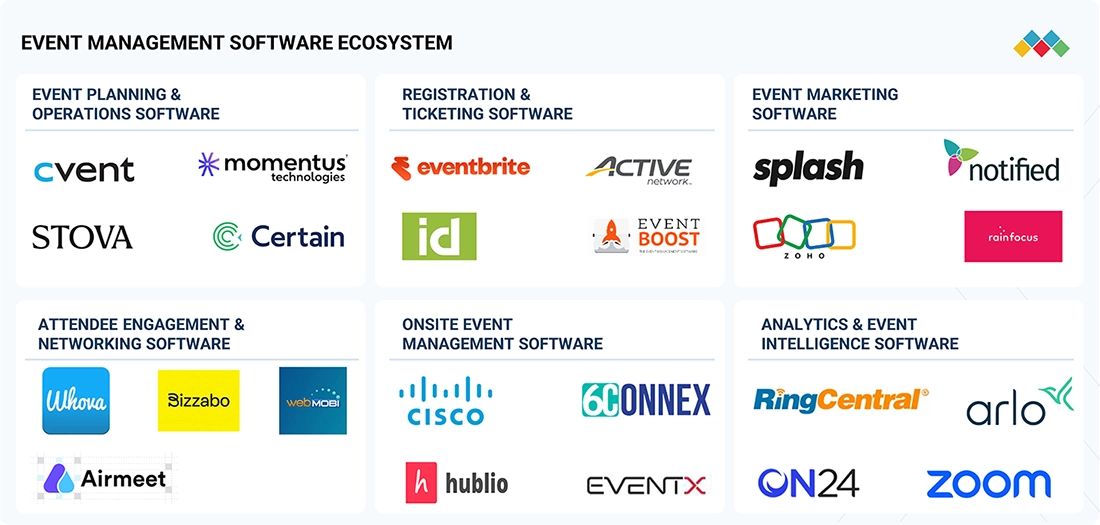
EVENT MANAGEMENT SOFTWARE MARKET: COMMERCIAL USE CASES ACROSS INDUSTRIES
| COMPANY | USE CASE DESCRIPTION | BENEFITS |
|---|---|---|
 |
Cvent and Capital Group centralized and scaled the company’s global meetings and events program through an integrated event management platform covering registration, attendee engagement, venue sourcing, onsite management, workflow automation, and reporting. | Executed 3 times more events | Increased client engagement through events by 30 times | Reduced average event cost by 66% | Established a unified source of attendee and event data | Automated venue sourcing, registration, badge printing, attendance tracking, and reporting processes. |
 |
Bizzabo and Experity planned, executed, and measured the company’s inaugural two-day Urgent Care Connect healthcare conference using Bizzabo’s Event Experience OS, registration, onsite management, and reporting capabilities. | Generated 19 times ROI from the event | Influenced USD 9 million in sales pipeline | Generated USD 5.4 million in post-event pipeline | Increased the closed/won rate by 30% | Generated USD 80,000 in sponsorship revenue | Hosted 365 attendees. |
 |
RainFocus and Ellucian enhanced the Ellucian Live conference through a mobile event application, integrated attendee agendas, session catalogs, surveys, meeting scheduling, and chat-based networking capabilities. | Achieved 87.6% mobile application adoption among attendees | Increased the odds of attendees registering for meetings by 231% | Increased the likelihood of attendees attending meetings by 134% | Improved session participation and networking | Increased sponsorship and exhibitor engagement value |
 |
vFairs and Semex transformed the company’s annual distributor and seller conference into an interactive global virtual event featuring customized virtual spaces, exhibitor booths, live sessions, chatrooms, networking, and single sign-on registration. | Increased attendance from approximately 150 to 500 participants | Expanded the event’s geographic reach to global distributors and partners | Delivered a stronger and more engaging sales message | Enabled attendees to access recorded sessions conveniently | Improved international networking and knowledge exchange. |
Logos and trademarks shown above are the property of their respective owners. Their use here is for informational and illustrative purposes only.
Related Ecosystem
Cloud Computing
- Software as A Service (SaaS)
- Natural Language Processing (NLP)
- Platform as A Service (PaaS)
- Machine Learning
- Supply Chain Management
- International Business Machines Corporation
- MICROSOFT CORPORATION
- Oracle Corporation
- Amazon.com, Inc.
Digitalization And Iot
- Sensors
- Remote Monitoring
- Supply Chain Management
- Passenger Information System (PIS)
- Platform as A Service (PaaS)
- International Business Machines Corporation
- Cisco Systems, Inc.
- MICROSOFT CORPORATION
- Oracle Corporation
- Siemens ag
Software And Services
- Natural Language Processing (NLP)
- Machine Learning
- Supply Chain Management
- Predictive Analytics
- Image Sensors
- International Business Machines Corporation
- MICROSOFT CORPORATION
- Oracle Corporation
- SAP SE
- Amazon.com, Inc.
Key Takeaways
- Japan's event management software market will nearly double from $691.5M (2026) to $1,293.7M (2031), representing a 13.3% CAGR.
- Japan's market growth is fueled by enterprise demand for hybrid event solutions and digital transformation initiatives across corporate sectors.
- Japan's adoption of cloud-based and AI-powered event platforms is accelerating, driven by the need for real-time analytics and attendee personalization.
- Japan's position within Asia Pacific strengthens as local vendors and international players expand offerings tailored to the Japanese market's unique requirements.
Event Management Software Market Report Scope
| Report Metric | Details |
|---|---|
| Base Year | 2026 |
| Fastest Growing Segment | AI-ENABLED EVENT MANAGEMENT SOFTWARE (Technology Type) |
| Forecast Period | 2026-2031 |
| Growth Rate | CAGR of 14.6% from 2026 to 2031 |
| Largest Segment | SOFTWARE (Offering) |
| Market Size Base Year (Billions) | ~USD 18.62 (2026) |
| Revenue Forecast (Billions) | ~USD 36.8 (2031) |
| Segments Covered | Offering, Service, Professional Service, Managed Service, Software Type, Event Type, Deployment Type, Technology Type, Organization Size, End User, Technology, Corporate Enterprise |
Japan Event Management Software Market Report Segmentation
12 segment dimensions are covered across the global market.
By Offering
- Service
- Services
- Software
By Service
- Managed Service
- Managed Services
- Professional Service
- Professional Services
By Professional Service
- Consulting
- Deployment & Integration
- Support & Maintenance
By Managed Service
- Managed Event Operations
- Platform Administration
- Technical Support
By Software Type
- Analytics, AI & Event Intelligence
- Analytics, AI, And Event Intelligence
- Attendee Engagement & Networking
- Event Marketing
- Event Planning & Operations
- On-Site Event Management
- Other Software
- Registration & Ticketing
- Virtual & Hybrid Event Platforms
By Event Type
- Conferences
- Corporate Meetings
- Entertainment & Sports Events
- Government Events
- Product Launches
- Trade Shows & Exhibitions
By Deployment Type
- Cloud
- On-Premises
- Service
- Software
By Technology Type
- AI-Enabled Event Management Software
- Conventional Event Management Software
By Organization Size
- Large Enterprises
- Smes
By End User
- Corporate Enterprises
- Education Institutions
- Event Management Companies
- Sports & Cultural Organizations
By Technology
- AI-Enabled Event Management Software
- Conventional Event Management Software
By Corporate Enterprise
- Bfsi
- Hospitality
- It & Telecom
- Manufacturing
- Media & Entertainment
- Retail & E-Commerce
Target Audience
- Event Management Software Vendors : Vendors seeking to enter or expand in Japan need market-specific data on sizing, growth rates, and competitive dynamics to develop localized solutions and establish market presence in this high-growth segment.
- Japanese Enterprise Event Teams : Corporate event managers and procurement teams require market intelligence to benchmark software solutions, understand industry trends, and justify investments in modern event management platforms to leadership.
- Investment & Private Equity Firms : Investors evaluating opportunities in Japan's ICT sector need validated market data, growth projections, and competitive landscape analysis to assess the viability and ROI potential of event management software companies.
- System Integrators & Consultants : Japanese IT consultants and system integrators need market insights to advise clients on event technology adoption, identify emerging solutions, and position themselves as trusted advisors in the growing market.
- Conference & Hospitality Operators : Japanese hotels, convention centers, and event venues require market data to understand software adoption trends, competitive offerings, and technology investments needed to enhance their event services and competitiveness.
Reasons to Buy this Report
- Market Size & Growth Validation : Obtain precise market valuation data for Japan (USD 691.5M in 2026) and verified forecast projections through 2031, enabling accurate business planning and investment decisions specific to the Japanese market.
- Competitive Positioning Intelligence : Understand Japan's 13.3% CAGR relative to global benchmarks (14.6%), helping identify market gaps, competitive advantages, and opportunities for differentiation in the Japanese event management software landscape.
- Localized Market Insights : Access Japan-specific analysis of digital adoption trends, corporate event spending patterns, and technology preferences that inform go-to-market strategies and product localization for Japanese enterprises.
- Strategic Investment Guidance : Make informed decisions about market entry, expansion, or partnership opportunities in Japan with comprehensive data on market maturity, growth drivers, and sector-specific demand across corporate and experiential segments.
- Forecast-Driven Planning : Leverage detailed 5-year projections showing Japan's market expansion to USD 1,293.7M by 2031, enabling long-term resource allocation, product development roadmaps, and revenue forecasting aligned with regional growth.
Frequently asked questions
What is the current size of Japan's event management software market?
Japan's event management software market is valued at USD 691.5 million in 2026 and is projected to reach USD 1,293.7 million by 2031.
What is the growth rate of Japan's event management software market?
Japan's event management software market is growing at a compound annual growth rate (CAGR) of 13.3% from 2026 to 2031.
What factors are driving growth in Japan's event management software market?
Japan's market growth is driven by increased adoption of hybrid event solutions, digital transformation initiatives, enterprise spending on event technology, and demand for AI-powered analytics and attendee personalization features.
Which segments are leading Japan's event management software market?
Japan's market is led by corporate event management, conference organization, and experiential marketing segments, with strong adoption among large enterprises and event organizers.
How does Japan's market compare to the global event management software market?
Japan's 13.3% CAGR is slightly below the global average of 14.6%, reflecting Japan's mature market dynamics while still demonstrating strong regional growth potential within Asia Pacific.
RESEARCH METHODOLOGY
This research study on the event management software market involved extensive secondary sources, directories, IEEE Communication-Efficient: Algorithms and Systems, International Journal of Innovation and Technology Management, and paid databases. Primary sources were mainly industry experts from the core and related industries, preferred event management software providers, third-party service providers, consulting service providers, end users, and other commercial enterprises. In-depth interviews with primary respondents, including key industry participants and subject matter experts, were conducted to obtain and verify critical qualitative and quantitative information and assess the market’s prospects.
Secondary Research
In the secondary research process, various sources were referred to identify and collect information for this study. Secondary sources included annual reports, press releases, and investor presentations of companies; white papers, journals, and certified publications; and articles from recognized authors, directories, and databases. The data was also collected from other secondary sources, such as journals, government websites, blogs, and vendors’ websites. Additionally, the event management software spending of various countries was extracted from the respective sources.
Primary Research
In the primary research process, various sources from the supply and demand sides were interviewed to obtain qualitative and quantitative information on the market. The primary sources from the supply side included various industry experts, such as Chief Experience Officers (CXOs), Vice Presidents (VPs), and directors specializing in business development, marketing, and event management software service providers. It also included key executives from event management software vendors, system integrators (SIs), professional service providers, industry associations, and other key opinion leaders.
Breakup of primary profiles:
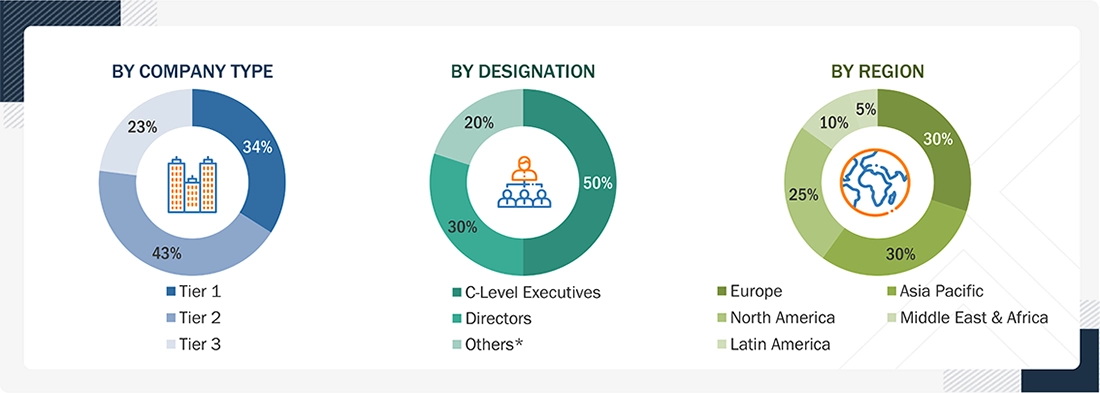
Note: Tier 1 companies’ revenues are more than USD 10 billion; tier 2 companies’ revenues range between USD 1 and 10 billion; and tier 3 companies’ revenues range between USD 500 million and USD 1 billion. Other designations include sales managers, marketing managers, and product managers.
Source: Industry Experts
To know about the assumptions considered for the study, download the pdf brochure
Market Size Estimation
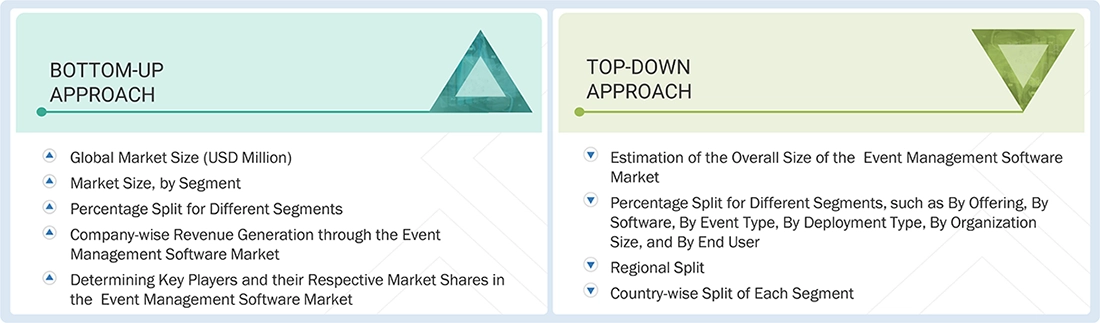
Multiple approaches were adopted to estimate and forecast the event management software market. The first approach involved estimating the market size by companies’ revenue generated through the sale of event management software products.
Market Size Estimation Methodology: Top-down Approach
The top-down approach prepared an exhaustive list of all the vendors offering products in the event management software market. The revenue contribution of the market vendors was estimated through annual reports, press releases, funding, investor presentations, paid databases, and primary interviews. Each vendor’s offerings were evaluated based on platform, degree of customization, type, application, end user, and region. The markets were triangulated through primary and secondary research. The primary procedure included extensive interviews for key insights from industry leaders, such as CIOs, CEOs, VPs, directors, and marketing executives. The market numbers were further triangulated with the existing MarketsandMarkets’ repository for validation.
Market Size Estimation Methodology: Bottom-up Approach
The bottom-up approach identified the adoption rate of the event management software products among different verticals in key countries, considering their regions contributing the most to the market share. For cross-validation, the adoption of event management software products among enterprises and other use cases for their regions was identified and extrapolated. Use cases identified in different areas were weighed for the market size calculation.
Based on the market numbers, the regional split was determined by primary and secondary sources. The procedure included an analysis of the event management software market’s regional penetration. Based on secondary research, the regional spending on Information and Communications Technology (ICT), socioeconomic analysis of each country, strategic vendor analysis of major event management software service providers, and organic and inorganic business development activities of regional and global players were estimated.
Event Management Software Market : Top-Down and Bottom-Up Approach
Data Triangulation
After determining the overall market size using the market size estimation processes as explained above, the market was split into several segments and subsegments. Data triangulation and market breakup procedures were employed, wherever applicable, to complete the overall market engineering process and arrive at the exact statistics of each market segment and subsegment. The overall market size was then used in the top-down procedure to estimate the size of other individual markets via percentage splits of the market segmentation.
Market Definition
The event management software market comprises digital platforms, tools, and services that enable organizations to plan, promote, execute, and analyze events across in-person, virtual, and hybrid formats. The market includes solutions for event planning and operations, registration and ticketing, event marketing, attendee engagement and networking, onsite event management, and analytics and event intelligence, powered by technologies such as artificial intelligence, cloud computing, mobile applications, and data analytics. These platforms facilitate end-to-end event workflows through centralized registration, automated marketing campaigns, mobile event apps, and real-time engagement tools, creating measurable marketing return for event organizers and enhancing attendee participation across corporate, association, and public sector events.
Key Stakeholders
- Event Management Software Vendors
- Event Management Companies & Agencies
- Corporate Enterprises & Marketing Teams
- Professional Conference Organizers
- Exhibition & Trade Show Organizers
- Associations & Non-Profit Organizations
- Education Institutions
- Government Bodies & Public Sector Agencies
- System Integrators & Consulting Firms
- Cloud & Infrastructure Providers
- Payment Gateway & Ticketing Partners
- CRM & Marketing Automation Providers
- Venue Owners & Hospitality Providers
Report Objectives
- To define, describe, and forecast the event management software market based on offering, software, event type, technology, organization size, end user, and region,
- To forecast the market size of the five major regional segments: North America, Europe, Asia Pacific, the Middle East & Africa, and Latin America
- To strategically analyze the market subsegments with respect to individual growth trends, prospects, and contributions to the total market
- To provide detailed information related to the major factors influencing market growth (drivers, restraints, opportunities, and challenges)
- To strategically analyze macro and micro markets with respect to growth trends, prospects, and their contribution to the overall market
- To analyze industry trends, patents and innovations, and pricing data related to the market
- To analyze the opportunities in the market for stakeholders and provide details of the competitive landscape for major players
- To profile key players in the market and comprehensively analyze their market share/ranking and core competencies
- To track and analyze competitive developments, such as mergers & acquisitions, product developments, and partnerships & collaborations in the market
Available customizations:
With the given market data, MarketsandMarkets offers customizations as per the company’s specific needs. The following customization options are available for the report:
Product Analysis
- The product matrix provides a detailed comparison of the product portfolio of each company.
Regional Analysis
- Further breakup of the North American event management software market
- Further breakup of the European event management software market
- Further breakup of the Asia Pacific event management software market
- Further breakup of the Middle East & African event management software market
- Further breakup of the Latin American event management software market
Company Information
- Detailed analysis and profiling of additional market players (up to five)
Get the Full Event Management Software Market Report
Full forecast, segment splits, and company analysis for all Event Management Software Market.
- US Event Management Software Market
- Canada Event Management Software Market
- UK Event Management Software Market
- Germany Event Management Software Market
- France Event Management Software Market
- Italy Event Management Software Market
- China Event Management Software Market
- India Event Management Software Market
- South Korea Event Management Software Market
- Brazil Event Management Software Market
- Mexico Event Management Software Market
- UAE Event Management Software Market
- South Africa Event Management Software Market
- Rest Of Europe Event Management Software Market
- Rest Of Asia Pacific Event Management Software Market
- Rest Of Latin America Event Management Software Market
- GCC Event Management Software Market
- Ksa Event Management Software Market
- Other GCC Countries Event Management Software Market
Need a Tailored Report?
Customize this report to your needs
Get 10% FREE Customization
Customize This Report
