
Europe Industrial IoT Market (2024-2029)

The Europe Industrial IoT Market was valued at $43580 Million in 2024 and projected to reach to $60480 Million by 2029, representing a compound annual growth rate of 6.8%. Europe's Industrial IoT market is positioned for steady growth, expanding from $43.58 billion in 2024 to $60.48 billion by 2029 at a 6.8% CAGR.


| Market Size in | USD 26.32 MN |
| Market Forecast in | |
| CAGR | |
| Forecast Period | |
| Units Considered | Value (USD MN) |
Europe Industrial IoT Market Trends and Insights
- Europe is a key hub for advanced manufacturing and digital transformation, driving adoption of IoT solutions across automotive, pharmaceuticals, and energy sectors.
- The region's strong regulatory framework and emphasis on Industry 4.0 initiatives position Europe as a mature yet rapidly evolving market for industrial connectivity and edge computing technologies. During the 2024-2029 forecast period, Europe will experience accelerated IoT deployment driven by sustainability mandates, labor shortages, and the need for operational efficiency.
- European enterprises are increasingly investing in predictive maintenance, real-time monitoring, and data analytics capabilities.
- The region's focus on green manufacturing and circular economy principles further incentivizes Industrial IoT adoption, making Europe a strategic market for semiconductor and electronics vendors targeting enterprise-grade solutions..
Key Market Statistics
- CAGR (2024-2029) 6.8% CAGR
- Market Size, 2024 ~USD 43580 Million
- Forecast, 2029 ~USD 60480 Million
- Geography Europe
Europe Industrial IoT Market Overview
Market Leadership in Advanced Manufacturing :
Europe dominates Industrial IoT adoption in automotive and pharmaceuticals, leveraging its strong engineering heritage and precision manufacturing capabilities to drive IoT integration across production lines.
Regulatory Framework Advantage :
Europe's stringent data protection regulations (GDPR) and Industry 4.0 standards create a competitive advantage, positioning the region as a trusted hub for secure and compliant IoT solutions.
Digital Transformation Investment :
European manufacturers are investing heavily in digital transformation initiatives, with IoT solutions enabling predictive maintenance, energy efficiency, and supply chain optimization across industrial sectors.
Energy Sector Growth Driver :
The transition to renewable energy and smart grid technologies is accelerating Industrial IoT adoption in Europe's energy sector, supporting sustainability goals and operational efficiency.
Europe Industrial IoT Market Dynamics
- The region's mature manufacturing base, combined with strong investments in Industry 4.0 initiatives and digital infrastructure, supports sustained market expansion.
- Key growth drivers include increasing adoption of predictive maintenance solutions, IoT-enabled supply chain visibility, and energy management systems across automotive, pharmaceutical, and industrial sectors. The European market benefits from a robust regulatory environment and emphasis on data security, attracting enterprises seeking compliant IoT deployments.
- However, growth rates remain slightly below the global average of 8.1%, reflecting market maturity and competitive saturation in developed economies.
- Strategic focus on edge computing, 5G integration, and AI-powered analytics will unlock new opportunities for IoT solution providers targeting European industrial enterprises..
Market Ecosystem
Related Ecosystem
Industrial Automation
- Sensors
- Image Sensors
- Manufacturing Execution System (MES)
- Actuators
- Flow Sensors
- Siemens ag
- ABB India Limited
- Emerson Electric Co.
- HONEYWELL INTERNATIONAL INC.
- SCHNEIDER ELECTRIC SE
Industrial Iot
- Sensors
- Pressure Sensors
- Flow Sensors
- Gas Sensors
- Image Sensors
- Siemens ag
- ABB India Limited
- HONEYWELL INTERNATIONAL INC.
- Emerson Electric Co.
- SCHNEIDER ELECTRIC SE
Internet Of Things And M2M
- Sensors
- Cellular Network
- Digital Signal Processor (DSP)
- Global Positioning System (GPS)
- Image Sensors
- MITSUI ELECTRONICS INC
- MICROSOFT CORPORATION
- INTEL CORPORATION
- Amazon.com, Inc.
- Cisco Systems, Inc.
Key Takeaways
- Europe's Industrial IoT market will grow from $43.58B (2024) to $60.48B (2029) at a 6.8% CAGR.
- Europe leads in Industry 4.0 adoption, with strong regulatory support and sustainability-driven IoT investments.
- Automotive, pharmaceuticals, and energy sectors are primary growth drivers for Industrial IoT in Europe.
- Predictive maintenance and real-time monitoring solutions are accelerating IoT deployment across European manufacturing.
Industrial IoT Market Report Scope
| Report Metric | Details |
|---|---|
| Base Year | 2024 |
| Fastest Growing Segment | SERVICES (Platforms) |
| Forecast Period | 2024-2029 |
| Growth Rate | CAGR of 8.1% from 2024 to 2029 |
| Largest Segment | HARDWARE (Offering) |
| Market Size Base Year (Billions) | ~USD 193.95 (2024) |
| Revenue Forecast (Billions) | ~USD 286.3 (2029) |
| Segments Covered | Deployment, Offering, Hardware, Software, Platforms, Vertical, Connectivity Technology |
Europe Industrial IoT Market Report Segmentation
7 segment dimensions are covered across the global market.
By Deployment
- Cloud-Based
- On-Premise
By Offering
- Hardware
- Platforms
- Software
By Hardware
- Connectivity Ic
- Logic Devices
- Memory Devices
- Processor
- Processors
- Sensors
By Software
- Distribution Management System
- Farm Management System
- Manufacturing Execution System
- Outage Management System
- Product Lifecycle Management
- Remote Patient Monitoring
- Retail Management Software
- Scada
- Transit Management System
- Visualization Software
By Platforms
- Application Enablement Platform
- Connectivity Management Platform
- Device Management Platform
- Services
By Vertical
- Agriculture
- Energy
- Healthcare
- Manufacturing
- Metals & Mining
- Oil & Gas
- Retail
- Transportation
By Connectivity Technology
- Wired
- Wireless
Target Audience
- IoT Solution Providers : Develop Europe-specific product roadmaps and localization strategies by understanding regional market dynamics, regulatory requirements, and sector-specific IoT adoption patterns.
- Industrial Equipment Manufacturers : Integrate IoT capabilities into manufacturing equipment targeting European enterprises by leveraging market insights on Industry 4.0 adoption and predictive maintenance demand.
- Enterprise IT Decision Makers : Evaluate IoT investment opportunities and vendor selection criteria with data-driven insights on European market trends, competitive offerings, and ROI benchmarks.
- Consulting & Systems Integrators : Guide client digital transformation initiatives with comprehensive European market intelligence, enabling informed recommendations on IoT architecture and implementation strategies.
- Investment & Strategy Teams : Support M&A, partnership, and investment decisions in European Industrial IoT with detailed market sizing, growth forecasts, and competitive landscape analysis.
Countries within Europe - compare and drill down
| Country | 2025 size (native) |
|---|---|
| Germany | USD 24490 Million |
| UK | USD 15340 Million |
| France | USD 8410 Million |
| Rest Of Europe | USD 12250 Million |
Country market size visualization
Reasons to Buy this Report
- Country-Level Market Breakdown : Access detailed market sizing for Germany, UK, France, and Rest of Europe, enabling targeted go-to-market strategies and competitive positioning in high-value European markets.
- Sector-Specific Growth Drivers : Understand adoption patterns across automotive, pharmaceuticals, energy, and manufacturing sectors unique to Europe, identifying vertical-specific opportunities and investment priorities.
- Regulatory & Compliance Insights : Gain intelligence on GDPR compliance requirements, Industry 4.0 standards, and data sovereignty regulations shaping IoT solution design and deployment strategies in Europe.
- Competitive Landscape Analysis : Benchmark against regional competitors and identify market gaps in European Industrial IoT, supporting product development and partnership strategies for market penetration.
- 5-Year Forecast & Trend Analysis : Leverage comprehensive forecasts through 2029 to plan R&D investments, resource allocation, and expansion timelines aligned with European market growth trajectories.
Frequently asked questions
What is the current size of Europe's Industrial IoT market?
Europe's Industrial IoT market is valued at $43.58 billion in 2024 and is projected to reach $60.48 billion by 2029.
What is the growth rate of Industrial IoT in Europe?
Europe's Industrial IoT market is expected to grow at a compound annual growth rate (CAGR) of 6.8% from 2024 to 2029.
Which industries are driving Industrial IoT adoption in Europe?
Automotive, pharmaceuticals, energy, and advanced manufacturing sectors are the primary drivers of Industrial IoT adoption across Europe.
What are the key growth factors for Industrial IoT in Europe?
Sustainability mandates, Industry 4.0 initiatives, labor shortages, and the need for operational efficiency are key growth factors driving Industrial IoT adoption in Europe.
How does Europe's Industrial IoT growth compare to global trends?
Europe's 6.8% CAGR is slightly lower than the global 8.1% CAGR, reflecting Europe's mature market status and higher baseline adoption rates.
RESEARCH METHODOLOGY
The study involved four major activities in estimating the current size of the industrial IoT market-exhaustive secondary research collected information on the market and its peer and parent markets. The next step was to validate these findings, assumptions, and sizing with industry experts across the value chain through primary research. Both top-down and bottom-up approaches were employed to estimate the total market size. After that, market breakdown and data triangulation were used to estimate the market size of segments and subsegments.
Secondary Research
Various secondary sources have been referred to in the secondary research process for identifying and collecting information important for this study. These secondary sources include high-speed data converter technology journals and magazines, annual reports, press releases, investor presentations of companies, white papers, certified publications and articles from recognized authors, and directories and databases such as Factiva, Hoovers, and OneSource.
Primary Research
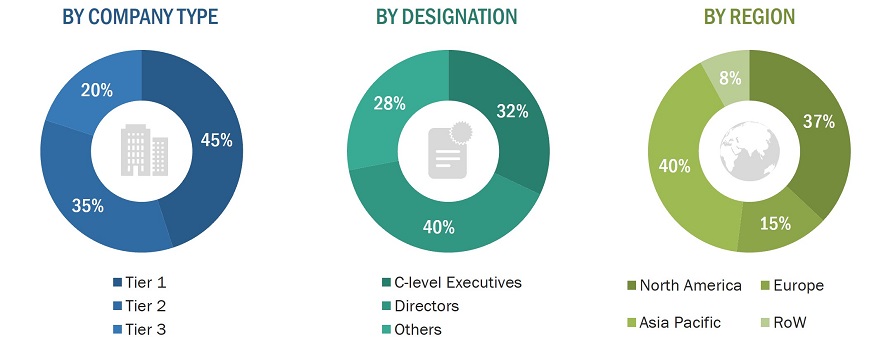
Various primary sources from both supply and demand sides have been interviewed in the primary research process to obtain qualitative and quantitative information important for this report. The primary sources from the supply side included industry experts such as CEOs, VPs, marketing directors, technology and innovation directors, and related executives from key companies and organizations operating in the industrial IoT market. After complete market engineering (including calculations regarding market statistics, market breakdown, market size estimations, market forecasting, and data triangulation), extensive primary research was conducted to gather information as well as to verify and validate the critical numbers arrived at.
To know about the assumptions considered for the study, download the pdf brochure
Market Size Estimation
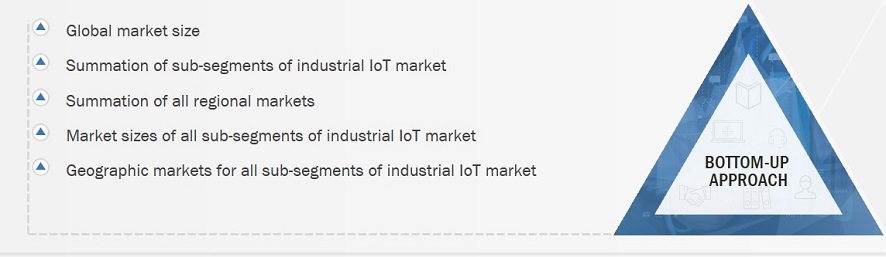
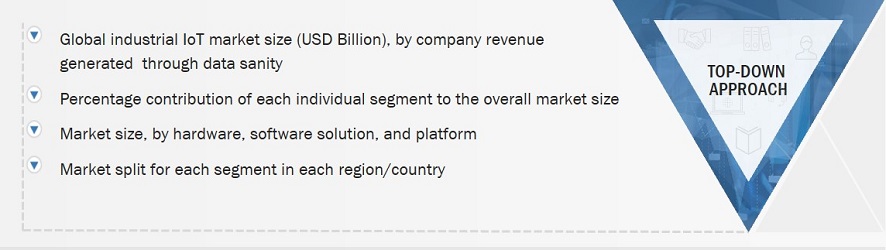
In the complete market estimation process, both top-down and bottom-up approaches have been implemented, along with several data triangulation methods, to estimate and validate the size of the industrial IoT market and other dependent submarkets listed in this report.
- Extensive secondary research has identified key players in the industry and market.
- In terms of value, the industry’s supply chain and market size have been determined through primary and secondary research processes.
- All percentage shares, splits, and breakdowns have been determined using secondary sources and verified through primary sources.
Industrial Iot Market: Bottom-Up Approach
Industrial Iot Market: Top-Down Approach
Data Triangulation
After arriving at the overall market size from the estimation process explained above, the global market has been split into several segments and subsegments. Market breakdown and data triangulation procedures have been employed wherever applicable to complete the overall market engineering process and arrive at exact statistics for all segments and subsegments. The data has been triangulated by studying several factors and trends identified from both the demand and supply sides.
Market Definition
Industrial Internet of Things (IIoT) can be defined as an environment wherein complex industrial systems are networked together in a way that their sensor data is transmitted over the Internet for remote monitoring and performance analysis. In this research study, the IIoT market has been analyzed for the manufacturing, energy, oil & gas, metals & mining, transportation, healthcare, retail, and agriculture verticals. Sensors and networking technologies are the key IIoT enablers in each of these verticals.
Key Stakeholders
- Semiconductor component manufacturers and distributors
- Industrial automation equipment providers
- Semiconductor component providers
- Companies providing wired and wireless connectivity services
- Software application and platform providers
- Data analytics and cloud computing solution providers
- Original design manufacturers (ODM) and original equipment manufacturers (OEM) providing technology solutions
- Intellectual property (IP) core and license providers
- Research organizations and consulting companies
- Government bodies, such as regulating authorities and policymakers
- Venture capitalists and private equity firms
- Associations, organizations, and alliances related to IIoT
- End users of IIoT solutions across different verticals
Report Objectives
The following are the primary objectives of the study.
- To forecast the size of the industrial IoT market, in terms of value, based on offering, connectivity technology, deployment, vertical, and region
- To define, describe, and forecast the industrial IoT market size, in terms of volume, based on hardware
- To provide detailed information regarding the drivers, restraints, opportunities, and challenges influencing the growth of the market
- To study the complete value chain and related industry segments and conduct a value chain analysis of the industrial IoT market landscape
- To describe and forecast the market, in terms of value, for various segments across four main regions: North America, Asia Pacific, Europe, and Rest of the World (RoW)
- To strategically analyze the ecosystem, regulatory landscape, patent landscape, Porter’s Five Forces, import and export scenarios for products covered under HS code 903190 trade landscape, and case studies pertaining to the market under study
- To strategically analyze micromarkets1 with respect to individual growth trends, prospects, and their contributions to the overall market
- To analyze opportunities for stakeholders by identifying high-growth segments in the market
- To strategically profile the key players and provide a detailed competitive landscape of the industrial IoT market
- To analyze strategic approaches adopted by the leading players in the industrial IoT market, including product launches, recent developments, and acquisitions
Available Customizations
With the given market data, MarketsandMarkets offers customizations according to a company’s specific needs. The following customization options are available for the report:
Company Information:
- Detailed analysis and profiling of additional market players (up to 5)
Get the Full Industrial IoT Market Report
Full forecast, segment splits, and company analysis for all Industrial IoT Market.
- US Industrial IoT Market
- Canada Industrial IoT Market
- Mexico Industrial IoT Market
- Germany Industrial IoT Market
- UK Industrial IoT Market
- France Industrial IoT Market
- Rest Of Europe Industrial IoT Market
- China Industrial IoT Market
- Japan Industrial IoT Market
- India Industrial IoT Market
- South Korea Industrial IoT Market
- Rest Of Asia Pacific Industrial IoT Market
- GCC Countries Industrial IoT Market
- South America Industrial IoT Market
Need a Tailored Report?
Customize this report to your needs
Get 10% FREE Customization
Customize This Report
