
Europe Laboratory Information Management System Market (2025-2030)

The Europe Laboratory Information Management System Market was valued at $728.5 Million in 2025 and projected to reach to $1301 Million by 2030, representing a compound annual growth rate of 12.3%. Europe's Laboratory Information Management System market is positioned for sustained expansion, growing from $728.5 million in 2025 to $1,301.0 million by 2030 at a 12.3% CAGR.


| Market Size in | USD 26.32 MN |
| Market Forecast in | |
| CAGR | |
| Forecast Period | |
| Units Considered | Value (USD MN) |
Europe Laboratory Information Management System Market Trends and Insights
- This expansion reflects Europe's strong regulatory environment, advanced healthcare infrastructure, and increasing demand for digitalized laboratory operations across clinical, pharmaceutical, and research institutions.
- Europe's adoption of LIMS solutions is driven by stringent compliance requirements, including ISO and CE marking standards, which necessitate sophisticated data management and traceability systems. The European market benefits from significant investments in healthcare IT modernization and the region's emphasis on precision medicine and personalized diagnostics.
- Europe's pharmaceutical and biotechnology sectors are major contributors to LIMS adoption, alongside growing implementation in clinical laboratories and academic research centers.
- The 12.3% compound annual growth rate through 2030 underscores Europe's commitment to laboratory automation and digital transformation, positioning the region as a key growth market within the global LIMS landscape..
Key Market Statistics
- CAGR (2025-2030) 12.3% CAGR
- Market Size, 2025 ~USD 728.5 Million
- Forecast, 2030 ~USD 1301 Million
- Geography Europe
Europe Laboratory Information Management System Market Overview
Strong Regulatory Compliance Drivers :
Europe's stringent regulatory framework, including GDPR and IVD Regulation, mandates advanced LIMS solutions for data management and laboratory operations, creating sustained demand across clinical and pharmaceutical sectors.
Germany Leads Regional Market :
Germany dominates Europe's LIMS market with $183.6 million in 2025, driven by its robust pharmaceutical industry, advanced healthcare infrastructure, and high adoption of digital laboratory solutions.
Rapid Digital Transformation :
European laboratories are accelerating digitalization initiatives to improve operational efficiency, reduce turnaround times, and enhance data traceability, supporting consistent 12.3% CAGR growth through 2030.
Pharmaceutical & Research Sector Growth :
Expansion in pharmaceutical R&D, clinical diagnostics, and biomedical research institutions across Europe is driving LIMS adoption for complex sample management and regulatory compliance requirements.
Europe Laboratory Information Management System Market Dynamics
- This growth is underpinned by Europe's advanced healthcare infrastructure, stringent regulatory requirements, and widespread digital transformation initiatives across clinical laboratories, pharmaceutical companies, and research institutions.
- The region's commitment to data security and compliance standards continues to drive investment in sophisticated LIMS platforms. Key growth catalysts include increasing laboratory automation, rising demand for integrated laboratory workflows, and the expansion of personalized medicine and genomic testing.
- European laboratories are prioritizing cloud-based LIMS solutions and AI-enabled analytics to enhance operational efficiency.
- With Germany, UK, and France leading adoption, the market is expected to see accelerated penetration in mid-sized laboratories and emerging research centers across Central and Eastern Europe..
Market Ecosystem
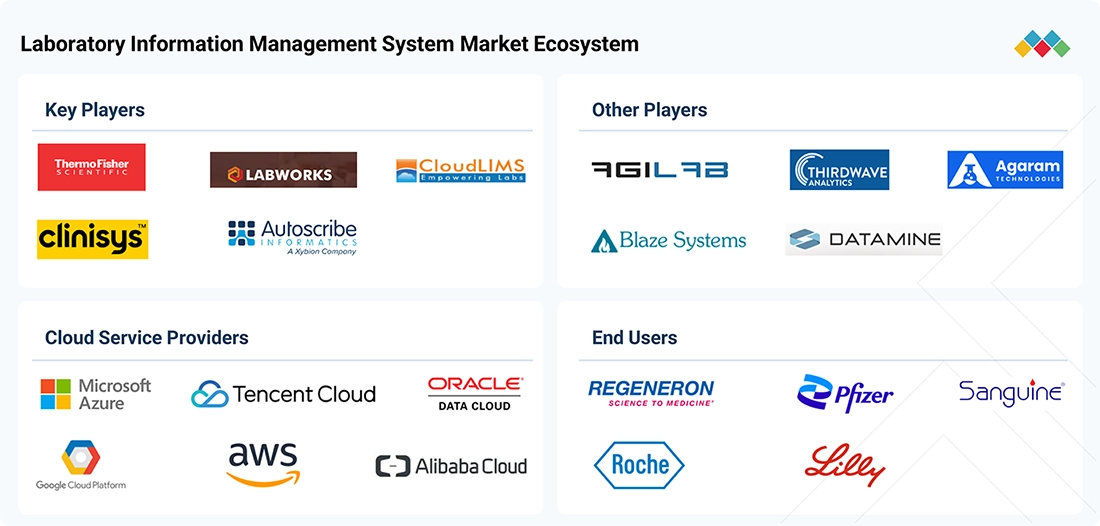
LABORATORY INFORMATION MANAGEMENT SYSTEM MARKET: COMMERCIAL USE CASES ACROSS INDUSTRIES
| COMPANY | USE CASE DESCRIPTION | BENEFITS |
|---|---|---|
 |
Automates sample management, testing, lot/batch tracking, stability studies, and laboratory workflows across pharmaceutical, clinical, food, environmental, and industrial laboratories. | Faster turnaround times, reduced manual errors, improved sample traceability, real-time laboratory visibility, and stronger regulatory compliance. |
 |
Supports end-to-end laboratory management across pharma/biotech R&D, QC, manufacturing, clinical and molecular diagnostics, including sample, batch, stability, and consumables management. | Faster deployment, standardized workflows, improved data accuracy and visibility, streamlined compliance, and higher laboratory productivity. |
 |
SampleManager LIMS manages samples, instruments, equipment, inventory, SOPs, testing, and reporting, with integration across instruments, CDS, ERP, PIMS, and MES for multi-site laboratories. | Improved laboratory efficiency, data integrity and traceability, automated workflows, stronger compliance, and faster, better-informed decisions. |
 |
Manages the complete specimen lifecycle for clinical laboratories from collection and receiving through testing, processing, storage, and referral while automating laboratory processes and workflows. | Improved sample accuracy and traceability, faster testing and reporting, simplified compliance, and reduced workflow inefficiencies. |
 |
Agilent SLIMS/OpenLab Sync manages samples, workflows, and data across applications such as NGS, biobanking, analytical testing, and research, with integration to instruments and other laboratory systems. | End-to-end sample traceability, reduced manual intervention and errors, faster workflows, improved data integrity, and better integration across laboratory systems. |
Logos and trademarks shown above are the property of their respective owners. Their use here is for informational and illustrative purposes only.
Related Ecosystem
Healthcare Analytics
- Machine Learning
- Natural Language Processing (NLP)
- Blood Pressure Monitors
- Computed Tomography (CT)
- Magnetic Resonance Imaging (MRI)
- Oracle Corporation
- PHILIPS HEALTHCARE
- Siemens healthineers
- International Business Machines Corporation
- EPIC SYSTEMS CORPORATION
Healthcare It
- Computed Tomography (CT)
- Machine Learning
- Magnetic Resonance Imaging (MRI)
- Natural Language Processing (NLP)
- Predictive Analytics
- CERNER CORPORATION
- PHILIPS HEALTHCARE
- Oracle Corporation
- GE HealthCare Technologies Inc.
- Siemens healthineers
In Vitro Diagnostics
- Polymerase Chain Reaction (PCR)
- Enzyme-Linked Immunosorbent Assay (ELISA)
- Dna Microarrays
- Assay Kits
- Microarrays
- ROCHE HOLDINGS AG
- Thermo Fisher Scientific Inc.
- Danaher Corporation
- Abbott Laboratories
- Biomerieux s.a.
Key Takeaways
- Europe's LIMS market will nearly double from $728.5M (2025) to $1,301M (2030), reflecting strong regional demand for laboratory digitalization.
- Europe's stringent regulatory framework and compliance requirements drive sustained adoption of LIMS across pharmaceutical, clinical, and research laboratories.
- Europe's pharmaceutical and biotechnology sectors are primary growth engines, supported by investments in precision medicine and personalized diagnostics.
- Europe's 12.3% CAGR demonstrates the region's leadership in healthcare IT modernization and laboratory automation within the global market.
Laboratory Information Management System Market Report Scope
| Report Metric | Details |
|---|---|
| Base Year | 2025 |
| Fastest Growing Segment | CLOUD LIMS (Deployment Model) |
| Forecast Period | 2025–2030 |
| Growth Rate | CAGR of 12.5% from 2025 to 2030 |
| Largest Segment | LIFE SCIENCES (Industry) |
| Market Size Base Year (Billions) | ~USD 2.88 (2025) |
| Revenue Forecast (Billions) | ~USD 5.19 (2030) |
| Segments Covered | Component, Type, Deployment Model, Industry, End-Use Industry |
Europe Laboratory Information Management System Market Report Segmentation
5 segment dimensions are covered across the global market.
By Component
- Services
- Software
- Support
By Type
- Academic Research Institutes
- Biobanks & Biorepositories
- Broad-Based Lims
- Clinical Research Laboratories
- Contract Service Organizations
- Industry-Specific Lims
- Infrastructure-As-A-Service
- Ngs Laboratories
- Pharmaceutical & Biotechnology Companies
- Platform-As-A-Service
- Software-As-A-Service
- Toxicology Laboratories
By Deployment Model
- Cloud Lims
- On-Premise Lims
- Remotely Hosted Lims
By Industry
- Chemicals
- Environmental Testing
- Food & Beverage And Agriculture
- Forensics
- Life Sciences
- Other Industries
- Petrochemicals And Oil & Gas
By End-Use Industry
- Academic Research Institutes
- Biobanks & Biorepositories
- Clinical Research Laboratories
- Contract Service Organizations
- Ngs Laboratories
- Pharmaceutical & Biotechnology Companies
- Toxicology Laboratories
EUROPE: LABORATORY INFORMATION SYSTEM (LIMS) MARKET, BY INDUSTRY, 2023–2030
| Segment | 2023 | 2024 | 2025 | 2026 | 2027 | 2028 | 2030 | CAGR (%) |
|---|---|---|---|---|---|---|---|---|
| CHEMICALS | 47.2 | 52.9 | 59.2 | 66.3 | 73.9 | 82.4 | 100.2 | 11.1 |
| ENVIRONMENTAL TESTING | 30.3 | 33.5 | 37.1 | 40.9 | 45.1 | 49.6 | 58.8 | 9.7 |
| FOOD & BEVERAGE AND AGRICULTURE | 89.3 | 101.9 | 116.1 | 132.1 | 150 | 170 | 214.3 | 13 |
| FORENSICS | 5.9 | 6.4 | 7 | 7.7 | 8.3 | 9.1 | 10.5 | 8.5 |
| LIFE SCIENCES | 318.8 | 360.1 | 408.9 | 463.8 | 524.9 | 593.1 | 742.3 | 12.7 |
| OTHER INDUSTRIES | 7.4 | 10.2 | 11 | 11.7 | 12.6 | 13.4 | 14.9 | 6.4 |
| PETROCHEMICALS AND OIL & GAS | 69.5 | 78.8 | 89.2 | 101 | 114 | 128.4 | 159.9 | 12.4 |
| TOTAL | 568.3 | 643.9 | 728.5 | 823.4 | 928.7 | 1046 | 1301 | 12.3 |
REST OF EUROPE: LABORATORY INFORMATION SYSTEM (LIMS) MARKET, BY INDUSTRY, 2023–2030
| Segment | 2023 | 2024 | 2025 | 2026 | 2027 | 2028 | 2030 | CAGR (%) |
|---|---|---|---|---|---|---|---|---|
| CHEMICALS | 3.41 | 3.81 | 4.24 | 4.71 | 5.22 | 5.78 | 6.95 | 10.4 |
| ENVIRONMENTAL TESTING | 1.9 | 2.09 | 2.3 | 2.52 | 2.76 | 3.02 | 3.54 | 9 |
| FOOD & BEVERAGE AND AGRICULTURE | 6.22 | 7.05 | 7.98 | 9.03 | 10.19 | 11.48 | 14.29 | 12.4 |
| FORENSICS | 0.3 | 0.32 | 0.35 | 0.38 | 0.41 | 0.44 | 0.51 | 7.7 |
| LIFE SCIENCES | 22.41 | 24.97 | 28.18 | 31.77 | 35.73 | 40.13 | 49.61 | 12 |
| OTHER INDUSTRIES | 0.66 | 1.06 | 1.14 | 1.23 | 1.33 | 1.43 | 1.62 | 7.2 |
| PETROCHEMICALS AND OIL & GAS | 4.85 | 5.46 | 6.15 | 6.91 | 7.76 | 8.69 | 10.69 | 11.7 |
| TOTAL | 39.75 | 44.76 | 50.34 | 56.56 | 63.4 | 70.97 | 87.19 | 11.6 |
Target Audience
- LIMS Software Vendors : Evaluate European market expansion opportunities, identify high-growth countries, and benchmark competitive positioning against regional and global players to optimize product-market fit and sales strategies.
- Healthcare IT Consultants : Leverage detailed market data and regulatory insights to advise European healthcare organizations on LIMS selection, implementation roadmaps, and digital transformation initiatives aligned with compliance requirements.
- Pharmaceutical & Biotech Companies : Assess LIMS investment requirements, understand regional adoption trends, and identify best-in-class solutions to streamline laboratory operations and ensure regulatory compliance across European operations.
- Clinical Laboratory Networks : Understand market dynamics, competitive offerings, and technology trends to make informed decisions on LIMS modernization, integration capabilities, and vendor partnerships across European facilities.
- Healthcare Investment & M&A Teams : Analyze market growth potential, identify acquisition targets, and evaluate investment opportunities in European LIMS providers and healthcare IT companies with strong regional market presence.
Key Companies in the Europe Laboratory Information Management System Market
| Company | HQ | Ownership | Strongest segments |
|---|---|---|---|
| LEIDOS | United States | Public Company | LIMS Software (On-premise),LIMS Software (Cloud – SaaS/PaaS/IaaS),Implementation & Integration Services, |
| IMMUCOR, INC. | United States | Private Company | Transfusion segment software & informatics (NEO/Echo, Capture, blood bank workflows),Transplant & Molecular segment software (Array Imaging System, BASIS database, molecular typing workflows),Services (implementation, integration with LIS/LIMS, validation, training), |
| THERMO FISHER SCIENTIFIC INC. | United States | Public Company | Pharma & Biopharma LIMS (incl. GxP services),NGS & Omics LIMS / Platform for Science,Chemicals, Agri, and Food & Beverage LIMS, |
| STARLIMS CORPORATION | Israel | Private Company | Core LIMS Software (On-premise + Cloud),Implementation, Validation, and Support Services,ELN and Scientific Data Management (SDMS), |
| AGILENT TECHNOLOGIES, INC. | United States | Public Company | LIMS / Lab Information & Workflow Management Software,Informatics-Linked Services (SaaS, validation, consulting, compliance),Informatics-Adjacent Automation & Sample Prep (hardware plus scheduling software), |
| SIEMENS | Germany | Public Company | Software,Services,On-premise, |
LEIDOS
Leidos is a publicly traded U.S. company founded in 1969 with 50,000 employees. The company provides science, engineering, and information technology services primarily to government and commercial customers.
IMMUCOR, INC.
Immucor, Inc. is a private U.S. company founded in 1982 with 1,125 employees. The company develops and manufactures blood typing and transfusion diagnostic products for healthcare providers.
THERMO FISHER SCIENTIFIC INC.
Thermo Fisher Scientific Inc. is a publicly traded U.S. company founded in 1956 with 125,000 employees. The company is a global leader in serving science, providing laboratory equipment, reagents, and analytical instruments.
STARLIMS CORPORATION
StarLIMS Corporation is a private Israeli company founded in 1986 with 162 employees. The company develops laboratory information management system (LIMS) software solutions.
AGILENT TECHNOLOGIES, INC.
Agilent Technologies, Inc. is a publicly traded U.S. company founded in 1999 with 18,000 employees. The company provides life sciences, diagnostics, and applied chemical markets with instruments and software.
SIEMENS
Siemens is a publicly traded German company founded in 1847 with 310,312 employees. The company is a global conglomerate providing products and services in electrification, automation, and digitalization.
Countries within Europe - compare and drill down
| Country | 2025 size (native) |
|---|---|
| Germany | USD 183.6 Million |
| UK | USD 120.7 Million |
| France | USD 68 Million |
| Italy | USD 31.8 Million |
| Spain | USD 20.2 Million |
| Rest Of Europe | USD 119.2 Million |
Country market size visualization
Reasons to Buy this Report
- Regional Market Sizing & Forecasts : Obtain precise market valuations for Europe ($728.5M in 2025) and country-level breakdowns including Germany, UK, France, Italy, and Spain with detailed 2030 projections to support strategic planning.
- Regulatory & Compliance Insights : Understand how GDPR, IVD Regulation, and European quality standards shape LIMS adoption and create differentiated market opportunities across clinical, pharmaceutical, and research segments.
- Competitive Landscape Analysis : Identify leading LIMS vendors, emerging players, and market consolidation trends specific to Europe, enabling informed partnership and investment decisions in the region.
- Growth Driver Identification : Analyze key catalysts including digital transformation initiatives, laboratory automation adoption, and personalized medicine expansion driving the 12.3% CAGR across European markets.
- Country-Specific Market Dynamics : Access granular insights into Germany's $183.6M market leadership, UK's $120.7M opportunity, and emerging markets in Central/Eastern Europe to tailor regional go-to-market strategies.
Frequently asked questions
What is the current size of Europe's LIMS market in 2025?
Europe's Laboratory Information Management System market is valued at $728.5 million in 2025, representing a significant portion of the global LIMS market.
What is the projected market size for Europe's LIMS by 2030?
Europe's LIMS market is forecast to reach $1,301.0 million by 2030, reflecting a compound annual growth rate of 12.3% over the five-year period.
What drives LIMS adoption across Europe?
Europe's LIMS adoption is driven by stringent regulatory compliance requirements (ISO, CE marking), healthcare IT modernization initiatives, and the region's focus on precision medicine and personalized diagnostics.
Which sectors are leading LIMS growth in Europe?
Europe's pharmaceutical and biotechnology sectors are primary drivers of LIMS adoption, alongside clinical laboratories and academic research institutions implementing digital laboratory solutions.
How does Europe's LIMS growth compare to global trends?
Europe's 12.3% CAGR is closely aligned with the global 12.5% CAGR, demonstrating that Europe is a key growth market with comparable momentum to worldwide LIMS expansion.
RESEARCH METHODOLOGY
The study involved several key activities to estimate the current size of the laboratory information management system market. We conducted extensive secondary research to gather market information. Next, we validated the findings, assumptions, and size estimates by consulting industry experts across the value chain through primary research. We employed various methods, including top-down and bottom-up approaches, to estimate the overall market size. Next, we used market segmentation and data triangulation techniques to determine the size of specific segments and subsegments within the laboratory information management system market.
Secondary Research
This research study relied heavily on secondary sources, including directories and databases such as Dun & Bradstreet, Bloomberg Business, and Factiva; white papers, annual reports, and companies’ house documents; investor presentations; and SEC filings. The market for companies providing laboratory information management system solutions is assessed using secondary data from paid and free sources. This involves analyzing the product portfolios of major industry players and evaluating these companies based on performance and quality. The secondary research process used various resources to gather information for this study. Sources included annual reports, press releases, investor presentations, white papers, academic journals, certified publications, articles by recognized authors, directories, and databases.
The secondary research process involved reviewing secondary sources to identify and collect information related to the study. These sources included annual reports, press releases, investor presentations of laboratory information management system vendors, forums, certified publications, and whitepapers. Secondary research provided critical information on the industry’s value chain, the total pool of key players, market classification, and segmentation from market- and technology-oriented perspectives.
Primary Research
In the primary research process, we interviewed sources from both the supply and demand sides to obtain qualitative and quantitative information for this report. Primary sources mainly included industry experts from core and related industries, as well as preferred suppliers, manufacturers, distributors, technology developers, researchers, and organizations across all segments of this industry’s value chain. We conducted in-depth interviews with primary respondents, including key industry participants, subject-matter experts (SMEs), C-level executives of key market players, and industry consultants, among others, to obtain and verify critical qualitative and quantitative information and assess prospects. Primary research was conducted to identify segmentation types, industry trends, key players, and key market dynamics such as drivers, restraints, opportunities, challenges, industry trends, and strategies adopted by key players.
After completing the market engineering process, which includes calculations for market statistics, market breakdown, size estimations, forecasting, and data triangulation, we conducted extensive primary research. This research aimed to gather information and verify the critical numbers obtained during the market analysis. Additionally, we conducted primary research to identify market segmentation types, analyze industry trends, evaluate the competitive landscape of laboratory information management systems offered by various players, and understand key market dynamics such as drivers, restraints, opportunities, challenges, industry trends, and strategies employed by key market participants.
In the complete market engineering process, we used top-down and bottom-up approaches and several data triangulation methods to estimate and forecast the overall market segments and subsegments listed in this report. We conducted extensive qualitative and quantitative analysis across the entire market engineering process to identify key information/insights throughout the report.
Breakdown of Primary Respondents:
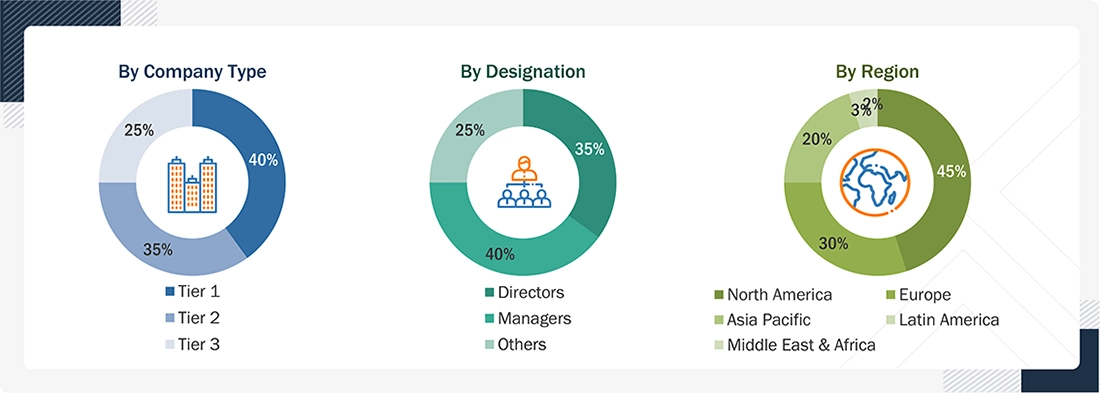
Note 1: Others include sales, marketing, and product managers.
Note 2: Tiers are defined based on a company’s total revenue. As of 2025: Tier 1 = >USD 1 billion, Tier 2 = USD 500 million to USD 1 billion, and Tier 3 = <USD 500 million.
To know about the assumptions considered for the study, download the pdf brochure
Market Size Estimation
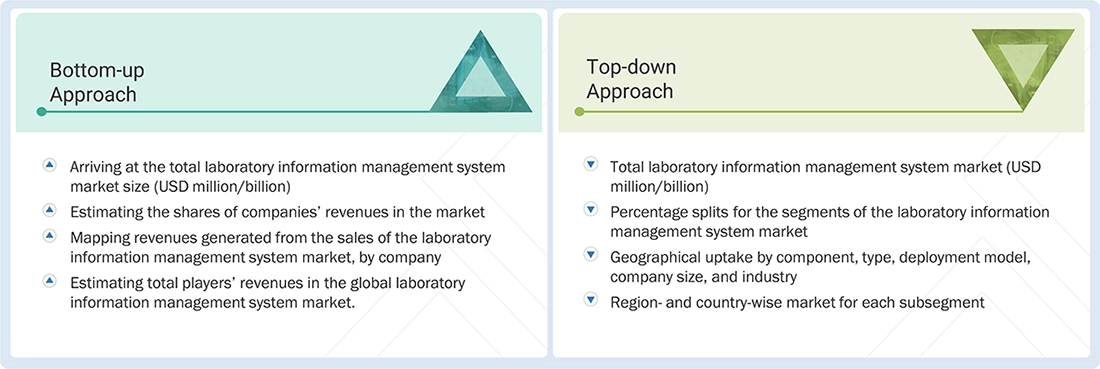
The market size estimates and forecasts in this study are derived through a mix of the bottom-up approach (revenue share analysis of leading players) and the top-down approach (assessment of utilization/adoption/penetration trends by type, component, deployment model, company size, industry, and region).
Data Triangulation
After arriving at the overall market size using the market size estimation processes, the market was split into several segments and subsegments. To complete the overall market engineering process and arrive at the exact statistics of each market segment and subsegment, the data triangulation and market breakdown procedures were employed, wherever applicable. The data was triangulated by studying various factors and trends from the demand and supply sides in the LIMS market.
Market Definition
Laboratory information management systems are software-based solutions designed to streamline and support the complex operations of modern laboratories. These systems provide comprehensive functionalities such as workflow management, data tracking, sample and inventory management, regulatory compliance, and data exchange interfaces.
Key Stakeholders
- Laboratory Information Management System Solution Providers
- Platform Providers
- Technology Providers
- System Integrators
- Pharmaceutical & Biotechnology Companies
- Process Industries
- Forums, Alliances, and Associations
- Distributors
- Venture Capitalists
- Government Organizations
- Institutional Investors and Investment Banks
- Investors/Shareholders
- Consulting Companies
- Raw Material and Component Manufacturers
Report Objectives
- To define, describe, and forecast the global LIMS market based on type, component, deployment model, company size, industry, and region
- To provide detailed information regarding the factors influencing the growth of the market (such as the drivers, restraints, opportunities, and challenges)
- To strategically analyze micromarkets with respect to individual growth trends, prospects, and contributions to the overall LIMS market
- To analyze market opportunities for stakeholders and provide details of the competitive landscape for market leaders
- To forecast the size of the LIMS market in five main regions (along with their respective key countries): North America, Europe, Asia Pacific, Latin America, and the Middle East & Africa
- To profile key players and comprehensively analyze their product portfolios, market positions, and core competencies in the market
- To track and analyze competitive developments such as product launches, expansions, partnerships, agreements, collaborations, and acquisitions in the LIMS market
- To benchmark players within the LIMS market using the Company Evaluation Matrix framework, which analyzes market players on various parameters within the broad categories of business strategy, market share, and product offering
Available customizations:
With the provided market data, MarketsandMarkets offers customizations to meet your company’s specific needs. The following customization options are available for the report:
Company Information
- Detailed analysis and profiling of additional market players (up to 5)
Geographic Analysis
- Further breakdown of the Rest of Europe LIMS market into Denmark, Norway, and others
- Further breakdown of the Rest of Asia Pacific LIMS market into Vietnam, New Zealand, and others
Get the Full Laboratory Information Management System Market Report
Full forecast, segment splits, and company analysis for all Laboratory Information Management System Market.
- US Laboratory Information Management System Market
- Canada Laboratory Information Management System Market
- Germany Laboratory Information Management System Market
- UK Laboratory Information Management System Market
- France Laboratory Information Management System Market
- Italy Laboratory Information Management System Market
- Spain Laboratory Information Management System Market
- Japan Laboratory Information Management System Market
- China Laboratory Information Management System Market
- India Laboratory Information Management System Market
- Brazil Laboratory Information Management System Market
- Mexico Laboratory Information Management System Market
- Rest Of Europe Laboratory Information Management System Market
Need a Tailored Report?
Customize this report to your needs
Get 10% FREE Customization
Customize This Report
