
North America Marine Battery Market (2024-2029)

The North America Marine Battery Market was valued at $149.6 Million in 2024 and projected to reach to $265.6 Million by 2029, representing a compound annual growth rate of 10.0%. North America's marine battery market is positioned for significant expansion, driven by increasing electrification of naval fleets and commercial shipping operations.


| Market Size in | USD 26.32 MN |
| Market Forecast in | |
| CAGR | |
| Forecast Period | |
| Units Considered | Value (USD MN) |
North America Marine Battery Market Trends and Insights
- North America's leadership in this sector is driven by increasing adoption of electric propulsion systems in naval vessels, commercial shipping, and offshore platforms.
- The region's advanced manufacturing capabilities and stringent environmental regulations are accelerating the transition toward sustainable marine power solutions. North America's marine battery market benefits from significant government investments in defense modernization and the electrification of maritime fleets.
- The 10.0% compound annual growth rate reflects North America's commitment to reducing carbon emissions and enhancing operational efficiency across the aerospace and defence sector.
- By 2029, North America is expected to solidify its position as a key hub for marine battery innovation and deployment, supported by major shipbuilding facilities and research institutions..
Key Market Statistics
- CAGR (2024-2029) 10.0% CAGR
- Market Size, 2024 ~USD 149.6 Million
- Forecast, 2029 ~USD 265.6 Million
- Geography North America
North America Marine Battery Market Overview
US Market Dominance :
The United States accounts for $223.9 million of North America's marine battery market, representing 75% of the region's total value and driving innovation in naval electrification and commercial shipping applications.
10% Regional CAGR :
North America's marine battery market is expanding at 10% CAGR through 2029, outpacing the global growth rate of 9.3%, reflecting strong regional demand for sustainable maritime solutions.
Electric Naval Propulsion Leadership :
North American defense and commercial sectors are rapidly adopting electric propulsion systems in naval vessels and offshore platforms, supported by advanced manufacturing infrastructure and regulatory compliance requirements.
Environmental Regulation Drivers :
Stringent environmental regulations in the US and Canada are accelerating the transition from traditional fuel-based systems to battery-powered marine solutions, creating sustained market growth opportunities.
North America Marine Battery Market Dynamics
- The region's technological leadership, combined with substantial government investments in defense modernization and environmental compliance, creates a favorable ecosystem for battery technology adoption.
- The US market's dominance is complemented by Canada's growing participation in sustainable maritime initiatives. By 2029, the North American market is expected to reach $265.6 million, reflecting strong demand from both military and commercial sectors.
- Continued innovation in battery chemistry, energy density improvements, and charging infrastructure development will support this growth trajectory.
- Strategic partnerships between defense contractors, battery manufacturers, and maritime operators will further accelerate market penetration across the region..
Market Ecosystem
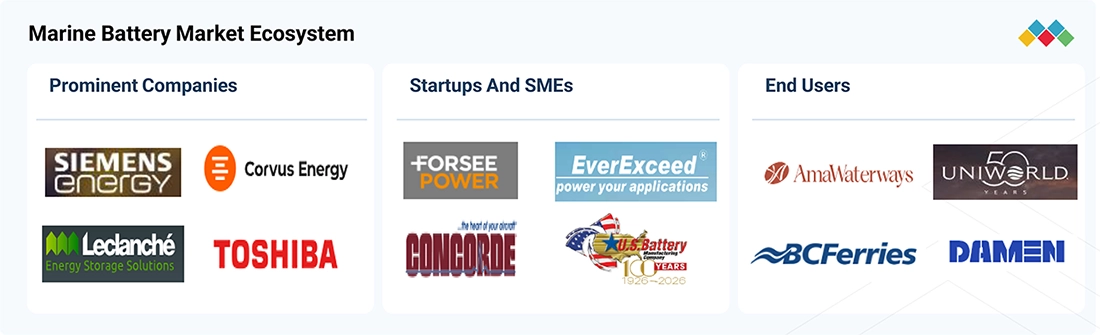
MARINE BATTERY MARKET SIZE, SHARE & TRENDS: COMMERCIAL USE CASES ACROSS INDUSTRIES
| COMPANY | USE CASE DESCRIPTION | BENEFITS |
|---|---|---|
 |
Corvus Energy's Blue Whale marine battery energy storage system is designed for large commercial vessels, including cruise ships, Ro-Ro/Ro-Pax ferries, merchant vessels, and workboats. The modular lithium iron phosphate (LFP) system supports installations exceeding 10 MWh and integrates battery management, thermal runaway protection, and remote monitoring capabilities. It is optimized for long-duration energy storage and low C-rate applications. | Provides scalable, high-capacity energy storage for large vessels requiring extended electric operations. Its modular architecture supports flexible installation and reduced onboard space requirements. Integrated safety systems improve reliability, while battery-powered operations reduce fuel consumption, emissions, and noise during voyages and port stays. |
 |
CATL supplies advanced lithium-ion marine battery systems for electric passenger vessels and commercial ships. In July 2025, its battery technology powered Yujian 77, an all-electric passenger vessel operating in Xiamen Bay. The vessel incorporates a 3,918 kWh battery system using Cell-to-Pack technology and integrated charging architecture, providing an electric cruising range of approximately 100 km. | Enables zero-emission passenger transportation with lower noise and improved onboard comfort. High energy density supports extended electric operating ranges, while integrated charging technology improves operational efficiency. Advanced battery safety features support reliable performance in demanding marine environments and reduce dependence on conventional marine fuels. |
 |
Saft's Seanergy 2.0 lithium-ion marine battery system is designed for fully electric and hybrid vessels, including ferries, tugboats, offshore support vessels, cruise ships, and yachts. The modular nickel manganese cobalt (NMC) battery architecture supports system voltages up to 1,060 V and integrates battery management, safety, and remote condition monitoring capabilities. The system can be configured for propulsion and onboard auxiliary power applications. | Provides compact and scalable energy storage that improves installation flexibility across different vessel types. Its modular design supports easier system integration and retrofit applications, while remote monitoring enhances operational visibility. Battery-powered propulsion reduces fuel consumption, CO2 and NO? emissions, and supports improved vessel energy efficiency. |
 |
EnerSys supplies ODYSSEY Performance and Extreme Marine Dual Purpose batteries for recreational boats, fishing vessels, and other marine applications. These batteries use Thin Plate Pure Lead (TPPL) absorbed glass mat (AGM) technology to combine high engine-starting power with deep-cycle energy storage. The batteries support engine starting, trolling motors, and onboard electronic accessories while offering vibration resistance and sealed construction. | Combines strong engine-starting performance with sustained auxiliary power in a single battery system. TPPL technology supports faster charging, extended cycle life, and improved resistance to vibration and demanding temperatures. Maintenance-free construction reduces servicing requirements and improves reliability for recreational and commercial marine operators. |
 |
GS Yuasa develops and manufactures large-capacity lithium-ion batteries for Japanese Maritime Self-Defense Force submarines through its subsidiary GS Yuasa Technology. The batteries support underwater propulsion and onboard electrical power requirements, replacing conventional lead-acid systems in newer submarine platforms. GS Yuasa is also investing in additional production capacity to support future submarine construction and battery replacement requirements. | Provides high energy storage capacity for demanding underwater operations and supports extended submerged endurance compared with conventional lead-acid battery systems. Lithium-ion technology improves energy storage performance and supports flexible power delivery for propulsion and onboard equipment. Specialized battery engineering and manufacturing capabilities strengthen reliability in demanding naval applications. |
Logos and trademarks shown above are the property of their respective owners. Their use here is for informational and illustrative purposes only.
Related Ecosystem
Defence Platforms And Systems
- Sensors
- Unmanned Ground Vehicles (UGV)
- Fighter Aircraft
- Special Mission Aircraft
- Antennas
- BAE Systems plc
- Thales group
- LOCKHEED MARTIN CORPORATION
- Northrop Grumman Corporation
- L3Harris Technologies, Inc.
Marine
- Tankers
- Fuel Cell
- HVAC System
- Navigation Systems
- Sensors
- Wartsila
- Kongsberg Gruppen ASA
- L3Harris Technologies, Inc.
- ABB India Limited
- Thales group
Engines And Gensets
- Fuel Cell
- Agricultural Tractors
- Analytics Software
- Biometric Systems
- Cogeneration
- General Electric Company
- Wartsila
- Siemens ag
- Cummins Inc.
- UNIPER GLOBAL COMMODITIES SE
Key Takeaways
- North America's marine battery market is valued at $149.6 million in 2024 and will reach $265.6 million by 2029, representing a 10.0% CAGR.
- North America leads in marine electrification due to advanced manufacturing, defense spending, and strict environmental compliance standards.
- Government initiatives and naval modernization programs are primary growth catalysts for North America's marine battery adoption.
- North America is positioned as a global innovation hub for sustainable marine propulsion technologies through 2029.
Marine Battery Market Report Scope
| Report Metric | Details |
|---|---|
| Base Year | 2024 |
| Fastest Growing Segment | SOLID-STATE (Design) |
| Forecast Period | 2024-2029 |
| Growth Rate | CAGR of 9.3% from 2024 to 2029 |
| Largest Segment | LIQUID/GEL-BASED (Design) |
| Market Size Base Year (Billions) | ~USD 0.88 (2024) |
| Revenue Forecast (Billions) | ~USD 1.38 (2029) |
| Segments Covered | Type, Function, Power, Capacity, Design, Form, Propulsion, Sales, Vessel Type, Commercial Vessel, Passenger Vessel, Cargo Vessel, Defense Vessel, Unmanned Maritime Vehicle |
North America Marine Battery Market Report Segmentation
14 segment dimensions are covered across the global market.
By Type
- Dredgers
- Fishing Vessels
- Fuel Cell
- Lead-Acid
- Lithium
- Lithium-Ion
- Nickel Cadmium
- Research Vessels
- Sodium-Ion
- Tugs And Workboats
By Function
- Deep-Cycle Batteries
- Dual-Purpose Batteries
- Starting Batteries
By Power
- 151-745 Kw
- 746-7,560 Kw
- 75-150 Kw
- < 75 Kw
- > 7,560 Kw
By Capacity
- 100-250 Ah
- < 100 Ah
- > 250 Ah
By Design
- Liquid/Gel-Based
- Solid-State
By Form
- Cylindrical
- Pouch
- Prismatic
By Propulsion
- Conventional
- Fully Electric
- Hybrid
By Sales
- Aftermarket
- Oems
- OEM'S
By Vessel Type
- Commercial
- Defense
- Unmanned Maritime Vehicles
By Commercial Vessel
- Cargo Vessels
- Other Vessels
- Passenger Vessels
By Passenger Vessel
- Cruise Ships
- Ferries
- Yachts
By Cargo Vessel
- Barges
- Bulk Carriers
- Container Vessels
- Dry Cargo Ships
- Gas Tankers
- Tankers
By Defense Vessel
- Aircraft Carriers
- Amphibious Ships
- Corvettes
- Destroyers
- Frigates
- Patrol Vessels
By Unmanned Maritime Vehicle
- Unmanned Surface Vehicles (Usvs)
- Unmanned Underwater Vehicles (Uuvs)
Target Audience
- Defense Contractors : Naval modernization programs and electric propulsion system integration require detailed market intelligence on North American procurement trends and technology adoption timelines.
- Battery Manufacturers : Understanding North America's $149.6M market opportunity and 10% growth trajectory is critical for capacity planning, R&D investment, and supply chain development decisions.
- Maritime Operators : Commercial shipping and offshore platform operators need market data to evaluate electrification ROI, regulatory compliance pathways, and technology vendor selection in North America.
- Investment Firms : Private equity and venture capital investors require regional market sizing and growth forecasts to identify acquisition targets and fund allocation strategies in marine battery technology.
- Government & Policy Makers : Regulatory bodies and government agencies need comprehensive market analysis to inform environmental policy, defense procurement strategies, and sustainable maritime infrastructure investments.
Countries within North America - compare and drill down
| Country | 2025 size (native) |
|---|---|
| US | USD 223.9 Million |
| Canada | USD 41.8 Million |
Country market size visualization
Reasons to Buy this Report
- Market Size & Growth Data : Access precise valuation of North America's $149.6M market with 10% CAGR projections through 2029, enabling accurate financial forecasting and investment planning specific to the region.
- Country-Level Breakdown : Detailed market segmentation for US ($223.9M) and Canada ($41.8M) provides granular insights into regional variations, competitive dynamics, and localized growth opportunities.
- Sector-Specific Insights : Comprehensive analysis of naval, commercial shipping, and offshore applications within North America's aerospace & defense industry, identifying high-potential market segments.
- Competitive Intelligence : Understand North America's advanced manufacturing capabilities and regulatory environment to benchmark against global competitors and identify strategic positioning opportunities.
- Strategic Planning Support : Leverage regional growth drivers and environmental regulation trends to develop targeted market entry strategies and product development roadmaps for North American stakeholders.
Frequently asked questions
What is the current size of the marine battery market in North America?
The North America marine battery market was valued at $149.6 million in 2024 and is expected to grow to $265.6 million by 2029.
What is the projected growth rate for North America's marine battery market?
North America's marine battery market is projected to grow at a compound annual growth rate (CAGR) of 10.0% from 2024 to 2029.
What factors are driving growth in North America's marine battery market?
Key drivers include defense modernization initiatives, environmental regulations, electrification of commercial shipping, and advancements in battery technology.
Which sectors in North America are adopting marine batteries most rapidly?
Naval defense, commercial shipping, offshore platforms, and renewable energy installations are the primary sectors driving North America's marine battery adoption.
How does North America's marine battery market compare to global trends?
North America's 10.0% CAGR outpaces the global average of 9.3%, reflecting the region's stronger investment in marine electrification and defense modernization.
RESEARCH METHODOLOGY
The study used four main activities to estimate the current size of the marine batteries market. First, detailed secondary research was conducted to collect information on marine battery manufacturers, vessel types, battery chemistries, propulsion systems, applications, retrofit and newbuild trends, pricing, installations, and ongoing market developments. The collected information and key assumptions were then checked through primary interviews with industry participants and experts across the value chain. Demand-side analysis was used to estimate spending on marine batteries by vessel type, chemistry, function, propulsion, power, capacity, design, form, installation type, C-rate, and region. Finally, market breakdown and data triangulation were used to calculate the size of each segment and subsegment.
Secondary Research
Secondary research included information from government maritime authorities, ship registries, classification societies, shipbuilding associations, company annual reports, regulatory filings, investor presentations, product documents, press releases, technical papers, and recognized maritime industry databases. Sources such as the International Maritime Organization (IMO), UNCTAD, DNV, and national maritime authorities were used to review vessel fleet statistics, shipbuilding activity, maritime regulations, and vessel electrification trends. Company financial filings, official product information, and publicly disclosed contracts were used to study marine battery portfolios, revenues, supply agreements, production capabilities, battery technologies, vessel applications, customers, and geographical presence.
Primary Research
Primary research was conducted after completing secondary research. Interviews were carried out with marine battery manufacturers, battery system integrators, propulsion system providers, shipbuilders, vessel operators, component suppliers, distributors, and other industry participants. The interviews covered major countries across North America, Europe, Asia Pacific, the Middle East, and the Rest of the World. Primary information was collected through questionnaires, emails, and telephone interviews. This information was used to validate market estimates, battery adoption trends, vessel electrification demand, system pricing, installation trends, retrofit opportunities, operational applications, and assumptions for individual market segments.
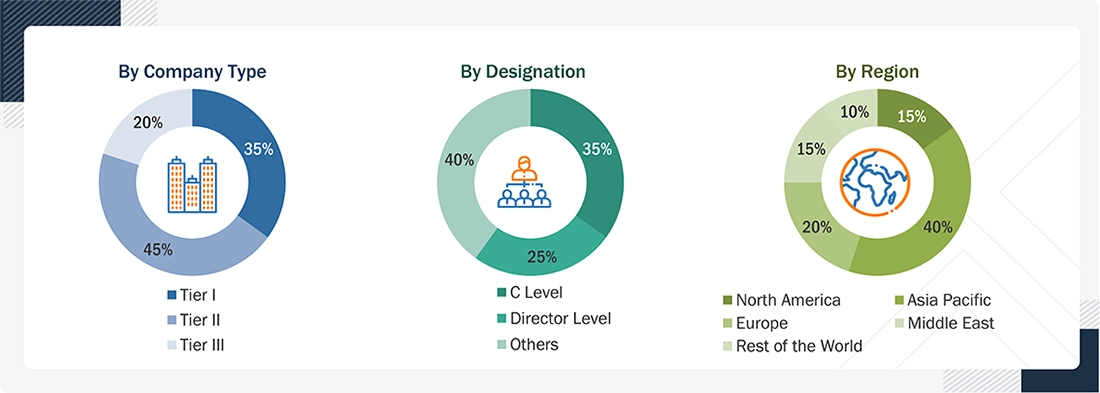
To know about the assumptions considered for the study, download the pdf brochure
Market Size Estimation
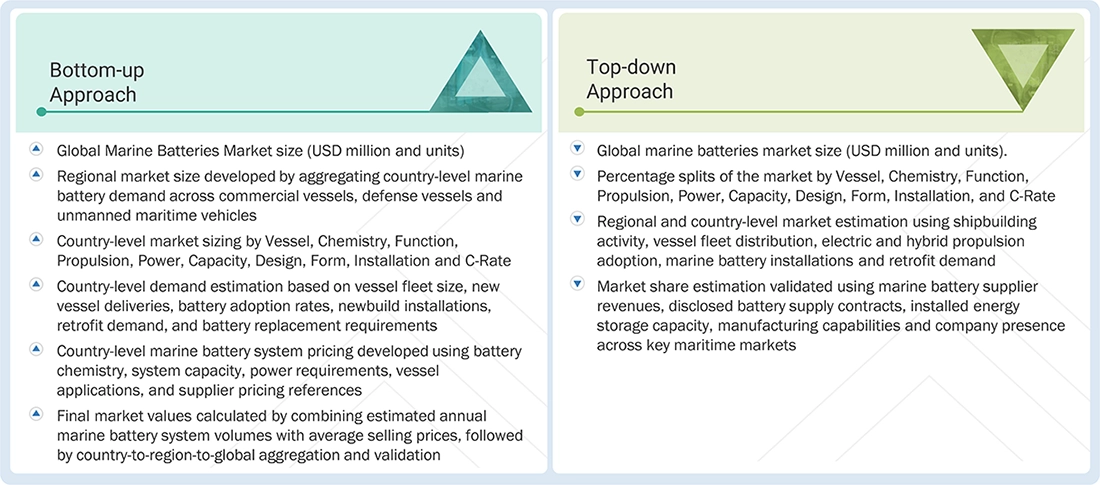
The top-down and bottom-up approaches were used to estimate and validate the size of the marine batteries market. The research methodology used to estimate the size of the market included the following details:
- Key marine battery companies were identified through secondary research. Their market positions were estimated using company revenues, product portfolios, marine battery system offerings, contract activity, production capabilities, geographic presence, and participation across commercial, defense, and unmanned maritime applications. Annual reports, financial filings, product documents, company presentations, shipbuilding announcements, marine electrification project details, and interviews with company executives, engineers, system integrators, distributors, vessel operators, and other industry participants were used for the analysis. Companies such as Corvus Energy, Contemporary Amperex Technology Co., Limited (CATL), Saft Groupe SAS, EnerSys, and GS Yuasa Corporation, for example, were assessed using their disclosed battery products, supply contracts, production activities, and system integration capabilities as indicators of market activity.
- Market shares, segment splits, regional shares, and growth rates were first estimated using secondary sources and then checked through primary interviews. The analysis covered market segmentation by vessel, chemistry, function, propulsion, power, capacity, design, form, installation, and C-Rate, along with marine battery pricing, vessel electrification trends, retrofit demand, battery replacement cycles, installation activity, and regional demand patterns.
- Demand for marine batteries across commercial vessels, defense vessels, and unmanned maritime vehicles was considered. The analysis included battery demand for newbuild vessels, retrofit and replacement requirements, hybrid and fully electric propulsion systems, onboard auxiliary power applications, and battery energy storage requirements across different vessel classes. The study also considered battery chemistry preferences, energy density requirements, charging needs, safety standards, operating conditions, and application-specific adoption trends across regional marine markets.
- The collected information was compared and combined through data triangulation. Final market values were calculated using company-level revenues, disclosed supply contracts, battery pricing, installed and planned system volumes, shipbuilding and retrofit activity, regional vessel demand, and primary-interview validation. Regional and country-level estimates were aggregated and reconciled with the global market size across all segments and subsegments.
Marine Battery Market: Top-Down and Bottom-Up Approach
Data Triangulation
After determining the overall market size, the marine batteries market was divided into its main segments and subsegments. Data triangulation and market breakdown methods were used to estimate the size of each segment and subsegment. The analysis considered factors from both the demand and supply sides, including vessel fleet size, shipbuilding activities, marine battery production capacity, company participation, supply contract values, system pricing, annual battery deliveries, newbuild installations, retrofit demand, and regional vessel electrification trends. The assessment also covered battery requirements across commercial vessels, defense vessels, and unmanned maritime vehicles, including ferries, cargo vessels, tugboats, offshore support vessels, naval platforms, unmanned surface vehicles, and unmanned underwater vehicles. Country-level estimates were aggregated into regional markets and reconciled with the global market size to validate market values, annual system volumes and growth rates.
Market Definition
The marine batteries market refers to the development of batteries specifically designed for use in marine environments. A marine battery is an energy device that converts chemical energy into electrical energy through electrochemical reactions. It consists of one or more electrochemical cells with terminals that provide power to various systems on vessels, including propulsion, navigation, and auxiliary equipment. Available in chemistries such as lithium, lead-acid, and fuel cells, marine batteries are built to withstand harsh marine conditions, offering different capacities to match vessel sizes and requirements, which is important in supporting sustainable maritime operations, with functions such as deep-cycle batteries, dual-purpose batteries, and starter batteries to assist during vessel operation.
Key Stakeholders
- Marine Battery Manufacturers
- Battery Cell and Module Manufacturers
- Marine Battery Energy Storage System Providers
- Battery Management System (BMS) Providers
- Marine Electric and Hybrid Propulsion System Manufacturers
- Marine Power Electronics and Energy Management System Providers
- Shipbuilders and Shipyards
- Marine System Integrators and Engineering Companies
- Commercial Vessel Owners and Operators
- Ferry and Passenger Vessel Operators
Report Objectives
- To define, describe, segment and forecast the size of the marine batteries market based on vessel, chemistry, function, propulsion, power, capacity, design, form, installation, C-Rate, and region
- To forecast the size of the market segments across five regions: North America, Europe, Asia Pacific, Middle East, and the Rest of the World
- To identify and analyze key drivers, restraints, opportunities, and challenges influencing the growth of the market
- To identify industry trends, market trends, and technology trends in the marine batteries market
- To analyze micro markets with respect to individual technology trends, growth prospects, and their contribution to the overall market
- To strategically profile key market players and analyze their market position and core capabilities
- To provide a detailed competitive landscape of the market and analyze competitive strategies such as product launches, partnerships, agreements, and collaborations adopted by key players
- To assess the financial position of key players along with their key products, unique offerings, and recent developments
Available customizations:
MarketsandMarkets offers the following customizations for this market report:
- Additional country-level analysis of the marine batteries market
- Profiling of other market players (up to 5)
Product Analysis
- Product matrix, which provides a detailed comparison of the product portfolio of each company in the marine batteries market
Get the Full Marine Battery Market Report
Full forecast, segment splits, and company analysis for all Marine Battery Market.
- Africa Marine Battery Market
- Brazil Marine Battery Market
- Canada Marine Battery Market
- China Marine Battery Market
- Denmark Marine Battery Market
- India Marine Battery Market
- Japan Marine Battery Market
- Mexico Marine Battery Market
- Netherlands Marine Battery Market
- Norway Marine Battery Market
- Rest Of Asia Pacific Marine Battery Market
- Rest Of Europe Marine Battery Market
- Rest Of Middle East Marine Battery Market
- Saudi Arabia Marine Battery Market
- South Korea Marine Battery Market
- Sweden Marine Battery Market
- Turkey Marine Battery Market
- UAE Marine Battery Market
- UK Marine Battery Market
- US Marine Battery Market
Need a Tailored Report?
Customize this report to your needs
Get 10% FREE Customization
Customize This Report