
Canada Network Slicing Market (2025-2030)

The Canada Network Slicing Market was valued at $68.68 Million in 2025 and projected to reach to $156.55 Million by 2030, representing a compound annual growth rate of 17.9%. Canada's network slicing market is poised for sustained growth driven by accelerating 5G rollout and enterprise demand for customized network solutions.


| Market Size in | USD 26.32 MN |
| Market Forecast in | |
| CAGR | |
| Forecast Period | |
| Units Considered | Value (USD MN) |
Canada Network Slicing Market Trends and Insights
- This expansion reflects Canada's increasing adoption of 5G infrastructure and the growing demand for virtualized network services across telecommunications providers.
- Canada is positioning itself as a key player in North America's network slicing ecosystem, driven by investments in advanced telecom infrastructure and enterprise digital transformation initiatives. The Canadian market benefits from strong regulatory support and the presence of major telecom operators investing in network modernization.
- Canada's network slicing capabilities enable service providers to deliver differentiated services for IoT, autonomous vehicles, and mission-critical applications.
- Between 2025 and 2030, Canada is expected to see accelerated deployment of network slicing solutions as enterprises increasingly require customized network performance and reliability guarantees. Canada's competitive advantage lies in its advanced telecommunications infrastructure and skilled workforce.
- The country's network slicing market growth is supported by government initiatives promoting 5G adoption and digital innovation, positioning Canada as a regional innovation hub within North America..
Key Market Statistics
- CAGR (2025-2030) 17.9% CAGR
- Market Size, 2025 ~USD 68.68 Million
- Forecast, 2030 ~USD 156.55 Million
- Country Canada
Canada Network Slicing Market Overview
Market Valuation Growth :
Canada's network slicing market is valued at $68.68 million in 2025, with a projected CAGR of 17.9% through 2030, reaching $156.55 million. This growth trajectory outpaces the global average of 16.6%, positioning Canada as a high-growth market in North America.
5G Infrastructure Expansion :
Canadian telecommunications providers are rapidly deploying 5G networks across urban and rural regions, driving demand for network slicing capabilities. This infrastructure investment is a primary catalyst for market expansion and service differentiation among major carriers.
Virtualized Network Services Adoption :
Canadian telecom operators are increasingly adopting virtualized network services to optimize resource allocation and reduce operational costs. Network slicing enables providers to create isolated virtual networks for specific use cases, improving service quality and customer experience.
North American Strategic Position :
Canada is emerging as a key player in North America's network slicing ecosystem, with strong regulatory support for 5G deployment and digital transformation initiatives. The country's tech-forward approach attracts investment from global network infrastructure vendors and service providers.
Canada Network Slicing Market Dynamics
- Telecommunications providers are investing heavily in network virtualization to support diverse applications ranging from IoT to autonomous vehicles, creating significant opportunities for technology vendors and service integrators.
- The Canadian government's commitment to digital infrastructure and spectrum allocation further supports market expansion.
- By 2030, network slicing is expected to become a standard offering among major Canadian carriers, enabling new revenue streams and competitive differentiation in an increasingly crowded telecom landscape..
Market Ecosystem
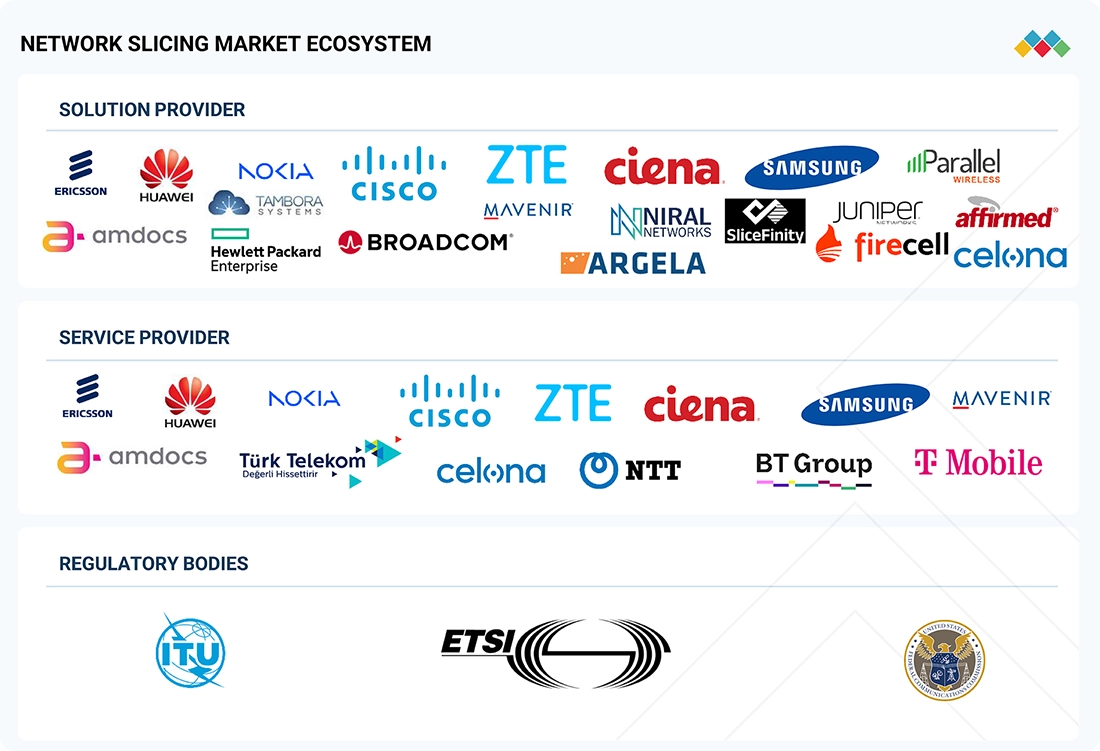
Network Slicing Market: COMMERCIAL USE CASES ACROSS INDUSTRIES
| COMPANY | USE CASE DESCRIPTION | BENEFITS |
|---|---|---|
 |
Ericsson enables dynamic 5G network slicing for telecom operators, supporting enterprise-specific applications such as smart manufacturing, connected healthcare, and mission-critical communication. | Delivers ultra-reliable, low-latency connectivity, faster service provisioning, and improved monetization for operators through differentiated network performance. |
 |
Huawei provides end-to-end network slicing solutions with AI-driven orchestration and intelligent slice lifecycle management for industries like automotive, energy, and public safety. | Enhances operational efficiency and service quality while reducing OPEX through automation and real-time resource optimization. |
 |
Nokia’s slicing platform enables multi-domain network slicing across RAN, transport, and core networks, allowing CSPs to deliver customizable connectivity for enterprise and IoT services. | Enables rapid deployment of tailored 5G services, greater scalability, and new revenue opportunities through on-demand, SLA-based connectivity. |
 |
Cisco offers a cloud-native 5G network slicing solution integrated with its Service Orchestrator and Crosswork Automation Suite, enabling operators to dynamically create, manage, and assure network slices across RAN, transport, and core domains. | Delivers end-to-end visibility, automated slice lifecycle management, and assured QoS, helping operators accelerate time-to-market for enterprise 5G services and reduce network complexity. |
 |
ZTE provides a full-stack network slicing solution leveraging AI-based orchestration and intelligent service assurance. It supports multi-scenario slicing for industries like manufacturing, transportation, and public safety through its Common Network Resource Pool (CNRP) framework. | Improves network agility and reliability with on-demand slice creation, ensures efficient resource utilization, and enables differentiated services for diverse verticals through intelligent automation. |
Logos and trademarks shown above are the property of their respective owners. Their use here is for informational and illustrative purposes only.
Related Ecosystem
Data Centre And Networking
- Software-Defined Networking (SDN)
- Mid-Sized Data Centers
- Small Data Centers
- Remote Monitoring
- Smart Healthcare
- Cisco Systems, Inc.
- HUAWEI TECHNOLOGIES CO LTD
- Hewlett Packard Enterprise Company
- MITSUBISHI ELECTRIC INFORMATION SYSTEMS CORPORATION
- MITSUBISHI ELECTRIC INFORMATION NETWORK CORPORATION
Key Takeaways
- Canada's network slicing market will grow from $68.68M (2025) to $156.55M (2030), representing a 17.9% CAGR.
- Canada's 5G infrastructure investments and enterprise digital transformation are primary growth catalysts for network slicing adoption.
- Canada's telecom operators are deploying network slicing to support IoT, autonomous vehicles, and mission-critical enterprise applications.
- Canada's regulatory environment and skilled workforce position the country as a North American leader in network slicing innovation.
Network Slicing Market Report Scope
| Report Metric | Details |
|---|---|
| Base Year | 2025 |
| Fastest Growing Segment | SMES (Organization Size) |
| Forecast Period | 2025–2030 |
| Growth Rate | CAGR of 16.6% from 2025 to 2030 |
| Largest Segment | LARGE ENTERPRISES (Organization Size) |
| Market Size Base Year (Billions) | ~USD 1.3 (2025) |
| Revenue Forecast (Billions) | ~USD 2.81 (2030) |
| Segments Covered | Offering, Type, End User, Enterprise, Service, Professional Service, Component, Solution, Network Type, Deployment Mode, Organization Size, Enterprise Vertical |
Canada Network Slicing Market Report Segmentation
12 segment dimensions are covered across the global market.
By Offering
- Service
- Solution
By Type
- Communication And Collaboration
- Deployment & Integration
- Lan And Wlan
- Managed Services
- Network Planning & Designing
- Network Security
- Professional Services
- Support & Maintenance
- Wan
By End User
- Bfsi
- Education
- Enterprise Vertical
- Enterprises
- Government
- Healthcare
- Manufacturing
- Media And Entertainment
- Other End Users
- Retail And Ecommerce
- Service Providers
- Software And Technology
- Telecom Operators
By Enterprise
- Automotive
- Energy & Utilities
- Government & Public Sector
- Healthcare & Life Sciences
- Manufacturing
- Media & Entertainment
- Other Enterprises
- Transportation & Logistics
By Service
- Managed Services
- Professional Services
By Professional Service
- Advisory And Consulting
- Deployment & Integration
- Deployment And Integration
- Network Planning & Designing
- Support & Maintenance
- Training And Support
By Component
- Services
- Solutions
By Solution
- Intent-Based Networking
- Network Automation Tools
By Network Type
- Hybrid
- Physical
- Virtual
By Deployment Mode
- Cloud
- On-Premises
By Organization Size
- Large Enterprises
- Smes
By Enterprise Vertical
- Bfsi
- Education
- Energy And Utilities
- Healthcare
- It
- Manufacturing
CANADA: NETWORK SLICING MARKET, BY END USER, 2025–2030
| Segment | 2025 | 2026 | 2027 | 2028 | 2029 | 2030 | CAGR (%) |
|---|---|---|---|---|---|---|---|
| ENTERPRISES | 10.78 | 12.86 | 14.91 | 16.88 | 18.68 | 20.27 | 13.5 |
| TELECOM OPERATORS | 57.9 | 72.02 | 87.24 | 103.24 | 119.68 | 136.27 | 18.7 |
| TOTAL | 68.68 | 84.88 | 102.15 | 120.11 | 138.36 | 156.55 | 17.9 |
Target Audience
- Telecom Equipment Vendors : Network infrastructure and software vendors need Canada-specific market data to prioritize product development, allocate sales resources, and develop localized go-to-market strategies for Canadian carriers implementing network slicing solutions.
- Telecommunications Service Providers : Canadian carriers require competitive intelligence and market benchmarking data to inform 5G network slicing investments, service portfolio development, and strategic positioning against competitors in the rapidly evolving Canadian telecom landscape.
- Enterprise Technology Buyers : Canadian enterprises and large organizations need insights into network slicing capabilities and service offerings available from local providers to evaluate solutions for IoT, edge computing, and mission-critical application requirements.
- Investment & Strategy Consultants : Management consultants and investment firms advising telecom clients require detailed Canadian market analysis to support strategic planning, M&A evaluation, and investment thesis development in the network slicing and 5G infrastructure sectors.
- Government & Policy Makers : Canadian government agencies and regulatory bodies benefit from market data to inform spectrum policy, digital infrastructure investment decisions, and competitive analysis of Canada's position in the global network slicing ecosystem.
Key Companies in the Canada Network Slicing Market
| Company | HQ | Ownership | Strongest segments |
|---|---|---|---|
| DEUTSCHE TELEKOM AG | Germany | Public Company | Mobile services (consumer and business),Fixed-network and broadband services,ICT, cloud, and security solutions, |
| VIAVI SOLUTIONS | United States | Public Company | Network and Service Enablement (NSE),Optical Security and Performance Products (OSP), |
| NETSCOUT SYSTEMS, INC | United States | Public Company | nGeniusONE, ISNG, vSTREAM, Infinistream, packet flow systems, test access,Arbor DDoS (Sightline, TMS, Insight, Edge Defense),Omnis Insights and Omnis Cyber Intelligence, |
| OBERTHUR TECHNOLOGIES | France | Private Company | Financial Services Institutions (payment cards, personalization, mobile payments),Mobile Network Operators (SIM, eSIM, mobile money, remote management),Connected Devices and Identity Markets (IoT, embedded security, ID documents, access), |
| COMMSCOPE HOLDING COMPANY, INC | United States | Public Company | RUCKUS Wi-Fi and indoor cellular (hardware),RUCKUS software, cloud management, and IoT suite,Aurora cable access and video infrastructure, |
| CASA SYSTEMS | United States | Private Company | Converged cable access and fixed-line broadband platforms,Virtualized core (vEPC, 5G core) and axyom EMS,Small cells and fixed wireless access devices, |
| A1-TELEKOM | Austria | Public Company | Mobile access, data, and messaging,Fixed broadband, TV/IPTV, and voice,ICT, cloud, security, and IoT solutions, |
| CERAGON NETWORKS LTD | Israel | Public Company | IP-20/50 all-outdoor (IP-20C-HP, IP-50E, IP-50EX/EXP/EXA, IP-50C, IP-50CX),IP-20/50 split-mount/all-indoor (IP-20N/IP-20A, IP-20F, IP-20G),IP-50 disaggregated (IP-50FX and related), |
| ERICSSON | Sweden | Public Company | Networks (RAN, transport, antennas, deployment services),Cloud Software and Services (core, BSS/OSS, managed services),Enterprise (WWAN, private 5G, communications platform), |
| NOKIA | Finland | Public Company | Network Infrastructure (IP, Optical, Fixed Access, In-home Wi-Fi, Cloud/Virtualization),Mobile Networks (RAN, Microwave, Network Management and Services),Cloud and Network Services (5G Core, Private Wireless, Industrial Edge, Network APIs, Automation Software), |
| CISCO SYSTEMS, INC. | United States | Public Company | Enterprise networking (campus, data center, branch, wireless),Security (network security, SASE, identity, threat detection/response),Collaboration (Webex suite, devices, contact center, CPaaS), |
DEUTSCHE TELEKOM AG
Deutsche Telekom AG is a German public telecommunications company founded in 1995 with 196,586 employees. It operates as one of Europe's leading integrated telecommunications providers.
VIAVI SOLUTIONS
Viavi Solutions is a United States public company founded in 1923 with 3,600 employees, providing network testing and software solutions for telecommunications and broadband industries.
NETSCOUT SYSTEMS, INC
Netscout Systems, Inc. is a United States public company founded in 1984 with 2,063 employees, specializing in network performance software and services.
OBERTHUR TECHNOLOGIES
Oberthur Technologies is a French private company founded in 2011 with 6,127 employees, providing digital security and telecommunications solutions.
COMMSCOPE HOLDING COMPANY, INC
CommScope Holding Company, Inc. is a United States public company founded in 1976 with 4,500 employees, manufacturing and distributing infrastructure solutions for communications networks.
CASA SYSTEMS
Casa Systems is a United States private company founded in 2003 with 1,043 employees, providing software and services for cable and telecommunications operators.
A1-TELEKOM
A1-Telekom is an Austrian public company founded in 1996 with 16,644 employees, operating as a major telecommunications provider in Austria and Southeast Europe.
CERAGON NETWORKS LTD
Ceragon Networks Ltd. is an Israeli public company founded in 1996 with 1,091 employees, specializing in wireless backhaul and fronthaul solutions.
ERICSSON
Ericsson is a Swedish public company founded in 1876 with 87,521 employees, a global leader in telecommunications equipment and services.
NOKIA
Nokia is a Finnish public company founded in 1865 with 78,005 employees, providing telecommunications infrastructure and network services worldwide.
CISCO SYSTEMS, INC.
Cisco Systems, Inc. is a United States public company founded in 1984 with 86,200 employees, a leading provider of networking and telecommunications equipment.
Reasons to Buy this Report
- Market Size & Growth Validation : Obtain precise market valuation data for Canada ($68.68M in 2025) with verified 17.9% CAGR projections through 2030. Validate investment decisions and business case development with authoritative market sizing specific to the Canadian region.
- Competitive Landscape Intelligence : Understand the competitive positioning of Canadian telecom providers and identify market leaders in network slicing adoption. Benchmark your organization's capabilities against regional competitors and identify partnership or acquisition opportunities.
- 5G Deployment Roadmap Insights : Access detailed analysis of Canadian carrier 5G rollout timelines and network slicing implementation strategies. Align product development and go-to-market strategies with actual deployment schedules and carrier requirements across major Canadian markets.
- Revenue Stream Opportunities : Identify emerging revenue models and service monetization strategies specific to Canada's network slicing market. Discover enterprise use cases, vertical market opportunities, and pricing strategies that resonate with Canadian telecom operators and end customers.
- Regulatory & Policy Context : Understand Canadian regulatory frameworks, spectrum allocation policies, and government digital transformation initiatives that drive network slicing adoption. Stay informed on compliance requirements and policy changes affecting market entry and expansion strategies.
Frequently asked questions
What is the current size of Canada's network slicing market?
Canada's network slicing market is valued at $68.68 million in 2025 and is expected to grow to $156.55 million by 2030.
What is the projected growth rate for Canada's network slicing market?
Canada's network slicing market is projected to grow at a compound annual growth rate (CAGR) of 17.9% from 2025 to 2030.
What are the main drivers of network slicing adoption in Canada?
Canada's network slicing growth is driven by 5G infrastructure expansion, enterprise digital transformation, IoT deployment, and demand for mission-critical applications requiring customized network performance.
Which industries in Canada are adopting network slicing solutions?
Canada's network slicing adoption spans telecommunications, autonomous vehicles, IoT, healthcare, financial services, and manufacturing sectors requiring reliable, differentiated network services.
How does Canada's network slicing market compare to North America?
Canada represents a significant portion of North America's network slicing market, with strong growth momentum supported by advanced telecom infrastructure and government digital innovation initiatives.
RESEARCH METHODOLOGY
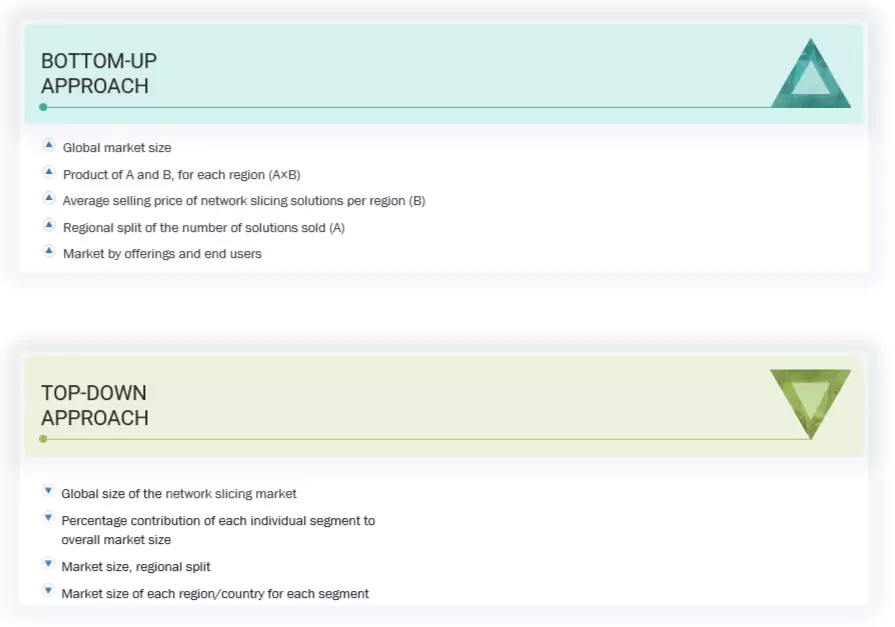
The research study involved four major activities in estimating the network slicing market size. Exhaustive secondary research has been done to collect important information about the market and peer markets. The next step has been to validate these findings and assumptions and size them with the help of primary research with industry experts across the value chain. Both top-down and bottom-up approaches have been used to estimate the market size. Post which the market breakdown and data triangulation have been adopted to estimate the market sizes of segments and sub-segments.
Secondary Research
The market size of the companies offering network slicing solutions to various end users was arrived at based on the secondary data available through paid and unpaid sources, analyzing the product portfolios of major companies in the ecosystem, and rating the companies based on their performance and quality. In the secondary research process, various sources were referred to identify and collect information for the study. The secondary sources include annual reports, press releases, investor presentations of companies, white papers, certified publications, and articles from recognized associations and government publishing sources.
Secondary research was mainly used to obtain critical information about industry insights, the market’s monetary chain, the overall pool of key players, market classification and segmentation according to industry trends to the bottom-most level, regional markets, and key developments from both market-oriented and technology-oriented perspectives.
Primary Research
In the primary research process, various sources from the supply and demand sides were interviewed to obtain qualitative and quantitative information for the report, such as Chief Experience Officers (CXOs), Vice Presidents (VPs), directors from business development, marketing, and product development/innovation teams, and related key executives from network slicing solutions vendors, system integrators, professional and managed service providers, industry associations, independent consultants, and key opinion leaders.
Primary interviews were conducted to gather insights, such as market statistics, data on revenue collected from platforms and services, market breakups, market size estimations, market forecasts, and data triangulation. Stakeholders from the demand side, such as Chief Information Officers (CIOs), Chief Finance Officers (CFOs), Chief Strategy Officers (CSOs), and the installation team of end users who use network slicing solutions, were interviewed to understand buyers’ perspectives on suppliers, products, service providers, and their current use of network slicing solutions which is expected to affect the overall network slicing market growth.
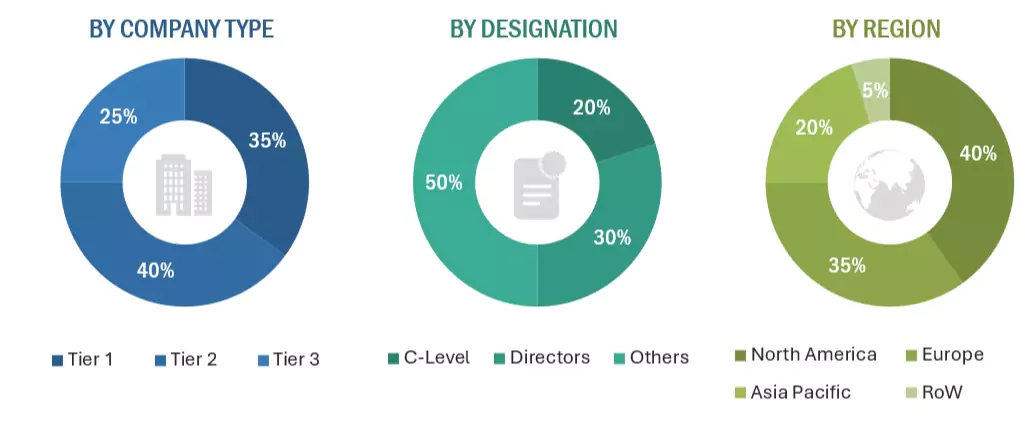
Notes: Tier 1 companies have revenues over USD 1 billion, Tier 2 companies have revenues between USD
500 million and 1 billion, and Tier 3 companies have revenues less than USD 500 million.
Other designations include sales managers, marketing managers, and product managers.
Source: Industry Experts
To know about the assumptions considered for the study, download the pdf brochure
Market Size Estimation
Both top-down and bottom-up approaches were used to estimate and validate the total size of the Network slicing market. These methods were also used extensively to estimate the size of various subsegments in the market. The research methodology used to estimate the market size includes the following:
Network Slicing Market : Top-Down and Bottom-Up Approach
Data Triangulation
After arriving at the overall market size from the above estimation process, the network slicing market has been split into several segments and sub-segments. To complete the overall market engineering process and arrive at the exact statistics for all segments and sub-segments, data triangulation and market breakdown procedures have been used, wherever applicable. The data has been triangulated by studying various factors and trends from both the demand and supply sides. The network slicing market size has been validated using top-down and bottom-up approaches.
Market Definition
According to Ericsson, network slicing enables multiple logical networks to operate on a shared physical network infrastructure by creating “slices” that are logically separated, self-contained, independent, and secured. These sliced networks can be independently configured to target specific services or users with distinct speed, latency, and reliability needs. It provides an opportunity to monetize 5G network investments and unleash the power of differentiated connectivity.
As per Celona, network slicing is a type of functionality that enables multiple independent networks to exist on the same physical network, using different “slices” of the same spectrum band. This allows organizations to accommodate different application requirements for security, reliability, and performance on the same network. It leverages Software-defined Networking (SDN), Network Function Virtualization (NFV), and automation to quickly segment the network and its resources to support specific applications, devices, domains, and groups.
Stakeholders
- System Integrators
- Network Infrastructure Enablers
- Technology Vendors
- Resellers
- Value-added Resellers (VARs)
- Independent Software Vendors (ISVs)
- Managed Service Providers (MSPs)
- Compliance Regulatory Authorities
- Government Authorities
- Investment Firms
- Network Slicing Alliances/Groups
- Enterprises/Businesses
Report Objectives
- To determine, segment, and forecast the network slicing market based on offering, end user, and region in terms of value
- To forecast the size of the market segments with respect to five main regions: North America, Europe, Asia Pacific, Middle East & Africa, and Latin America
- To provide detailed information about the major factors (drivers, restraints, opportunities, and challenges) influencing the growth of the market
- To study the complete value chain and related industry segments, and perform a value chain analysis of the market landscape
- To strategically analyze the macro and micromarkets with respect to individual growth trends, prospects, and contributions to the total market
- To analyze the industry trends, pricing data, patents, and innovations related to the market
- To analyze the opportunities for stakeholders by identifying the high-growth segments of the market
- To profile the key players in the market and comprehensively analyze their market share/ranking and core competencies
- To track and analyze competitive developments, such as mergers & acquisitions, product launches & developments, partnerships, agreements, collaborations, business expansions, and research & development (R&D) activities
Available Customizations
With the given market data, MarketsandMarkets offers customizations per the company’s specific needs. The following customization options are available for the report:
Geographic Analysis as per Feasibility
- Further break-up of the Asia Pacific market into countries contributing 75% to the regional market size
- Further break-up of the North American market into countries contributing 75% to the regional market size
- Further break-up of the Latin American market into countries contributing 75% to the regional market size
- Further break-up of the Middle East & African market into countries contributing 75% to the regional market size
- Further break-up of the European market into countries contributing 75% to the regional market size
Company Information
- Detailed analysis and profiling of additional market players (up to five)
Get the Full Network Slicing Market Report
Full forecast, segment splits, and company analysis for all Network Slicing Market.
- US Network Slicing Market
- Germany Network Slicing Market
- China Network Slicing Market
- Brazil Network Slicing Market
- France Network Slicing Market
- Italy Network Slicing Market
- Nordic Countries Network Slicing Market
- Rest Of Europe Network Slicing Market
- Spain Network Slicing Market
- UK Network Slicing Market
- India Network Slicing Market
- Japan Network Slicing Market
- Rest Of Asia Pacific Network Slicing Market
- South Korea Network Slicing Market
- Southeast Asia Network Slicing Market
- Mexico Network Slicing Market
- Rest Of Latin America Network Slicing Market
- Ksa Network Slicing Market
- South Africa Network Slicing Market
- UAE Network Slicing Market
Need a Tailored Report?
Customize this report to your needs
Get 10% FREE Customization
Customize This Report
