
Australia Portable Projector Market (2024-2029)

The Australia Portable Projector Market was valued at $38.4 Million in 2024 and projected to reach to $47.6 Million by 2029, representing a compound annual growth rate of 4.4%. Australia's portable projector market is poised for steady expansion through 2029, driven by increasing digitalization in educational institutions and corporate environments.


| Market Size in | USD 26.32 MN |
| Market Forecast in | |
| CAGR | |
| Forecast Period | |
| Units Considered | Value (USD MN) |
Australia Portable Projector Market Trends and Insights
- This growth trajectory reflects increasing demand for flexible display solutions across education, corporate, and entertainment sectors in Australia.
- The 4.4% compound annual growth rate demonstrates Australia's sustained interest in portable projection technology as a practical alternative to fixed installation systems. In Australia, the portable projector market is driven by rising adoption in small-to-medium enterprises, educational institutions, and the growing remote work culture.
- Australia's tech-savvy consumer base and strong purchasing power support market expansion through 2029.
- Key applications in Australia include business presentations, classroom instruction, outdoor entertainment, and home theater setups, positioning the country as a significant contributor to the Asia Pacific portable projector segment..
Key Market Statistics
- CAGR (2024-2029) 4.4% CAGR
- Market Size, 2024 ~USD 38.4 Million
- Forecast, 2029 ~USD 47.6 Million
- Country Australia
Australia Portable Projector Market Overview
Market Valuation :
Australia's portable projector market is valued at USD 38.4 million in 2024, with strong growth momentum expected to reach USD 47.6 million by 2029.
Consistent Growth Rate :
The Australian market maintains a steady 4.4% CAGR, aligning with global growth trends and indicating sustained demand for portable projection solutions across the region.
Sector Diversification :
Growth is driven by increasing adoption across education institutions, corporate training facilities, and entertainment venues throughout Australia, reflecting diverse application opportunities.
Regional Expansion Potential :
Australia's growing tech-savvy population and rising investment in digital infrastructure create favorable conditions for portable projector market expansion over the forecast period.
Australia Portable Projector Market Dynamics
- The adoption of hybrid work models and remote learning solutions continues to fuel demand for flexible display technologies across Australian businesses and schools.
- Key growth drivers include rising consumer preference for portable entertainment solutions and growing investments in digital transformation initiatives. The market's 4.4% CAGR reflects Australia's mature yet expanding technology adoption landscape.
- Educational institutions are increasingly integrating portable projectors into classrooms, while corporate sectors leverage these solutions for presentations and collaborative workspaces.
- As Australian organizations prioritize flexible, mobile-first solutions, the portable projector market is expected to capture sustained growth opportunities through 2029..
Market Ecosystem
Related Ecosystem
Display Technology
- Augmented Reality
- Liquid Crystal Display (LCD)
- Sensors
- Virtual Reality Devices
- Liquid Crystal on Silicon (LCOS)
- VIVITEK CORPORATION
- Samsung
- Lenovo
- Panasonic Holdings Corporation
- Lg corp
Electronics System And Components
- Sensors
- Temperature Sensors
- Pressure Sensors
- Actuators
- Image Sensors
- Lenovo
- Samsung
- Texas Instruments Incorporated
- HONEYWELL INTERNATIONAL INC.
- Teledyne Technologies Incorporated
Key Takeaways
- Australia's portable projector market is valued at USD 38.4 million in 2024 and is forecast to reach USD 47.6 million by 2029, representing a 4.4% CAGR.
- Australia's market growth is fueled by increasing adoption in corporate, educational, and entertainment sectors seeking flexible display solutions.
- Australia's tech-savvy population and strong purchasing power position the country as a key growth market within the Asia Pacific region.
- Portable projectors in Australia are increasingly used for remote work, hybrid meetings, outdoor events, and educational applications through 2029.
Portable Projector Market Report Scope
| Report Metric | Details |
|---|---|
| Base Year | 2024 |
| Fastest Growing Segment | MICRO-LED (Display Technology) |
| Forecast Period | 2024-2029 |
| Growth Rate | CAGR of 4.4% from 2024 to 2029 |
| Largest Segment | LCD (Display Technology) |
| Market Size Base Year (Billions) | ~USD 1.69 (2024) |
| Revenue Forecast (Billions) | ~USD 2.1 (2029) |
| Segments Covered | Technology, Dimension, Lumen, Resolution, Application, Projected Image Size, Display Technology |
Australia Portable Projector Market Report Segmentation
7 segment dimensions are covered across the global market.
By Technology
- Dlp
- Lcd
- Lcos
By Dimension
- 2D
- 3D
By Lumen
- 500 To 3,000
- Above 3,000
- Below 500
By Resolution
- 4K
- Hd & Full Hd
- Vga
- Xga
By Application
- Consumer
- Education
- Enterprise
- Healthcare
- Other Applications
By Projected Image Size
- 50 To 200 Inches
- Above 200 Inches
- Below 50 Inches
By Display Technology
- Direct-View Led
- Lcd
- Micro-Led
- Oled
- Other Display Technologies
- Quantum Dot Display
Target Audience
- Market Entry Strategists : Companies planning to enter or expand in Australia need localized market data to assess opportunity size, growth potential, and competitive dynamics specific to the Australian portable projector sector.
- Product Development Managers : Product teams require Australia-specific demand insights and sector trends to develop solutions aligned with local educational, corporate, and entertainment market requirements.
- Investment & Finance Professionals : Investors and financial analysts need accurate Australia market valuations and forecasts to evaluate investment opportunities, assess ROI potential, and support funding decisions in the region.
- Sales & Marketing Directors : Regional sales and marketing leaders need Australia-focused market intelligence to develop targeted campaigns, identify high-growth segments, and optimize resource allocation for maximum market penetration.
- Business Development Executives : BD professionals require detailed Australia market data to identify partnership opportunities, negotiate with local distributors, and develop region-specific business strategies and growth plans.
Reasons to Buy this Report
- Australia-Specific Market Sizing : Access precise market valuation data for Australia (USD 38.4M in 2024), enabling accurate budget allocation and investment decisions tailored to the Australian portable projector market.
- Localized Growth Forecasts : Obtain detailed 5-year projections specific to Australia's market trajectory, helping stakeholders plan product launches, expansion strategies, and resource allocation for the region.
- Sector-Specific Insights : Understand demand patterns across Australian education, corporate, and entertainment sectors, allowing targeted marketing strategies and product development aligned with local market needs.
- Competitive Positioning : Benchmark your business against Australia's 4.4% CAGR growth rate to identify competitive advantages, market gaps, and opportunities for differentiation in the Australian landscape.
- Strategic Decision Support : Leverage Australia-focused market intelligence to support go-to-market strategies, partnership development, and investment decisions specific to the Australian portable projector ecosystem.
Frequently asked questions
What is the current size of Australia's portable projector market?
Australia's portable projector market was valued at USD 38.4 million in 2024 and is expected to grow to USD 47.6 million by 2029.
What is the projected growth rate for portable projectors in Australia?
Australia's portable projector market is projected to grow at a compound annual growth rate (CAGR) of 4.4% from 2024 to 2029.
Which sectors are driving portable projector demand in Australia?
In Australia, demand is driven by corporate enterprises, educational institutions, remote work adoption, and the entertainment and events industry.
What are the primary applications for portable projectors in Australia?
Primary applications in Australia include business presentations, classroom instruction, outdoor entertainment, home theater, and hybrid meeting solutions.
How does Australia's portable projector market compare to the Asia Pacific region?
Australia represents a significant segment within Asia Pacific, with strong purchasing power and technology adoption supporting consistent market growth through 2029.
RESEARCH METHODOLOGY
The study involved four major activities in estimating the current size of the portable projector market. Exhaustive secondary research has been done to collect information on the market, peer market, and parent market. To validate these findings, assumptions, and sizing with industry experts across the value chain through primary research has been the next step. Both top-down and bottom-up approaches have been employed to estimate the complete market size. After that, market breakdown and data triangulation methods have been used to estimate the market size of segments and subsegments. Two sources of information—secondary and primary—have been used to identify and collect information for an extensive technical and commercial study of the portable projector market.
Secondary Research
Various secondary sources have been referred to in the secondary research process to identify and collect information important for this study. The secondary sources include annual reports, press releases, and investor presentations of companies; white papers; journals and certified publications; and articles from recognized authors, websites, directories, and databases. Secondary research has been conducted to obtain key information about the industry’s supply chain, the market’s value chain, the total pool of key players, market segmentation according to the industry trends (to the bottom-most level), regional markets, and key developments from market- and technology-oriented perspectives. The secondary data has been collected and analyzed to determine the overall market size, further validated by primary research.
Primary Research
Extensive primary research was conducted after gaining knowledge about the current scenario of the portable projector market through secondary research. Several primary interviews were conducted with experts from the demand and supply sides across four major regions—North America, Europe, Asia Pacific and RoW. This primary data was collected through questionnaires, emails, and telephonic interviews.
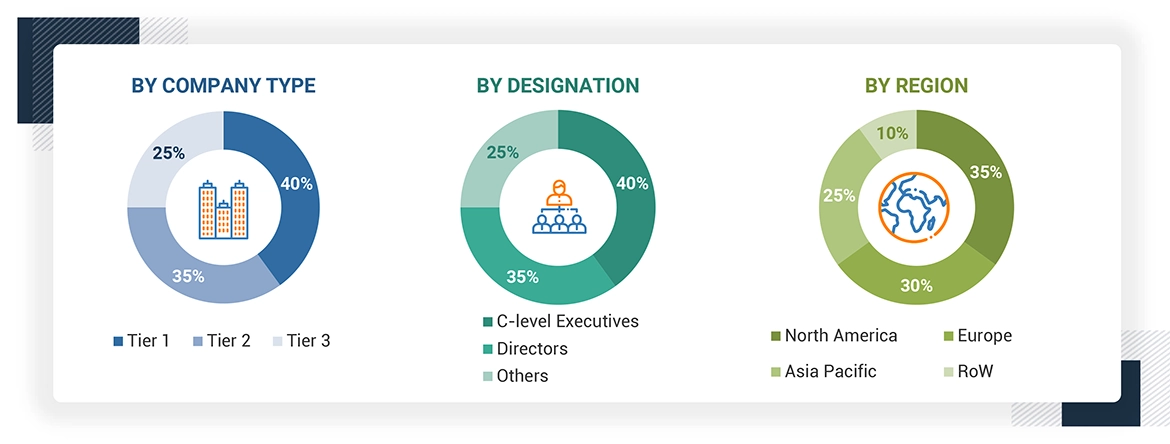
Note: The three tiers of the companies are defined based on their total revenue in 2023: Tier 1 - revenue greater than or equal to USD 1 billion; Tier 2 - revenue between USD 100 million and USD 1 billion; and Tier 3 revenue less than or equal to USD 100 million. Other designations include sales managers, marketing managers, and product managers.
To know about the assumptions considered for the study, download the pdf brochure
Market Size Estimation
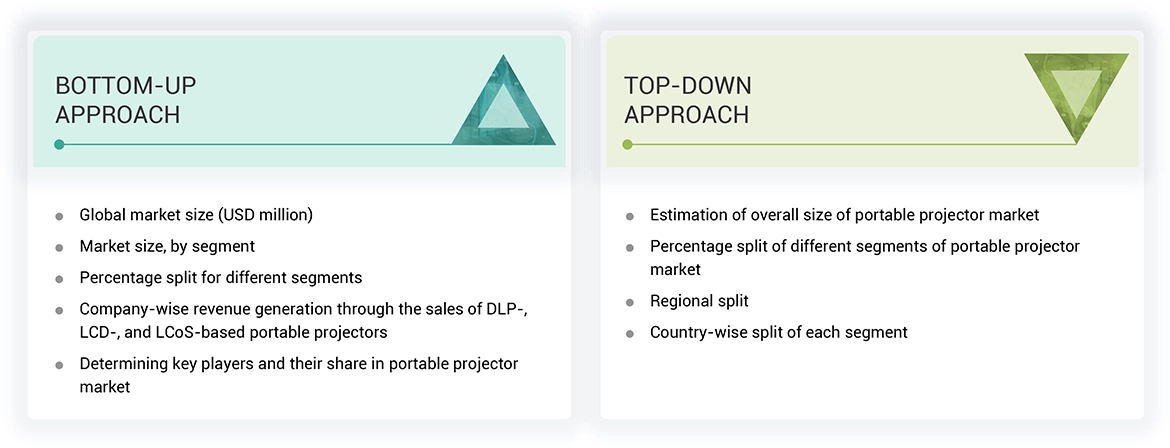
Both top-down and bottom-up approaches have been used to estimate and validate the total size of the portable projector market. These methods have also been used extensively to estimate the size of various subsegments in the market. The following research methodology has been used to estimate the market size:
- Major players in the industry and markets have been identified through extensive secondary research.
- The industry’s value chain and market size (in terms of value) have been determined through primary and secondary research processes.
- All percentage shares, splits, and breakdowns have been determined using secondary sources and verified through primary sources.
Portable Projector Market : Top-Down and Bottom-Up Approach
Data Triangulation
After arriving at the overall size of the portable projector market from the market size estimation process explained above, the total market has been split into several segments and subsegments. Data triangulation and market breakdown procedures have been employed, wherever applicable, to complete the overall market engineering process and arrive at the exact statistics for all segments and subsegments of the market. The data has been triangulated by studying various factors and trends from both the demand and supply sides. Along with this, the market size has been validated using both top-down and bottom-up approaches.
Market Definition
A portable projector is a compact and lightweight device capable of projecting images or videos onto a surface. A portable projector is also known as pico or pocket projectors. It is designed to be easily carried and used in a variety of environments, such as homes, offices, classrooms, or outdoor spaces. These projectors use LED or laser light sources, which provide longer life, lower power consumption and improved color accuracy compared to traditional lamp-based projectors. A portable projector typically incorporates advanced features such as wireless connectivity, built-in smart capabilities, and high-resolution displays to provide a convenient viewing experience.
Key Stakeholders
- Portable Projector providers
- Raw material suppliers
- System Integrators
- Original Equipment Manufacturers (OEM)
- Government organizations, forums, alliances, and associations
- Research organizations
- Software Developers
- Technology standard organizations, forums, alliances, and associations
- Technology investors
- End-use industries (Education, Business, Consumer Electronics and Healthcare & Medical)
- Venture capitalists, private equity firms, and startups
Report Objectives
- To define, describe and forecast the portable projector market, in terms of technology, dimension, projected image size, lumen, resolution, end-user and region.
- To describe and forecast the market, in terms of value, with regard to four main regions: North America, Europe, Asia Pacific, and Rest of the World (RoW) along with their respective countries
- To provide detailed information regarding major factors influencing the market growth (drivers, restraints, opportunities, and challenges)
- To provide a detailed overview of the value chain of portable projectors.
- To strategically analyze micromarkets with respect to individual growth trends, prospects, and contributions to the portable projector market
- To analyze opportunities in the market for stakeholders by identifying high-growth segments of the portable projector market.
- To strategically profile key players and comprehensively analyze their market position in terms of ranking and core competencies, along with detailing the competitive landscape for market leaders
- To analyze competitive strategies, such as product launches, expansions, mergers and acquisitions, adopted by key market players in the portable projector market.
This research report categorizes the portable projector market by technology, dimension, projected image size, lumen, resolution, end-user and region.
Available Customizations
With the given market data, MarketsandMarkets offers customizations according to the company’s specific needs. The following customization options are available for the report:
Company Information:
- Detailed analysis and profiling of additional market players (up to 5)
Get the Full Portable Projector Market Report
Full forecast, segment splits, and company analysis for all Portable Projector Market.
- US Portable Projector Market
- Canada Portable Projector Market
- Mexico Portable Projector Market
- Germany Portable Projector Market
- UK Portable Projector Market
- France Portable Projector Market
- Spain Portable Projector Market
- Italy Portable Projector Market
- Rest Of Europe Portable Projector Market
- China Portable Projector Market
- Japan Portable Projector Market
- India Portable Projector Market
- South Korea Portable Projector Market
- Singapore Portable Projector Market
- Malaysia Portable Projector Market
- Rest Of Asia Pacific Portable Projector Market
- GCC Countries Portable Projector Market
- Rest Of Middle East Portable Projector Market
Need a Tailored Report?
Customize this report to your needs
Get 10% FREE Customization
Customize This Report
