
Japan Smart Irrigation Market (2025-2030)

The Japan Smart Irrigation Market was valued at $26.6 Million in 2025 and projected to reach to $44.5 Million by 2030, representing a compound annual growth rate of 10.8%. Japan's smart irrigation market is positioned for sustained expansion as the nation addresses critical water management challenges through technological innovation.


| Market Size in | USD 26.32 MN |
| Market Forecast in | |
| CAGR | |
| Forecast Period | |
| Units Considered | Value (USD MN) |
Japan Smart Irrigation Market Trends and Insights
- Japan is leveraging advanced sensor technologies and IoT integration to optimize water management across agricultural and landscaping sectors.
- The market in Japan is driven by increasing water scarcity concerns, aging agricultural infrastructure, and government initiatives promoting sustainable farming practices. In Japan, smart irrigation adoption is accelerated by the country's technological expertise and emphasis on precision agriculture.
- Japan's market benefits from strong semiconductor and electronics manufacturing capabilities, enabling cost-effective deployment of smart controllers and soil moisture sensors.
- By 2030, Japan is expected to solidify its position as a regional leader in smart irrigation innovation, with growing integration of AI-powered irrigation scheduling and real-time monitoring systems. Japan's regulatory environment and commitment to environmental sustainability further support market expansion.
- The country's aging rural population in Japan is driving demand for automated irrigation solutions that reduce labor requirements.
- Japan's smart irrigation market reflects broader trends in digital agriculture transformation across Asia Pacific..
Key Market Statistics
- CAGR (2025-2030) 10.8% CAGR
- Market Size, 2025 ~USD 26.6 Million
- Forecast, 2030 ~USD 44.5 Million
- Country Japan
Japan Smart Irrigation Market Overview
Market Valuation Growth :
Japan's smart irrigation market is valued at $26.6 million in 2025, with projections to reach $44.5 million by 2030, representing a robust 10.8% CAGR aligned with global growth trends.
Water Scarcity & Sustainability :
Increasing water scarcity concerns in Japan are driving adoption of advanced sensor technologies and IoT-integrated irrigation systems to optimize water management in agriculture and landscaping.
Agricultural Infrastructure Modernization :
Japan's aging agricultural infrastructure is being revitalized through smart irrigation solutions, enabling farmers to improve crop yields while reducing operational costs and environmental impact.
Government Support & Policy :
Japanese government initiatives promoting sustainable agriculture and water conservation are accelerating smart irrigation adoption across rural and urban landscaping applications.
Japan Smart Irrigation Market Dynamics
- The integration of IoT sensors, AI-driven analytics, and automated irrigation systems is transforming how Japanese farmers and landscapers approach resource efficiency.
- Government backing for sustainable agricultural practices, combined with increasing environmental awareness, creates a favorable ecosystem for market growth.
- By 2030, smart irrigation solutions are expected to become mainstream across Japan's agricultural sector, with significant penetration in both large-scale farming operations and precision horticulture applications.
- The market's 10.8% CAGR reflects strong demand for water-efficient technologies that align with Japan's sustainability goals and demographic challenges in rural agriculture..
Market Ecosystem
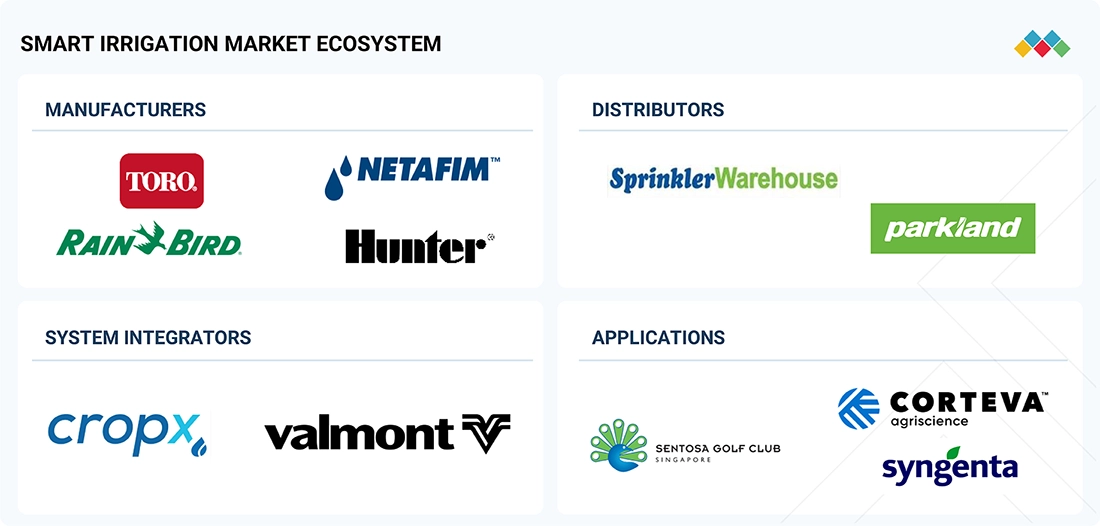
SMART IRRIGATION MARKET SIZE, SHARE & GROWTH: COMMERCIAL USE CASES ACROSS INDUSTRIES
| COMPANY | USE CASE DESCRIPTION | BENEFITS |
|---|---|---|
 |
Toro developed automated irrigation controllers integrated with weather-based data and IoT connectivity to optimize watering schedules for commercial landscapes and golf courses | Reduced water consumption by up to 30%, improved irrigation accuracy, and minimized manual intervention, enhancing sustainability and cost savings |
 |
Netafim launched precision irrigation systems combining soil moisture sensors and AI-driven analytics to deliver water and nutrients efficiently to crops in real time | Increased crop yield and quality, reduced fertilizer use, and improved resource efficiency in large-scale agricultural operations |
 |
Rain Bird deployed smart sprinkler systems using Wi-Fi-enabled controllers and mobile app connectivity for residential and commercial landscapes | Improved user convenience, decreased water wastage, and optimized irrigation schedules based on real-time environmental data |
Logos and trademarks shown above are the property of their respective owners. Their use here is for informational and illustrative purposes only.
Related Ecosystem
Electrical System And Components
- Natural Language Processing (NLP)
- Sensors
- Machine Learning
- Temperature Sensors
- Actuators
- ABB India Limited
- Siemens ag
- SCHNEIDER ELECTRIC SE
- Eaton Corporation plc
- General Electric Company
Sensors And Control
- Sensors
- Image Sensors
- Temperature Sensors
- Pressure Sensors
- Flow Sensors
- BAUMER ELECTRIC AG
- HONEYWELL INTERNATIONAL INC.
- Stmicroelectronics
- Lenovo
- Texas Instruments Incorporated
Key Takeaways
- Japan's smart irrigation market grows from $26.6M (2025) to $44.5M (2030) at 10.8% CAGR.
- Japan leverages semiconductor expertise and IoT technologies to drive precision agriculture adoption.
- Water scarcity and labor shortages in Japan accelerate demand for automated irrigation solutions.
- Japan is positioned as a regional innovation leader in AI-powered and sensor-based irrigation systems by 2030.
Smart Irrigation Market Report Scope
| Report Metric | Details |
|---|---|
| Base Year | 2025 |
| Fastest Growing Segment | SENSOR-BASED (System Type) |
| Forecast Period | 2025–2030 |
| Growth Rate | CAGR of 10.8% from 2025 to 2030 |
| Largest Segment | CONTROLLERS (Component) |
| Market Size Base Year (Billions) | ~USD 1.59 (2025) |
| Revenue Forecast (Billions) | ~USD 2.65 (2030) |
| Segments Covered | Component, Type, System Type |
Japan Smart Irrigation Market Report Segmentation
3 segment dimensions are covered across the global market.
By Component
- Controller
- Controllers
- Other Components
- Sensors
- Water Flow Meters
By Type
- Ec Sensor
- Evapotranspiration
- Fertigation Sensors
- Other Sensors
- Ph Sensor
- Rain/Freeze Sensors
- Soil Moisture Sensors
- Soil Sensors
- Temperature Sensors
By System Type
- Sensor-Based
- Weather-Based
Target Audience
- Agricultural Technology Providers : Manufacturers and solution providers need Japan-specific market data to develop localized smart irrigation products, understand competitive positioning, and identify distribution channels in the Japanese agricultural sector.
- Investment & Venture Capital Firms : Investors evaluating opportunities in Japan's agritech space require detailed market sizing, growth forecasts, and regional drivers to assess portfolio potential and fund allocation decisions.
- Government & Policy Makers : Japanese agricultural and environmental agencies need market intelligence to inform policy development, subsidy programs, and sustainability initiatives aligned with smart irrigation adoption.
- Water Management & Utilities Companies : Water authorities and utility providers in Japan require market insights to develop smart irrigation partnerships, understand adoption rates, and plan infrastructure modernization initiatives.
- Consulting & Strategy Firms : Business consultants advising clients in Japan's agricultural and technology sectors need accurate market data to support strategic recommendations, feasibility studies, and market entry strategies.
Key Companies in the Japan Smart Irrigation Market
| Company | HQ | Ownership | Strongest segments |
|---|---|---|---|
| AGCO CORPORATION | United States | Public Company | |
| WILO SE | Germany | Private Company | |
| RIVULIS IRRIGATION | Israel | Private Company | |
| ALIAXIS | Belgium | Public Company | |
| LENOVO | China | Public Company | |
| MITSUI & CO., LTD. | Japan | Public Company | |
| THE TORO COMPANY | Canada | Public Company | Specialized mobile equipment and heavy equipment (sales and rentals),Product support and industrial engines,Power generation, storage enclosures, and control systems, |
AGCO CORPORATION
AGCO Corporation is a publicly traded agricultural equipment manufacturer founded in 1990 and headquartered in the United States. The company employs approximately 22,000 people and designs, manufactures, and distributes a wide range of farming machinery and related equipment.
WILO SE
Wilo SE is a privately held German pump and fluid handling company founded in 1872 with 8,442 employees. The company manufactures pumping systems and related products for heating, cooling, and water management applications.
RIVULIS IRRIGATION
Rivulis Irrigation is a privately held Israeli irrigation solutions company founded in 1966. The company designs and manufactures drip irrigation and micro-irrigation systems for agricultural applications.
ALIAXIS
Aliaxis is a publicly traded Belgian company founded in 1980 with 16,000 employees that manufactures and distributes plastic piping systems and fluid handling solutions. The company serves water management, heating, cooling, and industrial markets globally.
LENOVO
Lenovo is a publicly traded Chinese technology company founded in 1984 that designs, manufactures, and sells personal computers, servers, and related computing devices. The company is one of the world's largest PC manufacturers.
MITSUI & CO., LTD.
Mitsui & Co., Ltd. is a publicly traded Japanese trading and investment company founded in 1947 with 55,463 employees. The company operates across multiple sectors including energy, metals, machinery, chemicals, and food products.
THE TORO COMPANY
The Toro Company is a publicly traded Canadian company founded in 1961 with 7,900 employees that manufactures turf maintenance equipment, irrigation systems, and landscaping products. The company serves professional and consumer markets globally.
Reasons to Buy this Report
- Japan-Specific Market Sizing : Access precise valuation data for Japan's smart irrigation market with verified 2025 baseline ($26.6M) and 2030 forecasts ($44.5M), enabling accurate business planning and investment decisions.
- Regional Growth Drivers Analysis : Understand Japan-specific factors driving market expansion, including water scarcity pressures, aging agricultural infrastructure, and government sustainability policies unique to the Japanese market.
- Competitive Landscape Intelligence : Identify opportunities and competitive dynamics within Japan's smart irrigation ecosystem, including local player positioning and technology adoption patterns specific to Japanese agricultural practices.
- Strategic Market Entry Planning : Develop targeted go-to-market strategies for Japan with insights into regional demand patterns, regulatory environment, and customer preferences for smart irrigation solutions.
- Investment & Partnership Opportunities : Evaluate growth potential and identify strategic partnership opportunities in Japan's expanding smart irrigation sector with clear market trajectory and sector-specific expansion drivers.
Frequently asked questions
What is the current size of Japan's smart irrigation market?
Japan's smart irrigation market is valued at $26.6 million in 2025 and is projected to reach $44.5 million by 2030.
What is the CAGR for smart irrigation in Japan?
Japan's smart irrigation market is expected to grow at a compound annual growth rate (CAGR) of 10.8% from 2025 to 2030.
What are the primary drivers of smart irrigation adoption in Japan?
Key drivers in Japan include water scarcity concerns, aging agricultural infrastructure, labor shortages, government sustainability initiatives, and the country's advanced semiconductor and electronics manufacturing capabilities.
Which technologies are leading Japan's smart irrigation market?
Japan's market is dominated by IoT-enabled sensors, AI-powered irrigation controllers, soil moisture monitoring systems, and real-time data analytics platforms that optimize water usage.
How does Japan's smart irrigation market compare regionally?
Japan is positioned as a regional innovation leader in Asia Pacific, leveraging its technological expertise and manufacturing capabilities to advance smart irrigation solutions across the region.
RESEARCH METHODOLOGY
The research study involved four major activities in estimating the size of the smart irrigation market. Exhaustive secondary research has been done to collect important information about the market and peer markets. The validation of these findings, assumptions, and sizing with the help of primary research with industry experts across the value chain has been the next step. Both top-down and bottom-up approaches have been used to estimate the market size. Post which the market breakdown and data triangulation have been adopted to estimate the market sizes of segments and sub-segments.
Secondary Research
In the secondary research process, various secondary sources were referred to identify and collect information required for this study. The secondary sources include annual reports, press releases, investor presentations of companies, white papers, and articles from recognized authors. Secondary research has been mainly done to obtain key information about the market’s value chain, the pool of key market players, market segmentation according to industry trends, regional outlook, and developments from both market and technology perspectives.
Primary Research
In primary research, various primary sources from both supply and demand sides have been interviewed to obtain qualitative and quantitative insights required for this report. Primary sources from the supply side include experts such as CEOs, vice presidents, marketing directors, manufacturers, technology and innovation directors, end users, and related executives from multiple key companies and organizations operating in the smart irrigation market ecosystem. After interacting with industry experts, brief sessions were conducted with highly experienced independent consultants to reinforce the findings from our primary research. This, along with the in-house subject matter experts’ opinions, has led us to the findings as described in the remainder of this report. The breakdown of primary respondents is as follows:
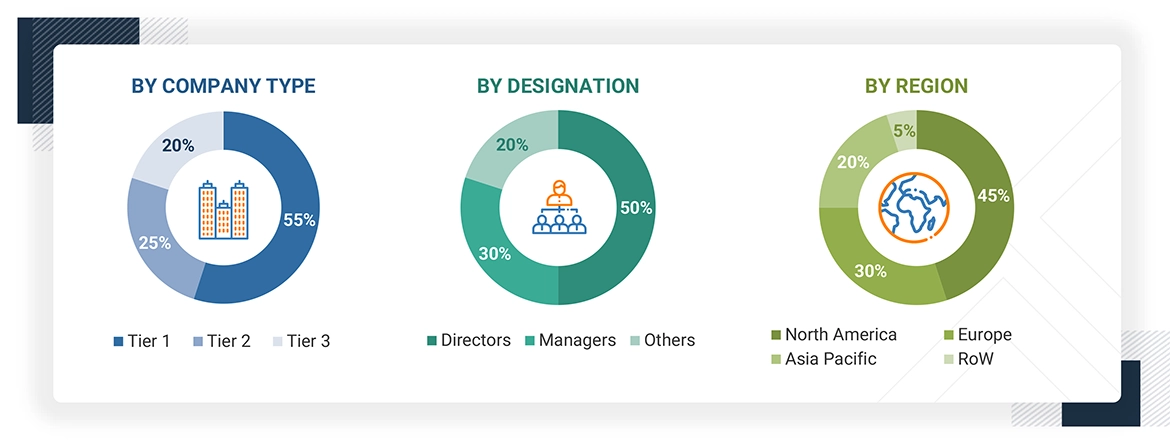
Note: “Others” includes sales, marketing, and product managers
To know about the assumptions considered for the study, download the pdf brochure
Market Size Estimation
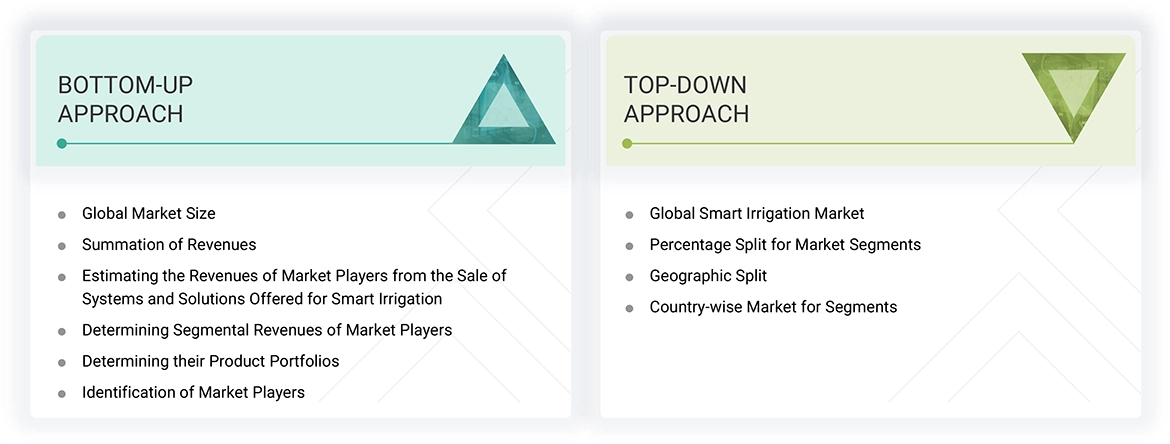
In the market engineering process, both top-down and bottom-up approaches, along with data triangulation methods, have been used to estimate and validate the size of the smart irrigation market and other dependent submarkets. The research methodology used to estimate the market sizes includes the following:
The bottom-up procedure has been employed to arrive at the overall size of the smart irrigation market.
- Major companies that provide smart irrigation systems were identified. This included analyzing company portfolios, product offerings, and presence across various regions.
- The segment-specific revenues of the companies, particularly those related to smart irrigation, were determined.
- These individual revenue figures were compiled to determine the total revenue generated across the identified companies within the sector.
- Using this consolidated data, the global market size for smart irrigation was obtained.
The top-down approach has been used to estimate and validate the total size of the smart irrigation market.
- Identified top-line investments and spending in the ecosystem and major market developments to consider segment-level splits
- Estimated the overall smart irrigation market size, then segmented the global market by allocating shares based on the segments considered
- Distributed the segment-level markets into regions and countries by aligning regional smart irrigation activity with economic indicators, smart irrigation manufacturing presence, and national development initiatives
Smart Irrigation Market : Top-Down and Bottom-Up Approach
Data Triangulation
After arriving at the overall market size using the market size estimation processes as explained above, the market has been split into several segments and subsegments. To complete the entire market engineering process and arrive at the exact statistics of each market segment and subsegment, data triangulation and market breakdown procedures have been employed, wherever applicable. The data has been triangulated by studying various factors and trends from the demand and supply sides of the smart irrigation market
Market Definition
The smart irrigation sector involves the development, integration, and implementation of advanced irrigation technologies designed to optimize water usage in agricultural, commercial, and residential applications. This market focuses on improving irrigation efficiency, conserving water resources, and enhancing crop yields by automating and precisely controlling irrigation processes. Smart irrigation systems utilize a network of technologies, including soil moisture sensors, weather-based controllers, flow meters, and automated valves, supported by IoT platforms, cloud computing, and data analytics, to deliver targeted water applications based on real-time environmental data. The smart irrigation industry provides a comprehensive range of solutions and services, such as sensor-based irrigation systems to monitor soil moisture and crop needs, climate-based irrigation controllers that adjust watering schedules based on weather data, and advanced control systems that enable remote management and automation of irrigation operations. These systems are capable of detecting leaks, measuring water flow, and preventing overwatering or underwatering, ultimately ensuring water efficiency and crop health.
Key Stakeholders
- Agricultural equipment component suppliers
- Original equipment manufacturers (OEMs)
- Irrigation system component and device suppliers and distributors
- Software, service, and technology providers
- Standardization and testing firms
- Government bodies such as regulatory authorities and policymakers
- Research institutes and organizations
- Farmer organizations
Report Objectives
- To define, describe, segment, and forecast the smart irrigation market by system type, component, and application in terms of value
- To describe and forecast the market for various segments, with respect to four main regions: North America, Europe, Asia Pacific, and RoW, in terms of value
- To provide detailed information regarding drivers, restraints, opportunities, and challenges influencing the growth of the smart irrigation market
- To offer a detailed overview of the smart irrigation market’s value chain, along with the ecosystem, technology trends, use cases, regulatory environment, and Porter’s five forces analysis
- To analyze industry trends, patents and innovations, and trade data (export and import data) related to smart irrigation
- To strategically analyze the micromarkets with respect to individual growth trends, prospects, and contributions to the total market
- To identify the key players and comprehensively analyze their market share and core competencies
- To analyze opportunities for stakeholders and provide a detailed competitive landscape of the market
- To investigate competitive developments, such as product launches/developments, collaborations, agreements, partnerships, acquisitions, and research & development (R&D), carried out by players in the smart irrigation market
- To profile key players in the smart irrigation market and comprehensively analyze their market ranking based on their revenue, market share, and core competencies
Available customizations:
With the given market data, MarketsandMarkets offers customizations according to the specific requirements of companies. The following customization options are available for the report:
Country-wise Information:
- Country-wise breakdown for North America, Europe, Asia Pacific, and Rest of the World
Company Information:
- Detailed analysis and profiling of additional market players (up to five)
Get the Full Smart Irrigation Market Report
Full forecast, segment splits, and company analysis for all Smart Irrigation Market.
- US Smart Irrigation Market
- Canada Smart Irrigation Market
- Mexico Smart Irrigation Market
- UK Smart Irrigation Market
- Germany Smart Irrigation Market
- France Smart Irrigation Market
- Italy Smart Irrigation Market
- Spain Smart Irrigation Market
- Poland Smart Irrigation Market
- China Smart Irrigation Market
- South Korea Smart Irrigation Market
- India Smart Irrigation Market
- Australia Smart Irrigation Market
- Indonesia Smart Irrigation Market
- Malaysia Smart Irrigation Market
- Thailand Smart Irrigation Market
- Vietnam Smart Irrigation Market
- Saudi Arabia Smart Irrigation Market
- UAE Smart Irrigation Market
- Kuwait Smart Irrigation Market
- Qatar Smart Irrigation Market
- Bahrain Smart Irrigation Market
- Oman Smart Irrigation Market
Need a Tailored Report?
Customize this report to your needs
Get 10% FREE Customization
Customize This Report
