
Latin America Smart Stadiums Market (2024-2029)

The Latin America Smart Stadiums Market was valued at $1378.3 Million in 2024 and projected to reach to $2923.3 Million by 2029, representing a compound annual growth rate of 16.2%. Latin America's smart stadiums market is poised for substantial expansion, driven by the region's fervent sports culture and increasing digital transformation investments.


| Market Size in | USD 26.32 MN |
| Market Forecast in | |
| CAGR | |
| Forecast Period | |
| Units Considered | Value (USD MN) |
Latin America Smart Stadiums Market Trends and Insights
- This expansion reflects Latin America's increasing investment in digital infrastructure and fan engagement technologies across major sporting venues.
- Latin America is capitalizing on the region's passionate sports culture and rising demand for enhanced spectator experiences through IoT, AI, and cloud-based stadium management solutions. The Latin America smart stadiums market is driven by modernization initiatives in countries with established sports industries, including Brazil, Mexico, and Argentina.
- Latin America's growth trajectory at 16.2% CAGR demonstrates strong momentum as stadium operators adopt integrated ticketing, real-time analytics, and smart security systems.
- Latin America's market expansion is supported by improving broadband connectivity, increased corporate sponsorship, and government backing for sports infrastructure development through 2029..
Key Market Statistics
- CAGR (2024-2029) 16.2% CAGR
- Market Size, 2024 ~USD 1378.3 Million
- Forecast, 2029 ~USD 2923.3 Million
- Geography Latin America
Latin America Smart Stadiums Market Overview
Strong Regional Growth Trajectory :
Latin America's smart stadiums market is expanding at a 16.2% CAGR, nearly matching the global rate of 16.3%, demonstrating the region's competitive positioning in digital stadium innovation and technology adoption.
Passionate Sports Culture Driving Adoption :
The region's deeply rooted sports enthusiasm and fan engagement culture are catalyzing investments in smart stadium technologies, creating unique opportunities for vendors targeting Latin American sporting venues and entertainment complexes.
Digital Infrastructure Investment Surge :
Latin American countries are significantly increasing capital allocation toward digital infrastructure modernization, with smart stadiums emerging as a priority for enhancing operational efficiency and fan experiences across major sporting facilities.
Market Expansion Potential :
With projected growth from USD 1,378.3 million in 2024 to USD 2,923.3 million by 2029, Latin America represents a doubling market opportunity, reflecting accelerating technology adoption and venue modernization initiatives across the region.
Latin America Smart Stadiums Market Dynamics
- Major sporting venues across Brazil, Mexico, and other key markets are prioritizing fan engagement technologies, operational analytics, and integrated connectivity solutions.
- The region's growing middle class and rising disposable incomes are fueling demand for enhanced stadium experiences, while governments and private investors recognize smart stadiums as catalysts for economic development and tourism growth. The forecast period through 2029 will witness accelerated adoption of IoT, AI-powered analytics, and cloud-based management systems in Latin American stadiums.
- Strategic partnerships between technology providers and regional sports organizations, combined with improving broadband infrastructure, will unlock new revenue streams and operational efficiencies.
- Latin America's competitive 16.2% CAGR positions the region as a high-growth market, attracting significant vendor investment and innovation tailored to local sporting preferences and economic conditions..
Market Ecosystem
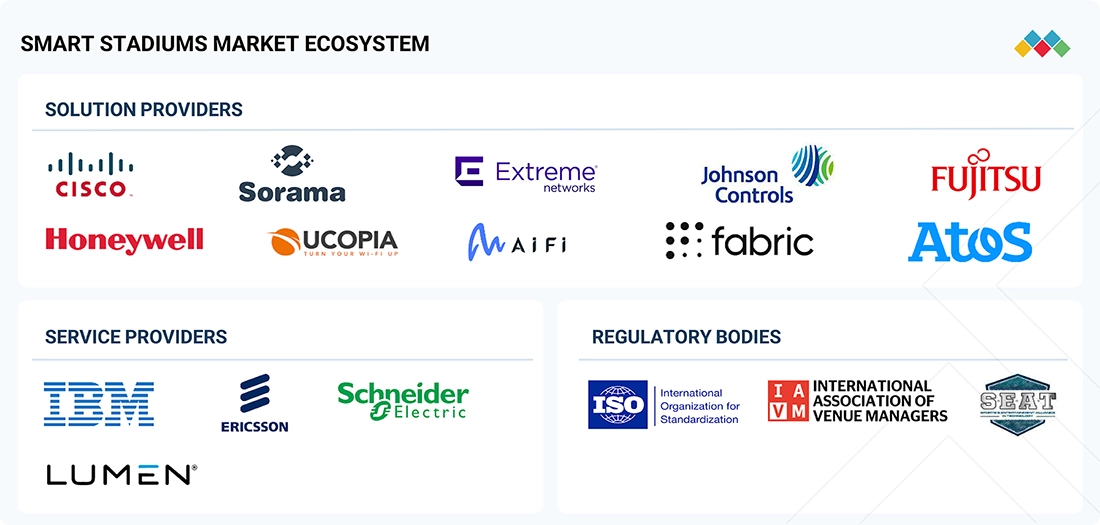
Smart Stadiums Market: COMMERCIAL USE CASES ACROSS INDUSTRIES
| COMPANY | USE CASE DESCRIPTION | BENEFITS |
|---|---|---|
 |
The client is responsible for operating multiple stadiums in Qatar, with the goal of enhancing operational efficiency and the fan experience, particularly in preparation for the FIFA World Cup 2022. These stadiums are pivotal in showcasing Qatar's capabilities in hosting major international events. | Significant reduction in energy consumption, leading to lower operational costs | Enhanced fan experience through improved comfort and security measures | Increased operational efficiency, allowing for better management of resources during high-capacity events |
 |
River Plate Club is a prominent football club based in Buenos Aires, Argentina, known for its rich history and strong fan base. The club strives to deliver an exceptional experience for its fans and visitors, particularly during matches and events held at its stadium. | Significantly improved internet speeds and reliability, allowing fans to share their experiences in real time | Enhanced fan engagement using mobile applications and social media during events | Future-proofing the stadium's connectivity infrastructure, making it adaptable to emerging technologies and growing demands |
Logos and trademarks shown above are the property of their respective owners. Their use here is for informational and illustrative purposes only.
Related Ecosystem
Analytics
- Natural Language Processing (NLP)
- Machine Learning
- Supply Chain Management
- Predictive Analytics
- Image Sensors
- International Business Machines Corporation
- MICROSOFT CORPORATION
- Oracle Corporation
- SAP SE
Digitalization And Iot
- Sensors
- Remote Monitoring
- Supply Chain Management
- Passenger Information System (PIS)
- Platform as A Service (PaaS)
- International Business Machines Corporation
- Cisco Systems, Inc.
- MICROSOFT CORPORATION
- Oracle Corporation
- HUAWEI TECHNOLOGIES CO LTD
Mobility And Telecom
- Smart Utilities
- Smart Healthcare
- Sensors
- Parking Management System
- Passenger Information System (PIS)
- AT&T Inc.
- Cisco Systems, Inc.
- HUAWEI TECHNOLOGIES CO LTD
- Telefonaktiebolaget LM Ericsson (publ)
- International Business Machines Corporation
Key Takeaways
- Latin America's smart stadiums market will nearly double from USD 1,378.3 million in 2024 to USD 2,923.3 million by 2029, growing at a 16.2% CAGR.
- Latin America's market growth is fueled by major sporting events, stadium modernization projects, and increasing fan demand for digital engagement platforms.
- Latin America's adoption of smart technologies includes IoT sensors, AI-powered analytics, mobile ticketing, and integrated security systems across venues.
- Latin America's regional leaders-Brazil, Mexico, and Argentina-are driving investment in smart stadium infrastructure to enhance operational efficiency and revenue generation.
Smart Stadiums Market Report Scope
| Report Metric | Details |
|---|---|
| Base Year | 2024 |
| Fastest Growing Segment | SMART TRANSPORTATION (Application) |
| Forecast Period | 2024-2029 |
| Growth Rate | CAGR of 16.3% from 2024 to 2029 |
| Largest Segment | SMART CITIZEN SERVICES (Application) |
| Market Size Base Year (Billions) | ~USD 19.59 (2024) |
| Revenue Forecast (Billions) | ~USD 41.68 (2029) |
| Segments Covered | Offering, Type, Stadium Type, Solution, Digital Content Management, Stadium And Public Security, Building Automation, Event Management, Service, Professional Service, Technology, Sport, End User, Application |
Latin America Smart Stadiums Market Report Segmentation
14 segment dimensions are covered across the global market.
By Offering
- Services
- Solutions
By Type
- Access Control
- Audio And Video Management
- Building Automation
- Consulting
- Crowd Management
- Cybersecurity
- Deployment & Integration
- Digital Content Management
- Digital Signage
- Emergency And Disaster Management
- Energy Management Systems
- Event Management
- Event Marketing And Registration
- Facility Management Systems
- Managed Services
- Mobile And Web Content Management
- Network Management
- Parking Management Systems
- Professional Services
- Psim
- Security Scanning, Imaging, And Metal Detection
- Stadium And Public Security
- Support & Maintenance
- Ticketing Management
- Video Surveillance
- Workforce Management
By Stadium Type
- Indoor
- Multi-Purpose
- Outdoor
By Solution
- Building Automation
- Crowd Management
- Data Management
- Digital Content Management
- Event Management
- Network Management
- Real-Time Location System
- Remote Monitoring
- Reporting And Analytics
- Security
- Stadium And Public Security
By Digital Content Management
- Audio And Video Management
- Digital Signage
- Mobile And Web Content Management
By Stadium And Public Security
- Access Control
- Cybersecurity
- Emergency And Disaster Management
- Psim
- Security Scanning, Imaging, And Metal Detection
- Video Surveillance
By Building Automation
- Energy Management Systems
- Facility Management Systems
- Parking Management Systems
By Event Management
- Event Marketing And Registration
- Ticketing Management
- Workforce Management
By Service
- Managed Services
- Professional Services
By Professional Service
- Consulting
- Deployment & Integration
- Support & Maintenance
By Technology
- Devices
- Esports
- Smart Stadiums
- Sports Analytics
By Sport
- American Football/Rugby
- Baseball
- Basketball
- Cricket
- Esports
- Golf
- ICE Hockey
- Soccer
- Tennis
By End User
- Athletes
- Clubs
- Coaches
- Leagues
- Sports Associations
By Application
- Smart Building
- Smart Citizen Services
- Smart Transportation
- Smart Utilities
Target Audience
- Stadium Operators & Venue Managers : Latin American stadium operators need market intelligence to justify smart technology investments, benchmark operational modernization costs, and identify best-in-class solutions for enhancing fan experiences and revenue optimization.
- Technology Vendors & Solution Providers : Smart stadium technology companies require regional market sizing, growth forecasts, and competitive landscape data to prioritize Latin America expansion, allocate R&D resources, and develop localized product strategies.
- Sports Organizations & Leagues : Regional sports bodies and professional leagues need market data to guide venue modernization initiatives, evaluate technology partnerships, and understand fan engagement technology trends across Latin American markets.
- Private Equity & Investment Firms : Investors targeting Latin America's sports infrastructure and digital transformation sectors require validated market forecasts and growth metrics to evaluate investment opportunities in smart stadium technology and venue operators.
- Government & Economic Development Agencies : Latin American government bodies and development agencies need market intelligence to inform digital infrastructure policies, incentivize stadium modernization, and understand technology adoption trends supporting economic growth.
Countries within Latin America - compare and drill down
| Country | 2025 size (native) |
|---|---|
| Brazil | USD 750.9 Million |
| Mexico | USD 545.9 Million |
| Rest Of Latin America | USD 1626.4 Million |
Country market size visualization
Reasons to Buy this Report
- Market Size & Growth Validation : Quantified market data for Latin America's smart stadiums sector with precise 2024 baseline (USD 1,378.3M) and 2029 forecast (USD 2,923.3M), enabling confident investment and expansion planning in this high-growth region.
- Regional Competitive Intelligence : Understand Latin America's 16.2% CAGR performance relative to global benchmarks, identify market dynamics unique to the region, and benchmark against country-level opportunities within Mexico and Rest of Latin America segments.
- Localized Opportunity Assessment : Access granular insights into Latin America's sports culture, digital infrastructure investments, and fan engagement priorities to tailor product offerings, go-to-market strategies, and partnership approaches for maximum regional relevance.
- Strategic Market Entry Planning : Leverage comprehensive Latin America market analysis to identify optimal entry points, assess competitive positioning, and develop region-specific business cases for smart stadium technology deployment and vendor partnerships.
- Investment Decision Support : Make data-driven capital allocation decisions with validated market forecasts, growth trajectory analysis, and regional economic indicators specific to Latin America's smart stadiums sector through 2029.
Frequently asked questions
What is the current size of Latin America's smart stadiums market?
Latin America's smart stadiums market was valued at USD 1,378.3 million in 2024 and is expected to reach USD 2,923.3 million by 2029.
What is the projected growth rate for Latin America's smart stadiums market?
Latin America's smart stadiums market is projected to grow at a compound annual growth rate (CAGR) of 16.2% from 2024 to 2029.
Which countries are leading Latin America's smart stadiums market?
Brazil, Mexico, and Argentina are the primary drivers of Latin America's smart stadiums market due to their established sports industries and significant stadium modernization initiatives.
What technologies are being adopted in Latin America's smart stadiums?
Latin America's smart stadiums are implementing IoT sensors, AI-powered analytics, mobile ticketing platforms, integrated security systems, and cloud-based management solutions.
What factors are driving growth in Latin America's smart stadiums market?
Latin America's market growth is driven by improving broadband connectivity, major sporting events, stadium modernization projects, corporate sponsorship increases, and government infrastructure investment.
RESEARCH METHODOLOGY
This research study involved the extensive use of secondary sources, directories, and databases, such as Dun & Bradstreet (D&B) Hoovers and Bloomberg BusinessWeek, to identify and collect valuable information for a technical, market-oriented, and commercial study of the Smart Stadiums market. The primary sources have been mainly industry experts from the core and related industries and preferred suppliers, manufacturers, distributors, service providers, technology developers, alliances, and organizations related to all segments of the value chain of this market. In-depth interviews have been conducted with various primary respondents, including key industry participants, subject matter experts, C-level executives of key market players, and industry consultants, to obtain and verify critical qualitative and quantitative information.
Secondary Research
In the secondary research process, various secondary sources were referred to identify and collect information for the study. The secondary sources included annual reports, press releases, investor presentations of companies, white papers, certified publications, and articles from recognized associations and government publishing sources. Several journals and associations, such as Stadium Innovation Conference 2024, SMART Conference 2024, Stadium Innovation Conference, World Stadium Congress, World of Stadiums, were also referred to. Secondary research was used to obtain key information about industry insights, the market’s monetary chain, the overall pool of key players, market classification and segmentation according to industry trends to the bottom-most level, regional markets, and key developments from both the market and technology-oriented perspectives.
Primary Research
In the primary research process, various primary sources from both the supply and demand sides were interviewed to obtain qualitative and quantitative information for the report. The primary sources from the supply side included industry experts, such as Chief Executive Officers (CEOs), Chief Technology Officers (CTOs), Chief Operating Officers (COOs), Vice Presidents (VPs), marketing directors, technology and innovation directors, and related key executives from various key companies and organizations operating in the Smart Stadiums market. The primary sources from the demand side included Smart Stadiums end users, consultants/specialists, Chief Information Officers (CIOs), and subject-matter experts from enterprises and government associations.
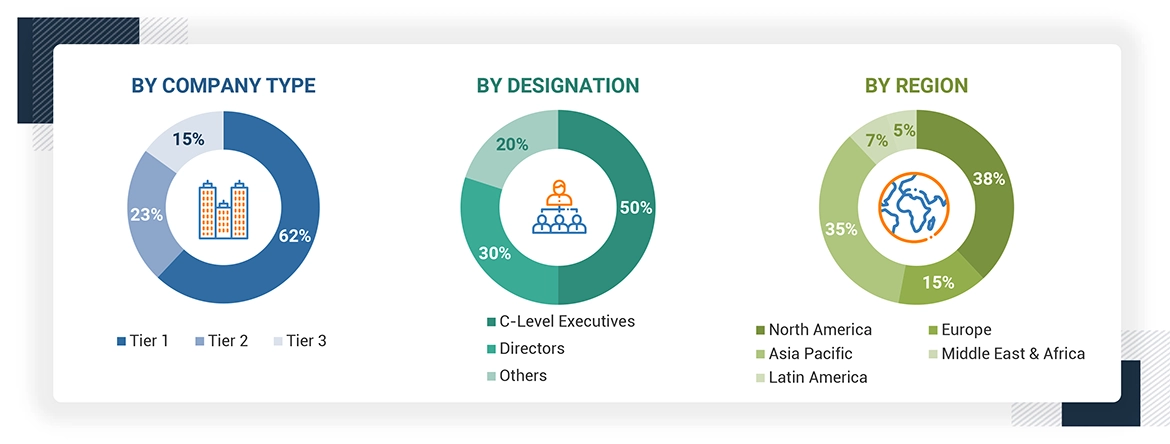
*Others include sales managers, marketing managers, and product managers.
Note: Tier 1 companies’ revenue is more than USD 1 billion; Tier 2 companies ‘revenue ranges between
USD 500 million to 1 billion; and Tier 3 companies’ revenue ranges in between USD
100 million and USD 500 million
To know about the assumptions considered for the study, download the pdf brochure
Market Size Estimation
Multiple approaches were adopted to estimate and forecast the size of the Smart Stadiums market. The first approach involves estimating market size by summing up the revenue generated by companies through the sale of Smart Stadiums.
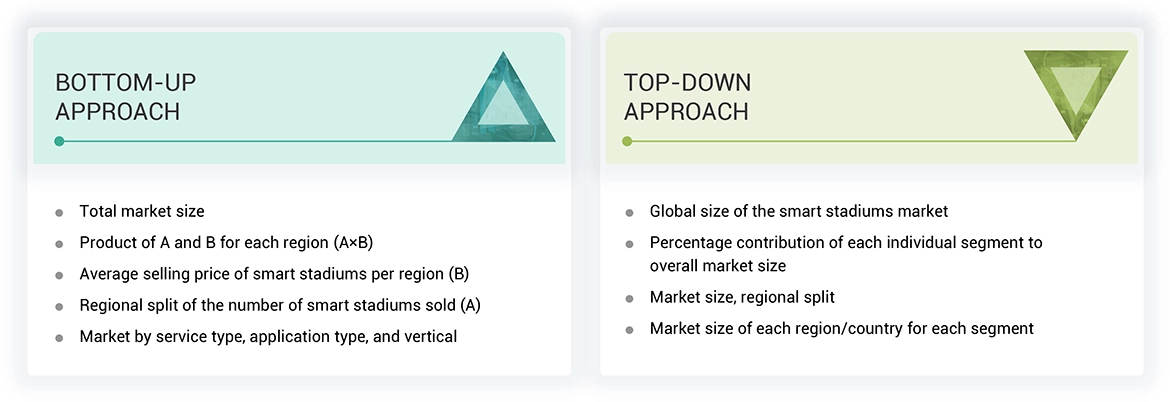
Both top-down and bottom-up approaches were used to estimate and validate the total size of the Smart Stadiums market. These methods were extensively used to estimate the size of various segments in the market. The research methodology used to estimate the market size includes the following:
- Key players in the market have been identified through extensive secondary research.
- In terms of value, the industry’s supply chain and market size have been determined through primary and secondary research processes.
- All percentage shares, splits, and breakups have been determined using secondary sources and verified through primary sources.
Smart Stadiums Market : Top-Down and Bottom-Up Approach
Data Triangulation
A Smart Stadium, is an application of smart technology integrated solutions and hardware in the stadium's infrastructure. Advanced digital technologies such as IoT, high-density Wi-Fi, integrated security systems, as well as mobile applications, are used to serve a better experience of sports and entertainment viewing, increased profitability, and improved security within the stadium.
According to Intel, a Smart Stadium may be defined as an arena where IoT, 5G connectivity, cloud computing, and AI-driven analytics deliver an immersed fan experience, improved stadium operations, enhanced safety, and revenue generation through data-driven decision-making.
Market Definition
Digital identity solutions refer to the tools and systems that enable individuals, organizations, and anything else related to computers, smartphones, and IoT devices, systems, services, and applications to establish and verify identities in a digital environment.
Stakeholders
- Stadium Owners and Operators
- Sports Teams and Leagues
- Event Organizers
- Fans and Spectators
- Technology Providers
- Network Operators
- Security Service Providers
- Government Agencies
- Facility Management Companies
- Infrastructure Providers
- Payment Solution Providers
- Broadcast and Media Companies
- Fan Engagement and Marketing Solution Providers
- Data Analytics Providers
- Sponsorship and Advertising Partners
- Health and Safety Providers
- Sustainability and Energy Management Providers
- Food and Beverage Service Providers
- Parking and Transportation Providers
- Digital Content Providers
Report Objectives
- To determine, segment, and forecast the Smart Stadiums market based on offering (solutions and services), stadium type, and region in terms of value
- To forecast the size of the market segments with respect to five main regions: North America, Europe, Asia Pacific, Middle East & Africa, and Latin America
- To provide detailed information about the major factors (drivers, restraints, opportunities, and challenges) influencing the growth of the market
- To study the complete value chain and related industry segments and perform a value chain analysis of the market landscape
- To strategically analyze the macro and micromarkets1 with respect to individual growth trends, prospects, and contributions to the total market
- To analyze the industry trends, pricing data, patents, and innovations related to the market
- To analyze the opportunities for stakeholders by identifying the high-growth segments of the market
- To profile the key players in the market and comprehensively analyze their market share/ranking and core competencies2
- To track and analyze competitive developments, such as mergers & acquisitions, product launches & developments, partnerships, agreements, collaborations, business expansions, and R&D activities
Available Customizations
With the given market data, MarketsandMarkets offers customizations as per the company’s specific needs. The following customization options are available for the report:
Country-wise information
- Analysis for additional countries (up to five)
Company Information
- Detailed analysis and profiling of additional market players (up to 5)
Get the Full Smart Stadiums Market Report
Full forecast, segment splits, and company analysis for all Smart Stadiums Market.
- Canada Smart Stadiums Market
- US Smart Stadiums Market
- UK Smart Stadiums Market
- China Smart Stadiums Market
- Brazil Smart Stadiums Market
- France Smart Stadiums Market
- Germany Smart Stadiums Market
- Italy Smart Stadiums Market
- Nordic Countries Smart Stadiums Market
- Rest Of Europe Smart Stadiums Market
- Spain Smart Stadiums Market
- India Smart Stadiums Market
- Japan Smart Stadiums Market
- Rest Of Asia Pacific Smart Stadiums Market
- South Korea Smart Stadiums Market
- Southeast Asia Smart Stadiums Market
- Mexico Smart Stadiums Market
- Rest Of Latin America Smart Stadiums Market
- Bahrain Smart Stadiums Market
- Ksa Smart Stadiums Market
- Kuwait Smart Stadiums Market
- Rest Of Middle East Smart Stadiums Market
- UAE Smart Stadiums Market
Need a Tailored Report?
Customize this report to your needs
Get 10% FREE Customization
Customize This Report
