
Malaysia Starch Derivatives Market (2023-2028)

The Malaysia Starch Derivatives Market was valued at $371.4 Million in 2023 and projected to reach to $434.7 Million by 2028, representing a compound annual growth rate of 3.2%. Malaysia's starch derivatives market is positioned for steady growth through 2028, supported by the country's robust food and beverage manufacturing sector.


| Market Size in | USD 26.32 MN |
| Market Forecast in | |
| CAGR | |
| Forecast Period | |
| Units Considered | Value (USD MN) |
Malaysia Starch Derivatives Market Trends and Insights
- Malaysia's food and beverage sector drives demand for modified starches, sweeteners, and thickening agents across confectionery, bakery, and processed food applications.
- The market in Malaysia benefits from rising consumer spending, urbanization, and the country's position as a regional food manufacturing hub. Key growth drivers in Malaysia include increasing adoption of convenience foods, growing demand for clean-label ingredients, and expansion of the food processing industry.
- Malaysia's starch derivatives market is supported by both domestic consumption and export-oriented food production.
- The forecast period through 2028 reflects steady demand from Malaysia's evolving food industry and regional trade dynamics..
Key Market Statistics
- CAGR (2023-2028) 3.2% CAGR
- Market Size, 2023 ~USD 371.4 Million
- Forecast, 2028 ~USD 434.7 Million
- Country Malaysia
Malaysia Starch Derivatives Market Overview
Market Valuation :
Malaysia's starch derivatives market reached USD 371.4 million in 2023, with projected growth to USD 434.7 million by 2028, representing a steady 3.2% CAGR.
Key Applications :
Modified starches, sweeteners, and thickening agents dominate Malaysia's market, driven by demand from confectionery, bakery, and processed food manufacturers across the region.
Growth Drivers :
Rising consumer demand for convenience foods, expanding food processing industries, and increasing adoption of functional ingredients in Malaysia's F&B sector fuel market expansion.
Competitive Landscape :
Malaysia's starch derivatives market is characterized by both multinational suppliers and regional manufacturers competing to serve the country's growing food production ecosystem.
Malaysia Starch Derivatives Market Dynamics
- The increasing consumption of processed and convenience foods, coupled with rising urbanization and disposable incomes, creates sustained demand for starch-based ingredients.
- Local food manufacturers are increasingly adopting modified starches to improve product texture, shelf-life, and nutritional profiles, particularly in bakery and confectionery segments. The market outlook remains positive as Malaysia strengthens its position as a regional food production hub.
- Government initiatives supporting food manufacturing, combined with growing export opportunities to neighboring Southeast Asian markets, are expected to drive ingredient demand.
- Additionally, consumer preference for clean-label and functional food products is encouraging manufacturers to innovate with advanced starch derivatives, creating new growth opportunities through 2028..
Market Ecosystem
Related Ecosystem
Fandb Additives
- Dairy Products
- Bakery Products
- Polyglycerol Esters
- Microorganism
- Carbohydrates
- AZELIS HOLDINGS SA
- Archer-Daniels-Midland Company
- Amway
- UNILEVER PLC
- DuPont de Nemours, Inc.
Fandb Ingredients
- Dairy Products
- Bakery Products
- Microorganism
- Polydextrose
- Carbohydrates
- AZELIS HOLDINGS SA
- Archer-Daniels-Midland Company
- Kerry Group plc
- Amway
- DSM FIRMMENICH
Key Takeaways
- Malaysia's starch derivatives market reached USD 371.4 million in 2023 with a projected value of USD 434.7 million by 2028.
- Malaysia's market is growing at a 3.2% CAGR, driven by expanding food processing and convenience food sectors.
- Modified starches and sweeteners dominate Malaysia's starch derivatives applications in bakery and confectionery products.
- Malaysia's position as a regional food manufacturing hub supports both domestic and export-driven market growth through 2028.
Starch Derivatives Market Report Scope
| Report Metric | Details |
|---|---|
| Base Year | 2023 |
| Fastest Growing Segment | –COSMETICS (Application) |
| Forecast Period | 2023–2028 |
| Growth Rate | CAGR of 3.4% from 2023 to 2028 |
| Largest Segment | DRY (Form) |
| Market Size Base Year (Billions) | ~USD 57.87 (2023) |
| Revenue Forecast (Billions) | ~USD 68.4 (2028) |
| Segments Covered | Type, Application, Source, Form |
Malaysia Starch Derivatives Market Report Segmentation
4 segment dimensions are covered across the global market.
By Type
- Cyclodextrin
- Glucose Syrup
- Hydrolysates
- Maltodextrin
- Modified Starch
By Application
- Feed
- Food & Beverages
- Industrial
- –Bakery & Confectionery Products
- –Beverages
- –Cosmetics
- –Medicines & Pharmaceuticals
- –Other Food Applications
- –Other Industrial Applications
- –Papermaking
- –Processed Foods
- –Weaving & Textiles
By Source
- Arrowroot
- Corn
- Other Sources
- Potato
- Rice
- Tapioca
- Wheat
By Form
- Dry
- Liquid
MALAYSIA: STARCH DERIVATIVES MARKET, BY APPLICATION, 2023–2028
| Segment | 2023 | 2024 | 2025 | 2026 | 2027 | 2028 | CAGR (%) |
|---|---|---|---|---|---|---|---|
| FEED | 31.2 | 32 | 32.9 | 33.8 | 34.9 | 36 | 2.9 |
| FOOD & BEVERAGES | 263.2 | 270.2 | 277.9 | 286.3 | 295.6 | 305.8 | 3 |
| INDUSTRIAL | 77 | 79.6 | 82.5 | 85.7 | 89.1 | 92.9 | 3.8 |
| TOTAL | 371.4 | 381.8 | 393.2 | 405.8 | 419.6 | 434.7 | 3.2 |
Target Audience
- Food & Beverage Manufacturers : Malaysian F&B producers need localized market data to optimize ingredient sourcing, forecast demand for starch derivatives, and plan production capacity expansions aligned with regional growth.
- Starch Ingredient Suppliers : Suppliers targeting Malaysia require country-specific market intelligence to identify customer segments, assess competitive positioning, and develop tailored sales strategies for confectionery and bakery sectors.
- Investment & Private Equity Firms : Investors evaluating opportunities in Malaysia's food processing sector need accurate market sizing and growth forecasts to assess portfolio companies and identify acquisition targets.
- Market Entry & Expansion Teams : Companies planning market entry or expansion in Malaysia require localized insights on market dynamics, regulatory environment, and competitive landscape to minimize risk and maximize ROI.
- Business Consultants & Analysts : Consultants advising clients on Malaysia's food industry strategy need verified market data and forecasts to support feasibility studies, business plans, and strategic recommendations.
Key Companies in the Malaysia Starch Derivatives Market
| Company | HQ | Ownership | Strongest segments |
|---|---|---|---|
| SOJITZ CORPORATION | Japan | Public Company | Metals, minerals, and energy resources,Automotive, mobility, and industrial machinery,Infrastructure, power, and transportation (incl. IPP/IWPP, aircraft, marine), |
| BUNGE LIMITED | United States | Public Company | Soybean Processing and Refining (incl. biodiesel & fertilizer),Softseed Processing and Refining (incl. biodiesel),Other Oilseeds Processing and Refining (specialty), |
| SENSUS, INC | United States | Public Company | SRT-100 and SRT-100+ systems,SRT-100 Vision systems,Sentinel service program and service contracts, |
| AMWAY | Malaysia | Public Company | Health and wellness (NUTRILITE, bodykey, XS),Beauty and personal care (ARTISTRY, G&H, GLISTER, SATINIQUE),Home living systems (eSpring, ATMOSPHERE), |
| ROYAL COSUN | Netherlands | Private Company | Beet sugar and co-products,Potato products (chilled, frozen, dried, specialties),Plant-based ingredients (inulin, starch, fruit and vegetable products), |
| CARGILL, INCORPORATED | United States | Private Company | Grains and oilseeds origination, trading, processing, and distribution,Animal nutrition and supplements,Meat and poultry products, |
| ADM | United States | Public Company | Ag Services and Oilseeds (target-market relevant share),Carbohydrate Solutions (food and feed applications),Nutrition – Human, |
| TATE & LYLE | United Kingdom | Public Company | Sweeteners (bulk and specialty),Fibres,Starches, proteins, and functional flours, |
| AGRANA BETEILIGUNGS-AG | Austria | Public Company | Food and Beverage Solutions,ACS-Starch,ACS-Sugar, |
| INGREDION INCORPORATED | United States | Public Company | Commodity sweeteners (HFCS, glucose syrups, dextrose, high maltose),Specialty and modified starches (food texturizers and clean-label solutions),Industrial starches and biomaterial solutions, |
| AVEBE | Netherlands | Private Company | Food-grade potato starch and functional systems (Solvitose, Perfectasol, Eliane, Etenia, Paselli, Perfectacote, Perfectafilm),Potato protein and feed co-products (Solanic, Protamylasse, Protamyl, Protastar),Industrial starches for paper, construction, adhesives, textiles, inks (Casucol, Amylofax, Perfectamyl, Puramyl, Farinex, Avedex, Solvicol), |
| THE SUKHJIT STARCH & CHEMICALS LTD. | India | Public Company | Maize starch (native),Modified and pregel starches,Liquid glucose, high maltose syrup, malto dextrin, |
| UNIVERSAL STARCH CHEM ALLIED LTD | India | Public Company | Maize starch (native and modified),Dextrose monohydrate and anhydrous,Liquid glucose and syrups, |
SOJITZ CORPORATION
Sojitz Corporation is a Japanese public company founded in 1862 with 26,789 employees. It operates as a diversified trading and investment company with a long-established presence in global markets.
BUNGE LIMITED
Bunge Limited is a United States-based public company founded in 1818 with 34,000 employees. It operates as a major global agribusiness and food ingredient company.
SENSUS, INC
Sensus, Inc. is a United States-based public company founded in 2010 with 60 employees. It operates as a specialized business within its sector.
AMWAY
Amway is a Malaysia-based public company founded in 1976 with 308 employees. It operates as a direct sales and consumer goods organization.
ROYAL COSUN
Royal Cosun is a private company based in the Netherlands with 4,528 employees. It operates within its industry sector with significant operational scale.
CARGILL, INCORPORATED
Cargill, Incorporated is a United States-based private company founded in 1865 with 155,000 employees. It is one of the largest privately-held agribusiness and food production companies globally.
ADM
ADM (Archer Daniels Midland) is a United States-based public company founded in 1902 with 41,147 employees. It operates as a major global processor of agricultural commodities and producer of food ingredients.
TATE & LYLE
Tate & Lyle is a United Kingdom-based public company founded in 1903 with 4,840 employees. It operates as a specialty food ingredients and solutions provider.
AGRANA BETEILIGUNGS-AG
Agrana Beteiligungs-AG is an Austria-based public company founded in 1988 with 8,353 employees. It operates as a producer of fruit preparations, starch products, and bioethanol.
INGREDION INCORPORATED
Ingredion Incorporated is a United States-based public company founded in 1906 with 11,200 employees. It operates as a global ingredient solutions provider for the food and industrial sectors.
AVEBE
Avebe is a Netherlands-based private company founded in 1919 with 1,155 employees. It operates as a producer of potato starch and starch-based products.
THE SUKHJIT STARCH & CHEMICALS LTD.
The Sukhjit Starch & Chemicals Ltd. is an India-based public company founded in 1943 with 1,336 employees. It operates as a producer of starch and chemical products.
UNIVERSAL STARCH CHEM ALLIED LTD
Universal Starch Chem Allied Ltd is an India-based public company founded in 1973 with 357 employees. It operates as a manufacturer of starch and allied chemical products.
Reasons to Buy this Report
- Market-Specific Sizing : Access precise valuation data for Malaysia's starch derivatives market with verified 2023 baseline (USD 371.4M) and 2028 forecasts, enabling accurate budget allocation and investment planning.
- Localized Growth Insights : Understand Malaysia-specific growth drivers including regional food manufacturing expansion, urbanization trends, and local consumer preferences shaping the 3.2% CAGR trajectory.
- Application-Focused Intelligence : Identify high-demand segments within Malaysia's confectionery, bakery, and processed food industries to prioritize product development and market entry strategies.
- Competitive Positioning : Benchmark against multinational and regional competitors operating in Malaysia's market to develop differentiated go-to-market strategies and partnership opportunities.
- Strategic Decision Support : Leverage Malaysia-specific forecasts and market dynamics to support investment decisions, expansion planning, and supply chain optimization for the 2023-2028 period.
Frequently asked questions
What is the current size of Malaysia's starch derivatives market?
Malaysia's starch derivatives market was valued at USD 371.4 million in 2023 and is expected to reach USD 434.7 million by 2028.
What is the growth rate of Malaysia's starch derivatives market?
Malaysia's starch derivatives market is growing at a compound annual growth rate (CAGR) of 3.2% from 2023 to 2028.
Which applications drive demand in Malaysia's starch derivatives market?
In Malaysia, starch derivatives are primarily used in bakery, confectionery, processed foods, and beverages as thickening agents, sweeteners, and texture modifiers.
What factors are supporting growth in Malaysia's starch derivatives market?
Malaysia's market growth is supported by rising urbanization, increased consumption of convenience foods, clean-label ingredient trends, and the country's role as a regional food manufacturing center.
How does Malaysia's starch derivatives market compare to global trends?
Malaysia's 3.2% CAGR is slightly below the global average of 3.4%, reflecting regional market maturity and localized demand patterns in the Asia Pacific region.
RESEARCH METHODOLOGY
This research involves the extensive use of secondary sources; directories; and databases (Bloomberg and Factiva) to identify and collect information useful for a technical, market-oriented, and commercial study of the Starch derivatives market. In-depth interviews were conducted with various primary respondents, such as key industry participants, Subject Matter Experts (SMEs), C-level executives of key market players, and industry consultants, to obtain and verify critical qualitative and quantitative information and to assess prospects.
Secondary Research
In the secondary research process, various sources, such as the Food and Agricultural Organization (FAO), United States Department of Agriculture (USDA), U.S. Food and Drug Administration (FDA) U.S. Food and Drug Administration (FDA), European Food Safety Authority (EFSA), World Health Organization (WHO), Consumer Healthcare Products Association (CHPA), European Federation of Associations of Health Product Manufacturers (EHPM), Canadian Health Food Association (CHFA), and Health Food Manufacturers' Association (HFMA), associations were referred to identify and collect information for this study. The secondary sources also include journals, press releases, investor presentations of companies, whitepapers, certified publications, articles by recognized authors and regulatory bodies, trade directories, and paid databases.
Primary Research
The Starch derivatives market encompasses various stakeholders involved in the supply chain, raw material manufacturers, raw material suppliers, regulatory organizations, and research institutions. To gather comprehensive information, primary sources from both the supply and demand sides were engaged. Primary interviewees from the supply side consisted of manufacturers, distributors, importers, and technology providers involved in the production and distribution of Precision fermentation. On the demand side, key opinion leaders, executives, and CEOs of companies in the Starch derivatives industry were approached through questionnaires, emails, and telephonic interviews. This approach ensured a comprehensive and well-rounded understanding of the Starch derivatives market from various perspectives.
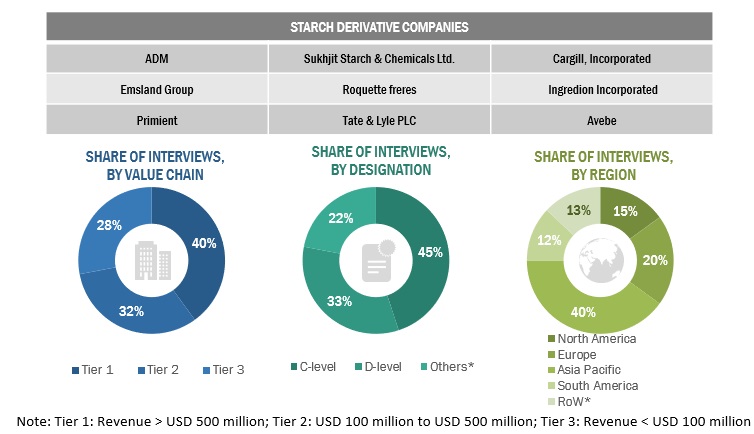
To know about the assumptions considered for the study, download the pdf brochure
Market Size Estimation
The top-down and bottom-up approaches were used to estimate and validate the market’s and various dependent submarkets’ size. The research methodology used to estimate the market size includes extensive secondary research of key players, reports, reviews, and newsletters of top market players, along with extensive interviews from leaders, such as CEOs, directors, and marketing executives.
Global Starch Derivatives Market Size: Bottom-Up Approach
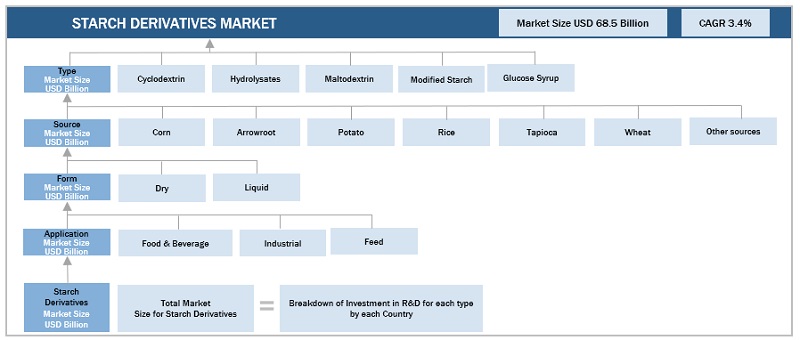
To know about the assumptions considered for the study, Request for Free Sample Report
Global Starch Derivatives Market Size: Top-Down Approach
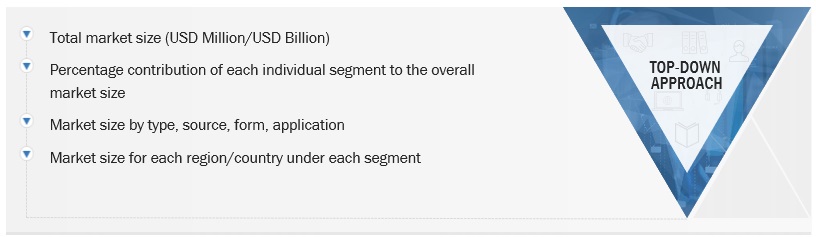
Market Definition
Starch is a naturally abundant nutrient carbohydrate consisting of a large number of glucose units, mainly obtained from natural sources such as corn, potatoes, wheat, rice, and other plant sources commonly prepared as a white amorphous powder. Starch derivatives are prepared by treating starch through different processes such as hydrolysis, extraction, purification, and chemical treatment to be utilized in a wide range of food and non-food applications. Starch derivatives are used for functions such as thickening, stabilizing, binding, and emulsification.
Data Triangulation
The data triangulation and market breakdown procedures explained above were implemented, wherever applicable, to complete the overall market engineering process and arrive at the exact statistics for various market segments and subsegments. The data was triangulated by studying various factors and trends from the demand and supply sides. Along with this, the market size was validated using both the top-down and bottom-up approaches.
Key Stakeholders
- Starch and starch derivative manufacturers and processors
- Intermediate suppliers such as traders and distributors of starch and starch derivatives
- Manufacturers of food & beverage ingredients, processed food, and feed
- Other manufacturing industries such as the personal care, pharmaceutical, and papermaking industries
- Government and research organizations
-
Associations, regulatory bodies, and other industry-related bodies:
- Starch Europe
- The Food and Agriculture Organization (FAO)
- Food and Drug Administration (FDA)
- US Department of Agriculture (USDA)
- European Food Safety Agency (EFSA)
- Agriculture and Agri-Food Canada
- National Corn Grower Association - World of Corn
- The International Food Additives Council (IFAC)
- Food Processing Suppliers Association (FPSA)
- Food Standards Australia New Zealand (FSANZ)
Report Objectives
- To define, segment, and project the global market for Starch derivatives on the basis of type, source, form, application, functionality, and region
- To provide detailed information regarding the key factors influencing the growth of the market (drivers, restraints, opportunities, and industry-specific challenges)
- To strategically analyze the micro markets with respect to individual growth trends, future prospects, and their contribution to the total market
- To analyze the opportunities in the market for stakeholders and provide a competitive landscape of the market leaders
- To project the size of the market and its submarkets, in terms of value with respect to the regions (along with the key countries)
- To strategically profile the key players and comprehensively analyze their market position and core competencies
- To analyze competitive developments in the Starch derivatives market, including joint ventures, mergers & acquisitions, new product developments, and research & development activities
Available Customizations:
With the given market data, MarketsandMarkets offers customizations according to company-specific scientific needs.
The following customization options are available for the report:
Product Analysis
- Product Matrix, which gives a detailed comparison of the product portfolio of each company
Geographic Analysis
With the given market data, MarketsandMarkets offers customizations according to company-specific scientific needs.
- Further breakdown of the Rest of the European Starch derivatives market, by key country
- Further breakdown of the Rest of the Asia Pacific Starch derivatives market, by key country
- Further breakdown of the Rest of South America Starch derivatives market, by key country
Company Information
- Detailed analyses and profiling of additional market players
Get the Full Starch Derivatives Market Report
Full forecast, segment splits, and company analysis for all Starch Derivatives Market.
- Canada Starch Derivatives Market
- Mexico Starch Derivatives Market
- US Starch Derivatives Market
- France Starch Derivatives Market
- Germany Starch Derivatives Market
- Italy Starch Derivatives Market
- Netherlands Starch Derivatives Market
- Poland Starch Derivatives Market
- Spain Starch Derivatives Market
- Turkey Starch Derivatives Market
- UK Starch Derivatives Market
- China Starch Derivatives Market
- India Starch Derivatives Market
- Indonesia Starch Derivatives Market
- Japan Starch Derivatives Market
- Philippines Starch Derivatives Market
- South Korea Starch Derivatives Market
- Thailand Starch Derivatives Market
- Vietnam Starch Derivatives Market
- Argentina Starch Derivatives Market
- Brazil Starch Derivatives Market
- Chile Starch Derivatives Market
- Colombia Starch Derivatives Market
- Peru Starch Derivatives Market
Need a Tailored Report?
Customize this report to your needs
Get 10% FREE Customization
Customize This Report
