
US Surgical Robots Market (2025-2030)

The US Surgical Robots Market was valued at $4971.2 Million in 2025 and projected to reach to $10246.5 Million by 2030, representing a compound annual growth rate of 15.6%. The US surgical robots market is poised for sustained growth through 2030, driven by increasing surgeon adoption, expanding procedural applications, and growing patient demand for minimally invasive options.


| Market Size in | USD 26.32 MN |
| Market Forecast in | |
| CAGR | |
| Forecast Period | |
| Units Considered | Value (USD MN) |
US Surgical Robots Market Trends and Insights
- The US market is driven by advanced healthcare infrastructure, high adoption rates of minimally invasive procedures, and significant investment in robotic-assisted surgical technologies.
- US hospitals and surgical centers are increasingly integrating robotic platforms to enhance precision, reduce patient recovery times, and improve clinical outcomes across multiple specialties. Growth in the US market is accelerated by favorable reimbursement policies, rising demand for precision surgery, and continuous technological innovation from leading manufacturers.
- The US represents a mature and competitive landscape where healthcare providers prioritize robotic solutions to maintain competitive advantage and meet patient expectations for advanced surgical care.
- Between 2025 and 2030, the US surgical robots market is expected to nearly double, reflecting strong capital investment and clinical validation across the healthcare system..
Key Market Statistics
- CAGR (2025-2030) 15.6% CAGR
- Market Size, 2025 ~USD 4971.2 Million
- Forecast, 2030 ~USD 10246.5 Million
- Country US
US Surgical Robots Market Overview
Market Valuation Growth :
The US surgical robots market is valued at $4,971.2 million in 2025 and is projected to reach $10,246.5 million by 2030, representing a robust 15.6% CAGR over the forecast period.
Advanced Healthcare Infrastructure :
The US benefits from world-class healthcare infrastructure with high hospital density and significant capital investment in surgical technology, enabling rapid adoption of robotic-assisted surgical systems across major medical centers.
Minimally Invasive Procedure Adoption :
US hospitals and surgical centers are increasingly prioritizing minimally invasive procedures, driving demand for robotic-assisted surgery solutions that offer improved precision, reduced recovery times, and better patient outcomes.
Competitive Market Dynamics :
The US market features intense competition among leading robotic surgery manufacturers, spurring innovation, product development, and strategic partnerships that accelerate technology advancement and market penetration.
US Surgical Robots Market Dynamics
- Healthcare providers are investing heavily in robotic platforms to enhance surgical capabilities, improve operational efficiency, and differentiate their service offerings in a competitive landscape.
- Reimbursement improvements and clinical evidence supporting robotic-assisted procedures are further accelerating market expansion.
- The market will likely see consolidation among smaller players while major manufacturers expand their product portfolios and geographic reach within the US healthcare system..
Market Ecosystem
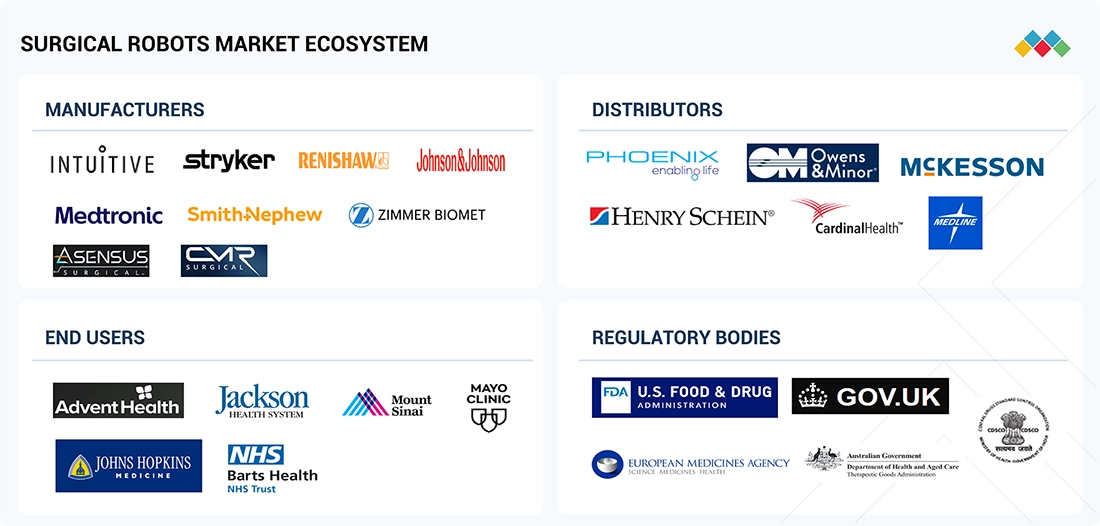
surgical-robots-market: COMMERCIAL USE CASES ACROSS INDUSTRIES
| COMPANY | USE CASE DESCRIPTION | BENEFITS |
|---|---|---|
 |
Surgical robotic systems and precision instruments designed for minimally invasive procedures across urology, gynecology, thoracic, and general surgery | Equipped with 3D visualization, multi-jointed instruments, and enhanced ergonomics to support highly controlled surgical maneuvers | Enhance surgical precision and dexterity, reduce tissue trauma and complications, support faster patient recovery, and improve consistency and reproducibility in complex minimally invasive procedures |
 |
Orthopedic robotic platform that combines CT-based planning with robotic arm guidance for knee and hip arthroplasty | Enables surgeons to execute personalized implant alignment and bone preparation based on patient-specific anatomy | Improve accuracy of implant positioning, enhance joint stability and alignment, reduce post-operative variability, and support long-term functional outcomes in joint replacement surgeries |
 |
Robotic guidance, navigation, and planning system used primarily in spine surgery | Integrates 3D planning, AI-enhanced imaging, and precise robotic guidance to support accurate screw placement and complex spinal corrections | Increase accuracy in spinal instrumentation, reduce intraoperative deviations, improve surgeon control in high-risk procedures, and enhance overall safety and predictability in spine surgeries |
 |
Compact, handheld robotic-assisted platform designed for partial and total knee arthroplasty | Uses real-time intraoperative mapping to help surgeons achieve precise ligament balancing and bone reshaping without requiring preoperative CT scans | Support personalized knee reconstruction, improve precision in bone preparation, reduce variability in soft-tissue balancing, and enhance workflow efficiency for outpatient and ASC environments |
 |
Multi-specialty robotic platforms that combine data analytics, navigation, and robotic guidance to optimize knee and hip arthroplasty as well as brain surgeries | Provide real-time anatomical data for personalized surgical execution | Increase accuracy of implant alignment, enhance surgical decision-making through real-time data, reduce complication risks, and standardize outcomes across orthopedic and neurosurgical procedures |
Logos and trademarks shown above are the property of their respective owners. Their use here is for informational and illustrative purposes only.
Related Ecosystem
Medical Devices
- Polymerase Chain Reaction (PCR)
- Magnetic Resonance Imaging (MRI)
- Disposable Autoinjectors
- Pulse Oximeters
- Blood Pressure Monitors
- Medtronic plc
- Abbott Laboratories
- Stryker Corporation
- Becton, Dickinson and Company
- CONMED Corporation
Key Takeaways
- The US surgical robots market will grow from $4,971.2M in 2025 to $10,246.5M in 2030, representing a 15.6% CAGR.
- The US market benefits from advanced healthcare infrastructure and strong reimbursement frameworks that support robotic surgical adoption.
- US hospitals are prioritizing minimally invasive robotic procedures to improve patient outcomes and reduce recovery times.
- The US represents a mature, competitive market where continuous innovation and clinical validation drive sustained market expansion.
Surgical Robots Market Report Scope
| Report Metric | Details |
|---|---|
| Base Year | 2025 |
| Fastest Growing Segment | ORTHOPEDIC ROBOTIC SYSTEMS (Type) |
| Forecast Period | 2025–2030 |
| Growth Rate | CAGR of 14.7% from 2025 to 2030 |
| Largest Segment | HOSPITALS & CLINICS (End User) |
| Market Size Base Year (Billions) | ~USD 13.67 (2025) |
| Revenue Forecast (Billions) | ~USD 27.14 (2030) |
| Segments Covered | Offering, Type, Application, End User |
US Surgical Robots Market Report Segmentation
4 segment dimensions are covered across the global market.
By Offering
- Instruments & Accessories
- Robotic Systems
- Services
By Type
- Laparoscopy Robotic Systems
- Neurosurgical Robotic Systems
- Orthopedic Robotic Systems
- Other Robotic Systems
By Application
- General Surgery
- Gynecological Surgery
- Microsurgery
- Neurosurgery
- Orthopedic Surgery
- Other Applications
- Otological Surgery
- Urological Surgery
By End User
- Ambulatory Surgery Centers
- Hospitals & Clinics
US: SURGICAL ROBOTS MARKET, BY END USER, 2023–2030
| Segment | 2023 | 2024 | 2025 | 2026 | 2027 | 2028 | 2029 | 2030 | CAGR (%) |
|---|---|---|---|---|---|---|---|---|---|
| AMBULATORY SURGERY CENTERS | 1087.55 | 1202.99 | 1331.81 | 1475.72 | 1636.63 | 1816.72 | 2018.49 | 2244.76 | 11 |
| HOSPITALS & CLINICS | 5460.3 | 6290.4 | 7252.9 | 8369.9 | 9667.6 | 11176.6 | 12933 | 14979.6 | 15.6 |
| TOTAL | 6547.8 | 7493.4 | 8584.7 | 9845.6 | 11304.2 | 12993.3 | 14951.4 | 17224.4 | 14.9 |
Target Audience
- Medical Device Manufacturers : Surgical robotics companies need US-specific market data to benchmark performance, identify competitive gaps, optimize product positioning, and develop targeted go-to-market strategies for the American healthcare system.
- Healthcare Investors & PE Firms : Investment professionals require detailed US market analysis to evaluate investment opportunities, assess portfolio company performance, identify acquisition targets, and make informed capital allocation decisions in surgical robotics.
- Hospital & Surgical Center Administrators : Healthcare facility leaders need market insights to justify capital expenditures on robotic systems, benchmark adoption rates against peer institutions, and develop technology roadmaps aligned with market trends and patient demand.
- Healthcare Consultants & Strategy Firms : Consulting professionals require comprehensive US market data to advise clients on technology adoption strategies, competitive positioning, market entry approaches, and long-term growth planning in surgical robotics.
- Market Researchers & Analysts : Research professionals need validated US market metrics, growth forecasts, and trend analysis to support client deliverables, publish industry reports, and provide evidence-based insights on the American surgical robotics market.
Key Companies in the US Surgical Robots Market
| Company | HQ | Ownership | Strongest segments |
|---|---|---|---|
| TRANSENTERIX | United States | Private Company | Robotic Systems (Laparoscopy, Orthopedic),Instruments & Accessories,Services, |
| TENET HEALTHCARE CORPORATION | United States | Public Company | Instruments & Accessories,Robotic Systems (Laparoscopy),Robotic Systems (Orthopedic), |
| STRYKER | United States | Public Company | Robotic Systems (Orthopedic),Instruments & Accessories,Services, |
| ZIMMER BIOMET | United States | Public Company | Robotic Systems - Orthopedic,Instruments & Accessories,Services, |
| MEDTRONIC | Ireland | Public Company | Instruments & Accessories,Robotic Systems - Laparoscopy,Robotic Systems - Orthopedic, |
| SMITH+NEPHEW | United Kingdom | Public Company | Robotic Systems – Orthopedic,Instruments & Accessories,Services, |
| ASENSUS SURGICAL US, INC. | United States | Subsidiary | Instruments & Accessories,Robotic Systems (Laparoscopy),Robotic Systems (Orthopedic), |
| SIEMENS HEALTHINEERS AG | Germany | Public Company | Instruments & Accessories,Robotic Systems (Laparoscopy),Robotic Systems (Orthopedic), |
| RENISHAW PLC | United Kingdom | Public Company | Robotic Systems (Neurosurgical / Stereotactic),Instruments & Accessories,Services & Software, |
| GLOBUS MEDICAL | United States | Public Company | Instruments & Accessories,Robotic Systems - Orthopedic,Robotic Systems - Laparoscopy, |
| JOHNSON & JOHNSON | United States | Public Company | Instruments & Accessories,Robotic Systems (Laparoscopy, Orthopedic),Services, |
| CORIN GROUP | United Kingdom | Private Company | Robotic Systems – Orthopedic (Apollo, ApolloKnee),Instruments & Accessories,Services, |
TRANSENTERIX
TRANSENTERIX is a United States-based private company with 208 employees operating in the medical device sector.
TENET HEALTHCARE CORPORATION
TENET HEALTHCARE CORPORATION is a major public healthcare provider founded in 1967 and headquartered in the United States, operating with approximately 88,500 employees across its healthcare facilities and services.
STRYKER
STRYKER is a publicly traded medical technology company founded in 1941 and headquartered in the United States, with approximately 56,000 employees serving the orthopedic and surgical markets.
ZIMMER BIOMET
ZIMMER BIOMET is a public company founded in 1927 and based in the United States, employing 17,000 people as a leading manufacturer of orthopedic and musculoskeletal healthcare products.
MEDTRONIC
MEDTRONIC is a publicly traded global medical technology company founded in 1949 and headquartered in Ireland, with approximately 95,000 employees developing and manufacturing medical devices and therapies.
SMITH+NEPHEW
SMITH+NEPHEW is a publicly traded British medical device company founded in 1856, employing 16,988 people and specializing in orthopedic reconstruction, advanced wound management, and sports medicine.
ASENSUS SURGICAL US, INC.
ASENSUS SURGICAL US, INC. is a subsidiary company based in the United States operating in the surgical technology sector.
SIEMENS HEALTHINEERS AG
SIEMENS HEALTHINEERS AG is a publicly traded German healthcare technology company founded in 1896, employing 72,369 people and providing diagnostic imaging, laboratory diagnostics, and point-of-care testing solutions.
RENISHAW PLC
RENISHAW PLC is a publicly traded British precision engineering company founded in 1973, employing 4,975 people and specializing in metrology, healthcare, and industrial automation technologies.
GLOBUS MEDICAL
GLOBUS MEDICAL is a publicly traded United States medical device company founded in 2003, employing 6,000 people and focusing on musculoskeletal healthcare solutions.
JOHNSON & JOHNSON
JOHNSON & JOHNSON is a publicly traded American multinational healthcare company founded in 1886, employing 138,200 people and operating across pharmaceuticals, medical devices, and consumer health sectors.
CORIN GROUP
CORIN GROUP is a private British orthopedic medical device company founded in 1985, employing 324 people and specializing in joint reconstruction solutions.
Reasons to Buy this Report
- Market Size & Growth Validation : Obtain precise US market valuation data ($4,971.2M in 2025) and verified growth projections through 2030, enabling accurate financial forecasting and investment decision-making specific to the American market.
- Competitive Landscape Intelligence : Understand the competitive positioning of robotic surgery manufacturers within the US market, identify key players, market share distribution, and strategic initiatives driving competitive advantage in this high-growth segment.
- Regional Adoption Insights : Access detailed analysis of US-specific adoption patterns, hospital penetration rates, procedural applications, and geographic variations across regions to identify high-opportunity markets and expansion strategies.
- Reimbursement & Regulatory Analysis : Gain comprehensive understanding of US-specific reimbursement policies, FDA approval pathways, regulatory requirements, and payer coverage decisions that directly impact market accessibility and revenue potential.
- Strategic Partnership Opportunities : Identify potential collaboration, acquisition, and partnership opportunities within the US market by understanding key stakeholders, technology gaps, and areas where strategic alliances can accelerate growth and market penetration.
Frequently asked questions
What is the current size of the US surgical robots market?
The US surgical robots market is valued at $4,971.2 million in 2025 and is projected to reach $10,246.5 million by 2030.
What is the expected growth rate for the US surgical robots market?
The US surgical robots market is expected to grow at a compound annual growth rate (CAGR) of 15.6% from 2025 to 2030.
What factors are driving growth in the US surgical robots market?
Key drivers include advanced healthcare infrastructure, favorable reimbursement policies, rising demand for minimally invasive procedures, and continuous technological innovation in the US market.
Why are US hospitals investing in surgical robot systems?
US hospitals invest in surgical robots to enhance surgical precision, reduce patient recovery times, improve clinical outcomes, and maintain competitive advantage in the healthcare market.
How does the US market compare to global surgical robots market trends?
The US market grows at 15.6% CAGR, outpacing the global market CAGR of 14.7%, reflecting the US's mature healthcare infrastructure and strong adoption of robotic-assisted surgical technologies.
RESEARCH METHODOLOGY
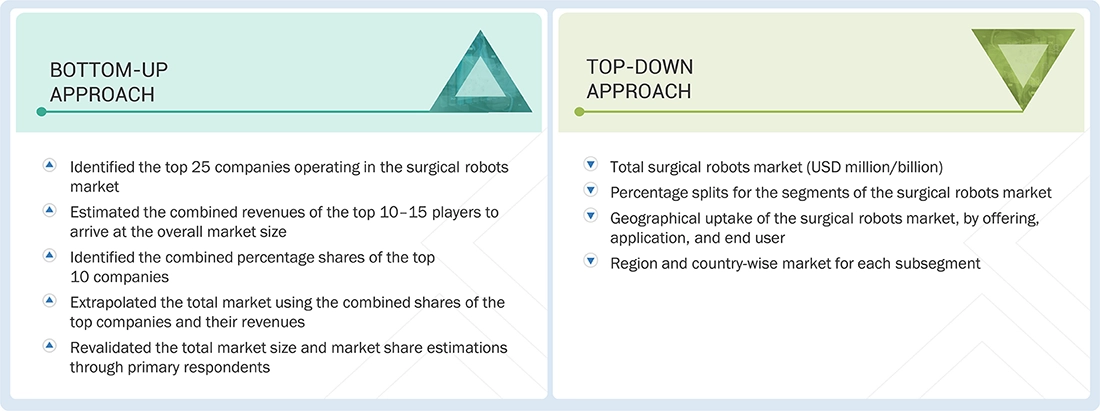
This study involved four major activities in estimating the current size of the surgical robots market. First, extensive secondary research was conducted to gather information on the market, including related and parent markets. The next step was to validate these findings, assumptions, and sizing with industry experts across the value chain through primary research. Both top-down and bottom-up approaches were employed to estimate the complete market size. After that, market breakdown and data triangulation were used to estimate the market size of segments and subsegments.
Secondary Research
The secondary research process involved the widespread use of secondary sources, directories, databases (such as Bloomberg Businessweek, Factiva, and D&B Hoovers), white papers, annual reports, company house documents, investor presentations, and SEC filings of companies. Secondary research was employed to identify and collect information relevant to the comprehensive, technical, market-oriented, and commercial study of the surgical robots market. It was also used to obtain important information about key players, market classification, and segmentation according to industry trends, as well as key developments related to market and technology perspectives. A database of the key industry leaders was also prepared using secondary research.
Primary Research
In the primary research process, various sources from both the supply and demand sides were interviewed to obtain qualitative and quantitative information for this report. The primary sources from the supply side include industry experts such as CEOs, vice presidents, marketing and sales directors, technology & innovation directors, and related key executives from various key companies and organizations operating in the surgical robots market. The primary sources from the demand side included industry experts, purchase & sales managers, doctors, and personnel from research organizations. Primary research was conducted to validate the market segmentation, identify key players in the market, and gather insights on key industry trends and key market dynamics.
A breakdown of the primary respondents for the surgical robots market is provided below:
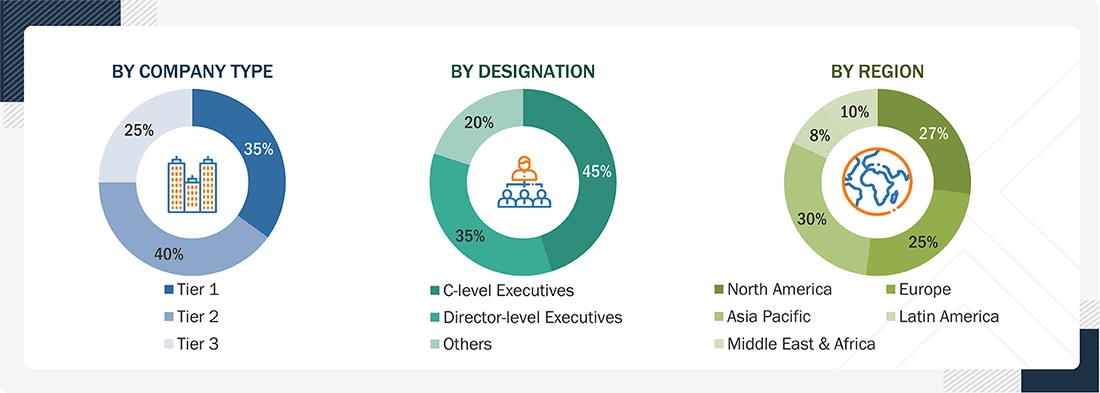
Note 1: C-level executives include CEOs, CFOs, COOs, and VPs.
Note 2: Other include sales managers, marketing managers, business development managers, product managers, distributors, and suppliers.
Note 3: Companies are classified into tiers based on their total revenue. As of 2024, Tier 1 = >USD 10.00 billion, Tier 2 = USD 1.00 billion to USD 10.00 billion, and Tier 3 = USD 1.00 billion.
Source: MarketsandMarkets Analysis
To know about the assumptions considered for the study, download the pdf brochure
Market Size Estimation
For the global market value, annual revenues were calculated based on the revenue mapping of major product manufacturers and OEMs active in the global surgical robots market. All the major product manufacturers were identified at the global and/or country/regional level. Revenue mapping was conducted for the respective business segments and subsegments for the major players. Also, the global surgical robots market was split into various segments and subsegments based on:
- List of major players operating in the products market at the regional and/or country level
- Product mapping of various surgical robot manufacturers at the regional and/or country level
- Mapping of annual revenue generated by listed major players from surgical robots (or the nearest reported business unit/product category)
- Revenue mapping of major players to be covered
- Extrapolation of the revenue mapping of the listed major players to derive the global market value of the respective segments/subsegments
- Summation of the market value of all segments/subsegments to arrive at the global surgical robots market
The above-mentioned data was consolidated and supplemented with detailed inputs and analysis from MarketsandMarkets, and is presented in this report.
Surgical Robots Market : Top-Down and Bottom-Up Approach
Data Triangulation
After arriving at the overall size of the global surgical robots market through the above-mentioned methodology, this market was split into several segments and subsegments. The data triangulation and market breakdown procedures were employed, wherever applicable, to complete the overall market engineering process and arrive at the exact market value data for the key segments and subsegments. The extrapolated market data was triangulated by studying various macroindicators and regional trends from both demand- and supply-side participants.
Market Definition
Surgical robots are the latest medicinal gadgets developed to aid surgeons in carrying out complicated surgeries with more control, precision, and flexibility than they would have achieved had they operated using traditional means. Such systems normally consist of robotic arms equipped with specialized equipment and high-definition cameras, which are manipulated by a surgeon through a console. Surgical robots facilitate minimal invasion of surgery and reduce recovery time of patients, hence minimizing problems and optimizing the overall surgical outcome.
Key Stakeholders
- Surgical robot and related device manufacturing companies
- Manufacturers of surgical robotic system equipment and instruments
- Suppliers and distributors of surgical robot systems
- Third-party refurbishers/suppliers
- Healthcare startups, consultants, and regulators
- Hospitals (public and private)
- Ambulatory surgery centers (ASCs)
- Academic medical institutes
- Surgeons, physicians, and operating room staff
- Government agencies
- Group purchasing organizations (GPOs)
- Corporate entities
- Government institutes
- Market research & consulting firms
- Contract manufacturing organizations (CMOs)
- Venture capitalists & investors
Report Objectives
- To define, describe, and forecast the surgical robots market by offering, application, end user, and region
- To provide detailed information regarding the major factors influencing the growth of this market (such as drivers, restraints, challenges, and opportunities)
- To analyze the micromarkets with respect to individual growth trends, prospects, and contributions to the overall surgical robots market
- To analyze the opportunities for stakeholders and provide details of the competitive landscape for market leaders
-
To forecast the size of the market segments with respect to five main regions:
North America, Europe, the Asia Pacific, Latin America, and the Middle East & Africa - To profile the key players and analyze their market shares and core competencies
- To track and analyze competitive developments such as product launches & approvals, acquisitions, expansions, partnerships, deployments, agreements, and collaborations in the overall surgical robots market
- To benchmark players within the market using the proprietary Company Evaluation Matrix framework, which analyzes market players on various parameters within the broad categories of business and product strategy
Available Customizations:
With the given market data, MarketsandMarkets offers customizations as per your company’s specific needs. The following customization options are available for the report:
Product Analysis
- The product matrix provides a detailed comparison of the product portfolio of each company.
Geographic Analysis
- Further breakdown of the Rest of Europe surgical robots market into Russia, Switzerland, Denmark, Austria, and others
- Further breakdown of the Rest of Asia Pacific surgical robots market into South Korea, Taiwan, and others
- Further breakdown of the Rest of Latin America surgical robots market into Argentina, Colombia, Chile, Ecuador, and others
- Further breakdown of the Southeast Asia surgical robots market into Malaysia, Singapore, New Zealand, and others
Competitive Landscape Assessment
- Market share analysis, by region (North America and Europe), which provides market shares of the top 3–5 key players in the surgical robots market
- Competitive leadership mapping for established players in the US
Get the Full Surgical Robots Market Report
Full forecast, segment splits, and company analysis for all Surgical Robots Market.
- Canada Surgical Robots Market
- Germany Surgical Robots Market
- UK Surgical Robots Market
- France Surgical Robots Market
- Spain Surgical Robots Market
- Italy Surgical Robots Market
- Japan Surgical Robots Market
- China Surgical Robots Market
- India Surgical Robots Market
- Australia Surgical Robots Market
- South Korea Surgical Robots Market
- Brazil Surgical Robots Market
- Mexico Surgical Robots Market
- Rest Of Europe Surgical Robots Market
- Rest Of Asia Pacific Surgical Robots Market
- Rest Of Latin America Surgical Robots Market
Need a Tailored Report?
Customize this report to your needs
Get 10% FREE Customization
Customize This Report
