
South Korea Terahertz Technology Market (2025-2030)

The South Korea Terahertz Technology Market was valued at $12.6 Million in 2025 and projected to reach to $31.8 Million by 2030, representing a compound annual growth rate of 20.4%. South Korea's terahertz technology market is poised for accelerated growth through 2030, driven by the country's robust semiconductor infrastructure and substantial R&D investments.


| Market Size in | USD 26.32 MN |
| Market Forecast in | |
| CAGR | |
| Forecast Period | |
| Units Considered | Value (USD MN) |
South Korea Terahertz Technology Market Trends and Insights
- South Korea's advanced semiconductor ecosystem and strong R&D investment position the country as a key regional player in terahertz innovation.
- The 20.4% compound annual growth rate significantly outpaces global trends, reflecting South Korea's leadership in next-generation electronics and communications infrastructure. South Korea's terahertz market growth is driven by increasing demand from telecommunications, imaging, and security applications across the Asia Pacific region.
- South Korea's government initiatives and private sector collaboration accelerate commercialization of terahertz-based solutions.
- By 2030, South Korea is expected to capture substantial market share through continued technological advancement and strategic partnerships with global semiconductor leaders..
Key Market Statistics
- CAGR (2025-2030) 20.4% CAGR
- Market Size, 2025 ~USD 12.6 Million
- Forecast, 2030 ~USD 31.8 Million
- Country South Korea
South Korea Terahertz Technology Market Overview
Exceptional Growth Trajectory :
South Korea's terahertz market is expanding at 20.4% CAGR, significantly outpacing the global rate of 15.8%, driven by aggressive semiconductor R&D investments and government innovation initiatives.
Advanced Semiconductor Ecosystem :
South Korea's world-leading semiconductor manufacturing capabilities and established supply chains provide a competitive advantage for terahertz technology development and commercialization.
Strong R&D Investment :
Government and private sector funding in South Korea supports terahertz research across telecommunications, imaging, and sensing applications, positioning the nation as a regional innovation hub.
Market Valuation Growth :
The market is valued at USD 12.6 million in 2025 and projected to reach USD 31.8 million by 2030, representing a 152% increase over the five-year forecast period.
South Korea Terahertz Technology Market Dynamics
- The nation's leadership in 5G/6G telecommunications and advanced imaging systems creates substantial demand for terahertz solutions across industrial and consumer applications.
- South Korea's strategic focus on next-generation technologies, combined with government support for emerging semiconductor innovations, ensures sustained market expansion.
- The 20.4% CAGR reflects strong domestic demand and export opportunities, positioning South Korea as a critical player in the global terahertz ecosystem..
Market Ecosystem
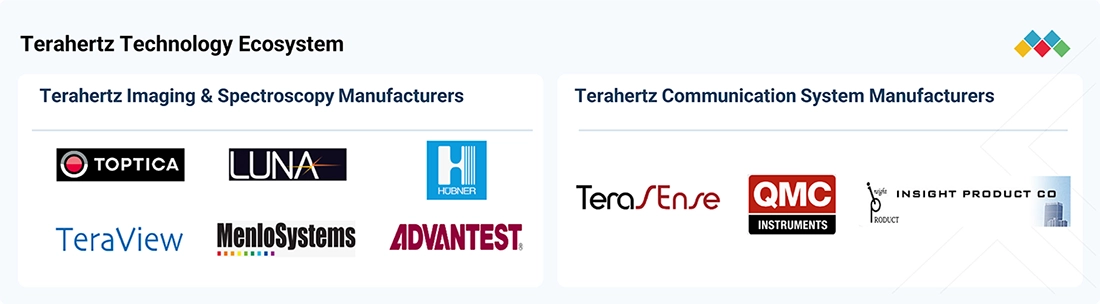
TERAHERTZ TECHNOLOGY MARKET SIZE, SHARE & TRENDS: COMMERCIAL USE CASES ACROSS INDUSTRIES
| COMPANY | USE CASE DESCRIPTION | BENEFITS |
|---|---|---|
 |
Advantest supplies terahertz spectroscopic imaging platforms such as the TAS7500 series for semiconductor and pharmaceutical manufacturing lines. The instrumentation conducts non destructive volumetric inspections of integrated circuit packaging, silicon substrates, and tablet coating layers. | Enables contactless detection of subsurface flaws and voids without destructive cross sectioning | Delivers high measurement repeatability for complex microelectronic assemblies | Verifies active pharmaceutical ingredient distribution without sample prep | Reduces component scrap rates across automated production runs |
 |
HÜBNER deploys the T-SENSE and T-COAT terahertz measurement systems across industrial post handling centers and manufacturing plants. The systems scan postal mail and packaged deliveries for illicit powders, liquids, and hidden hazards, while inspecting paint and composite layer thicknesses. | Detects concealed explosive and chemical threats without harmful ionizing X-rays | Delivers fast automated envelope processing up to 1,000 items per hour | Measures multilayer automotive coating stacks in a single pass | Eliminates radioactive exposure risks for screening operators |
 |
TOPTICA integrates broadband terahertz time domain spectroscopy platforms for inline industrial process control, gaseous emission tracking, and multilayer polymer inspection. The optical systems analyze thickness profiles of automotive paints, plastics, and pipes during extrusion. | Measures opaque multilayer coatings down to micrometer tolerances in real time | Provides high signal to noise ratios in harsh manufacturing environments | Replaces destructive thickness sampling with continuous inline monitoring | Lowers raw material waste by keeping layer thickness within exact design limits |
 |
Thorlabs supplies terahertz time domain spectroscopy kits, photoconductive antennas, and optical delay lines for academic institutions and industrial research laboratories. The systems analyze the electromagnetic properties, dielectric constants, and spectral fingerprints of novel materials. | Eliminates the need for manual alignment via modular fiber coupled optics | Provides broad spectral bandwidth coverage for accurate material characterization | Supports non ionizing biological tissue and polymer investigations | Lowers integration barriers for custom optical research test benches |
 |
Luna Innovations implements T-Gauge terahertz sensing systems in continuous industrial production environments, including aerospace manufacturing and tire calendering. The non contact sensors measure wall thickness, layer density, and material uniformity across high speed web processing lines. | Provides safe non nuclear thickness gauging for extruded plastics and rubber sheets | Tracks multilayer boundaries at high sampling rates during continuous processing | Reduces raw material expenditure by minimizing sheet thickness variations | Maintains high operational accuracy despite factory floor dust, heat, and moisture |
Logos and trademarks shown above are the property of their respective owners. Their use here is for informational and illustrative purposes only.
Related Ecosystem
Communication And Connectivity Technology
- Sensors
- Smart Card & Readers
- Cellular Network
- Femtocell
- Image Sensors
- Cisco Systems, Inc.
- HUAWEI TECHNOLOGIES CO LTD
- Lenovo
- CommScope Holding Company, Inc.
- Nokia corporation
Key Takeaways
- South Korea's terahertz technology market is valued at USD 12.6 million in 2025 with a projected CAGR of 20.4% through 2030.
- South Korea's market size is forecast to reach USD 31.8 million by 2030, driven by telecommunications and imaging applications.
- South Korea's advanced semiconductor infrastructure and government R&D support position it as a regional innovation leader.
- South Korea's terahertz market growth significantly exceeds global CAGR, indicating strong regional demand and competitive advantage.
Terahertz Technology Market Report Scope
| Report Metric | Details |
|---|---|
| Base Year | 2025 |
| Fastest Growing Segment | SATELLITE COMMUNICATIONS (Application) |
| Forecast Period | 2025-2030 |
| Growth Rate | CAGR of 15.8% from 2025 to 2030 |
| Largest Segment | TERAHERTZ IMAGING (Type) |
| Market Size Base Year (Billions) | ~USD 0.82 (2025) |
| Revenue Forecast (Billions) | ~USD 1.71 (2030) |
| Segments Covered | Type, Application |
South Korea Terahertz Technology Market Report Segmentation
2 segment dimensions are covered across the global market.
By Type
- Terahertz Communication Systems
- Terahertz Imaging
- Terahertz Spectroscopy
By Application
- Industrial Ndt
- Laboratory Research
- Medical & Healthcare
- Military & Homeland Security
- Outdoor/Indoor Wireless Communications
- Satellite Communications
- Tactical/Military Communications
Target Audience
- Semiconductor Manufacturers : South Korean chipmakers need market intelligence to develop terahertz components and integrate them into next-generation 5G/6G infrastructure and consumer devices.
- Technology Investors : Venture capital and private equity firms targeting South Korea's high-growth semiconductor sector require detailed market forecasts and opportunity analysis for terahertz investments.
- Government & Policy Makers : South Korean government agencies and economic development bodies use market data to guide R&D funding, innovation policies, and strategic technology initiatives.
- Equipment & Materials Suppliers : Global suppliers of terahertz manufacturing equipment and materials need South Korea-specific demand forecasts to optimize production and distribution strategies.
- Strategic Consultants : Management consulting firms advising clients on market entry, M&A, or technology partnerships in South Korea require granular regional market data and competitive insights.
Reasons to Buy this Report
- Regional Market Intelligence : Gain detailed insights into South Korea's terahertz market dynamics, competitive landscape, and growth drivers specific to Asia's semiconductor powerhouse.
- Investment Decision Support : Access comprehensive market sizing and forecasts (2025-2030) to identify investment opportunities in South Korea's high-growth terahertz sector.
- Technology Roadmap Alignment : Understand South Korea's R&D priorities and government initiatives shaping terahertz development in 5G/6G, imaging, and sensing applications.
- Competitive Positioning : Benchmark your organization against South Korean players and identify partnership or acquisition targets in the rapidly expanding terahertz ecosystem.
- Market Entry Strategy : Develop informed go-to-market strategies for South Korea with data on supply chain dynamics, regulatory environment, and key customer segments.
Frequently asked questions
What is the current size of South Korea's terahertz technology market?
South Korea's terahertz technology market is valued at USD 12.6 million in 2025, with strong growth momentum expected through the forecast period.
What is the projected market size for South Korea's terahertz technology by 2030?
South Korea's terahertz technology market is projected to reach USD 31.8 million by 2030, representing a 20.4% compound annual growth rate.
What drives growth in South Korea's terahertz technology market?
South Korea's market growth is driven by telecommunications infrastructure development, advanced imaging applications, security systems, and government R&D initiatives supporting semiconductor innovation.
How does South Korea's terahertz market compare to global trends?
South Korea's terahertz market CAGR of 20.4% significantly exceeds the global CAGR of 15.8%, reflecting South Korea's competitive advantage in semiconductor technology and innovation.
Which industries in South Korea are adopting terahertz technology?
South Korea's terahertz adoption spans telecommunications, medical imaging, security screening, materials characterization, and semiconductor manufacturing applications.
RESEARCH METHODOLOGY
The research process for this study involved the systematic gathering, recording, and analysis of data on customers and companies operating in the terahertz technology market. This process involved the extensive use of secondary sources, directories, and databases (Factiva and OANDA) to identify and collect valuable information for the comprehensive, technical, market-oriented, and commercial study of the terahertz technology market. In-depth interviews were conducted with primary respondents, including experts from core and related industries, as well as preferred manufacturers, to obtain and verify critical qualitative and quantitative information and assess growth prospects. Key players in the terahertz technology market were identified through secondary research, and their market rankings were determined through a combination of primary and secondary research. This research involved studying the annual reports of top players and conducting interviews with key industry experts, including CEOs, directors, and marketing executives.
Secondary Research
Various sources were utilized in the secondary research process to identify and collect information relevant to this study. These include company annual reports, press releases, investor presentations, white papers, technology journals, certified publications, articles by recognized authors, directories, and databases.
Secondary research was primarily used to gather key information on the industry’s value chain, the total pool of market players, market classification by industry trends at the most detailed level, regional markets, and key developments from both market- and technology-oriented perspectives.
Primary Research
Primary research was also conducted to identify the segmentation types, key players, competitive landscape, and key market dynamics, including drivers, restraints, opportunities, challenges, and industry trends, as well as the key strategies adopted by players operating in the terahertz technology market. Extensive qualitative and quantitative analyses were conducted across the complete market engineering process to present key information and insights throughout the report.
Extensive primary research has been conducted following the acquisition of knowledge about the terahertz technology market scenarios through secondary research. Several primary interviews were conducted with experts from the demand side (application and region) and the supply side (type and application) across four major geographic regions: North America, Europe, Asia Pacific, and RoW. Approximately 60% and 40% of the primary interviews were conducted from the supply and demand sides, respectively. These primary data have been collected through questionnaires, emails, and telephonic interviews.
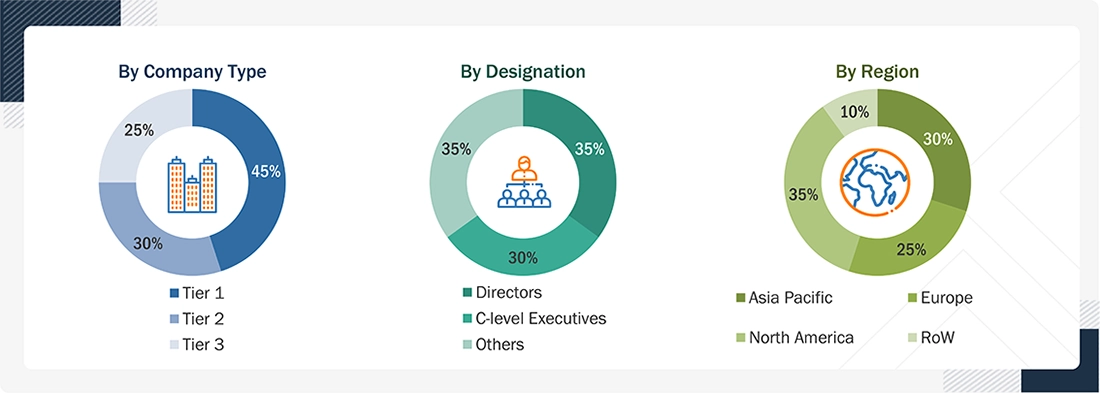
Notes: The three tiers of companies have been defined based on their total/segmental revenue as of 2025: Tier 1 = > USD 1 billion, Tier 2 = USD 1 billion–USD 500 million, and Tier 3 = < USD 500 million.
Other designations include sales, marketing, and product managers.
To know about the assumptions considered for the study, download the pdf brochure
Market Size Estimation
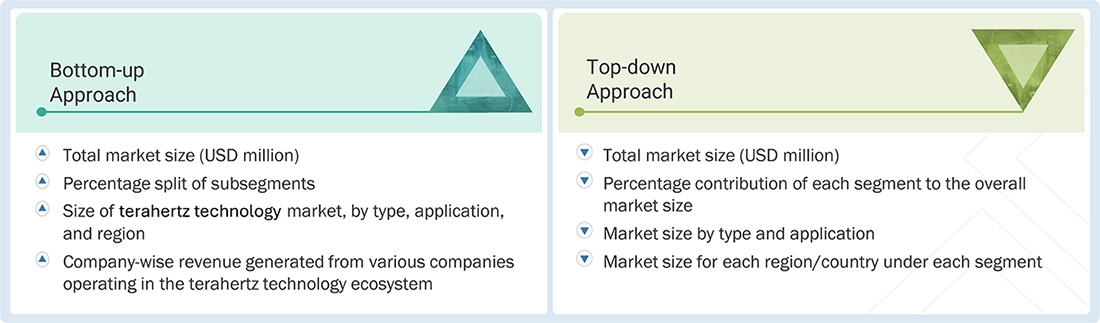
In the complete market engineering process, top-down and bottom-up approaches, along with several data triangulation methods, were used to estimate and validate the size of the terahertz technology market and various other dependent submarkets. Key players in the market were identified through secondary research, and their market share in each region was determined through a combination of primary and secondary research. This research methodology involved analyzing the annual and financial reports of the top players and conducting interviews with experts (including CEOs, VPs, directors, and marketing executives) to gather key insights (both quantitative and qualitative).
All percentage shares, splits, and breakdowns were determined using secondary sources and verified through primary sources. All possible parameters affecting the markets covered in this study were accounted for, examined in detail, verified through primary research, and analyzed to obtain final quantitative and qualitative data. This data was consolidated and supplemented with detailed inputs and analysis from MarketsandMarkets and presented in this report.
Terahertz Technology Market: Top-Down and Bottom-Up Approach
Data Triangulation
After determining the overall market size through the estimation process, as explained above, the total market was divided into several segments and subsegments. To complete the overall market engineering process and obtain precise statistics for all segments and subsegments, the data triangulation procedure was employed, as applicable. The data was triangulated by studying various factors and trends from the demand and supply sides. Additionally, the market has been validated using both top-down and bottom-up approaches.
Market Definition
Terahertz (THz) is a unit of measuring frequency equal to 1 trillion hertz (10¹² Hz). It usually refers to the frequency of an electromagnetic wave, which is a part of the electromagnetic spectrum invisible to the naked eye and lies between the microwave and the infrared ranges. T-rays are an example of a specific part of the spectrum within the ITU-designated band, ranging from 0.3 THz to 3 THz, and are widely used in astronomy. These waves can pass through a variety of amorphous substances, including several synthetics and textiles. Paper and cardboard are also transparent to terahertz waves. The penetration of conventionally opaque materials and high chemical selectivity are the two main advantages of terahertz radiation; thus, it has a wide range of applications. Major types of terahertz technology systems available in the market include terahertz imaging, terahertz spectroscopy, and terahertz communication systems.
Key Stakeholders
- Raw material suppliers
- Original equipment manufacturers (OEMs)
- Original design manufacturers (ODMs) and technology solution providers
- Research institutes
- Terahertz technology manufacturers
- Terahertz technology forums, alliances, and associations
- Governments and financial institutions
- Analysts and strategic business planners
Report Objectives
- To describe and forecast the terahertz technology market, in terms of value, based on type and application
- To define and forecast the market size, in terms of value, with regard to four main regions: North America, Europe, Asia Pacific, and the Rest of the World (RoW)
- To provide detailed information regarding drivers, restraints, opportunities, and challenges influencing the growth of the market
- To understand the impact of artificial intelligence (AI) on the market
- To strategically analyze micromarkets with respect to individual growth trends, prospects, and contributions to the total market
- To provide a qualitative overview of different terahertz technologies
- To analyze opportunities for various stakeholders by identifying high-growth segments of the market
- To strategically profile key players and comprehensively analyze their market position in terms of ranking and core competencies, along with detailing the competitive landscape of the market
- To analyze competitive developments, such as acquisitions, product launches, developments, and partnerships in the market
- To provide a detailed overview of the ecosystem analysis, case study analysis, patent analysis, trade analysis, technology analysis, average selling price (ASP) analysis, AI/Gen AI impact analysis, Porter’s five forces analysis, macroeconomic outlook, and regulatory landscape pertaining to the terahertz technology market
Available customizations:
With the given market data, MarketsandMarkets offers customizations according to the company’s specific needs. The following customization options are available for the report:
Company Information
-
Detailed analysis and profiling of additional market players (up to 5)
Get the Full Terahertz Technology Market Report
Full forecast, segment splits, and company analysis for all Terahertz Technology Market.
- US Terahertz Technology Market
- Canada Terahertz Technology Market
- Mexico Terahertz Technology Market
- UK Terahertz Technology Market
- Germany Terahertz Technology Market
- France Terahertz Technology Market
- Italy Terahertz Technology Market
- Spain Terahertz Technology Market
- China Terahertz Technology Market
- Japan Terahertz Technology Market
- India Terahertz Technology Market
- Rest Of Europe Terahertz Technology Market
- Rest Of Asia Pacific Terahertz Technology Market
Need a Tailored Report?
Customize this report to your needs
Get 10% FREE Customization
Customize This Report
