
US Electric Ship Market (2025-2030)

The US Electric Ship Market was valued at $312.1 Million in 2025 and projected to reach to $1541.3 Million by 2030, representing a compound annual growth rate of 25.6%. The US electric ship market is positioned for exceptional growth through 2030, driven by substantial federal defense budgets and strategic initiatives to modernize the naval fleet.


| Market Size in | USD 26.32 MN |
| Market Forecast in | |
| CAGR | |
| Forecast Period | |
| Units Considered | Value (USD MN) |
US Electric Ship Market Trends and Insights
- The US is driving innovation in naval electrification, supported by government defense spending and modernization initiatives focused on reducing emissions and operational costs.
- The US market's 25.6% compound annual growth rate significantly outpaces global trends, reflecting strong domestic demand for advanced propulsion systems in military and commercial vessels. US shipbuilders and defense contractors are investing heavily in electric propulsion technologies to meet regulatory requirements and enhance fleet efficiency.
- The US Navy's commitment to sustainable operations and the commercial shipping sector's adoption of electric systems are key catalysts for market expansion through 2030.
- Strategic partnerships between US manufacturers and technology providers are accelerating the development of next-generation electric ship platforms..
Key Market Statistics
- CAGR (2025-2030) 25.6% CAGR
- Market Size, 2025 ~USD 312.1 Million
- Forecast, 2030 ~USD 1541.3 Million
- Country US
US Electric Ship Market Overview
Rapid US Market Growth :
The US electric ship market is projected to grow from $312.1 million in 2025 to $1,541.3 million by 2030, representing a 25.6% CAGR that significantly exceeds the global average of 21%.
Defense Modernization Driver :
US government defense spending and naval modernization initiatives are accelerating electric ship adoption, with focus on reducing emissions, operational costs, and enhancing fleet sustainability.
Innovation Leadership :
The US is establishing itself as a leader in naval electrification technology, developing advanced propulsion systems and battery solutions for military and commercial maritime applications.
Strategic Military Advantage :
Electric propulsion systems offer the US Navy enhanced stealth capabilities, reduced acoustic signatures, and improved operational efficiency compared to traditional diesel-powered vessels.
US Electric Ship Market Dynamics
- Government mandates for emissions reduction and operational efficiency improvements are accelerating procurement of electric propulsion systems across military and commercial sectors.
- The US Navy's commitment to next-generation vessel development, combined with private sector innovation in battery and motor technologies, creates a robust ecosystem for market expansion.
- Investment in domestic manufacturing capabilities and supply chain development will further strengthen market competitiveness and reduce dependency on foreign suppliers..
Market Ecosystem
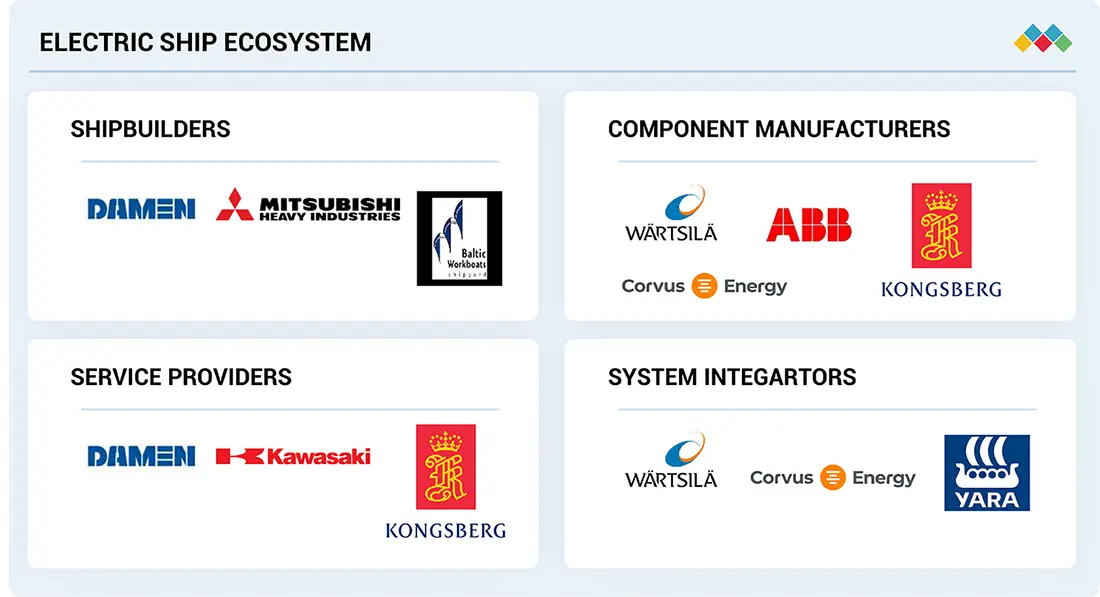
Electric Ship Market: COMMERCIAL USE CASES ACROSS INDUSTRIES
| COMPANY | USE CASE DESCRIPTION | BENEFITS |
|---|---|---|
 |
Yara launched the Yara Birkeland, the world’s first fully electric and autonomous container vessel for short-sea logistics in 2021. | Reduced CO2 and NO? emissions, Cuts 1,000 tonnes of CO2 annually, eliminates 40,000 truck trips per year, and sets benchmarks for zero-emission autonomous shipping.. |
 |
Wärtsilä deployed hybrid propulsion and advanced battery storage systems for the Aurora Botnia ferry, operating on the Kvarken route between Finland and Sweden. | Improved fuel efficiency by 50%, lowered emissions, and enabled flexible vessel operations in harsh Nordic conditions |
 |
ABB equipped Grandi Navi Veloci ferries with shore-to-ship power connectivity and battery support to cut port emissions. | Reduced port CO2 emissions by 30–40%, cut particulate matter by up to 98%, and ensured compliance with EU port emission standards |
 |
Kongsberg supplied propulsion and autonomous navigation systems for MS Ro Vision, the world’s first hybrid-electric live fish carrier. | Increased operational safety, supported semi-autonomous operations, and demonstrated scalable digital integration in maritime fleets. |
 |
Siemens Energy delivered modular power distribution systems for Elektra, the world’s first hydrogen-electric push boat. | Achieved 100% CO2-free operations, optimized energy distribution efficiency by 15%, and enabled emission-free inland waterway transport. |
 |
Corvus supplied battery systems for BC Ferries’ hybrid-electric vessels under its Island Class program. | Delivered high-capacity energy storage, reduced fuel costs by 25–30%, and enabled scalable electrification of short-haul routes. |
Logos and trademarks shown above are the property of their respective owners. Their use here is for informational and illustrative purposes only.
Related Ecosystem
Key Takeaways
- The US electric ship market will grow from $312.1M (2025) to $1,541.3M (2030), representing a 25.6% CAGR.
- US defense spending and Navy modernization programs are primary drivers of electric propulsion adoption.
- The US market growth rate significantly exceeds global averages, positioning the country as a regional leader.
- US commercial and military sectors are jointly advancing electric ship technology through coordinated investments.
Electric Ship Market Report Scope
| Report Metric | Details |
|---|---|
| Base Year | 2025 |
| Fastest Growing Segment | AUTONOMOUS (Autonomy) |
| Forecast Period | 2025–2030 |
| Growth Rate | CAGR of 21% from 2025 to 2030 |
| Largest Segment | COMMERCIAL (Ship Type) |
| Market Size Base Year (Billions) | ~USD 4.84 (2025) |
| Revenue Forecast (Billions) | ~USD 12.56 (2030) |
| Segments Covered | Propulsion, Solution, Autonomy, Power Capacity, Range, Tonnage, Ship Type, Type, Point Of Sale |
US Electric Ship Market Report Segmentation
9 segment dimensions are covered across the global market.
By Propulsion
- Battery-Powered
- Diesel & Battery-Powered
- Electro-Solar & Battery-Powered
- Fuel Cell & Battery-Powered
- Fully Electric
- Hybrid
- Lpg/Lng & Battery-Powered
By Solution
- Power Conversion
- Power Distribution
- Power Drive
- Power Generation
- Power Storage
- System Integration
By Autonomy
- Autonomous
- Manned
- Remotely Operated
By Power Capacity
- 151–745 Kw
- 746–7,560 Kw
- 75–150 Kw
- <75 Kw
- >7,560 Kw
By Range
- 101–1,000 Km
- 50–100 Km
- <50 Km
- >1,000 Km
By Tonnage
- 5,001–15,000 Dwt
- 5001–15,000 Dwt
- 500–5,000 Dwt
- <500 Dwt
- >15,000 Dwt
By Ship Type
- Aircraft Carriers
- Cargo Vessels
- Commercial
- Corvettes
- Defense
- Destroyers
- Frigates
- Offshore Support Vessel
- Offshore Support Vessels
- Passenger Vessels
- Submarines
By Type
- Battery-Powered
- Bulk Carriers
- Container Vessels
- Cruise Ships
- Diesel & Battery-Powered
- Dredgers
- Electro-Solar & Battery-Powered
- Ferries
- Fishing Vessels
- Fuel Cell & Battery-Powered
- General Cargo Ships
- Lpg/Lng & Battery-Powered
- Motorboats
- Research Vessels
- Submarines
- Tankers
- Tugs & Workboats
- Yachts
By Point Of Sale
- New Build & Line Fit
- Newbuild & Line Fit
- Retrofit
Target Audience
- Defense Contractors & OEMs : Naval shipbuilders and defense manufacturers need US-specific market data to align product development, bid on government contracts, and capture growing electric propulsion demand.
- Government & Military Agencies : US Navy and Department of Defense officials require market intelligence to inform procurement strategies, budget planning, and technology roadmap development for fleet electrification.
- Investment & Private Equity Firms : Investors targeting the aerospace & defense sector need US market forecasts and growth metrics to evaluate portfolio opportunities and assess returns in maritime electrification.
- Technology & Component Suppliers : Battery manufacturers, motor suppliers, and electronics firms need US demand projections to plan capacity expansion, R&D investment, and supply chain positioning.
- Maritime & Shipping Companies : Commercial vessel operators and shipping firms require US market insights to evaluate electric ship adoption timelines, cost-benefit analysis, and fleet modernization strategies.
Key Companies in the US Electric Ship Market
| Company | HQ | Ownership | Strongest segments |
|---|---|---|---|
| COCHIN SHIPYARD LIMITED | India | Public Company | Defence shipbuilding (aircraft carriers, combatants, patrol and support vessels),Commercial shipbuilding (tankers, bulkers, ferries, tugs, special-purpose and green vessels),Offshore vessels and structures (PSVs, AHTS, barges, offshore support), |
| AKASOL AG | Germany | Private Company | Bus and coach battery systems,Commercial and industrial vehicle battery systems,Rail, marine, and specialty vehicle systems, |
| ABB | Switzerland | Public Company | Electrification,Motion,Automation, |
| WäRTSILä | Finland | Public Company | Engine and hybrid power plants,Energy storage (Quantum BESS portfolio),GEMS Digital Energy Platform and software, |
| GE VERNOVA | United States | Public Company | Power (gas, nuclear, hydro, steam),Wind (onshore and offshore),Electrification (grid, power conversion, software, solar and storage), |
| KONGSBERG | Norway | Public Company | Kongsberg Defence & Aerospace,Kongsberg Discovery,Other (Digitalization, Energy), |
| SIEMENS | Germany | Public Company | Digital Industries (automation, PLM, simulation),Smart Infrastructure (electrification, buildings, grid),Mobility (rail systems, automation, services), |
| LECLANCHé SA | Switzerland | Public Company | Stationary Business Unit (grid, renewable integration, microgrids),E-Mobility Business Unit (marine, road, rail),Specialty Battery Business Unit (civil, military, medical, industrial), |
| BAE SYSTEMS | United Kingdom | Public Company | Air (combat air systems, Eurofighter, support),Maritime (submarines, shipbuilding, support),Electronic Systems (EW, avionics, sensors, space), |
| SAFT | United States | Public Company | Private passenger automobile,Homeowners (including dwelling fire and inland marine add-ons),Commercial automobile (fleets and individual vehicles), |
COCHIN SHIPYARD LIMITED
Cochin Shipyard Limited is an Indian public company founded in 1969 that operates as a major shipbuilding and ship repair facility. With 2,140 employees, the company serves both domestic and international maritime markets.
AKASOL AG
Akasol AG is a German private company founded in 1990 specializing in battery systems and energy storage solutions. The company employs 337 people and serves industrial and commercial markets.
ABB
ABB is a Swiss multinational public company founded in 1883 that operates in robotics, power, and automation technologies. With 112,700 employees worldwide, ABB serves diverse industrial and utility sectors globally.
WäRTSILä
Wärtsilä is a Finnish public company founded in 1834 providing advanced technologies and lifecycle solutions for the marine and energy sectors. The company employs 17,938 people and operates globally across multiple markets.
GE VERNOVA
GE Vernova is a United States public company founded in 2023 operating in renewable energy and power solutions. With 78,000 employees, the company serves global energy transition markets.
KONGSBERG
Kongsberg is a Norwegian public company founded in 1814 providing advanced technology and systems for maritime, defense, and aerospace sectors. The company employs 7,586 people and operates internationally.
SIEMENS
Siemens is a German multinational public company founded in 1847 specializing in electrification, automation, and digitalization technologies. With 310,312 employees, Siemens serves industrial, infrastructure, and energy markets worldwide.
LECLANCHé SA
Leclanché SA is a Swiss public company founded in 1909 that develops and manufactures battery and energy storage systems. The company employs 356 people and serves industrial and commercial energy applications.
BAE SYSTEMS
BAE Systems is a United Kingdom-based public company founded in 1979 operating in defense, aerospace, and security sectors. With 111,400 employees, the company serves government and commercial customers globally.
SAFT
Saft is a United States public company founded in 1979 specializing in advanced battery and energy storage technologies. The company employs 568 people and serves industrial, transportation, and renewable energy markets.
Reasons to Buy this Report
- Market Size & Growth Validation : Quantified US market data with precise valuations ($312.1M to $1,541.3M) and 25.6% CAGR enables accurate financial forecasting and investment decision-making specific to the American market.
- Defense Procurement Intelligence : Understand US government spending patterns, Navy modernization priorities, and defense budget allocations driving electric ship adoption to identify procurement opportunities and contract potential.
- Competitive Positioning Strategy : Gain insights into US market dynamics, technological leadership areas, and domestic manufacturing trends to benchmark competitors and identify strategic differentiation opportunities.
- Regulatory & Policy Landscape : Access analysis of US emissions regulations, naval sustainability mandates, and government incentives shaping market requirements and compliance standards for electric ship solutions.
- Investment & Partnership Opportunities : Identify high-growth segments, emerging players, and collaboration potential within the US electric ship ecosystem to guide M&A strategy and venture capital allocation decisions.
Frequently asked questions
What is the current size of the US electric ship market?
The US electric ship market is valued at $312.1 million in 2025 and is projected to reach $1,541.3 million by 2030.
What is the growth rate of the US electric ship market?
The US electric ship market is growing at a compound annual growth rate (CAGR) of 25.6% from 2025 to 2030.
What factors are driving growth in the US electric ship market?
Key drivers include US Navy modernization initiatives, environmental regulations, cost reduction objectives, and increased investment in sustainable naval technologies.
How does the US market compare to global electric ship market trends?
The US market's 25.6% CAGR significantly outpaces the global market CAGR of 21%, indicating stronger regional demand and investment.
Which sectors are leading electric ship adoption in the US?
Both the US military (Navy) and commercial shipping sectors are driving adoption, with defense applications leading due to modernization budgets and sustainability mandates.
RESEARCH METHODOLOGY
The study involved four major activities in estimating the current size of the electric ship market. Extensive secondary research was conducted to collect information on the electric ship market, its adjacent markets, and its parent market. The next step was to validate these findings, assumptions, and sizing with industry experts across the value chain through primary research. Demand-side analysis was carried out to estimate the overall size of the market. After that, market breakdown and data triangulation procedures were used to estimate the sizes of different segments and subsegments of the electric ship market.
Secondary Research
In the secondary research process, various sources were referred to identify and collect information for this study. The secondary sources included government sources; corporate filings such as annual reports, press releases, and investor presentations of companies; white papers, journals, and certified publications; and articles from recognized authors, directories, and databases.
Primary Research
Extensive primary research was conducted after acquiring information regarding the market scenario through secondary research. Several primary interviews were conducted with market experts from both the demand and supply sides across North America, Europe, Asia Pacific, the Middle East, and the Rest of the World, comprising Africa and Latin America. Primary data was collected through questionnaires, emails, and telephone interviews.
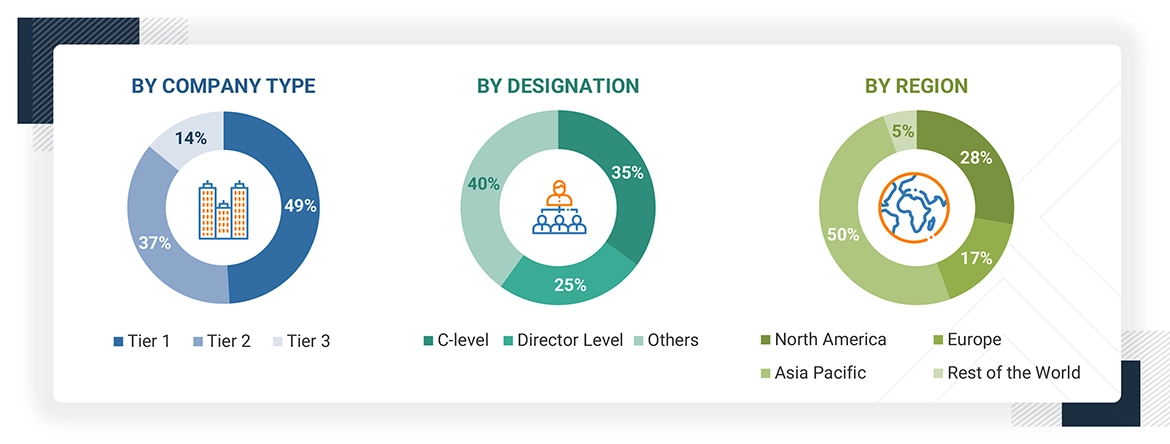
To know about the assumptions considered for the study, download the pdf brochure
Market Size Estimation
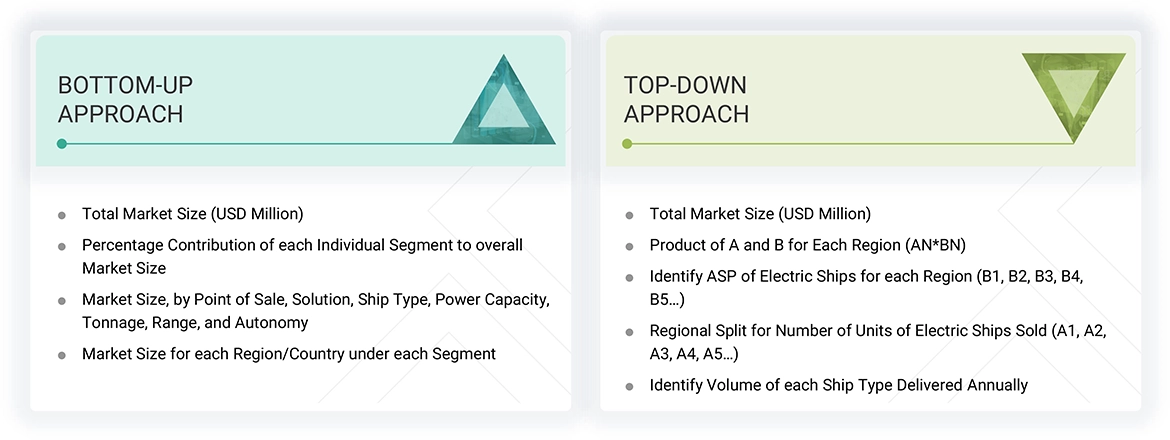
The top-down and bottom-up approaches were used to estimate and validate the size of the electric ship market. The research methodology used to estimate the market size includes the following details.
- Key players in the electric ship market were identified through secondary research, and their market share was determined through primary and secondary research. This included a study of the annual and financial reports of the top market players and extensive interviews with leaders such as directors, engineers, marketing executives, and other stakeholders of leading companies operating in the electric ship market.
- All percentage shares, splits, and breakdowns were determined using secondary sources and verified through primary sources. All possible parameters that affect the markets covered in this research study were accounted for, viewed in extensive detail, verified through primary research, and analyzed to obtain the final quantitative and qualitative data on the electric ship market. This data was consolidated, enhanced with detailed inputs, analyzed by MarketsandMarkets, and presented in this report.
Electric Ship Market : Top-Down and Bottom-Up Approach
Data Triangulation
After arriving at the overall market size, the total market was split into several segments and subsegments. The data triangulation and market breakdown procedures explained below were implemented, wherever applicable, to complete the overall market engineering process and arrive at the estimated market numbers for the market segments and subsegments. The data was triangulated by studying various factors and trends from the demand and supply sides. The market size was also validated using the top-down and bottom-up approaches.
Market Definition
The electric ship encompasses the development, deployment, and operation of vessels that utilize full or hybrid electric propulsion systems. It includes applications across passenger ferries, cargo vessels, defense platforms, and service ships, supported by advanced batteries, hybrid energy storage, and integrated power management systems. The market is driven by stringent environmental regulations, high fuel costs, and improvements in energy storage and distribution technologies that enhance operational efficiency and reduce lifecycle emissions. Beyond propulsion, the scope extends to supporting port infrastructure, charging networks, and digital energy management solutions that enable wider adoption.
Key Stakeholders
- System/Component Manufacturers
- Passenger Vessel Operators
- Shipping Vessel Operators
- Government Organizations
- Shipbuilders
- System Integrators
Report Objectives
- To define, describe, segment, and forecast the size of the electric ship market based on point of sale, solution, ship type, power capacity, tonnage, range, autonomy, and region from 2025 to 2032
- To forecast the size of market segments with respect to five major regions, namely North America, Europe, Asia Pacific, the Middle East, and the Rest of the World
- To identify and analyze key drivers, restraints, opportunities, and challenges influencing market growth
- To strategically analyze micro markets with respect to individual growth trends, prospects, and their contribution to the market
- To analyze opportunities for stakeholders in the market by identifying key market trends
- To analyze competitive developments such as acquisitions, agreements, contracts, expansions, joint ventures, partnerships, product launches/developments, and R&D activities in the market
- To provide a detailed competitive landscape of the market, in addition to an analysis of business and corporate strategies adopted by leading market players
- To strategically profile key market players and comprehensively analyze their core competencies
Customization Options
MarketsandMarkets offers the following customizations for this market report:
- Additional country-level analysis of the electric ship market
- Profiling of five additional market players
Product Analysis
- Product matrix, which provides a detailed comparison of the product portfolio of each company in the electric ship market
Company Information
- Detailed analysis and profiling of up to five additional market players
Get the Full Electric Ship Market Report
Full forecast, segment splits, and company analysis for all Electric Ship Market.
- Canada Electric Ship Market
- Denmark Electric Ship Market
- Finland Electric Ship Market
- Netherlands Electric Ship Market
- Norway Electric Ship Market
- Sweden Electric Ship Market
- UK Electric Ship Market
- Australia Electric Ship Market
- China Electric Ship Market
- India Electric Ship Market
- Japan Electric Ship Market
- South Korea Electric Ship Market
- Israel Electric Ship Market
- Saudi Arabia Electric Ship Market
- Turkey Electric Ship Market
- UAE Electric Ship Market
Need a Tailored Report?
Customize this report to your needs
Get 10% FREE Customization
Customize This Report
